
Why Do I Freeze When I Have Too Much to Do?
Keyora Research Q&A Library
This is part of the Keyora Research Q&A Series, derived from Keyora Nutritional Neurology Series .
Within the Keyora Nutritional Neurology framework, this Q&A translates complex nutrient–brain mechanisms into reader-friendly, evidence-bound answers, focusing on stress resilience, sleep quality, calm mood support, cognitive wellness, and the broader interaction between nutrition, neurochemistry, and daily nervous-system function.
First published by Keyora Research Journal: www.keyorahealth.com

Direct Answer
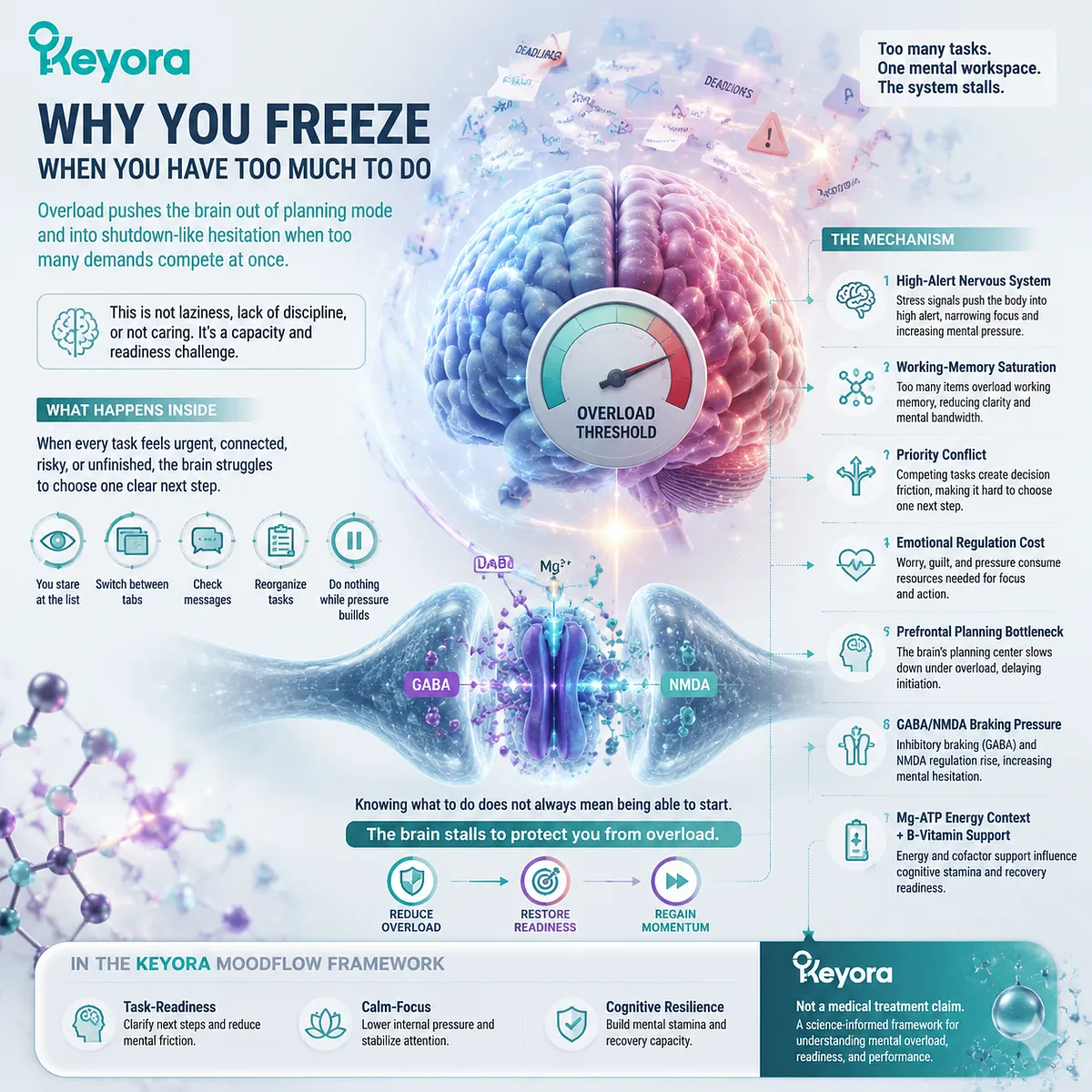
You may freeze when you have too much to do because overload can push the brain out of planning mode and into shutdown-like hesitation when too many demands compete at once.
The problem is not always laziness, lack of discipline, or not caring.
The problem may be that too many tasks are competing for the same mental workspace.
Knowing what to do does not always mean being able to start.
When every task feels urgent, connected, risky, or unfinished, the brain may struggle to choose one clear next step. Instead of moving forward, it may stall. You may stare at the list, switch between tabs, check messages, reorganize tasks, or do nothing while feeling more pressure inside.
Mechanistically, this can involve high-alert nervous-system activation, working-memory saturation, priority conflict, emotional regulation cost, prefrontal planning bottleneck, GABA/NMDA braking pressure, Mg-ATP energy context, B-vitamin cofactor support, and reduced recovery readiness.
In the Keyora MoodFlow framework, this is understood as a task-readiness, calm-focus, and cognitive-resilience question, not a medical treatment claim.
Why Too Many Tasks Can Make You Stop Instead of Start
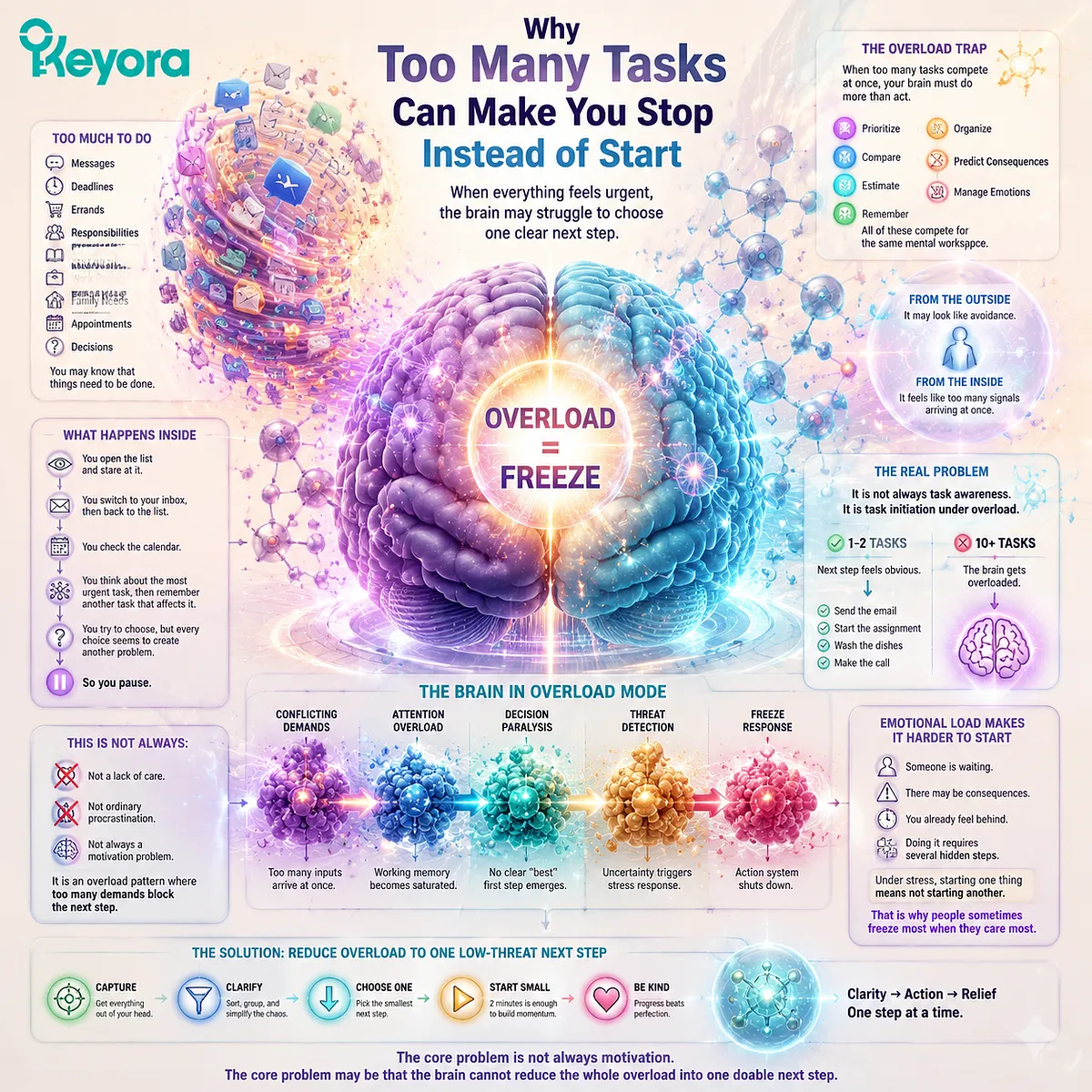
When everything feels urgent, the brain may struggle to choose one clear next step.
Freezing when you have too much to do can feel strange because you are not doing nothing because life is empty.
You may have a full task list. You may have messages waiting. You may have deadlines, errands, responsibilities, schoolwork, work projects, family needs, appointments, and decisions stacked together. You may know that things need to be done.
But the moment you try to start, the brain does not move.
You open the list and stare at it. You switch to your inbox, then back to the list. You check the calendar. You think about the most urgent task, then remember another task that affects it. You try to choose, but every choice seems to create another problem.
So you pause.
This is the “freeze when overwhelmed” feeling.
It is not always the same as not wanting to work. It is not always ordinary procrastination. It may feel more like your brain is standing in front of too many doors and cannot decide which one is safe to open first.
The problem is not always task awareness.
The problem is task initiation under overload.
When there are only one or two tasks, the next step may feel obvious. Send the email. Start the assignment. Wash the dishes. Make the call. But when ten tasks arrive together, the brain has to do more than act. It has to prioritize, compare, estimate, remember, organize, and predict consequences.
That is a very different load.
You are not just asking, “What should I do?” You are asking, “What should I do first, what happens if I choose wrong, who is waiting, what is urgent, what is important, what will take too long, what can be delayed, and what will create even more work once I start?”
All of those questions compete for the same mental workspace.
This is why too much to do can sometimes produce stillness instead of action.
From the outside, it may look like avoidance. Inside, it may feel like too many signals arriving at once. One part of the brain says, “Start now.” Another part says, “Choose the right thing first.” Another part says, “Do not forget the other task.” Another part says, “This is already too late.” Another part says, “What if starting one thing makes the others worse?”
The result can be a kind of shutdown-like hesitation.
This phrase does not mean a clinical freeze response or a medical diagnosis. In this article, it means an everyday overload pattern where the brain has trouble turning too many demands into one clear first action.
That distinction matters.
You may not be avoiding the task because you do not care. Your brain may be overloaded by too many competing demands to choose one next step.
This is especially common when tasks are emotionally loaded.
A task is not just a task when someone is waiting for it, when there may be consequences, when you already feel behind, or when doing it requires several hidden steps. Under stress, even starting can feel risky because starting one thing means not starting another.
That is why people sometimes freeze most when they care most.
The pressure to choose correctly can make choosing harder. The desire to do everything well can make the first step feel more difficult. The more the task list represents responsibility, identity, performance, or other people’s expectations, the more emotional regulation is required just to begin.
This is why the core problem is not always motivation.
The core problem may be that the brain cannot reduce the whole overload into one low-threat, doable next step.
The Task-Initiation Bottleneck Behind Overwhelm Freezing
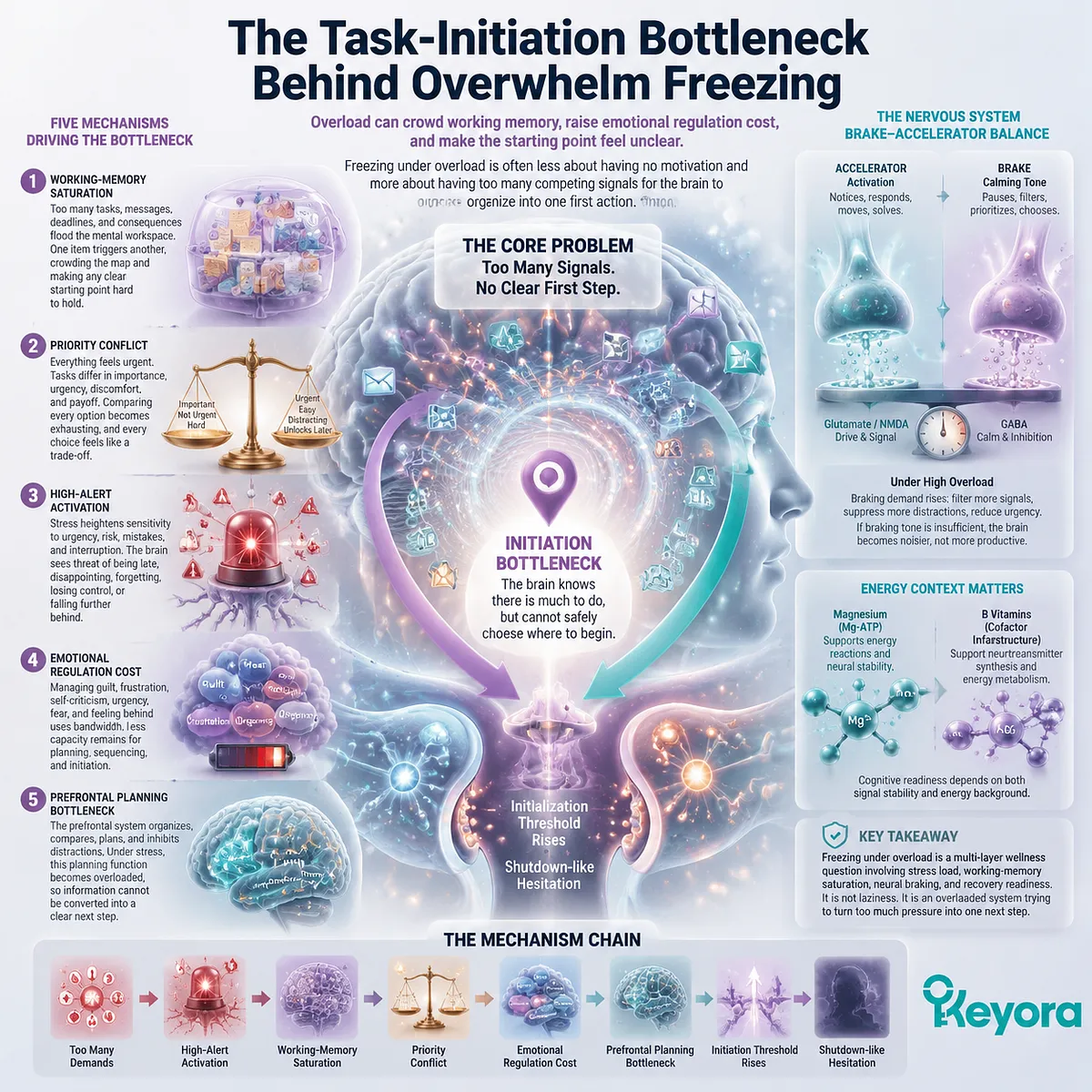
Overload can crowd working memory, raise emotional regulation cost, and make the starting point feel unclear.
Freezing under overload is often less about having no motivation and more about having too many competing signals for the brain to organize into one first action.
The first mechanism is working-memory saturation.
Working memory is the temporary mental workspace that holds what you are doing now, what you need to remember, and what you are trying to organize. It is useful, but it is limited. When too many tasks, deadlines, messages, and consequences enter at once, that workspace can become crowded.
A crowded working memory makes task initiation harder.
You may know there are many things to do, but you cannot hold the whole map clearly. One task reminds you of another. One message creates another decision. One deadline changes another priority. The more connected the tasks are, the harder it becomes to isolate one clean starting point.
The second mechanism is priority conflict.
When everything feels urgent, the brain may not know what to treat as first. A task can be important but not urgent. Another task can be urgent but small. Another task can be emotionally uncomfortable. Another task can be easy but distracting. Another task can unlock later progress but require more focus.
The brain has to compare all of this.
Under calm conditions, you may be able to sort it. Under stress, priority conflict can become exhausting. Every option feels like a trade-off. Starting one task can feel like neglecting the others. The result is hesitation.
Freeze can happen when every task feels like it should be first, but the brain cannot find one safe next step.
The third mechanism is high-alert activation.
When stress is high, the nervous system may become more sensitive to urgency, risk, interruption, and possible mistakes. The brain does not simply see a list. It sees a threat of being late, disappointing someone, forgetting something, losing control, or falling further behind.
This raises the emotional weight of the task list.
A normal list becomes a pressure map. Each item feels bigger because it carries consequence. The nervous system is no longer just planning. It is also scanning for danger, avoiding error, and trying to prevent more stress.
That makes starting harder.
The fourth mechanism is emotional regulation cost.
To begin under overload, you have to manage more than logistics. You may also have to manage guilt, frustration, self-criticism, urgency, fear of failure, and the feeling that you are already behind. Staying steady enough to choose a task requires emotional control.
That control uses bandwidth.
When emotional regulation cost is high, less bandwidth is available for planning, sequencing, and initiation. You may spend energy trying not to panic, not to feel guilty, not to shut down, and not to think about the entire list at once. That hidden effort can make action feel harder than it looks.
The fifth mechanism is the prefrontal planning bottleneck.
In everyday language, the prefrontal system helps organize goals, compare options, hold priorities, plan steps, and inhibit distractions. It is the part of the system that helps you move from “everything is too much” to “this is the next thing.”
Under stress, that planning function can become overloaded.
The brain may still understand the tasks. It may still care about the outcome. But the system that converts information into sequence may not have enough clear bandwidth to produce a starting step.
This is why overload can create a bottleneck at the initiation point.
The nervous system’s brake-and-accelerator balance also matters.
Activation is the accelerator. It helps you notice, respond, move, and solve problems. Braking helps you pause, filter, prioritize, and choose. GABA-related calming tone and NMDA/glutamate activation balance help explain why the brain can feel either organized or overactivated.
When overload is high, braking demand rises.
The system has to filter more signals, suppress more distractions, reduce urgency, and prevent every task from feeling equally loud. If the braking background feels insufficient, the brain may not become more productive. It may become noisier.
Energy context is also relevant.
Task initiation, planning, emotional regulation, and working-memory control require active resources. Magnesium’s role in Mg-ATP context and B vitamins’ role as cofactor infrastructure help explain why cognitive readiness depends on both signal stability and energy background.
This does not mean freezing under overload is caused by nutrient status. It means the experience can be understood as a multi-layer wellness question involving stress load, working-memory saturation, neural braking, and recovery readiness.
The mechanism chain looks like this:
too many demands → high-alert nervous-system activation → working-memory saturation → priority conflict → emotional regulation cost → prefrontal planning bottleneck → initiation threshold rises → shutdown-like hesitation
In plain language, the brain may freeze because it is trying to turn too much pressure into one next step, and that conversion system is overloaded.
How MoodFlow Supports Task Readiness Under Overload
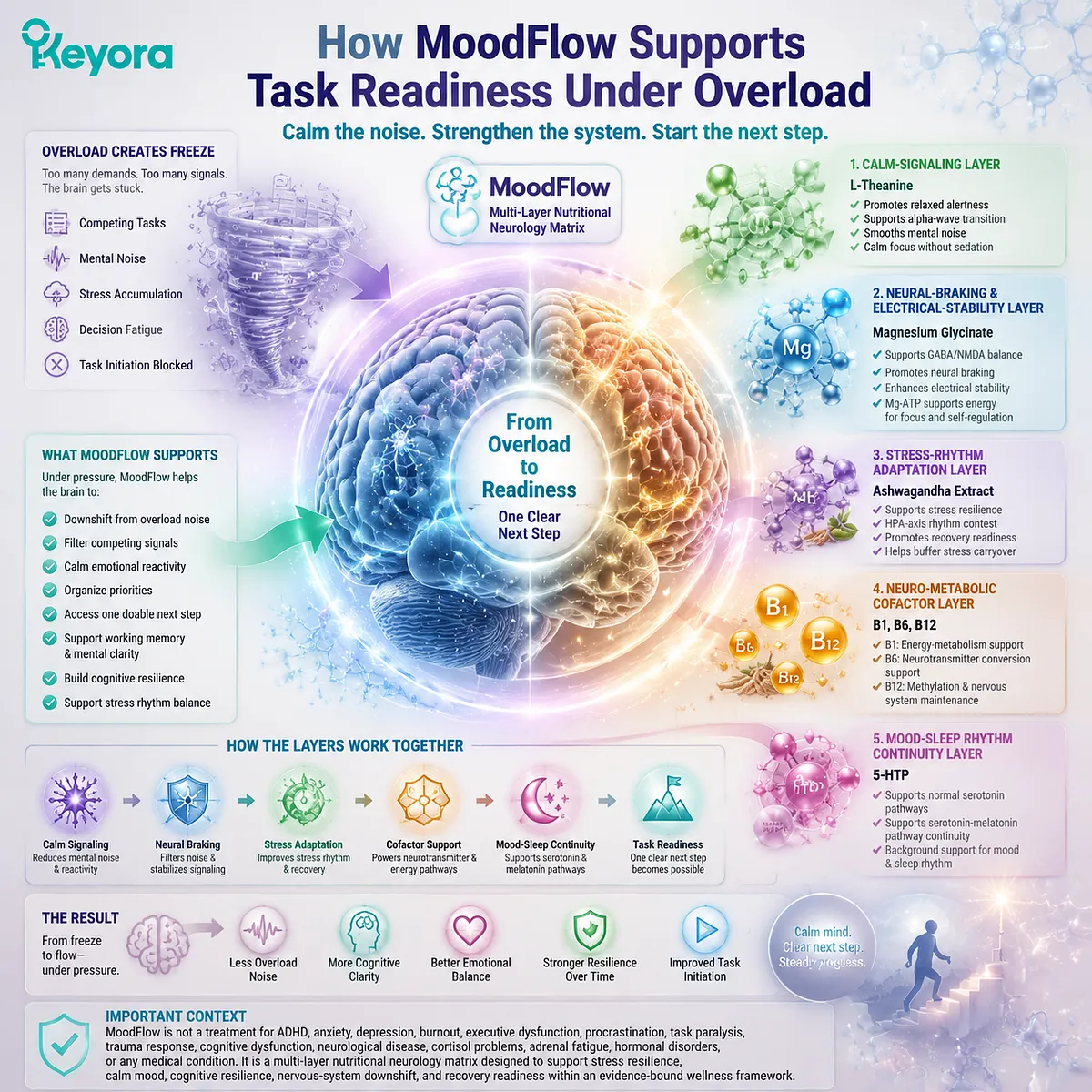
MoodFlow supports the calm-signaling, neural-braking, stress-rhythm, and cofactor layers involved in cognitive resilience and task readiness under pressure.
Keyora MoodFlow approaches freezing when you have too much to do as a calm-focus, task-readiness, and cognitive-resilience question.
The goal is not to treat task paralysis, procrastination, ADHD, executive dysfunction, anxiety, depression, burnout, trauma response, or any medical condition. The goal is to support the wellness pathways that help the nervous system move from overload noise toward steadier cognitive readiness under everyday pressure.
This distinction matters.
When someone freezes under overload, the answer is not always more pressure. More pressure may make the task list feel even louder. A more useful wellness frame is to support the layers that help the brain downshift, filter signals, organize priorities, and access one next step.
MoodFlow’s logic begins with calm signaling.
L-Theanine supports the calm-signaling layer.
In the MoodFlow framework, L-Theanine is associated with relaxed alertness, alpha-wave transition, signal smoothing, and calm focus without sedation. This is relevant because overload freezing does not always mean the person needs to become sleepy or detached.
The person may already be alert.
The problem is that alertness may be noisy, reactive, or scattered. L-Theanine helps explain calm signaling as support for a smoother internal background where the brain may have more room to choose a next step instead of reacting to every task as equally urgent.
Magnesium glycinate supports the neural-braking and electrical-stability layer.
Magnesium is relevant to GABA/NMDA activation balance, membrane excitability, and Mg-ATP energy context. In MoodFlow, magnesium glycinate is positioned as part of the neural braking and hardware-stabilizing layer.
For task-initiation overload, this layer is central.
When too many demands arrive at once, the brain needs braking capacity to filter noise, reduce overactivation, and prevent every input from becoming urgent. Neural braking helps explain the physiological background behind calm focus and response control.
Magnesium’s Mg-ATP context also matters because task initiation is not passive. Starting requires energy. Planning requires energy. Emotional regulation requires energy. Holding one next step in mind while ignoring other demands requires energy. The nervous system needs both signal stability and energy readiness.
Ashwagandha supports the stress-rhythm adaptation layer.
Overload freezing often becomes more likely when stress has been building across the day or week. A person may not freeze because of one task alone. The reaction may reflect accumulated stress-rhythm carryover, repeated pressure, and reduced recovery readiness.
Ashwagandha is positioned in MoodFlow around stress resilience, HPA-axis rhythm context, and recovery readiness. In this article, that does not mean Ashwagandha fixes cortisol, treats burnout, repairs the HPA axis, or cures overwhelm. It means Ashwagandha belongs to the stress-adaptation layer that helps explain why task readiness is connected to broader stress rhythm.
B1, B6, and B12 support the neuro-metabolic cofactor layer.
The nervous system depends on normal metabolic and neurotransmitter-related infrastructure. B1 supports energy-metabolism context. B6 supports neurotransmitter-related conversion context, including pathways relevant to calming and mood-related signaling. B12 supports methylation context and nervous-system maintenance.
In MoodFlow, these B vitamins are not positioned as treatments for fatigue, executive dysfunction, ADHD, brain fog, or cognitive problems. They are part of the cofactor background behind cognitive resilience, emotional steadiness, and normal pathway support under everyday pressure.
5-HTP plays a background role in mood-sleep rhythm continuity.
Because this article is about task initiation under overload, 5-HTP should not dominate the explanation. Its role is best understood as support for normal serotonin-related pathways and serotonin-melatonin pathway continuity within the broader MoodFlow architecture. This does not mean treating depression, correcting serotonin, or forcing sleep.
Vitamin D may also be understood as part of the broader rhythm and neuroimmune wellness context when relevant, but it should remain secondary.
Together, these layers explain why MoodFlow is not positioned as a productivity drug, stimulant, sedative, task-paralysis treatment, ADHD treatment, or procrastination cure. It is a multi-layer nutritional neurology matrix designed to support stress resilience, calm mood, cognitive resilience, nervous-system downshift, and recovery readiness within an evidence-bound wellness framework.
MoodFlow is not a treatment for ADHD, anxiety, depression, burnout, executive dysfunction, procrastination, task paralysis, trauma response, cognitive dysfunction, neurological disease, cortisol problems, adrenal fatigue, hormonal disorders, or any medical condition. In this article, Keyora uses “freezing when there is too much to do” as a wellness-language entry point for explaining stress load, working-memory saturation, task-initiation bottleneck, calm signaling, neural braking, stress-rhythm adaptation, and cognitive resilience under everyday pressure.
Closing Summary
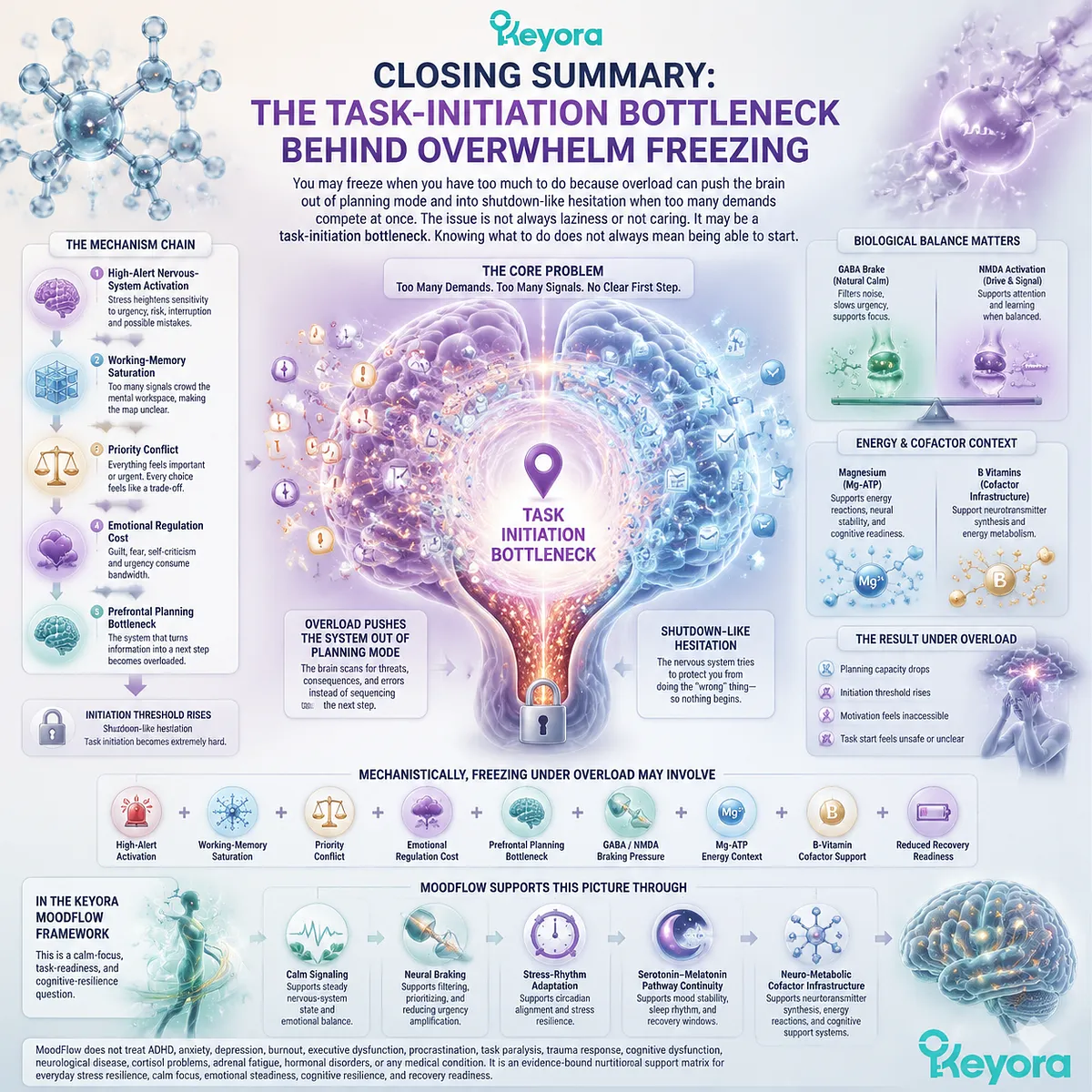
You may freeze when you have too much to do because overload can push the brain out of planning mode and into shutdown-like hesitation when too many demands compete at once. The issue is not always laziness or not caring. It may be a task-initiation bottleneck.
Knowing what to do does not always mean being able to start.
Mechanistically, freezing under overload may involve high-alert nervous-system activation, working-memory saturation, priority conflict, emotional regulation cost, prefrontal planning bottleneck, GABA/NMDA braking pressure, Mg-ATP energy context, B-vitamin cofactor support, and reduced recovery readiness.
In the Keyora MoodFlow framework, this is understood as a calm-focus, task-readiness, and cognitive-resilience question. MoodFlow supports this picture through calm signaling, neural braking, stress-rhythm adaptation, serotonin-melatonin pathway continuity, and neuro-metabolic cofactor infrastructure.
MoodFlow does not treat ADHD, anxiety, depression, burnout, executive dysfunction, procrastination, task paralysis, trauma response, cognitive dysfunction, neurological disease, cortisol problems, adrenal fatigue, hormonal disorders, or any medical condition. It is an evidence-bound nutritional support matrix for everyday stress resilience, calm focus, emotional steadiness, cognitive resilience, and recovery readiness.
This article is for educational and informational purposes only. It does not provide medical advice, diagnosis, treatment, cure, prevention, disease outcome claims, hormone restoration claims, fertility outcome claims, or formula-specific clinical efficacy claims.