
Why Do I Replay Stressful Conversations in My Head?
Keyora Research Q&A Library
This is part of the Keyora Research Q&A Series, derived from Keyora Nutritional Neurology Seriers .
Within the Keyora Nutritional Neurology framework, this Q&A translates complex nutrient–brain mechanisms into reader-friendly, evidence-bound answers, focusing on stress resilience, sleep quality, calm mood support, cognitive wellness, and the broader interaction between nutrition, neurochemistry, and daily nervous-system function.
First published by Keyora Research Journal: www.keyorahealth.com

Direct Answer
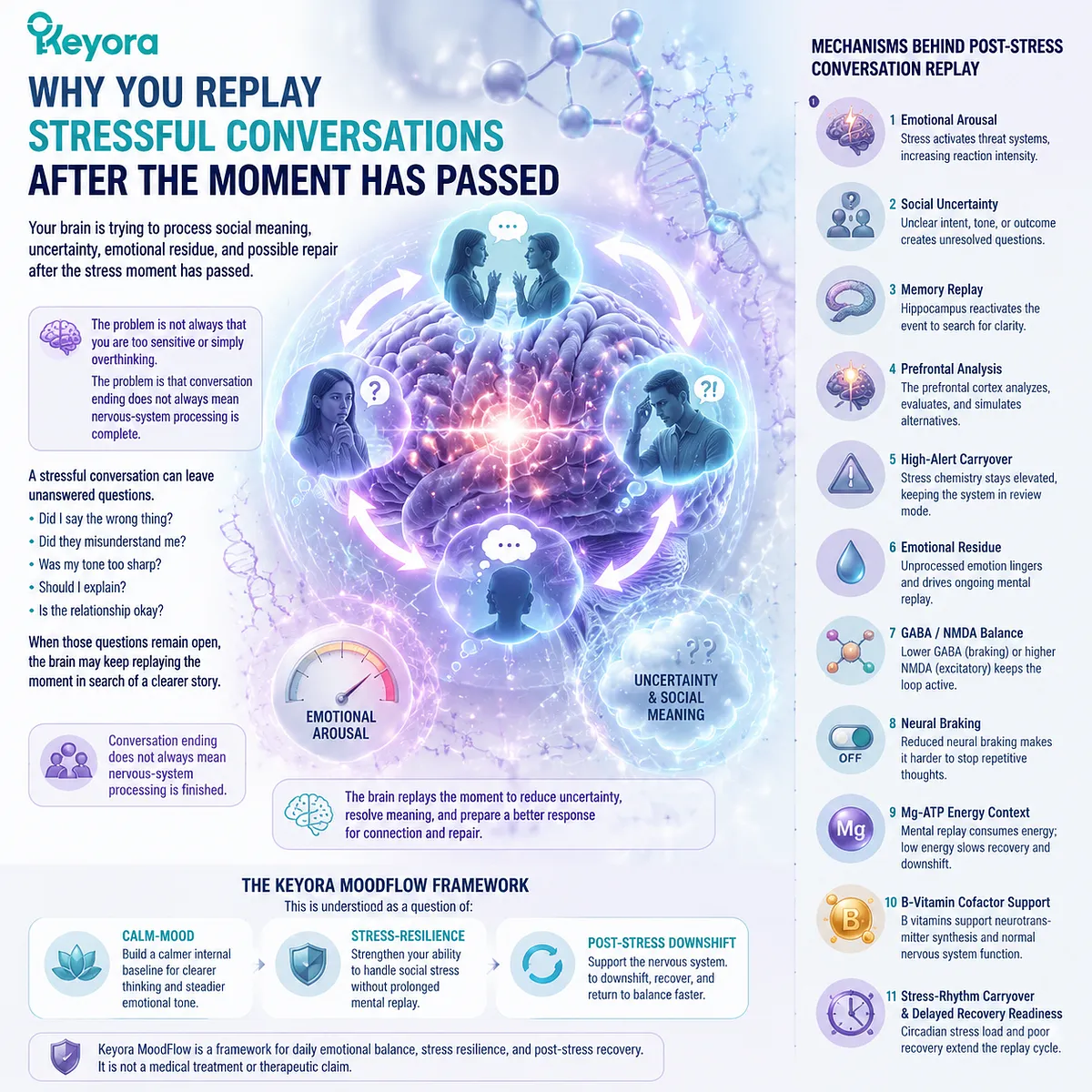
You may replay stressful conversations because your brain is trying to process social meaning, uncertainty, emotional residue, and possible repair after the stress moment has passed.
The conversation may be over, but your nervous system may not feel finished with what it meant.
The problem is not always that you are too sensitive or simply overthinking. The problem is that conversation ending does not always mean nervous-system processing is complete.
A stressful conversation can leave unanswered questions.
-
Did I say the wrong thing?
-
Did they misunderstand me?
-
Was my tone too sharp?
-
Should I explain?
-
Is the relationship okay?
When those questions remain open, the brain may keep replaying the moment in search of a clearer story.
Mechanistically, this can involve emotional arousal, social uncertainty, memory replay, prefrontal analysis, high-alert carryover, emotional residue, GABA/NMDA braking pressure, neural braking, Mg-ATP energy context, B-vitamin cofactor support, stress-rhythm carryover, and delayed recovery readiness.
In the Keyora MoodFlow framework, this is understood as a calm-mood, stress-resilience, and post-stress downshift question, not a medical treatment claim.
Why Your Brain Keeps Returning to the Conversation
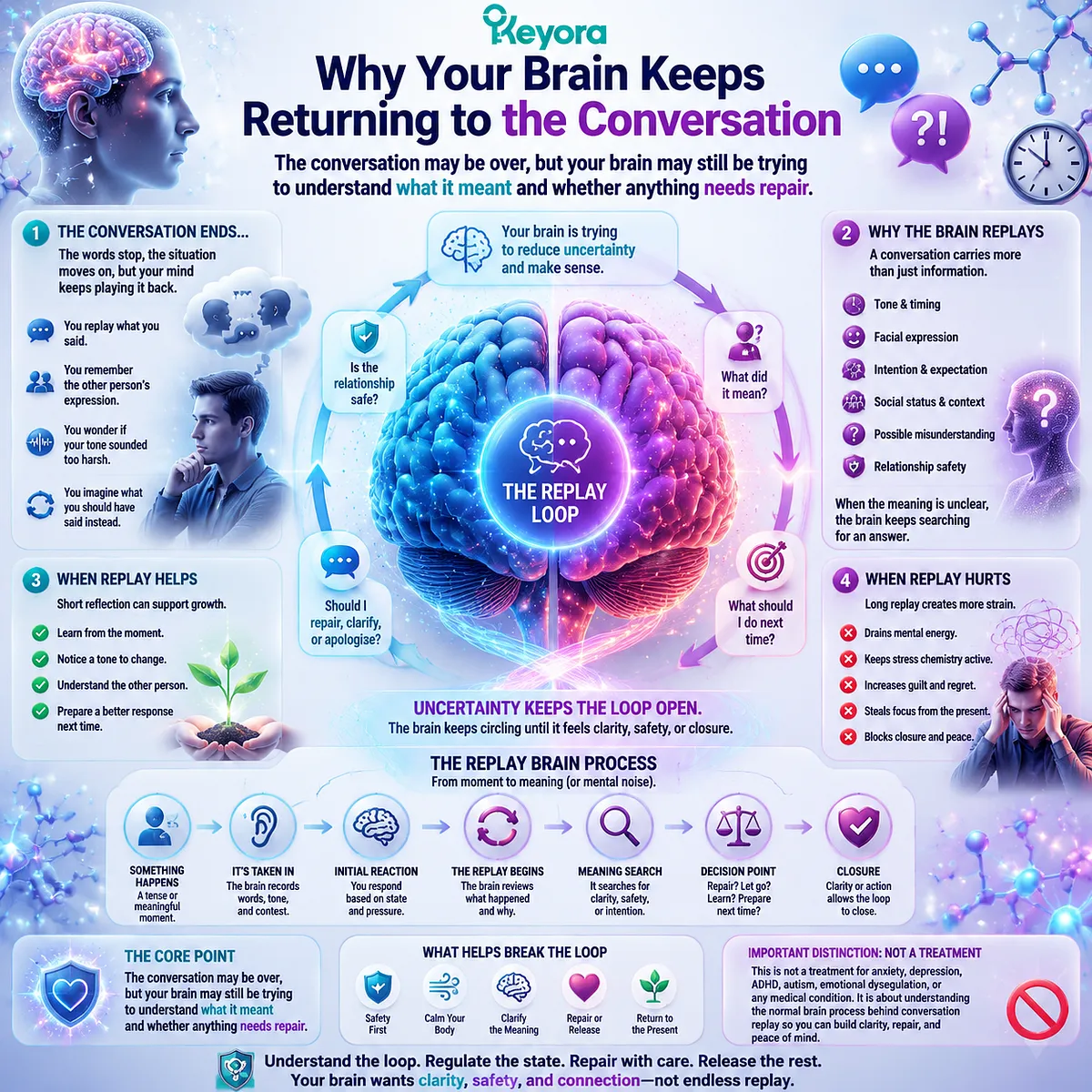
The conversation may be over, but your brain may still be trying to understand what it meant and whether anything needs repair.
A stressful conversation can end in the room before it ends in your mind.
You may walk away from the meeting, close the chat, end the call, or leave the situation. Other people may seem normal. The day may move on. But your brain keeps returning to the same moment.
You replay what you said. You remember the other person’s expression. You wonder whether your tone sounded too defensive. You think about what you should have said instead. You imagine a better version of the conversation where you were calmer, clearer, or more careful.
This can feel exhausting.
You may tell yourself to stop thinking about it, but the replay keeps coming back. You may try to focus on something else, but one sentence, one facial expression, or one unfinished feeling pulls your mind back into the conversation again.
This is the “replay stressful conversations in my head” pattern.
It can happen after conflict, awkward moments, tense meetings, difficult messages, emotional conversations, social pressure, performance situations, or moments when you snapped and later felt guilty. The conversation may be finished externally, but internally, the brain may still be trying to process its meaning.
That meaning can be complicated.
A conversation is not just information. It also contains tone, timing, facial expression, intention, expectation, social status, possible misunderstanding, and relationship safety. Unlike a task, a conversation does not always end with a clear checkbox.
You may not know whether the other person is truly fine.
You may not know whether they misunderstood you. You may not know whether your words sounded harsher than intended. You may not know whether you need to repair, clarify, apologize, or simply let it pass.
That uncertainty keeps the loop open.
The brain often replays a stressful conversation because it is trying to reduce ambiguity. It wants to turn an unclear social moment into a clearer story. It wants to understand what happened, what it meant, and whether anything needs to be done.
This does not mean the replay is always useless.
A short replay can help the brain learn. It can help you notice a tone you want to change, understand another person’s reaction, or prepare a better response next time. Reflection can support growth and repair.
But when replay continues too long, it can become draining.
The mind may keep circling the same moment without reaching a clear endpoint. Instead of helping you understand, the replay may keep the nervous system activated. Instead of bringing closure, it may bring more tension, regret, or mental noise.
This is why conversation replay can feel so different from ordinary memory.
Ordinary memory may pass through the mind and leave. Conversation replay feels sticky. It pulls attention back. It asks the same questions repeatedly. It creates the feeling that something is unfinished, even when nothing more is happening in the present moment.
The core point is simple:
The conversation may be over, but your brain may still be trying to understand what it meant and whether anything needs repair.
The Unfinished Meaning Loop Behind Conversation Replay
Stressful conversations can leave uncertainty, emotional residue, and repair questions that keep the brain replaying the moment.
The brain may replay the conversation because it is trying to turn an uncertain social moment into a clearer story.
This process is not random. It often begins with emotional arousal.
During a stressful conversation, the nervous system may become more alert. Your heart may feel faster. Your body may tense. Your attention may narrow. You may work harder to choose words, control tone, read the other person, and avoid saying something wrong.
Even after the conversation ends, that arousal may not disappear immediately.
The body may still carry the emotional residue of the moment. You may feel tension, embarrassment, guilt, defensiveness, regret, uncertainty, or the urge to repair. These signals tell the brain that something still matters.
When something still feels emotionally unfinished, memory replay can strengthen.
The brain returns to the scene because it is trying to understand the social meaning. Was that conflict serious? Did I sound unkind? Did they judge me? Did I explain enough? Should I follow up? Should I leave it alone?
These questions activate prefrontal analysis.
In simple language, the prefrontal system helps review events, compare options, understand consequences, and plan possible responses. After a stressful conversation, it may begin analyzing the moment to reduce uncertainty.
This can be useful when it leads to clarity.
But the same analysis can become repetitive when the brain cannot find a clear answer. If there is no obvious resolution, the mind may keep replaying the conversation to search for one.
Social uncertainty is especially hard to close.
A task can be complete. A message can be sent. A meeting can end. But the emotional meaning of a conversation may remain open. You may not receive a clear signal that everything is okay. You may not know how the other person truly felt.
That ambiguity can keep the replay loop active.
High-alert carryover adds another layer.
If the nervous system remains in an alert state after the conversation, it may continue scanning for risk. It may treat the replay as a way to prevent future problems. The brain may think, in effect, “If I analyze this enough, I can avoid making the same mistake again.”
That protective impulse can become tiring.
A short replay can help the brain learn. A long replay can keep the system activated.
The nervous system’s brake-and-accelerator balance also matters.
Activation helps the brain detect social risk, remember important details, and prepare for future response. Braking helps the system downshift, stop looping, and return attention to the present. GABA-related calming tone and NMDA/glutamate activation balance help explain why the system can feel either steady or stuck in repeated activation.
When the brain is still activated, the replay can feel difficult to stop.
Energy context matters too.
Reviewing a conversation, managing emotion, filtering regret, deciding whether repair is needed, and trying to redirect attention are all active processes. Magnesium’s role in Mg-ATP context and B vitamins’ role as cofactor infrastructure help explain why post-stress processing depends on both neural signaling and energy readiness.
This does not mean replaying conversations is caused by nutrient status. It means the experience can be understood as a multi-layer wellness question involving stress load, emotional regulation, social uncertainty, and recovery readiness.
The mechanism chain looks like this:
stressful conversation → emotional arousal → uncertainty signals remain → social meaning processing continues → memory replay strengthens → prefrontal analysis tries to reduce ambiguity → emotional residue keeps the loop active → recovery readiness is delayed
In plain language, your brain may keep replaying the conversation because it does not yet feel finished with the meaning of what happened.

How MoodFlow Supports Post-Stress Downshift
MoodFlow supports the calm-signaling, neural-braking, stress-rhythm, and cofactor layers involved in emotional steadiness and recovery readiness after stress.
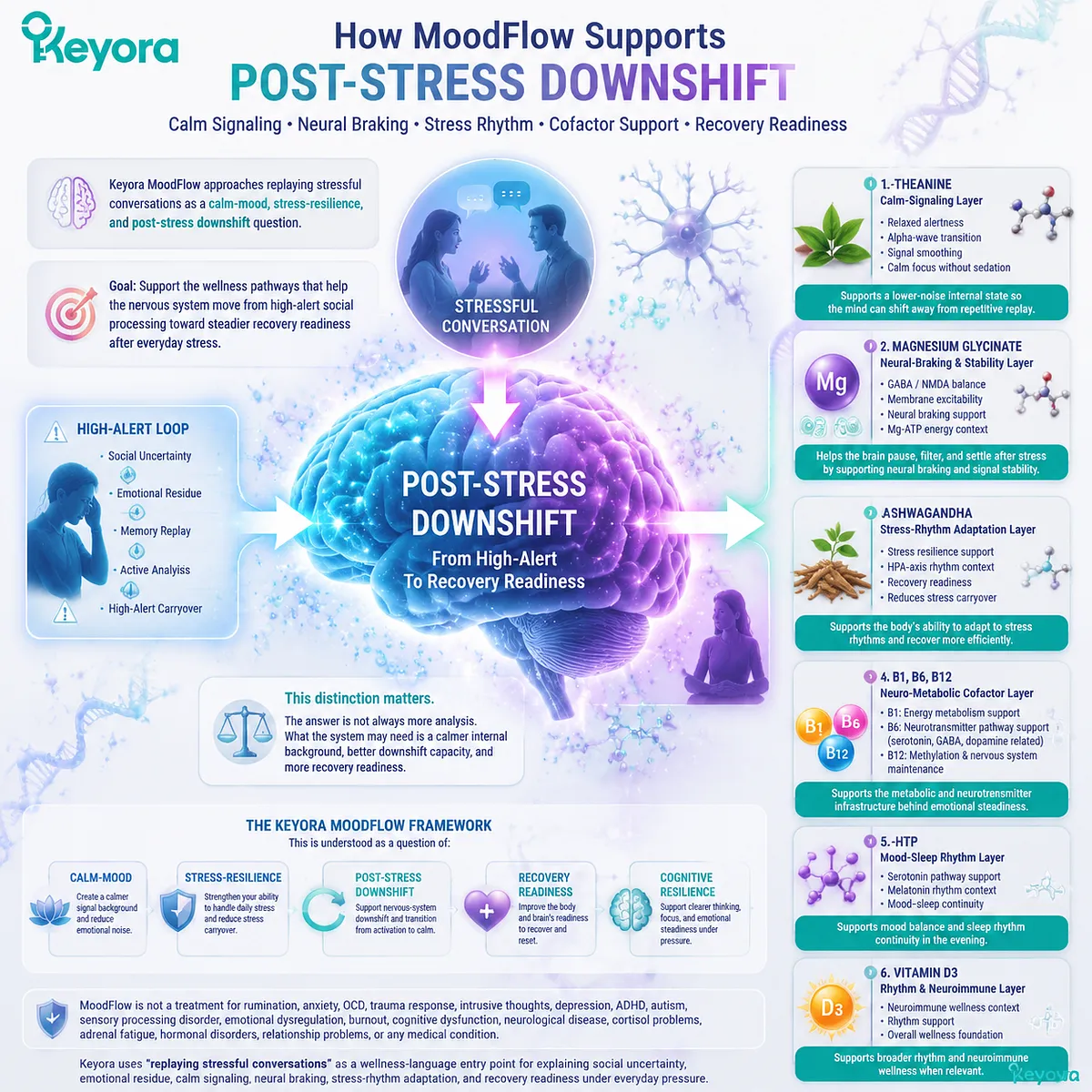
Keyora MoodFlow approaches replaying stressful conversations as a calm-mood, stress-resilience, and post-stress downshift question.
The goal is not to treat rumination, stop overthinking, treat anxiety, treat OCD, treat trauma response, treat intrusive thoughts, or repair relationships. The goal is to support the wellness pathways that help the nervous system move from high-alert social processing toward steadier recovery readiness after everyday stress.
This distinction matters.
When the mind replays a stressful conversation, the answer is not always more analysis. Sometimes the system has already analyzed the moment many times. What it may need is a calmer internal background, better downshift capacity, and more recovery readiness so the brain does not have to keep carrying the same emotional signal.
MoodFlow’s logic begins with the state behind post-stress downshift.
L-Theanine supports the calm-signaling layer.
In the MoodFlow framework, L-Theanine is associated with relaxed alertness, alpha-wave transition, signal smoothing, and calm focus without sedation. This is relevant because conversation replay is not always a sleepiness problem. The person may be alert, but the alertness may feel too sticky, socially focused, or difficult to disengage.
The goal is not to force sedation.
The goal is a calmer signal background. L-Theanine helps explain how calm signaling can support a lower-noise internal state where the mind may have more room to shift away from repeated social replay.
Magnesium glycinate supports the neural-braking and electrical-stability layer.
Magnesium is relevant to GABA/NMDA activation balance, membrane excitability, and Mg-ATP energy context. In MoodFlow, magnesium glycinate is positioned as part of the neural braking and hardware-stabilizing layer.
For conversation replay, this layer matters because the loop often reflects activation that has not fully downshifted. The brain may keep returning to the same moment because the emotional signal remains active. Neural braking helps explain the physiological background involved in pausing, filtering, and settling after stress.
Magnesium’s Mg-ATP context also matters because post-stress processing uses energy. Reviewing memory, regulating emotion, evaluating social meaning, and redirecting attention are active processes. The nervous system needs both signal stability and energy readiness.
Ashwagandha supports the stress-rhythm adaptation layer.
Conversation replay can become stronger when the stress system has been activated for hours or days. A tense conversation may sit on top of a broader stress-rhythm carryover. The mind may not only be replaying that one moment; it may also be carrying the accumulated pressure of the day.
Ashwagandha is positioned in MoodFlow around stress resilience, HPA-axis rhythm context, and recovery readiness. In this article, that does not mean Ashwagandha fixes cortisol, treats anxiety, treats rumination, or repairs the stress system. It means Ashwagandha belongs to the stress-adaptation layer that helps explain why post-stress downshift depends on broader stress rhythm.
B1, B6, and B12 support the neuro-metabolic cofactor layer.
The nervous system depends on normal metabolic and neurotransmitter-related infrastructure. B1 supports energy-metabolism context. B6 supports neurotransmitter-related conversion context, including pathways relevant to calming and mood-related signaling. B12 supports methylation context and nervous-system maintenance.
In MoodFlow, these B vitamins are not positioned as treatments for rumination, emotional dysregulation, cognitive dysfunction, or overthinking. They are part of the cofactor background behind emotional steadiness, cognitive resilience, and normal pathway support under everyday pressure.
5-HTP plays a background role in mood-sleep rhythm continuity.
Because conversation replay can sometimes feel more noticeable in the evening, 5-HTP may be understood as part of the serotonin-melatonin pathway continuity and mood-sleep rhythm background within the broader MoodFlow architecture. This does not mean treating insomnia, depression, intrusive thoughts, or serotonin deficiency.
Vitamin D may also be understood as part of the broader rhythm and neuroimmune wellness context when relevant, but it should remain secondary.
Together, these layers explain why MoodFlow is not positioned as an overthinking cure, rumination treatment, anxiety treatment, sedative, stimulant, or relationship-repair product. It is a multi-layer nutritional neurology matrix designed to support stress resilience, calm mood, cognitive resilience, nervous-system downshift, and recovery readiness within an evidence-bound wellness framework.
MoodFlow is not a treatment for rumination, anxiety, OCD, trauma response, intrusive thoughts, depression, ADHD, autism, sensory processing disorder, emotional dysregulation, burnout, cognitive dysfunction, neurological disease, cortisol problems, adrenal fatigue, hormonal disorders, relationship problems, or any medical condition. In this article, Keyora uses “replaying stressful conversations” as a wellness-language entry point for explaining social uncertainty, emotional residue, calm signaling, neural braking, stress-rhythm adaptation, and recovery readiness under everyday pressure.
Closing Summary
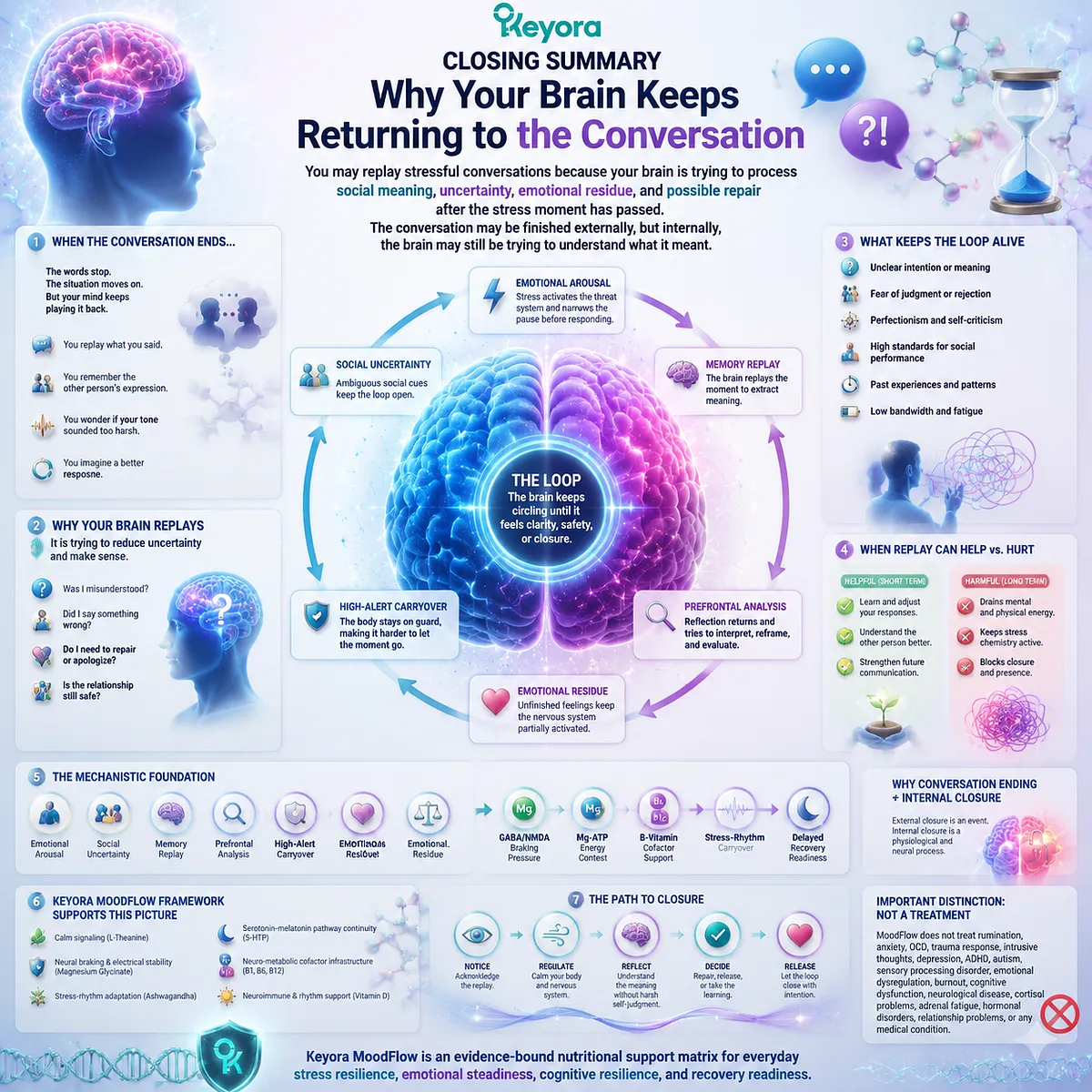
You may replay stressful conversations because your brain is trying to process social meaning, uncertainty, emotional residue, and possible repair after the stress moment has passed. The conversation may be finished externally, but internally, the brain may still be trying to understand what it meant.
This is why conversation ending does not always mean nervous-system processing is complete.
Mechanistically, conversation replay may involve emotional arousal, social uncertainty, memory replay, prefrontal analysis, high-alert carryover, emotional residue, GABA/NMDA braking pressure, Mg-ATP energy context, B-vitamin cofactor support, stress-rhythm carryover, and delayed recovery readiness.
In the Keyora MoodFlow framework, this is understood as a calm-mood, stress-resilience, and post-stress downshift question. MoodFlow supports this picture through calm signaling, neural braking, stress-rhythm adaptation, serotonin-melatonin pathway continuity, and neuro-metabolic cofactor infrastructure.
MoodFlow does not treat rumination, anxiety, OCD, trauma response, intrusive thoughts, depression, ADHD, autism, sensory processing disorder, emotional dysregulation, burnout, cognitive dysfunction, neurological disease, cortisol problems, adrenal fatigue, hormonal disorders, relationship problems, or any medical condition. It is an evidence-bound nutritional support matrix for everyday stress resilience, emotional steadiness, cognitive resilience, and recovery readiness.
This article is for educational and informational purposes only. It does not provide medical advice, diagnosis, treatment, cure, prevention, disease outcome claims, hormone restoration claims, fertility outcome claims, or formula-specific clinical efficacy claims.