
Why Do I Feel Guilty After I Snap Under Stress?
Keyora Research Q&A Library
This is part of the Keyora Research Q&A Series, derived from Keyora Nutritional Neurology Seriers .
Within the Keyora Nutritional Neurology framework, this Q&A translates complex nutrient–brain mechanisms into reader-friendly, evidence-bound answers, focusing on stress resilience, sleep quality, calm mood support, cognitive wellness, and the broader interaction between nutrition, neurochemistry, and daily nervous-system function.
First published by Keyora Research Journal: www.keyorahealth.com

Direct Answer
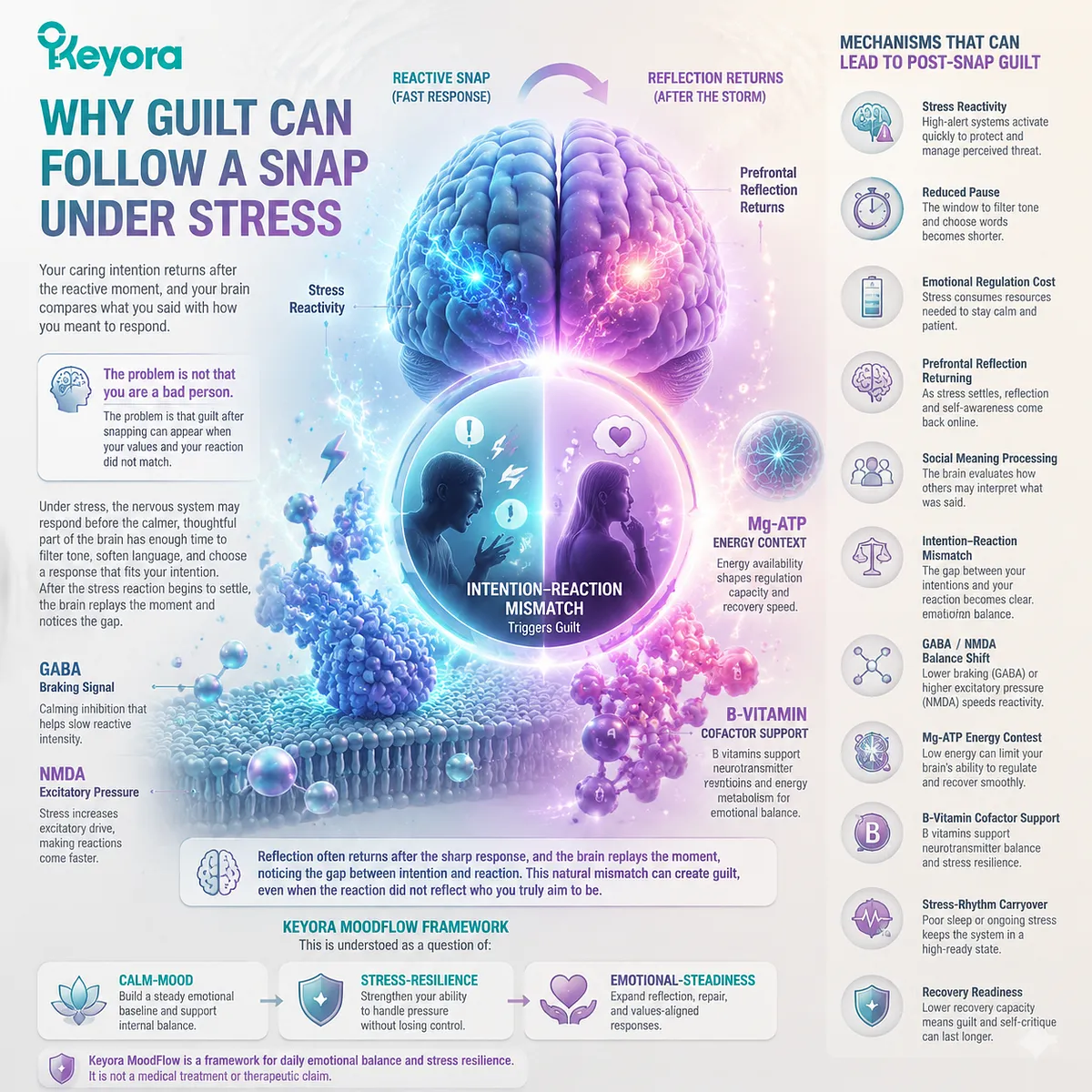
You may feel guilty after snapping under stress because your caring intention returns after the reactive moment, and your brain begins comparing what you said with how you meant to respond.
The sharp response may have happened quickly, but reflection often comes back afterward.
The problem is not always that you are a bad person. The problem is that guilt after snapping can appear when your values and your reaction did not match.
Under stress, the nervous system may respond before the calmer, more thoughtful part of the brain has enough time to filter tone, soften language, and choose a response that fits your intention.
After the stress reaction begins to settle, the brain may replay the moment and notice the gap.
Mechanistically, this can involve stress reactivity, reduced pause, emotional regulation cost, prefrontal reflection returning, social meaning processing, intention-reaction mismatch, GABA/NMDA braking pressure, Mg-ATP energy context, B-vitamin cofactor support, stress-rhythm carryover, and recovery readiness.
In the Keyora MoodFlow framework, this is understood as a calm-mood, stress-resilience, and emotional-steadiness question, not a medical treatment claim.
Why Guilt Can Show Up After a Stress Reaction
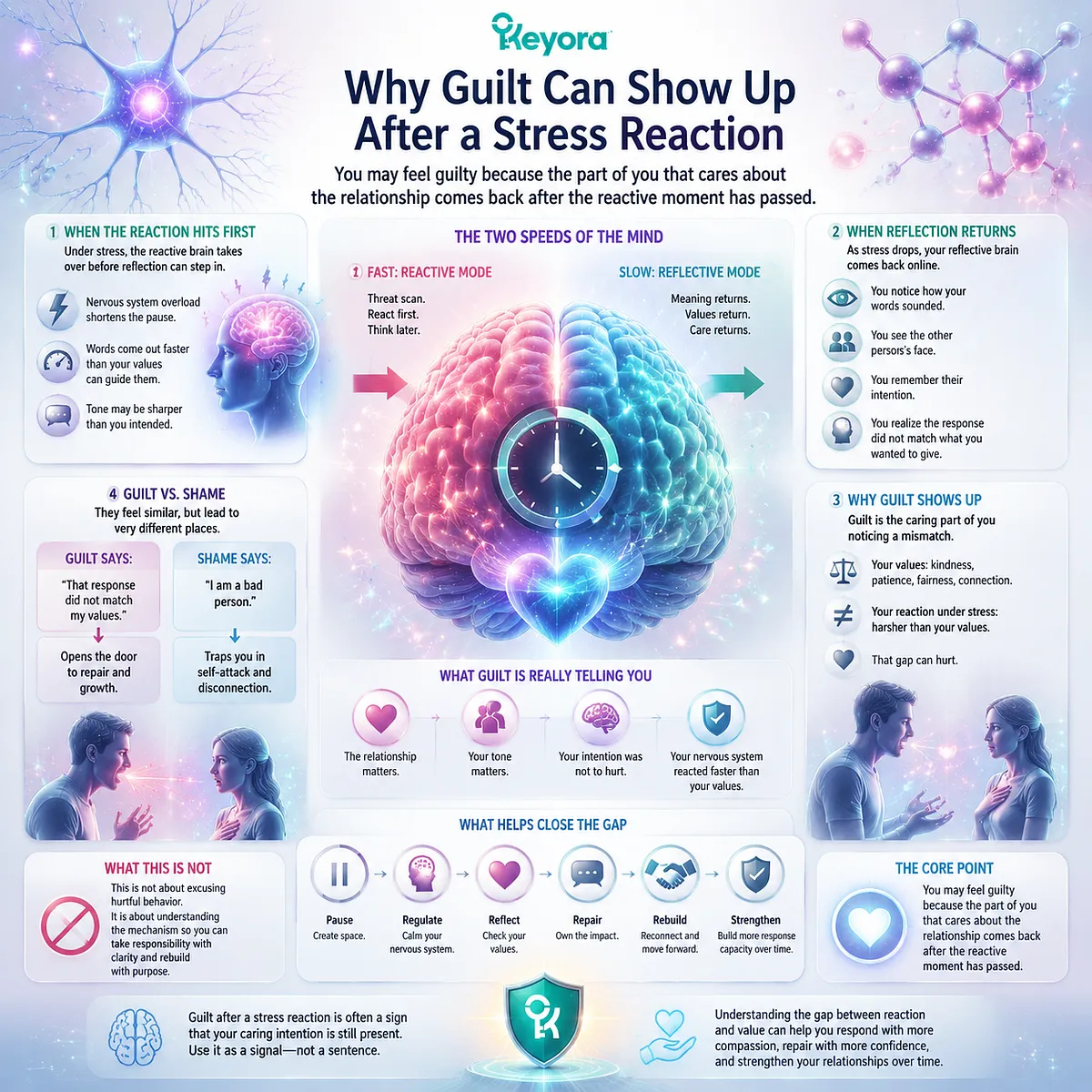
You may feel guilty because the part of you that cares about the relationship comes back after the reactive moment has passed.
Snapping under stress can be painful because the regret may arrive almost immediately.
You may say something too sharply, then hear your own tone a few seconds later in your mind. You may notice the other person’s face. You may remember that they were only asking a normal question. You may realize that the response you gave was not the response you wanted to give.
This can create a heavy feeling afterward.
You may think, “Why did I say it like that?” You may replay the exact words. You may wish you could pull the sentence back. You may feel embarrassed, guilty, or worried that the other person now thinks you do not care.
That guilt can feel like proof that something is wrong with you.
But guilt after snapping is not always proof of bad character. It can also be a sign that your caring intention is still present. You feel bad because the reaction did not match the kind of person you were trying to be in that moment.
This distinction matters.
If you did not care at all, the reaction might not bother you. The fact that you feel guilt may mean your system is noticing a mismatch between your values and your behavior. You may value kindness, patience, fairness, or connection, but under stress, your response came out harsher than those values.
That gap can hurt.
It is common for the reactive moment and the reflective moment to arrive at different speeds. Under pressure, the reactive response may come first. The nervous system is overloaded, the pause is short, and the words come out quickly. Then, as the stress state begins to drop, reflection returns.
That is when the meaning of what happened becomes clearer.
You may start to understand how your words sounded. You may remember the other person’s intention. You may notice that your tone carried more pressure than the situation deserved. You may realize that the stress you were carrying got transferred into the conversation.
This does not erase responsibility.
It simply gives the reaction a more accurate context. You can care about the effect of your words without turning one stressed reaction into a total judgment of your whole character.
That is the difference between guilt and shame.
Guilt says, “That response did not match my values.” Shame says, “I am a bad person.” Guilt can point toward repair. Shame often traps the person in self-attack.
For this article, the goal is not to give relationship advice or turn guilt into a diagnosis. The goal is to explain why the guilt can appear after a stress reaction. It often appears because the calmer, caring part of you comes back online and sees the gap between what happened and what you meant.
That gap can be uncomfortable, but it can also be useful.
It tells you that the relationship matters. It tells you that your tone matters. It tells you that your intention was not simply to hurt someone. It tells you that your nervous system may have reacted faster than your values could organize the response.
The core point is simple:
You may feel guilty because the part of you that cares about the relationship comes back after the reactive moment has passed.
The Intention-Reaction Gap Behind Post-Stress Guilt
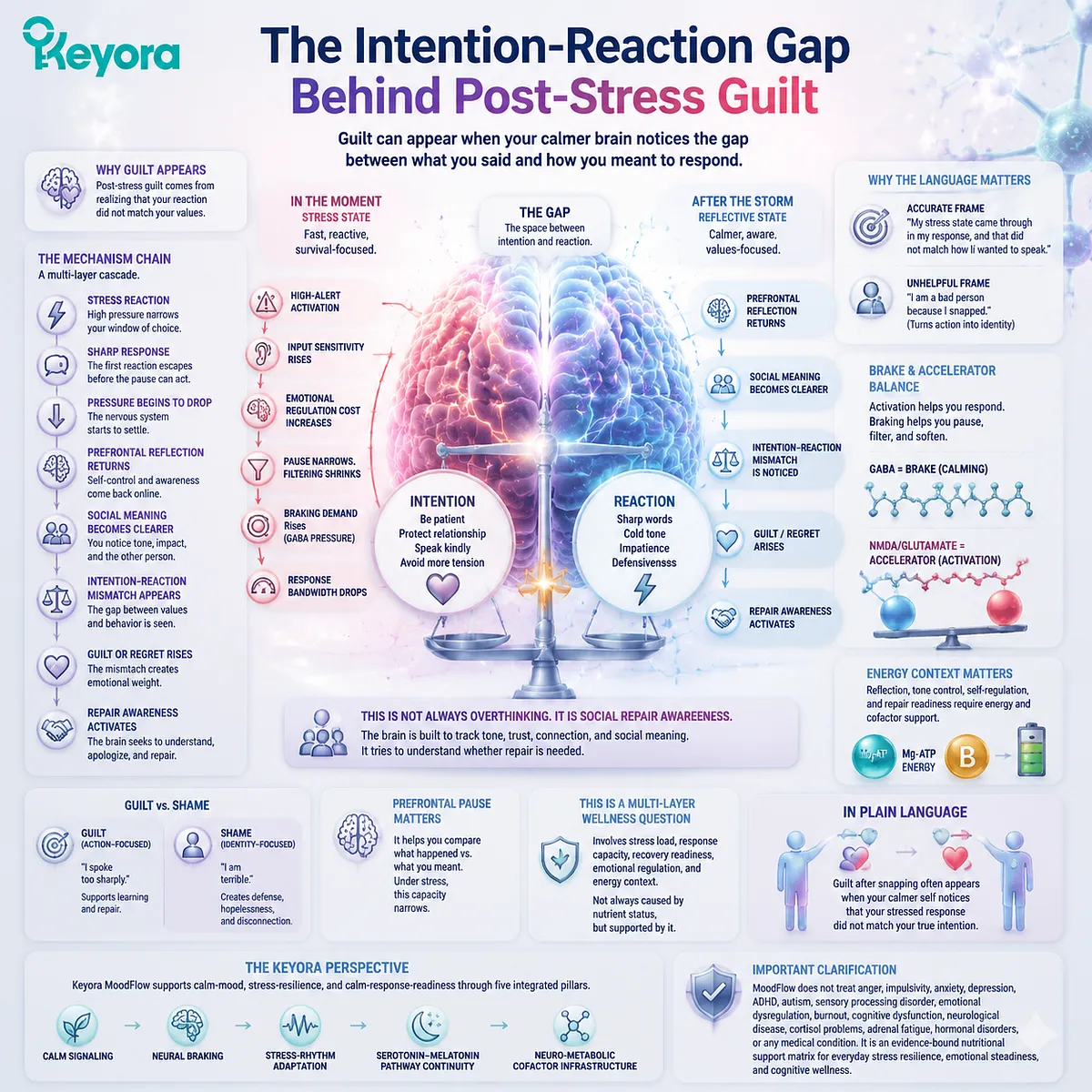
Guilt can appear when your calmer brain notices the gap between what you said and how you meant to respond.
Post-stress guilt often comes from realizing that your reaction did not match your values.
This is why guilt after snapping can feel so specific. You may not only feel generally bad. You may remember the sentence, the tone, the look on the other person’s face, or the exact moment when you wish you had paused. The brain replays the gap.
That gap is the space between intention and reaction.
Your intention may have been to stay patient, answer normally, protect the relationship, or avoid adding more tension. Your reaction may have been sharp, cold, impatient, or defensive. When the pressure drops, the brain begins comparing the two.
The guilt often comes from noticing the mismatch.
Stress can make this mismatch more likely because it can shorten the pause between feeling and responding. When the nervous system is carrying too much pressure, a small input may feel like another demand. A normal question may feel like interruption. A harmless comment may feel like criticism. The first response may come from the stress state instead of the relationship state.
This does not mean your caring intention disappeared.
It may mean your access to that intention was temporarily harder to use. The caring part may return a few seconds or minutes later, once the reactive state softens and the brain has more room to evaluate the social meaning of what happened.
Prefrontal reflection is part of this process.
In simple language, the prefrontal system helps with self-control, social judgment, planning, and response filtering. It helps you compare what happened with what you meant. It helps you notice the difference between a stress-driven response and a values-aligned response.
Under stress, that reflective capacity can be narrowed.
After the stress reaction begins to settle, it can come back. That is when you may start thinking, “That was too much,” or “I did not mean it that way,” or “I should have said that differently.”
This is not always overthinking.
Sometimes it is social repair awareness.
Human relationships depend on noticing when our behavior affects someone else. The brain is built to track tone, trust, connection, and social meaning. After snapping, guilt may arise because the brain is trying to understand whether repair is needed.
But guilt can become heavier when it turns into shame.
Guilt focuses on the action: “I spoke too sharply.” Shame expands the action into identity: “I am terrible.” The first can support learning and repair. The second can make the person feel trapped, defensive, or hopeless.
This is why the language matters.
A more accurate frame is not, “I am a bad person because I snapped.” A more accurate frame is, “My stress state came through in my response, and that did not match how I wanted to speak.”
That frame keeps responsibility without adding unnecessary self-attack.
The nervous system’s brake-and-accelerator balance also helps explain why the mismatch can happen. Activation helps you respond quickly. Braking helps you pause, filter, and soften. GABA-related calming tone and NMDA/glutamate activation balance help explain why the system can feel either steady or reactive.
When stress is high, braking demand rises.
The brain has to hold back more irritation, filter more impulses, and choose words more carefully. If the system has less available braking capacity, the first reaction may escape before the softer response is ready.
Energy context is also relevant.
Reflection, tone control, self-regulation, social awareness, and repair readiness are not passive. They require active resources. Magnesium’s role in Mg-ATP context and B vitamins’ role as cofactor infrastructure help explain why emotional steadiness depends on both signal stability and energy readiness.
This does not mean post-stress guilt is caused by nutrient status. It means the experience can be understood as a multi-layer wellness question involving stress load, response capacity, recovery readiness, and emotional regulation.
The mechanism chain looks like this:
stress reaction → sharp response → pressure begins to drop → prefrontal reflection returns → social meaning becomes clearer → intention-reaction mismatch appears → guilt or regret rises → repair awareness activates
In plain language, guilt after snapping often appears when your calmer self notices that your stressed response did not match your true intention.
How MoodFlow Supports Emotional Steadiness After Stress
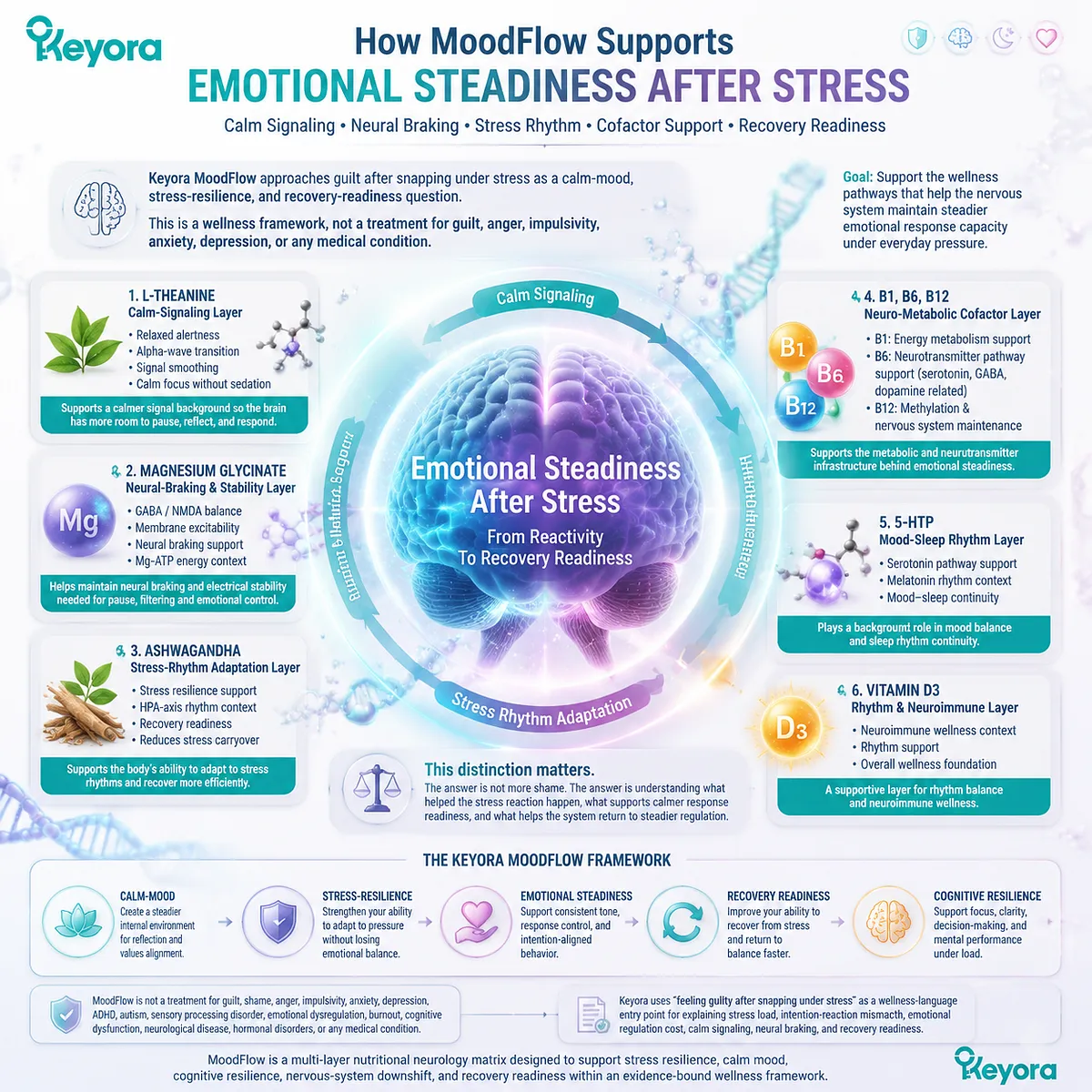
MoodFlow supports the calm-signaling, neural-braking, stress-rhythm, and cofactor layers involved in emotional steadiness and recovery readiness.
Keyora MoodFlow approaches guilt after snapping under stress as a calm-mood, stress-resilience, and recovery-readiness question.
The goal is not to treat guilt, erase responsibility, remove regret, or repair relationships. The goal is not to treat anger, impulsivity, emotional dysregulation, anxiety, depression, burnout, or any medical condition. The goal is to support the wellness pathways that help the nervous system maintain steadier emotional response capacity under everyday pressure.
This distinction matters.
When someone feels guilty after snapping, the answer is not always more shame. Shame can add more emotional load to a system that is already recovering from stress. A more useful wellness frame is to ask what helped the stress reaction happen, what supports calmer response readiness, and what helps the system return to steadier regulation after pressure.
MoodFlow’s logic begins with the state behind emotional steadiness.
L-Theanine supports the calm-signaling layer.
In the MoodFlow framework, L-Theanine is associated with relaxed alertness, alpha-wave transition, signal smoothing, and calm focus without sedation. This is relevant because post-stress guilt often appears after a reactive state. The nervous system may still feel activated, sensitive, or unsettled.
The goal is not to sedate the person or make them emotionally flat.
The goal is a calmer signal background. L-Theanine helps explain how calm signaling can support a steadier internal environment, where the brain may have more room to pause, reflect, and return to a values-aligned response style.
Magnesium glycinate supports the neural-braking and electrical-stability layer.
Magnesium is relevant to GABA/NMDA activation balance, membrane excitability, and Mg-ATP energy context. In MoodFlow, magnesium glycinate is positioned as part of the neural braking and hardware-stabilizing layer.
For post-stress guilt, this layer matters because the original sharp response often reflects a braking challenge. The system needed pause, filtering, and emotional control, but the stress response moved faster than the softer response. Neural braking helps explain the physiological background involved in emotional steadiness and calm response readiness.
Magnesium’s Mg-ATP context also matters because reflection and regulation require energy. Recognizing a mismatch, controlling tone, softening language, and returning to steadier behavior are active processes. They depend on both signal stability and energy readiness.
Ashwagandha supports the stress-rhythm adaptation layer.
Guilt after snapping often happens downstream of accumulated stress. The person may not have snapped because of one small moment alone. The reaction may have followed hours or days of stress-rhythm carryover, reduced recovery, high alertness, and emotional regulation cost.
Ashwagandha is positioned in MoodFlow around stress resilience, HPA-axis rhythm context, and recovery readiness. In this article, that does not mean Ashwagandha fixes cortisol, treats burnout, repairs the HPA axis, or treats guilt. It means Ashwagandha belongs to the stress-adaptation layer that helps explain why emotional steadiness is connected to broader stress rhythm.
B1, B6, and B12 support the neuro-metabolic cofactor layer.
The nervous system depends on normal metabolic and neurotransmitter-related infrastructure. B1 supports energy-metabolism context. B6 supports neurotransmitter-related conversion context, including pathways relevant to calming and mood-related signaling. B12 supports methylation context and nervous-system maintenance.
In MoodFlow, these B vitamins are not positioned as treatments for guilt, shame, irritability, emotional dysregulation, or cognitive dysfunction. They are part of the cofactor background behind emotional steadiness, response capacity, and normal pathway support under everyday pressure.
5-HTP plays a background role in mood-sleep rhythm continuity.
Because this article is about guilt after snapping under stress, 5-HTP should remain a supporting background layer. Its role is best understood as support for serotonin-melatonin pathway continuity and mood-sleep rhythm context within the broader MoodFlow architecture. This does not mean treating depression, correcting serotonin, or forcing sleep.
Vitamin D may also be understood as part of the broader rhythm and neuroimmune wellness context when relevant, but it should remain secondary.
Together, these layers explain why MoodFlow is not positioned as a guilt treatment, relationship-repair product, anger-control product, sedative, stimulant, or emotional-control cure. It is a multi-layer nutritional neurology matrix designed to support stress resilience, calm mood, cognitive resilience, nervous-system downshift, and recovery readiness within an evidence-bound wellness framework.
MoodFlow is not a treatment for guilt, shame, anger, impulsivity, anxiety, depression, ADHD, autism, sensory processing disorder, emotional dysregulation, burnout, cognitive dysfunction, neurological disease, cortisol problems, adrenal fatigue, hormonal disorders, relationship problems, or any medical condition. In this article, Keyora uses “feeling guilty after snapping under stress” as a wellness-language entry point for explaining stress load, intention-reaction mismatch, emotional regulation cost, calm signaling, neural braking, stress-rhythm adaptation, and recovery readiness under everyday pressure.
Closing Summary
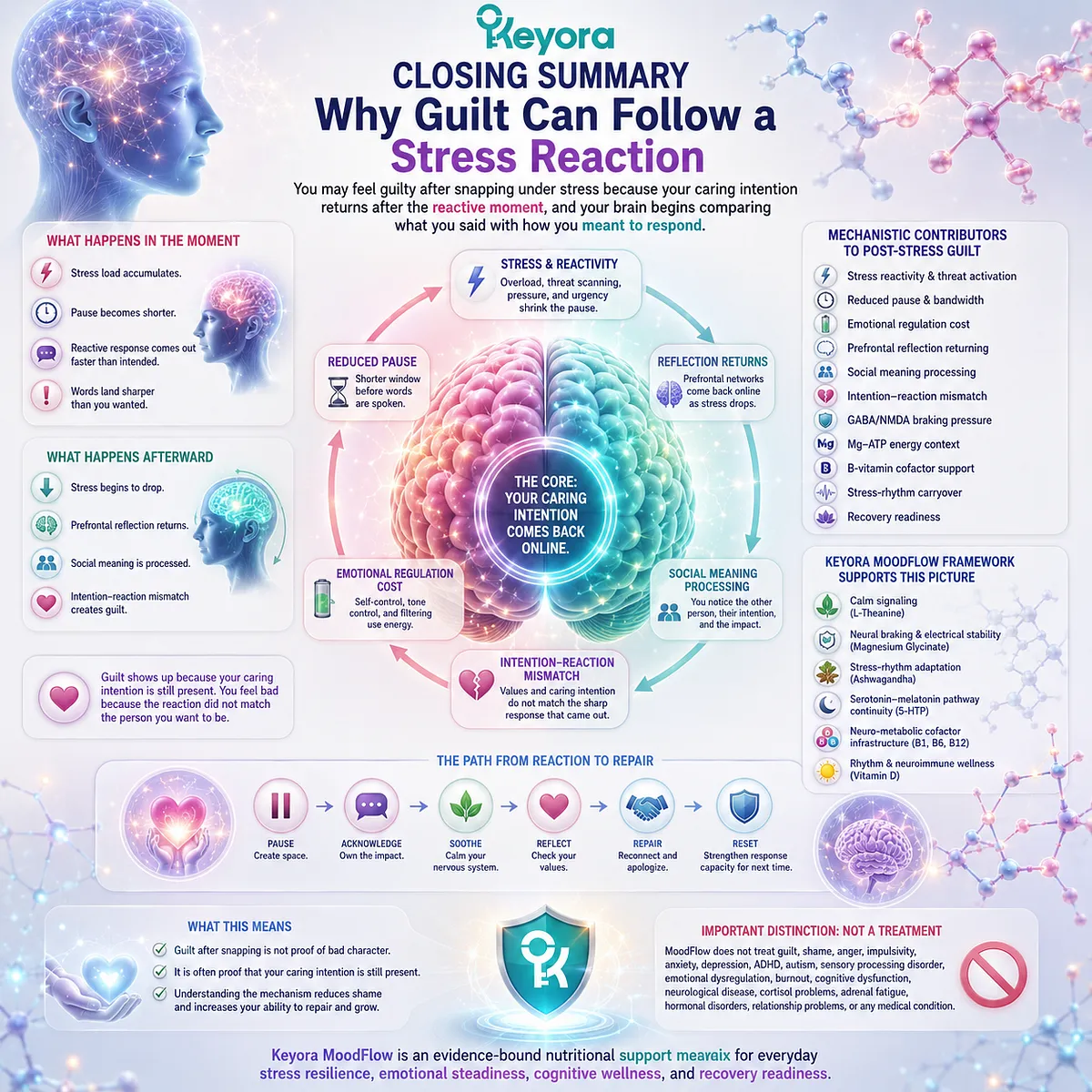
You may feel guilty after snapping under stress because your caring intention returns after the reactive moment, and your brain begins comparing what you said with how you meant to respond. The sharp response may have happened quickly, but reflection often comes back afterward.
This is why guilt after snapping is not always proof of bad character.
Mechanistically, post-stress guilt may involve stress reactivity, reduced pause, emotional regulation cost, prefrontal reflection returning, social meaning processing, intention-reaction mismatch, GABA/NMDA braking pressure, Mg-ATP energy context, B-vitamin cofactor support, stress-rhythm carryover, and recovery readiness.
In the Keyora MoodFlow framework, this is understood as a calm-mood, stress-resilience, and emotional-steadiness question. MoodFlow supports this picture through calm signaling, neural braking, stress-rhythm adaptation, serotonin-melatonin pathway continuity, and neuro-metabolic cofactor infrastructure.
MoodFlow does not treat guilt, shame, anger, impulsivity, anxiety, depression, ADHD, autism, sensory processing disorder, emotional dysregulation, burnout, cognitive dysfunction, neurological disease, cortisol problems, adrenal fatigue, hormonal disorders, relationship problems, or any medical condition. It is an evidence-bound nutritional support matrix for everyday stress resilience, emotional steadiness, and cognitive wellness.
This article is for educational and informational purposes only. It does not provide medical advice, diagnosis, treatment, cure, prevention, disease outcome claims, hormone restoration claims, fertility outcome claims, or formula-specific clinical efficacy claims.