
Why Do I Snap at People When I’m Stressed?
Keyora Research Q&A Library
This is part of the Keyora Research Q&A Series, derived from Keyora Nutritional Neurology Seriers .
Within the Keyora Nutritional Neurology framework, this Q&A translates complex nutrient–brain mechanisms into reader-friendly, evidence-bound answers, focusing on stress resilience, sleep quality, calm mood support, cognitive wellness, and the broader interaction between nutrition, neurochemistry, and daily nervous-system function.
First published by Keyora Research Journal: www.keyorahealth.com
Direct Answer
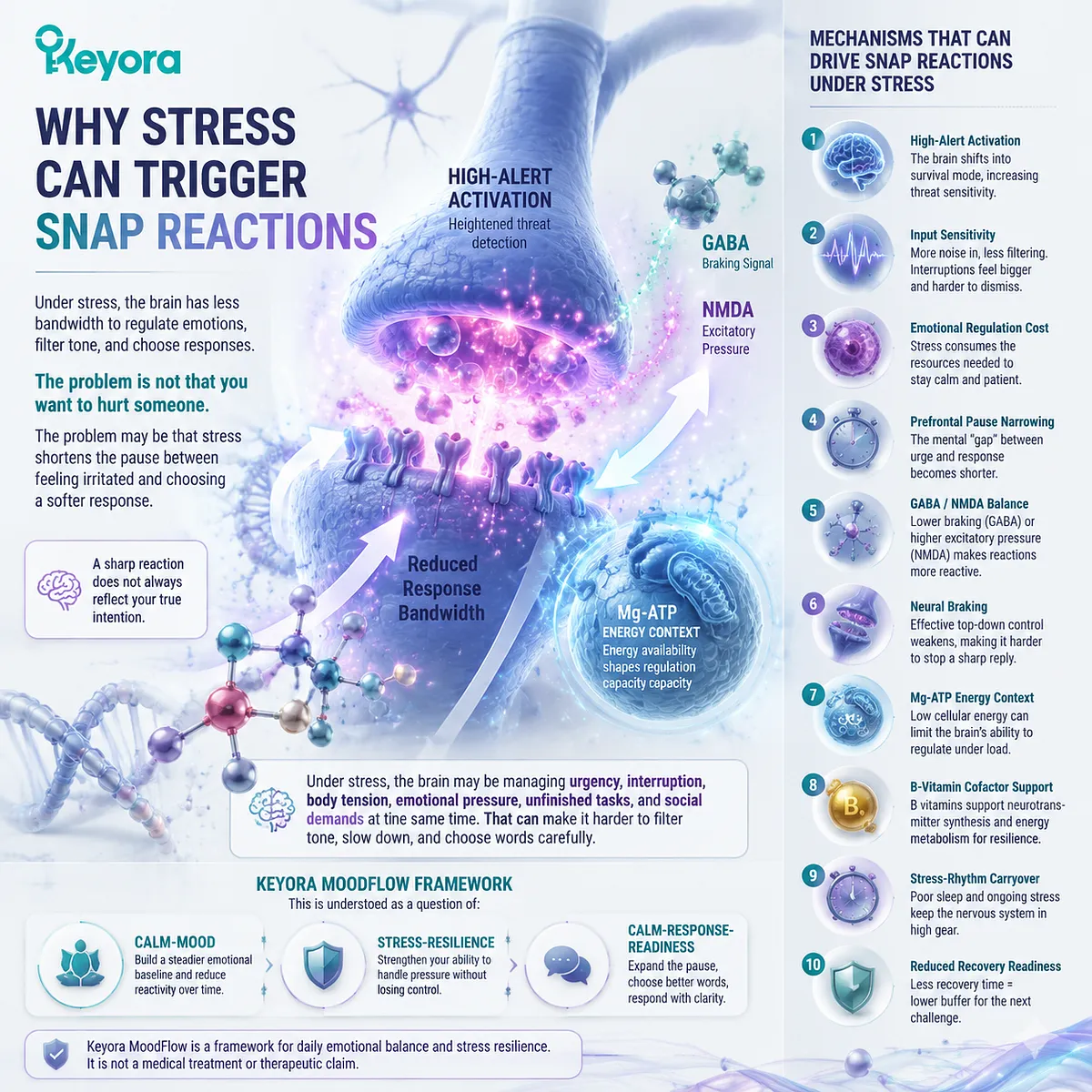
You may snap at people when stressed because high input load, emotional regulation cost, and reduced response bandwidth can make calm responses harder to access.
The problem is not always that you want to hurt someone.
The problem may be that stress shortens the pause between feeling irritated and choosing a softer response.
This is why a sharp reaction does not always reflect your true intention.
Under stress, the brain may be managing urgency, interruption, body tension, emotional pressure, unfinished tasks, and social demands at the same time. That can make it harder to filter tone, slow down, and choose words carefully.
Mechanistically, snapping under stress can involve high-alert activation, input sensitivity, emotional regulation cost, prefrontal pause narrowing, GABA/NMDA braking pressure, neural braking, Mg-ATP energy context, B-vitamin cofactor support, stress-rhythm carryover, and reduced recovery readiness.
In the Keyora MoodFlow framework, this is understood as a calm-mood, stress-resilience, and calm-response-readiness question, not a medical treatment claim.
Why Stress Can Make Your Response Come Out Sharper Than You Meant
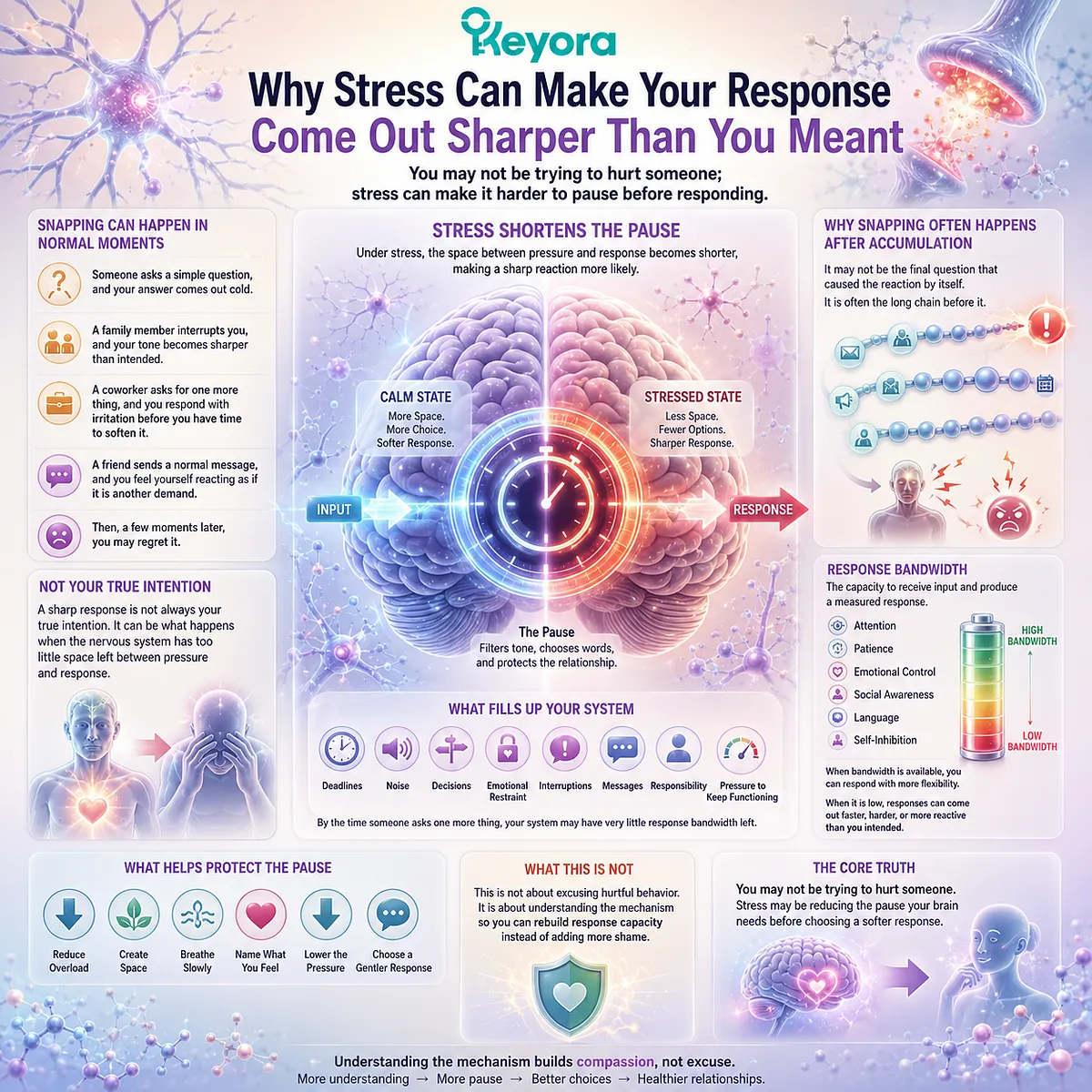
You may not be trying to hurt someone; stress can make it harder to pause before responding.
Snapping at people under stress can feel awful because it often does not match what you actually meant.
Someone asks a simple question, and your answer comes out cold. A family member interrupts you, and your tone becomes sharper than intended. A coworker asks for one more thing, and you respond with irritation before you have time to soften it. A friend sends a normal message, and you feel yourself reacting as if it is another demand.
Then, a few moments later, you may regret it.
You may think, “Why did I say it like that?” You may know the other person did not deserve that tone. You may even feel confused because you were not trying to be unkind. The reaction came out faster than the part of you that wanted to respond calmly.
This is one of the most important things to understand about stress-related snapping.
A sharp response is not always your true intention. Sometimes it is what happens when the nervous system has too little space left between pressure and response.
In a calmer state, you may be able to pause. You may hear the question, notice your irritation, take a breath, and choose a gentler answer. That pause gives the brain time to filter tone, choose language, and remember the relationship in front of you.
Under stress, that pause can become shorter.
The body may already feel tense. The mind may already be holding unfinished tasks. Attention may already be crowded. The nervous system may already be scanning for what could go wrong. In that state, a small input may not feel small. It may feel like one more thing arriving on top of too much.
This is why snapping often happens after accumulation.
It may not be the final question that caused the reaction by itself. It may be the long chain before it: the deadline, the noise, the decisions, the emotional restraint, the interruptions, the messages, the responsibility, and the pressure to keep functioning.
By the time someone asks one more thing, your system may have very little response bandwidth left.
Response bandwidth is the capacity to receive input and produce a measured response. It includes attention, patience, emotional control, social awareness, language, and self-inhibition. When bandwidth is available, you can respond with more flexibility. When it is low, responses can come out faster, harder, or more reactive than you intended.
This does not excuse hurting people.
But it helps explain why it happens.
Understanding the mechanism matters because shame alone rarely improves the pause. If you only label yourself as bad, mean, or broken, you may add more pressure to a system that is already overloaded. A better starting point is to understand what stress is doing to your response capacity.
You may not be trying to hurt someone.
Stress may be reducing the pause your brain needs before choosing a softer response.
The Reduced Pause Behind Snapping Under Stress
Snapping can happen when stress overloads the systems that help you filter, soften, and choose your response.
Snapping under stress is often less about wanting to react badly and more about losing access to the pause that allows a softer response.
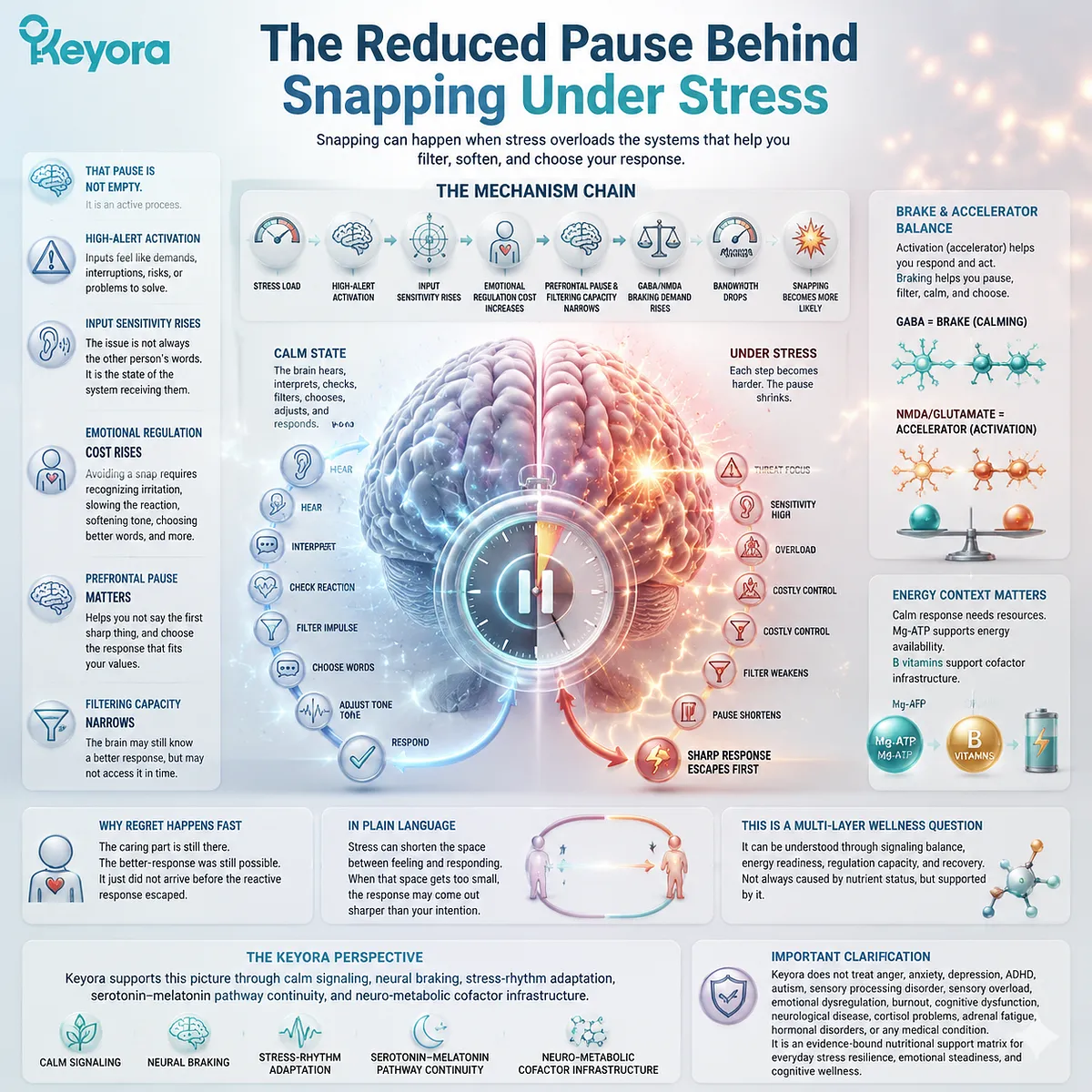
That pause is not empty. It is an active process.
In a calm state, the brain hears the input, interprets what it means, checks emotional reaction, filters the first impulse, chooses words, adjusts tone, and then responds. This can happen quickly, but it still requires coordination.
Under stress, each step becomes more difficult.
High-alert activation is one part of the mechanism. When the nervous system is in high alert, the brain is more likely to treat inputs as demands, interruptions, risks, or problems to solve. A normal question can feel like pressure. A small delay can feel like threat. A request can feel like one more demand on an already overloaded system.
This raises input sensitivity.
The issue is not always the other person’s words. It is the state of the system receiving them. In a recovered state, the same question might feel harmless. In a stressed state, it may feel invasive, urgent, or poorly timed.
Emotional regulation cost also rises.
To avoid snapping, the brain has to do several things at once. It has to recognize irritation, slow the reaction, soften the tone, choose better words, and avoid transferring stress onto another person. That is emotional work. It requires capacity.
When stress has already used much of that capacity, response control can become harder.
This is where the prefrontal pause matters.
In simple language, the prefrontal system helps with self-control, planning, social judgment, and response filtering. It helps you not say the first sharp thing that comes to mind. It helps you choose the response that fits your values, not just your stress state.
Under pressure, that filtering capacity can narrow.
The brain may still know what a better response would be. But the stressed system may not access that response quickly enough. The sharp answer comes out first, and the calmer version arrives later.
This is why people often regret snapping almost immediately.
The caring part was still there. The better response was still possible. It just did not arrive before the reactive response escaped.
The nervous system’s brake-and-accelerator balance also matters.
In simple terms, activation is the accelerator. It helps you notice, respond, move, and solve problems. Braking helps you pause, filter, calm, and choose. GABA-related calming tone and NMDA/glutamate activation balance help explain why the nervous system can feel steady or overactivated.
When stress is high, braking demand rises.
The system has to suppress more impulses, filter more signals, and hold back stronger reactions. If the braking background feels insufficient, the response may come out sharper than intended.
Energy context is another layer.
Response inhibition, tone control, emotional regulation, and social judgment are not passive. They require active resources. Magnesium’s role in Mg-ATP context and B vitamins’ role as cofactor infrastructure help explain why calm response depends on both signal stability and energy readiness.
This does not mean snapping under stress is always caused by nutrient status. It means the experience can be understood as a multi-layer wellness question.
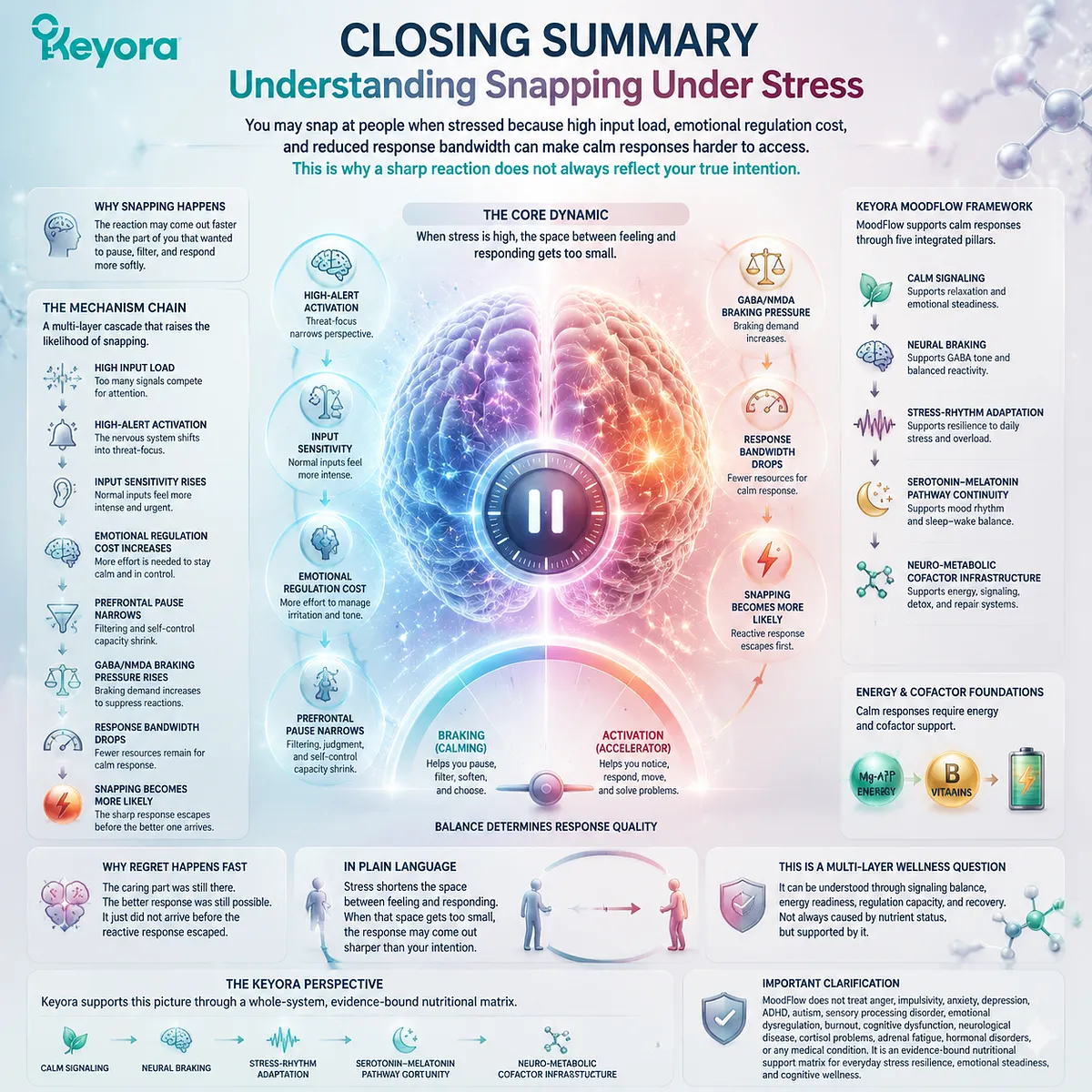
The mechanism chain looks like this:
stress load → high-alert activation → input sensitivity rises → emotional regulation cost increases → prefrontal pause and filtering capacity narrows → GABA/NMDA braking demand rises → response bandwidth drops → snapping becomes more likely
In plain language, stress can shorten the space between feeling and responding.
When that space gets too small, the response may come out sharper than your intention.
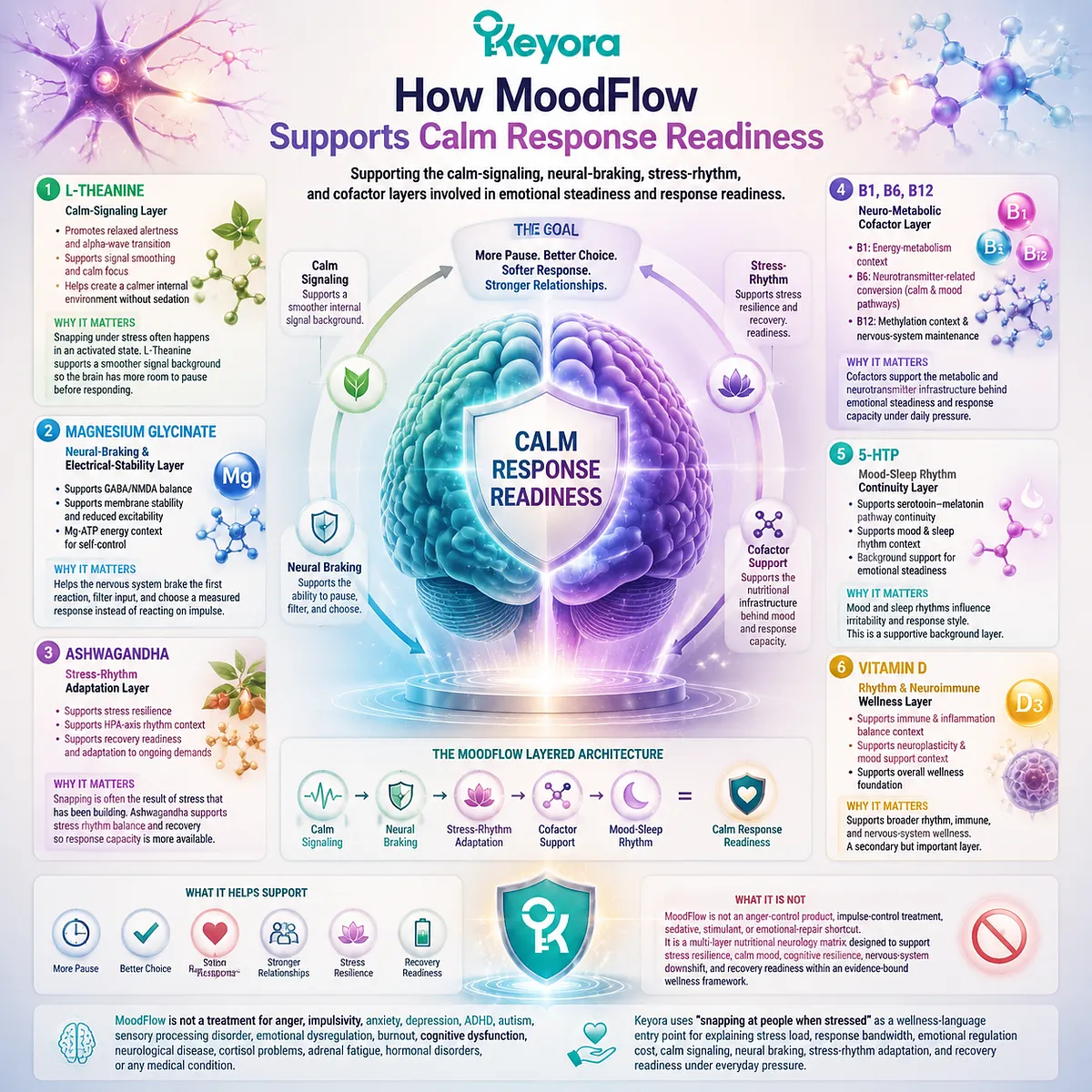
How MoodFlow Supports Calm Response Readiness
MoodFlow supports the calm-signaling, neural-braking, stress-rhythm, and cofactor layers involved in emotional steadiness and response readiness.
Keyora MoodFlow approaches snapping under stress as a calm-mood, stress-resilience, and calm-response-readiness question.
The goal is not to treat anger, impulsivity, emotional dysregulation, anxiety, depression, ADHD, burnout, or any medical condition. The goal is to support the wellness pathways that help the nervous system maintain steadier response capacity under everyday pressure.
This distinction matters.
When someone snaps under stress, the answer is not always more shame, more self-criticism, or more forced control. Self-awareness and repair matter, but the deeper wellness question is also about state: how much pressure is the nervous system carrying, and how much pause is still available?
MoodFlow’s logic begins with the state behind calm response.
L-Theanine supports the calm-signaling layer.
In the MoodFlow framework, L-Theanine is associated with relaxed alertness, alpha-wave transition, signal smoothing, and calm focus without sedation. This is relevant because snapping under stress often happens in an activated state, not a sleepy state.
The person may already be alert. They may already be stimulated. The issue is that the signal background is too reactive. L-Theanine helps explain calm signaling as support for a smoother internal environment where the brain may have more room to pause before responding.
Magnesium glycinate supports the neural-braking and electrical-stability layer.
Magnesium is relevant to GABA/NMDA activation balance, membrane excitability, and Mg-ATP energy context. In MoodFlow, magnesium glycinate is positioned as part of the neural braking and hardware-stabilizing layer.
For snapping under stress, this layer is central. The core issue is not only irritation. It is the difficulty of braking the first reaction before it becomes speech. Neural braking helps explain the physiological background involved in pausing, filtering, and choosing a measured response.
Magnesium’s Mg-ATP context also matters because self-control uses energy. Softening tone, regulating words, holding back irritation, and staying socially aware all require active control. The nervous system needs both signal stability and energy readiness.
Ashwagandha supports the stress-rhythm adaptation layer.
Snapping is often more likely when stress has been building across the day or week. A nervous system carrying stress-rhythm carryover may have less tolerance for interruptions, questions, noise, or social demands. The reaction may appear suddenly, but the load behind it may have been accumulating.
Ashwagandha is positioned in MoodFlow around stress resilience, HPA-axis rhythm context, and recovery readiness. In this article, that does not mean Ashwagandha fixes cortisol, treats burnout, repairs the HPA axis, or treats anger. It means Ashwagandha belongs to the stress-adaptation layer that helps explain why calm response is connected to broader stress rhythm.
B1, B6, and B12 support the neuro-metabolic cofactor layer.
The nervous system depends on normal metabolic and neurotransmitter-related infrastructure. B1 supports energy-metabolism context. B6 supports neurotransmitter-related conversion context, including pathways relevant to calming and mood-related signaling. B12 supports methylation context and nervous-system maintenance.
In MoodFlow, these B vitamins are not positioned as treatments for irritability, impulsivity, emotional dysregulation, or cognitive dysfunction. They are part of the cofactor background behind emotional steadiness, response capacity, and normal pathway support under everyday pressure.
5-HTP plays a background role in mood-sleep rhythm continuity.
Because this article is about snapping under stress, 5-HTP should remain a supporting background layer. Its role is best understood as support for serotonin-melatonin pathway continuity and mood-sleep rhythm context within the broader MoodFlow architecture. This does not mean treating depression, correcting serotonin, or forcing sleep.
Vitamin D may also be understood as part of the broader rhythm and neuroimmune wellness context when relevant, but it should remain secondary.
Together, these layers explain why MoodFlow is not positioned as an anger-control product, impulse-control treatment, sedative, stimulant, or emotional-repair shortcut. It is a multi-layer nutritional neurology matrix designed to support stress resilience, calm mood, cognitive resilience, nervous-system downshift, and recovery readiness within an evidence-bound wellness framework.
MoodFlow is not a treatment for anger, impulsivity, anxiety, depression, ADHD, autism, sensory processing disorder, emotional dysregulation, burnout, cognitive dysfunction, neurological disease, cortisol problems, adrenal fatigue, hormonal disorders, or any medical condition.
In this article, Keyora uses “snapping at people when stressed” as a wellness-language entry point for explaining stress load, response bandwidth, emotional regulation cost, calm signaling, neural braking, stress-rhythm adaptation, and recovery readiness under everyday pressure.
Closing Summary
You may snap at people when stressed because high input load, emotional regulation cost, and reduced response bandwidth can make calm responses harder to access. The reaction may come out faster than the part of you that wanted to pause, filter, and respond more softly.
This is why a sharp reaction does not always reflect your true intention.
Mechanistically, snapping under stress may involve high-alert activation, input sensitivity, emotional regulation cost, prefrontal pause narrowing, GABA/NMDA braking pressure, Mg-ATP energy context, B-vitamin cofactor support, stress-rhythm carryover, reduced response bandwidth, and lower recovery readiness.
In the Keyora MoodFlow framework, this is understood as a calm-mood, stress-resilience, and calm-response-readiness question. MoodFlow supports this picture through calm signaling, neural braking, stress-rhythm adaptation, serotonin-melatonin pathway continuity, and neuro-metabolic cofactor infrastructure.
MoodFlow does not treat anger, impulsivity, anxiety, depression, ADHD, autism, sensory processing disorder, emotional dysregulation, burnout, cognitive dysfunction, neurological disease, cortisol problems, adrenal fatigue, hormonal disorders, or any medical condition. It is an evidence-bound nutritional support matrix for everyday stress resilience, emotional steadiness, and cognitive wellness.
This article is for educational and informational purposes only. It does not provide medical advice, diagnosis, treatment, cure, prevention, disease outcome claims, hormone restoration claims, fertility outcome claims, or formula-specific clinical efficacy claims.