
Why Does My Nervous System Feel Stuck in High Alert?
Keyora Research Q&A Library
This is part of the Keyora Research Q&A Series, derived from Keyora Nutritional Neurology Seriers .
Within the Keyora Nutritional Neurology framework, this Q&A translates complex nutrient–brain mechanisms into reader-friendly, evidence-bound answers, focusing on stress resilience, sleep quality, calm mood support, cognitive wellness, and the broader interaction between nutrition, neurochemistry, and daily nervous-system function.
First published by Keyora Research Journal: www.keyorahealth.com
Direct Answer
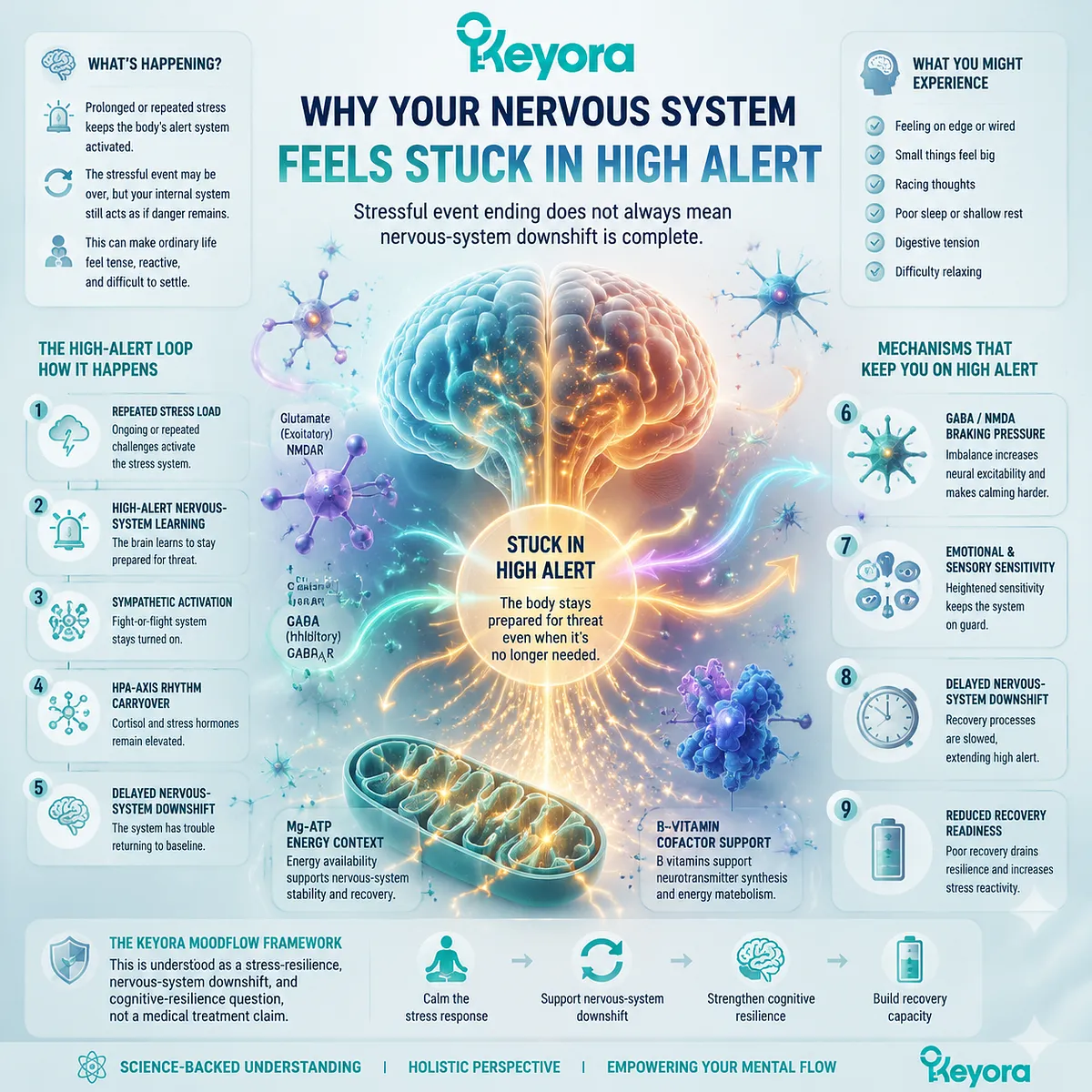
Your nervous system can feel stuck in high alert because prolonged or repeated stress can keep the body’s alert system active even after the immediate pressure has passed.
The stressful event may be over, but the internal system may still be acting as if it needs to stay prepared.
This can make ordinary life feel tense, reactive, and difficult to settle.
The problem is not always that something dangerous is happening now. The problem is that stress event ending does not always mean nervous-system downshift is complete.
Mechanistically, this can involve repeated stress load, high-alert nervous-system learning, sympathetic activation, HPA-axis rhythm carryover, GABA/NMDA braking pressure, emotional and sensory sensitivity, delayed nervous-system downshift, Mg-ATP energy context, B-vitamin cofactor support, and reduced recovery readiness.
In the Keyora MoodFlow framework, this is understood as a stress-resilience, nervous-system downshift, and cognitive-resilience question, not a medical treatment claim.
Why You Can Feel on Alert Even When Nothing Is Happening
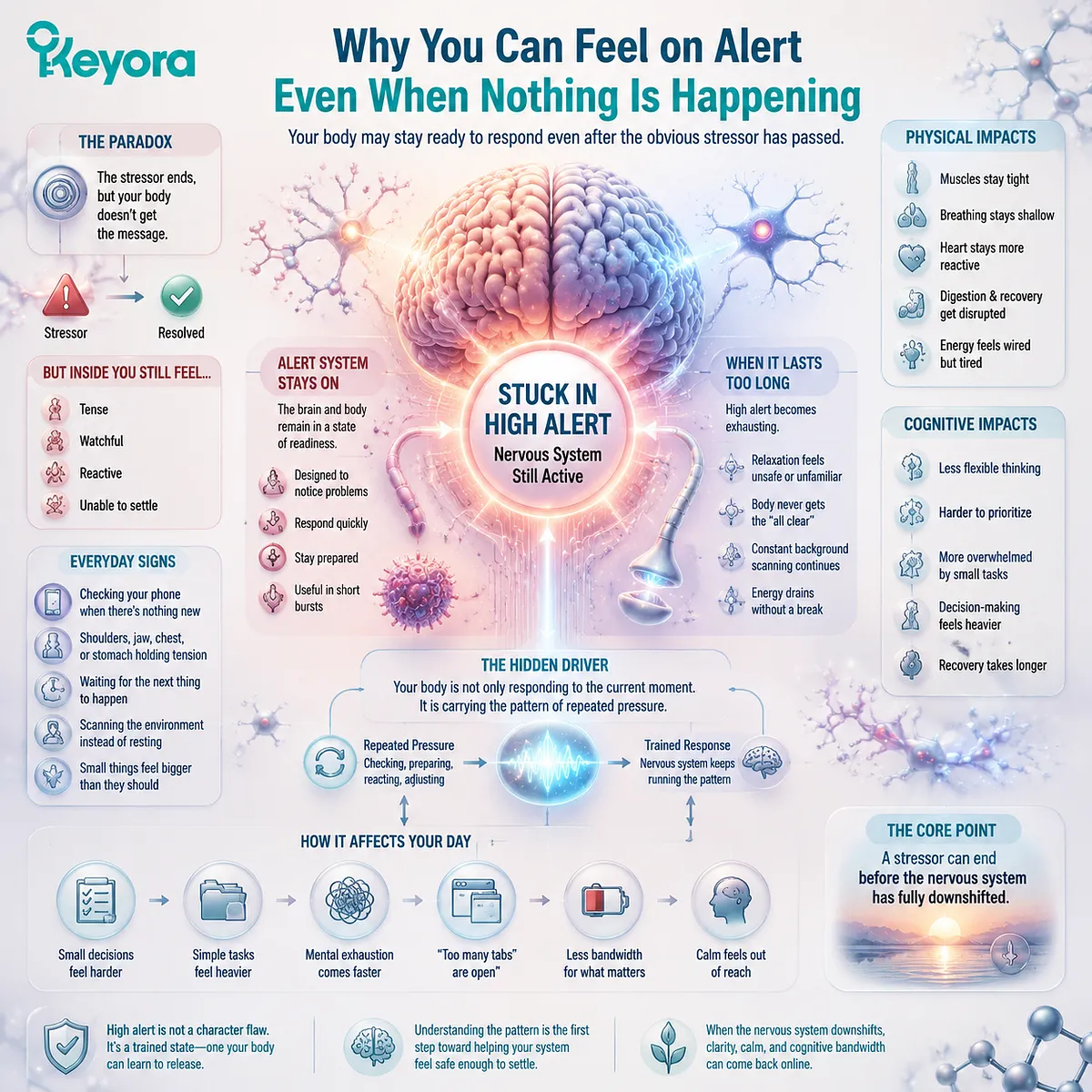
Your body may stay ready to respond even after the obvious stressor has passed.
Sometimes the stressful moment ends, but your body does not feel like it got the message.
The meeting is over. The deadline has passed. The conversation is finished. The urgent message has been answered. The visible pressure has lowered. But inside, you still feel tense, watchful, reactive, or unable to fully settle.
You may keep checking your phone even when there is nothing new. You may feel your shoulders, jaw, chest, stomach, or neck holding tension. You may sit down to rest but still feel like you are waiting for the next thing to happen. You may try to focus, but part of your attention keeps scanning the environment.
This is the “stuck in high alert” feeling.
It is not always dramatic. It may not feel like panic. It may simply feel like being on edge, unable to switch off, or unable to trust that things are actually calm.
In everyday life, this can show up as small reactions. A notification sound pulls your attention immediately. A simple question feels irritating. A delayed reply feels more important than it should. A quiet moment feels uncomfortable because your system is used to staying ready.
The pressure may be over, but your alert system may still be active.
This matters because high alert is not only a feeling. It is a state of readiness. The brain and body shift into a mode designed to notice problems, respond quickly, and stay prepared. In short bursts, this can be useful. It helps you meet deadlines, handle urgent tasks, and respond to challenges.
But when that state stays active too long, it can become exhausting.
A high-alert nervous system may make relaxation feel unsafe, unfamiliar, or simply unavailable. You may have time to rest, but your body may not feel ready for rest. You may not have an urgent task, but your brain may still be asking, “What’s next?” “What did I forget?” “What if something goes wrong?”
This is why people can feel tense even when nothing obvious is happening.
The body is not only responding to the current moment. It is also carrying the pattern of repeated pressure. If your day has trained you to keep checking, preparing, reacting, and adjusting, your nervous system may continue that pattern after the external demand has passed.
This is different from simply thinking too much.
Thinking is part of it, but the experience can also be physical. The body may remain braced. Breathing may feel shallow. Muscles may stay tight. Attention may feel jumpy. Small signals may feel louder. Quiet may not feel restorative.
This can affect cognition as well.
When the nervous system stays in high alert, the brain may have less flexible bandwidth for clear thinking, planning, decision-making, and recovery. It may become easier to feel overwhelmed, harder to prioritize, and more difficult to move calmly from one task to the next.
That is why this article belongs in the stress-driven cognitive overload cluster.
High alert is one of the background states that can make small decisions feel harder, simple tasks feel heavier, mental exhaustion feel stronger, and the mind feel like too many tabs are open.
The core point is simple:
A stressor can end before the nervous system has fully downshifted.
The Alert-System Carryover Behind Stress Overload
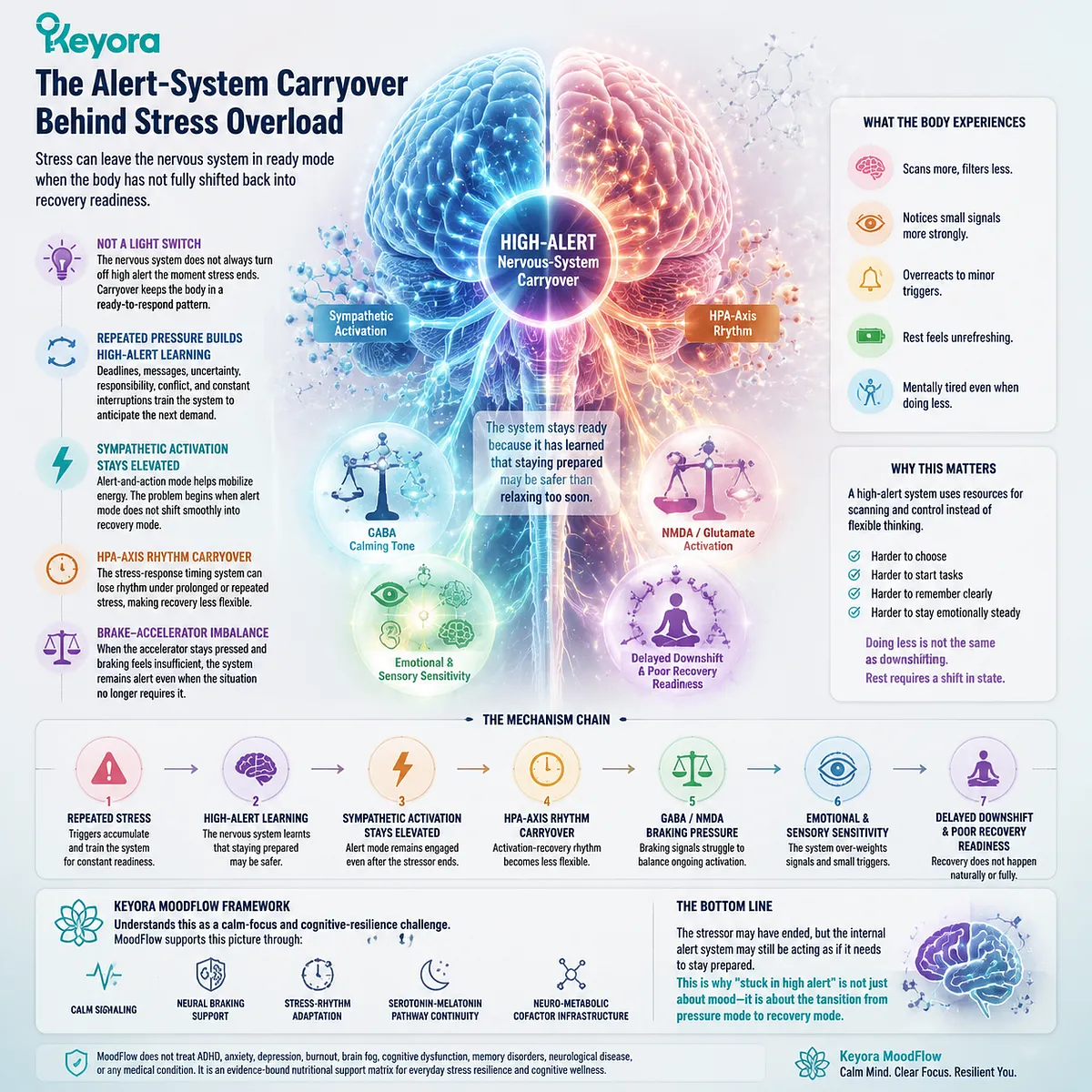
Stress can leave the nervous system in ready mode when the body has not fully shifted back into recovery readiness.
The nervous system does not always work like a light switch.
It does not necessarily turn off high alert the moment a stressful situation ends. Instead, stress can create carryover. The body may remain in a ready-to-respond pattern because it has learned that staying prepared may be safer than relaxing too soon.
This is especially common when pressure is repeated.
If stress happens once, the body may activate and then return to baseline. But if stress keeps returning through deadlines, messages, uncertainty, responsibility, conflict, or constant interruptions, the system may begin to anticipate the next demand before it arrives.
In consumer-friendly terms, the nervous system may learn to stay ready.
This does not mean the person is choosing to stay tense. It means the system has adapted to a high-demand environment. The brain becomes more likely to scan. The body becomes more likely to brace. Attention becomes more likely to jump toward possible problems.
The sympathetic nervous system is one part of this picture.
In simple language, sympathetic activation is the body’s alert-and-action mode. It helps mobilize energy, increase readiness, and respond to demands. This is not bad by itself. The problem begins when alert mode does not shift smoothly into recovery mode.
The HPA-axis rhythm context also matters.
The HPA axis is part of the body’s stress-response timing system. Under everyday pressure, it helps coordinate stress signals and recovery timing. But when stress is prolonged or repeated, the rhythm of activation and recovery can feel less flexible.
This does not mean there is a cortisol disease, adrenal fatigue, or a hormonal disorder. In this article, the focus is only on everyday stress rhythm and recovery readiness.
Another important layer is the brake-and-accelerator balance of the nervous system.
In simple terms, the brain needs both activation and braking. Activation helps you respond. Braking helps you calm, filter, settle, and recover. GABA-related calming tone and NMDA/glutamate activation balance help explain why the nervous system can feel steady or overactivated.
When the accelerator stays pressed and the braking background feels insufficient, the system may remain alert even when the situation no longer requires it.
This can increase emotional and sensory sensitivity.
A high-alert system may notice small signals more strongly. A message, sound, facial expression, unfinished task, or small change in tone may feel more important than it is. The brain is not neutral. It is filtering the world through readiness.
That readiness can make everyday life feel louder.
It can also interfere with recovery readiness. Rest is not only time away from work. Rest requires a shift in state. If the body is still scanning, bracing, predicting, and preparing, then sitting still may not feel restorative.
This is why someone can lie on the couch and still feel tense. They may not be doing anything visible, but internally the system may still be active.
Doing less is not the same as downshifting.
This connects directly to cognitive overload. When the nervous system is stuck in high alert, the brain may use resources for scanning and control instead of flexible thinking. It may become harder to choose, start tasks, remember clearly, or stay emotionally steady.
The mechanism chain looks like this:
repeated stress → high-alert nervous-system learning → sympathetic activation stays elevated → HPA-axis rhythm carryover → GABA/NMDA braking pressure → emotional and sensory sensitivity → delayed nervous-system downshift → poor recovery readiness
In plain language, the stressor may have ended, but the internal alert system may still be acting as if it needs to stay prepared.
That is why the “stuck in high alert” feeling is not just about mood. It is about the transition from pressure mode to recovery mode.
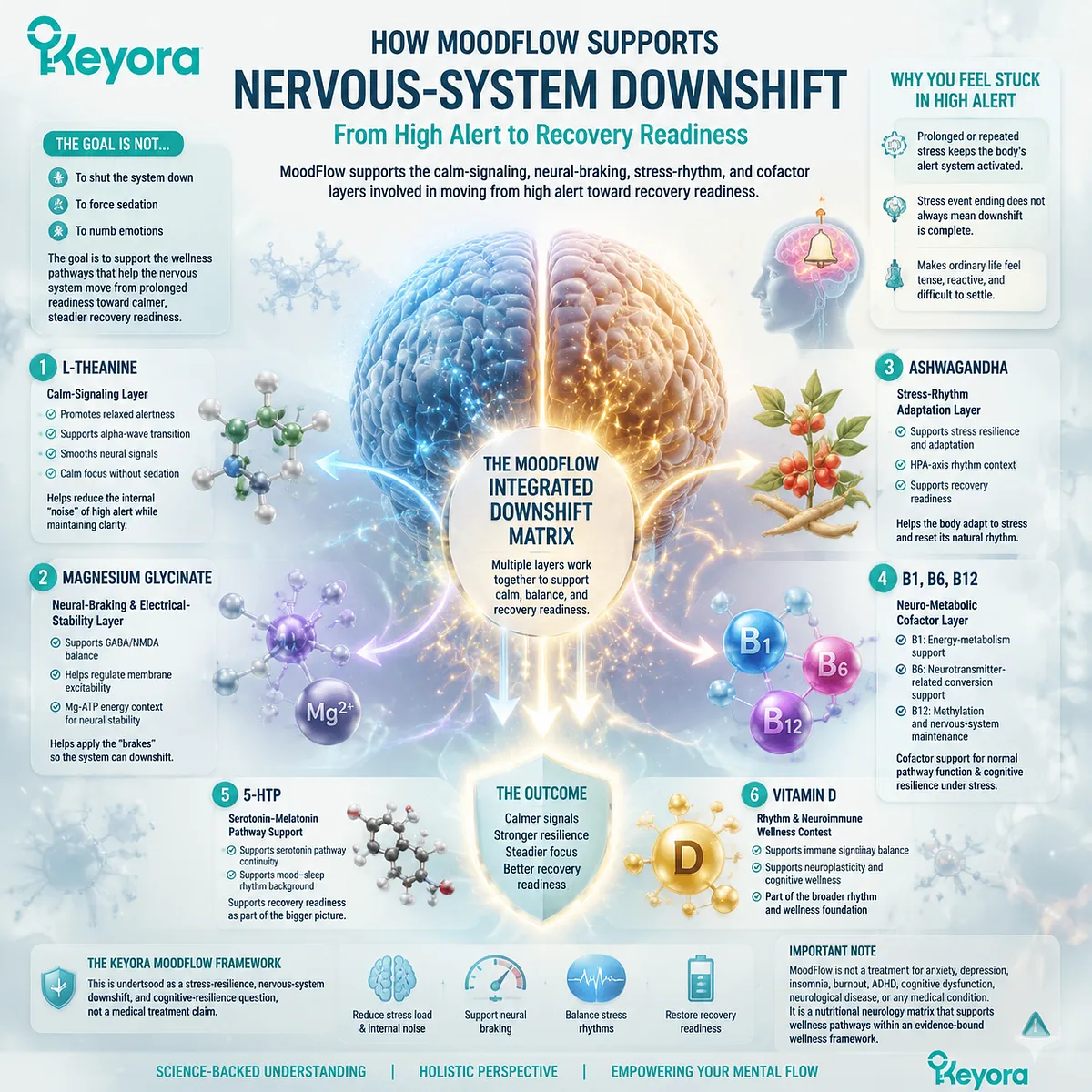
How MoodFlow Supports Nervous-System Downshift
MoodFlow supports the calm-signaling, neural-braking, stress-rhythm, and cofactor layers involved in moving from high alert toward recovery readiness.
Keyora MoodFlow approaches the stuck-in-high-alert feeling as a stress-resilience and nervous-system downshift question.
The goal is not to shut the system down. The goal is not to force sedation. The goal is to support the wellness pathways that help the nervous system move from prolonged readiness toward calmer, steadier recovery readiness.
This distinction matters.
People who feel stuck in high alert often do not need more stimulation. They may already feel activated. They may be alert, tense, reactive, and ready to respond. What they may need is a calmer internal background that supports downshift without grogginess.
L-Theanine supports the calm-signaling layer.
In the MoodFlow framework, L-Theanine is associated with relaxed alertness, alpha-wave transition, signal smoothing, and calm focus without sedation. This makes it relevant to high-alert states because the goal is not to become dull or sleepy. The goal is to support a calmer alert state.
For a nervous system that feels too reactive, calm signaling matters. It helps explain how someone can remain awake and functional while the background pressure feels less loud.
Magnesium glycinate supports the neural-braking and electrical-stability layer.
Magnesium is relevant to GABA/NMDA activation balance, membrane excitability, and Mg-ATP energy context. In MoodFlow, magnesium glycinate is positioned as part of the neural braking and hardware-stabilizing layer.
This matters because high-alert states often feel like the accelerator is still engaged. The system remains ready, reactive, and difficult to settle. Neural braking helps explain the physiological background needed for nervous-system downshift.
Magnesium’s Mg-ATP context also matters because stress adaptation, emotional regulation, and cognitive control require an energy background. Downshift is not passive. The brain and body need support for both signal stability and energy readiness.
Ashwagandha supports the stress-rhythm adaptation layer.
Article 35 is especially relevant to Ashwagandha because the central question is stress carryover. Ashwagandha is positioned in MoodFlow around stress resilience, HPA-axis rhythm context, and recovery readiness.
This does not mean Ashwagandha fixes cortisol, treats burnout, repairs the HPA axis, or cures anxiety. The safer and more accurate framing is that Ashwagandha supports the body’s stress-adaptation context under everyday pressure.
In the MoodFlow framework, this helps explain why high alert is not only a moment-to-moment feeling. It can be part of a broader rhythm: activation, response, recovery, and readiness for the next demand.
B1, B6, and B12 support the neuro-metabolic cofactor layer.
The nervous system depends on normal metabolic and neurotransmitter-related infrastructure. B1 supports energy-metabolism context. B6 supports neurotransmitter-related conversion context, including pathways relevant to calming and mood-related signaling. B12 supports methylation context and nervous-system maintenance.
In this article, B vitamins should not be presented as treating fatigue, anxiety, or cognitive dysfunction. Their role is cofactor support for normal pathway function and cognitive resilience under stress.
5-HTP plays a background role.
Because this article is high-alert-first, 5-HTP should not dominate the explanation. Its role is best understood as support for serotonin-melatonin pathway continuity and mood-sleep rhythm background within the broader MoodFlow architecture. That background may matter for recovery readiness, but this article is not about treating insomnia, depression, or serotonin deficiency.
Vitamin D may also be understood as part of the broader rhythm and neuroimmune wellness context when relevant, but it should remain secondary here.
Together, these layers explain why MoodFlow is not positioned as a sedative, stimulant, cortisol treatment, anxiety treatment, or productivity shortcut. It is a multi-layer nutritional neurology matrix designed to support stress resilience, calm mood, calm focus, cognitive resilience, nervous-system downshift, and recovery readiness within an evidence-bound wellness framework.
MoodFlow is not a treatment for anxiety, depression, insomnia, burnout, ADHD, cognitive dysfunction, neurological disease, memory disorders, adrenal fatigue, cortisol problems, or any medical condition.
In this article, Keyora uses the “stuck in high alert” feeling as a wellness-language entry point for explaining stress load, nervous-system downshift delay, calm signaling, neural braking, stress-rhythm adaptation, and recovery readiness under everyday pressure.
Closing Summary
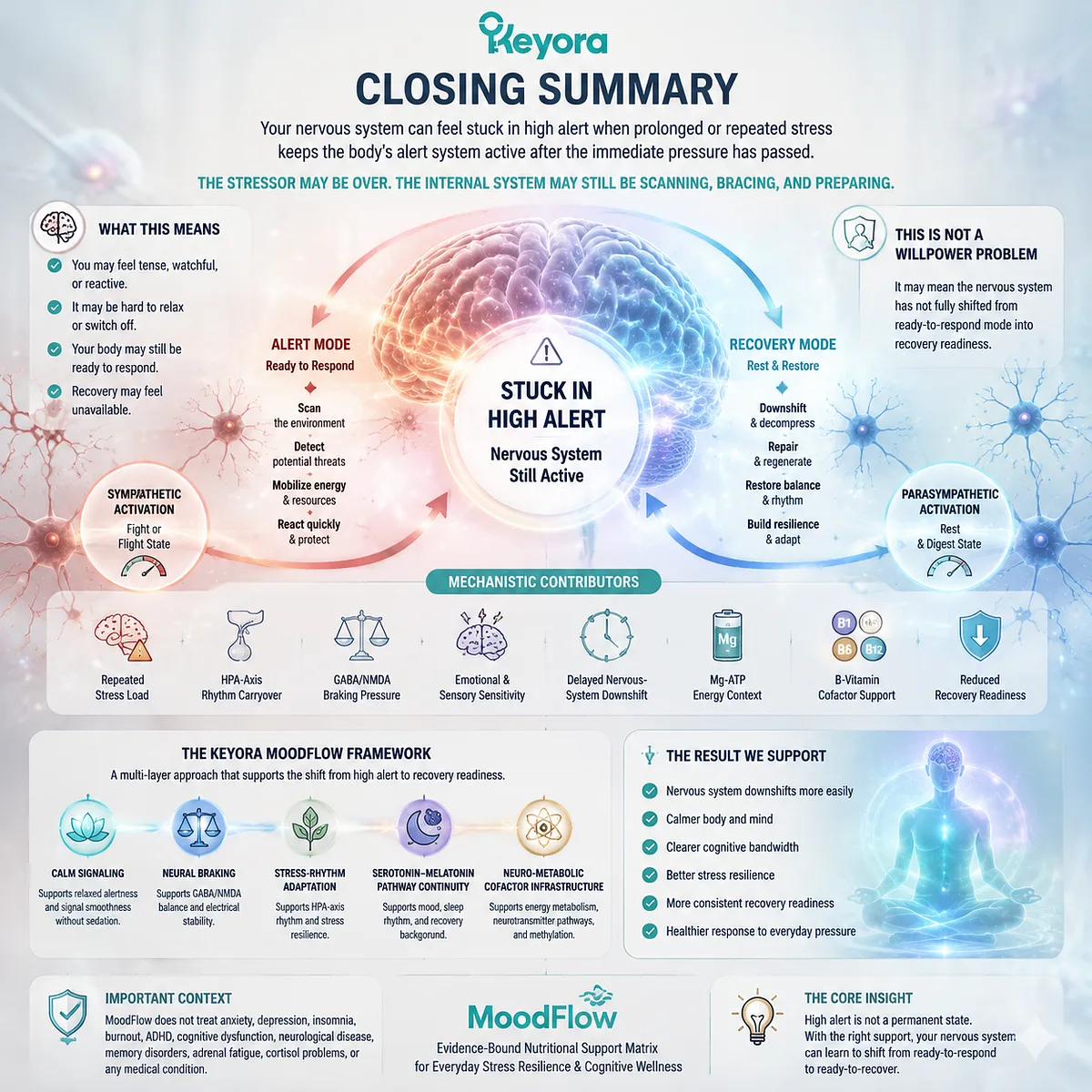
Your nervous system can feel stuck in high alert when prolonged or repeated stress keeps the body’s alert system active after the immediate pressure has passed. The stressor may be over, but the internal system may still be scanning, bracing, and preparing.
This does not always mean something is wrong with your willpower or mindset. It may mean the nervous system has not fully shifted from ready-to-respond mode into recovery readiness.
Mechanistically, this high-alert feeling may involve repeated stress load, sympathetic activation, HPA-axis rhythm carryover, GABA/NMDA braking pressure, emotional and sensory sensitivity, delayed nervous-system downshift, Mg-ATP energy context, B-vitamin cofactor support, and reduced recovery readiness.
In the Keyora MoodFlow framework, this is understood as a stress-resilience, nervous-system downshift, and cognitive-resilience question. MoodFlow supports this picture through calm signaling, neural braking, stress-rhythm adaptation, serotonin-melatonin pathway continuity, and neuro-metabolic cofactor infrastructure.
MoodFlow does not treat anxiety, depression, insomnia, burnout, ADHD, cognitive dysfunction, neurological disease, memory disorders, adrenal fatigue, cortisol problems, or any medical condition. It is an evidence-bound nutritional support matrix for everyday stress resilience and cognitive wellness.
This article is for educational and informational purposes only. It does not provide medical advice, diagnosis, treatment, cure, prevention, disease outcome claims, hormone restoration claims, fertility outcome claims, or formula-specific clinical efficacy claims.