
Why Do I Feel Mentally Exhausted Even When I Haven’t Done Much?
Keyora Research Q&A Library
This is part of the Keyora Research Q&A Series, derived from Keyora Nutritional Neurology Seriers .
Within the Keyora Nutritional Neurology framework, this Q&A translates complex nutrient–brain mechanisms into reader-friendly, evidence-bound answers, focusing on stress resilience, sleep quality, calm mood support, cognitive wellness, and the broader interaction between nutrition, neurochemistry, and daily nervous-system function.
First published by Keyora Research Journal: www.keyorahealth.com

Direct Answer
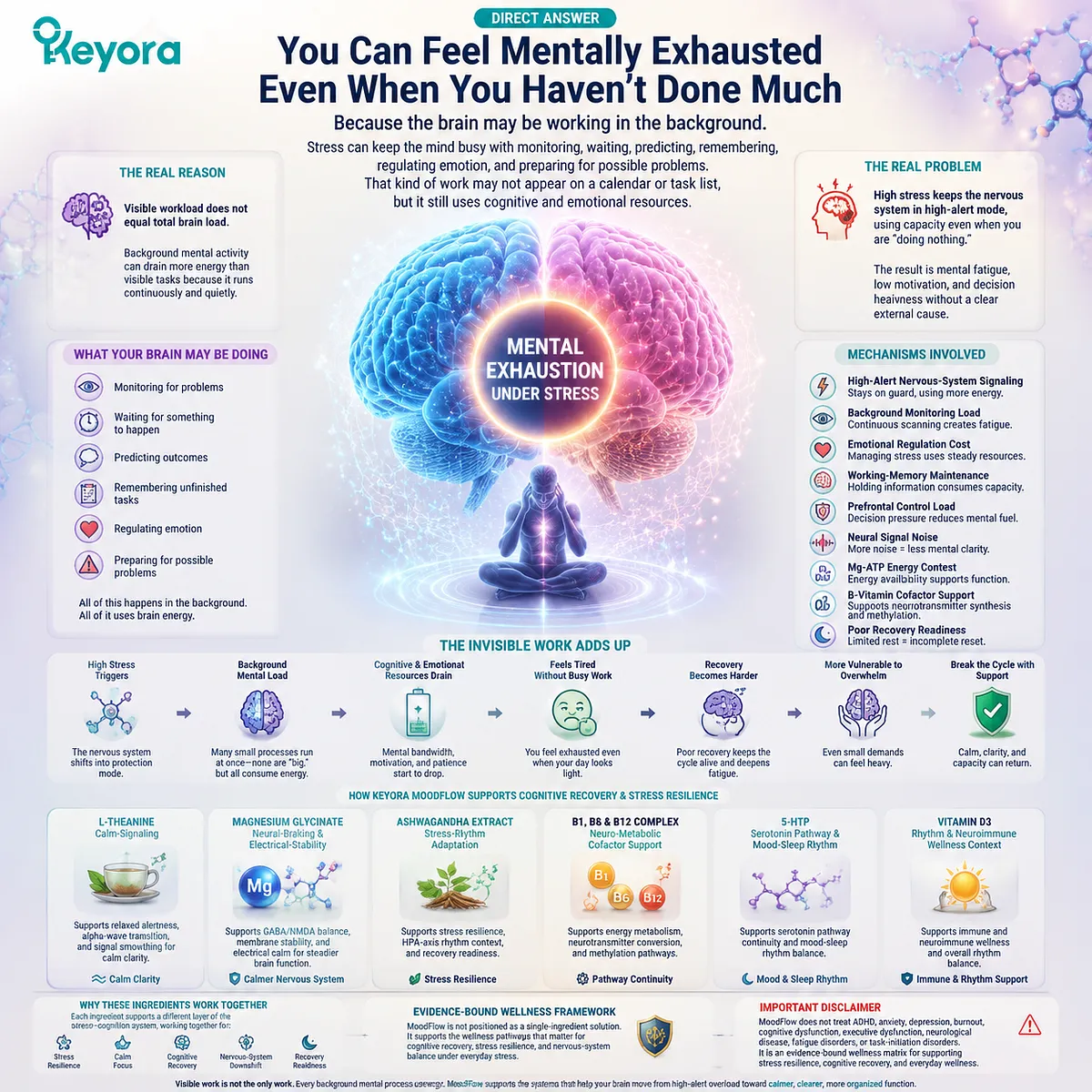
You can feel mentally exhausted even when you have not done much visible work because the brain may still be working in the background. Stress can keep the mind busy with monitoring, waiting, predicting, remembering, regulating emotion, and preparing for possible problems.
That kind of work may not appear on a calendar or task list, but it still uses cognitive and emotional resources.
The problem is not always how much you completed. The problem is that visible workload does not equal total brain load.
Mechanistically, mental exhaustion under stress can involve high-alert nervous-system signaling, background monitoring, emotional regulation cost, working-memory maintenance, prefrontal control load, neural signal noise, Mg-ATP energy context, B-vitamin cofactor support, and poor recovery readiness.
In the Keyora MoodFlow framework, this is understood as a cognitive-recovery and stress-load question, not a medical treatment claim.
Why You Can Feel Drained Without Doing Much
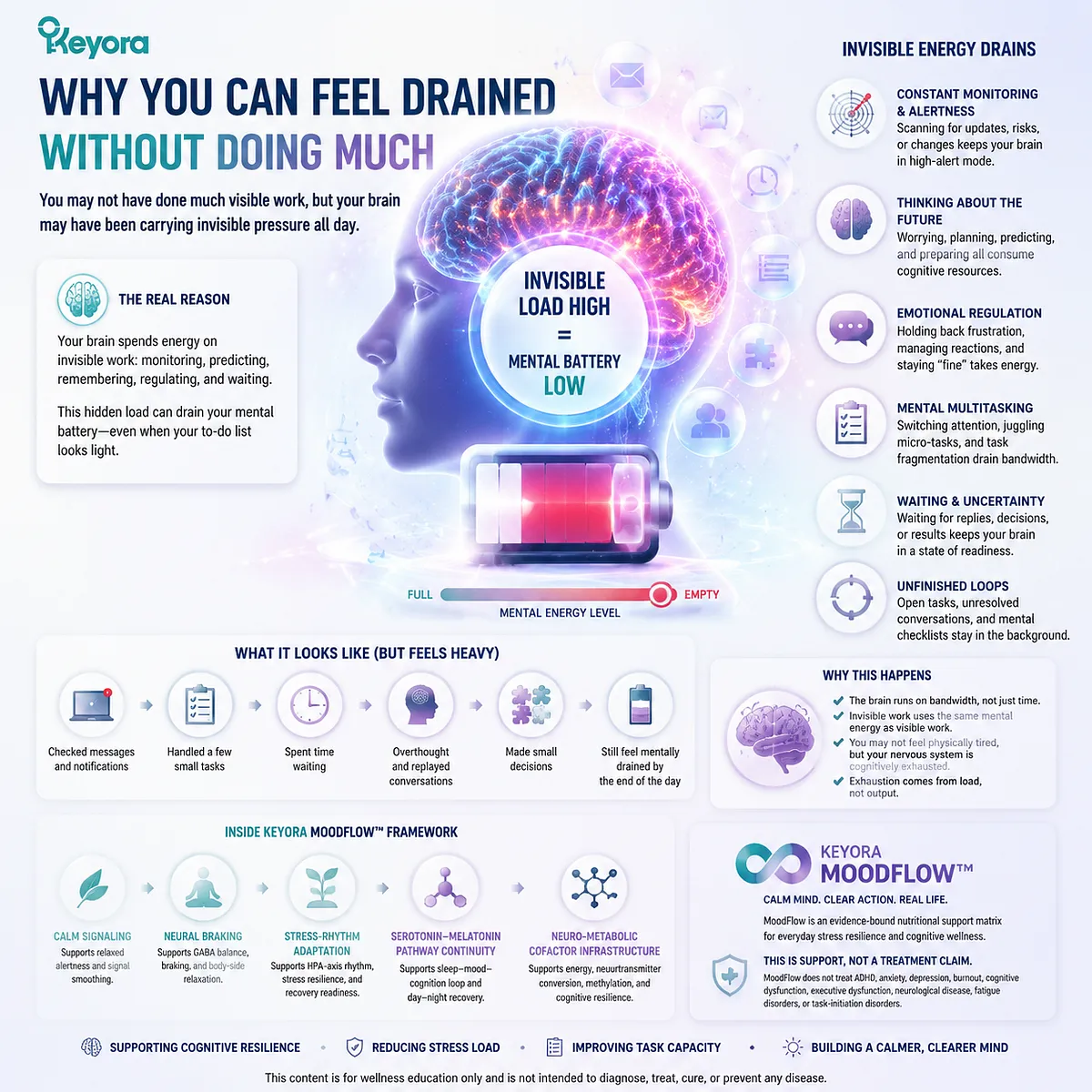
You may not have done much visible work, but your brain may have been carrying invisible pressure all day.
Mental exhaustion can feel confusing when there is not much to show for it.
You may look back at the day and think, “I didn’t really do that much. Why am I so tired?” Maybe you answered a few messages, checked notifications, sat at your computer, waited for updates, thought about what needed to be done, and handled a few small tasks. Nothing looked dramatic from the outside.
But by evening, your brain feels heavy.
You may feel like you cannot take in one more message. You may feel too drained to make plans, answer simple questions, or decide what to do next. You may not feel physically exhausted in the usual sense, but mentally, it feels as if the system is running low.
This is where many people misunderstand mental exhaustion.
They assume fatigue should match visible output. If they did not finish a major project, study for hours, attend back-to-back meetings, or complete a demanding workout, they feel they have no reason to be tired.
But the brain does not only spend energy on visible work.
It also spends energy on invisible processing.
Stress can make the brain monitor unfinished tasks, predict future problems, replay conversations, prepare for possible conflict, wait for responses, suppress frustration, and hold open mental loops. None of this may look productive, but it still keeps the nervous system active.
You may not have been doing nothing. You may have been mentally preparing, emotionally regulating, and staying on alert.
That difference matters.
A person can spend a whole day in a state of low-grade pressure without completing much. They may feel stuck between working and resting. They are not deeply focused, but they are also not truly relaxed. They are watching the inbox, thinking about deadlines, checking whether someone replied, remembering unfinished obligations, and trying to decide what to handle next.
That is not recovery. It is background load.
This is why mentally exhausted people often say, “I didn’t do anything, but I’m drained.” What they often mean is, “I didn’t produce much, but my brain never felt off-duty.”
The exhaustion may come from waiting. Waiting for feedback, waiting for a decision, waiting for results, waiting for someone’s mood to change, or waiting for the next problem to appear can be surprisingly draining. The body may look still, but the brain remains prepared.
The exhaustion may also come from emotional control.
Holding back irritation, staying polite, not reacting too strongly, hiding worry, staying functional, and trying to look fine can all use mental resources. Emotional regulation is not passive. It is active control.
This is why mental exhaustion often appears after days filled with uncertainty, interruptions, social pressure, responsibility, or unresolved tasks. The workload may not be physically large, but the cognitive-emotional load may be high.
In everyday terms, visible work is only one part of the story.
The hidden part is what your brain had to keep open all day.
The Hidden Stress Processing Behind Mental Exhaustion
Stress can keep the brain working in the background even when the body looks inactive.
Mental exhaustion under stress often begins with background monitoring.
Background monitoring is the brain’s habit of keeping track of possible problems even when you are not actively solving them. It may sound like an internal checklist that never closes. What have I forgotten? Who is waiting for me? What happens if this goes wrong? What should I do next? Why am I not further ahead?
When stress is high, the nervous system may shift toward a high-alert state. In that state, the brain becomes more sensitive to signals of risk, delay, conflict, or uncertainty. This can make the mind feel busy even when the body is sitting still.
That background alertness can be useful in short bursts. It helps people respond quickly when something truly needs attention. But when it stays active for too long, it can become tiring.
The brain is not fully resting. It is scanning.
Working memory is one reason this becomes exhausting.
Working memory is the temporary mental workspace that holds active information. It is where the brain keeps reminders, unfinished tasks, decisions, social concerns, and short-term plans. When stress keeps many items open at once, working memory can become crowded.
You may not be doing the task, but part of your brain may still be holding it.
That is why unfinished tasks can feel so tiring. They remain mentally active. Even when you are not working on them, they may continue to occupy space. The brain keeps checking whether they are done, whether they matter, and whether they might become urgent.
This hidden maintenance load can make a low-output day feel heavy.
Emotional regulation adds another layer.
When a person is under stress, they may spend the day managing reactions. They may avoid sounding impatient, push through disappointment, contain anxiety-like tension, stay calm during uncertainty, or keep functioning even when they feel overwhelmed. These processes may be invisible to others, but they require control.
The prefrontal cortex is heavily involved in that kind of control. In simple terms, it helps with planning, self-monitoring, prioritizing, impulse control, and flexible thinking. Under stress, this control system may be asked to do too much at once.
It has to keep track of tasks. It has to regulate emotion. It has to avoid distraction. It has to choose what matters. It has to suppress unhelpful reactions. It has to keep the person socially functional.
That kind of control load can feel like mental fatigue.
This is why doing less is not the same as recovering.
A person may spend the afternoon scrolling, checking messages, switching between tabs, and thinking about what they should do. From the outside, it may look like rest. But internally, the brain may still be processing pressure, comparing tasks, monitoring notifications, and feeling guilty for not making progress.
That is not the same as true recovery readiness.
Stress can also increase neural signal noise.
In consumer-friendly terms, the brain needs a workable balance between activation and braking. GABA-related calming tone and NMDA/glutamate activation balance help explain why the brain can feel either steady or overstimulated. When activation remains high, the mind may feel busy, tense, and hard to settle.
A noisy nervous-system background can make even quiet time feel unrestful.
Neuro-metabolic context also matters. Cognitive control, emotional regulation, attention switching, and stress adaptation require energy. Magnesium’s role in Mg-ATP context and B vitamins’ role as cofactor infrastructure help explain why mental exhaustion is not only an emotional experience. The brain’s support systems include both signaling balance and metabolic readiness.
This does not mean mental exhaustion is always caused by nutrient status. It means that stress-related cognitive fatigue can be understood as a multi-layer wellness question.
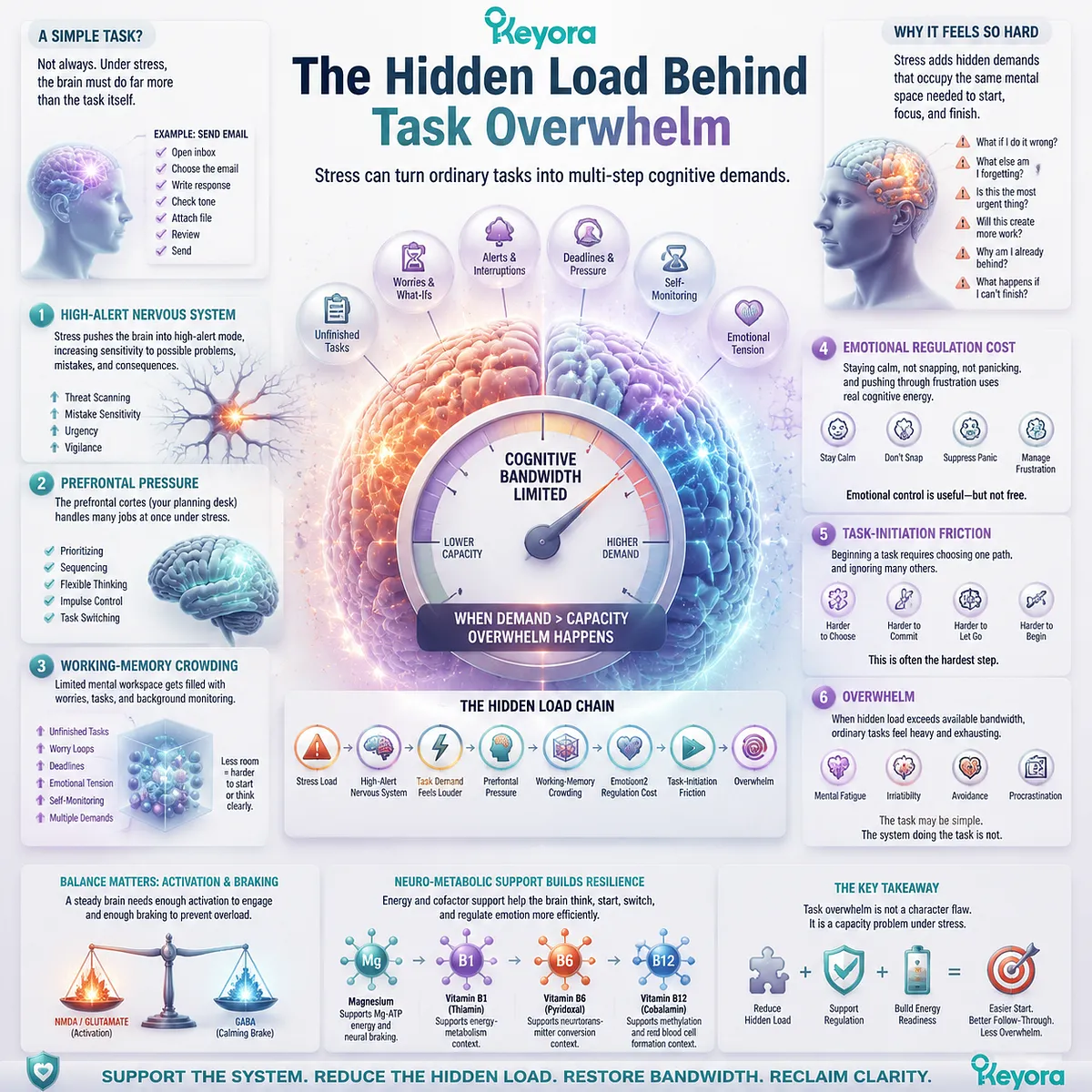
The key mechanism chain is:
stress load → high-alert nervous system → background monitoring → emotional regulation cost → working-memory maintenance → prefrontal control load → neuro-metabolic energy demand → mental exhaustion → poor recovery readiness
In plain language, your brain may feel tired because it has been running background programs all day.
Even if the visible workload was low, the hidden workload may have been high.
How MoodFlow Supports Mental Recovery Readiness
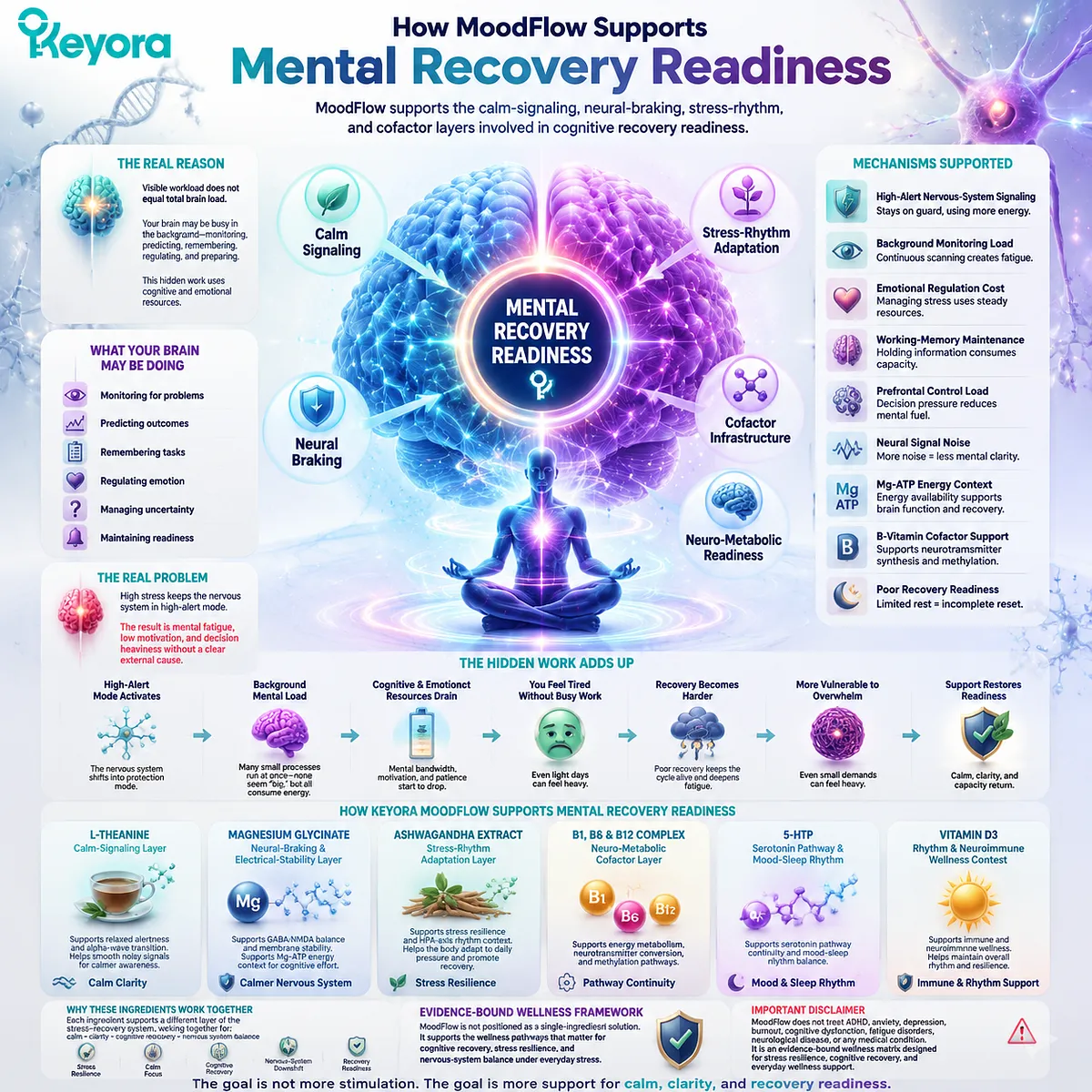
MoodFlow supports the calm-signaling, neural-braking, stress-rhythm, and cofactor layers involved in cognitive recovery readiness.
Keyora MoodFlow approaches stress-related mental exhaustion as a cognitive-recovery and stress-load question.
The goal is not to force stimulation. The goal is not to make the brain ignore pressure. The goal is to support the wellness pathways that help the nervous system move from background alertness toward calmer, steadier recovery readiness.
This distinction is important.
When people feel mentally exhausted, they often reach for more stimulation. More caffeine, more pressure, more urgency, more self-criticism, and more forced productivity may create a short-term push. But if the nervous system is already overloaded, stimulation alone may not solve the underlying pattern.
The deeper question is whether the brain has enough support for calm signaling, neural braking, stress-rhythm adaptation, and neuro-metabolic cofactor context.
L-Theanine supports the calm-signaling layer.
In the MoodFlow framework, L-Theanine is associated with relaxed alertness, alpha-wave transition, and signal smoothing. This is useful for mental exhaustion because the problem is not always lack of alertness. Many mentally exhausted people are still alert. They may be too alert, too reactive, or too unable to fully downshift.
L-Theanine helps explain the idea of calmer awareness. The brain does not need to be shut down. It needs a smoother signal environment where attention, emotion, and recovery can feel less pressured.
This makes L-Theanine especially relevant to the difference between stimulation and calm focus.
Magnesium glycinate supports the neural-braking and electrical-stability layer.
Magnesium is connected with GABA/NMDA activation balance, membrane excitability, and Mg-ATP energy context. In MoodFlow, magnesium glycinate is positioned as a neural braking and hardware-stabilizing layer, not as a generic magnesium supplement.
For mental exhaustion, this matters because long periods of hidden stress processing can make the nervous system feel electrically loud. Even when the body is still, the brain may remain activated. A steadier braking background can help explain why recovery readiness depends on more than stopping visible work.
Magnesium’s Mg-ATP context also supports the idea that cognitive effort requires an energy background. Mental exhaustion is not only about mood. It also involves the metabolic cost of attention control, emotional regulation, and stress adaptation.
Ashwagandha supports the stress-rhythm adaptation layer.
Stress-related mental exhaustion often builds across time. It may reflect a day, a week, or a longer pattern of staying prepared, responsible, and emotionally controlled. The issue is not always one stressful event. It may be the rhythm of stress that keeps the system from fully returning to a recovery-ready state.
Ashwagandha is positioned in MoodFlow around stress resilience, HPA-axis rhythm context, and recovery readiness. In this article, that does not mean Ashwagandha treats burnout, fixes cortisol, or repairs stress dysfunction. It means Ashwagandha belongs to the stress-adaptation layer of the formula’s wellness logic.
B1, B6, and B12 support the neuro-metabolic cofactor layer.
Mental recovery depends partly on the brain’s normal metabolic and neurotransmitter-related infrastructure. B1 supports energy-metabolism context. B6 supports neurotransmitter-related conversion context, including pathways relevant to calming and mood-related signaling. B12 supports methylation context and nervous-system maintenance.
In MoodFlow, these B vitamins are not positioned as a cure for fatigue or cognitive dysfunction. They are part of the cofactor infrastructure behind normal brain function, cognitive resilience, and stress-related pathway support.
5-HTP plays a background role in this article.
Because this article is mental-exhaustion-first, 5-HTP should not dominate the explanation. Its role is better understood as support for serotonin-melatonin pathway continuity and mood-sleep rhythm background within the broader MoodFlow architecture. A steadier mood-sleep rhythm context may matter for cognitive recovery, but this article is not about treating insomnia, depression, or serotonin deficiency.
Vitamin D may also be understood as part of the broader rhythm and neuroimmune wellness context when relevant, but it should remain secondary here.
Together, these layers explain why MoodFlow is not positioned as an energy drink, stimulant, sedative, or single-ingredient fatigue solution. It is a multi-layer nutritional neurology matrix designed to support stress resilience, calm focus, cognitive resilience, nervous-system downshift, and recovery readiness within an evidence-bound wellness framework.
MoodFlow is not a treatment for fatigue disorders, burnout, depression, anxiety, ADHD, cognitive dysfunction, memory disorders, neurological disease, or any medical condition. In this article, Keyora uses mental exhaustion as a wellness-language entry point for explaining stress load, hidden cognitive-emotional processing, neural braking, calm signaling, and neuro-metabolic support under everyday pressure.
Closing Summary
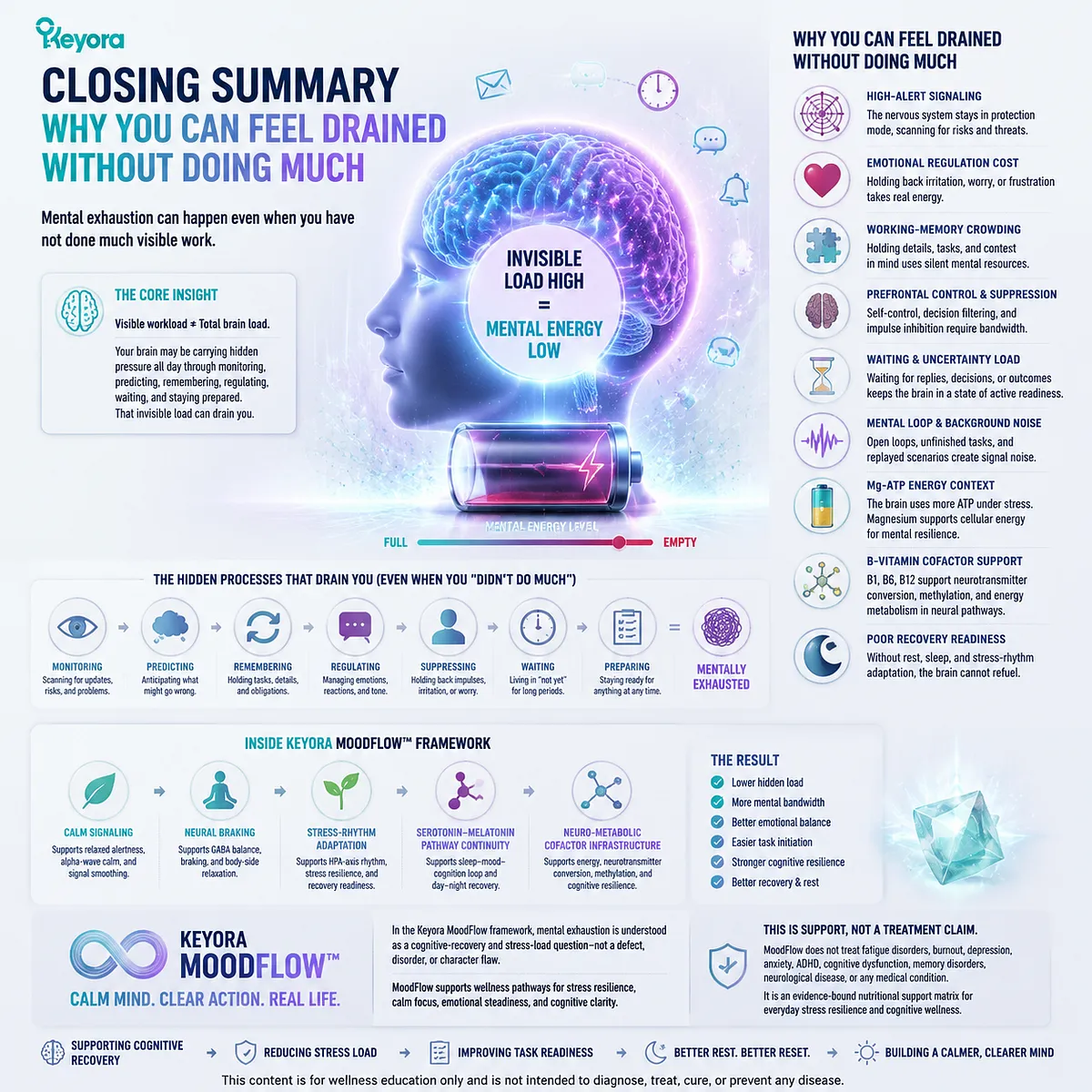
Mental exhaustion can happen even when you have not done much visible work because the brain may still be carrying hidden load. Stress can keep the mind busy with background monitoring, emotional regulation, working-memory maintenance, prefrontal control, and readiness for possible problems.
This is why visible workload does not always match total brain load.
You may not have completed many tasks, but your brain may have spent the day scanning, waiting, predicting, remembering, suppressing reactions, and trying to stay prepared. That invisible processing can be draining.
Mechanistically, stress-related mental exhaustion may involve high-alert nervous-system signaling, emotional regulation cost, working-memory crowding, neural signal noise, Mg-ATP energy context, B-vitamin cofactor support, and poor recovery readiness.
In the Keyora MoodFlow framework, this is a cognitive-recovery and stress-load question. MoodFlow supports this picture through calm signaling, neural braking, stress-rhythm adaptation, serotonin-melatonin pathway continuity, and neuro-metabolic cofactor infrastructure.
MoodFlow does not treat fatigue disorders, burnout, depression, anxiety, ADHD, cognitive dysfunction, memory disorders, neurological disease, or any medical condition. It is an evidence-bound nutritional support matrix for everyday stress resilience and cognitive wellness.
This article is for educational and informational purposes only. It does not provide medical advice, diagnosis, treatment, cure, prevention, disease outcome claims, hormone restoration claims, fertility outcome claims, or formula-specific clinical efficacy claims.