
Why Can’t I Focus When I’m Stressed?
Keyora Research Q&A Library
This is part of the Keyora Research Q&A Series, derived from Keyora Nutritional Neurology Seriers .
Within the Keyora Nutritional Neurology framework, this Q&A translates complex nutrient–brain mechanisms into reader-friendly, evidence-bound answers, focusing on stress resilience, sleep quality, calm mood support, cognitive wellness, and the broader interaction between nutrition, neurochemistry, and daily nervous-system function.
First published by Keyora Research Journal: www.keyorahealth.com

Direct Answer
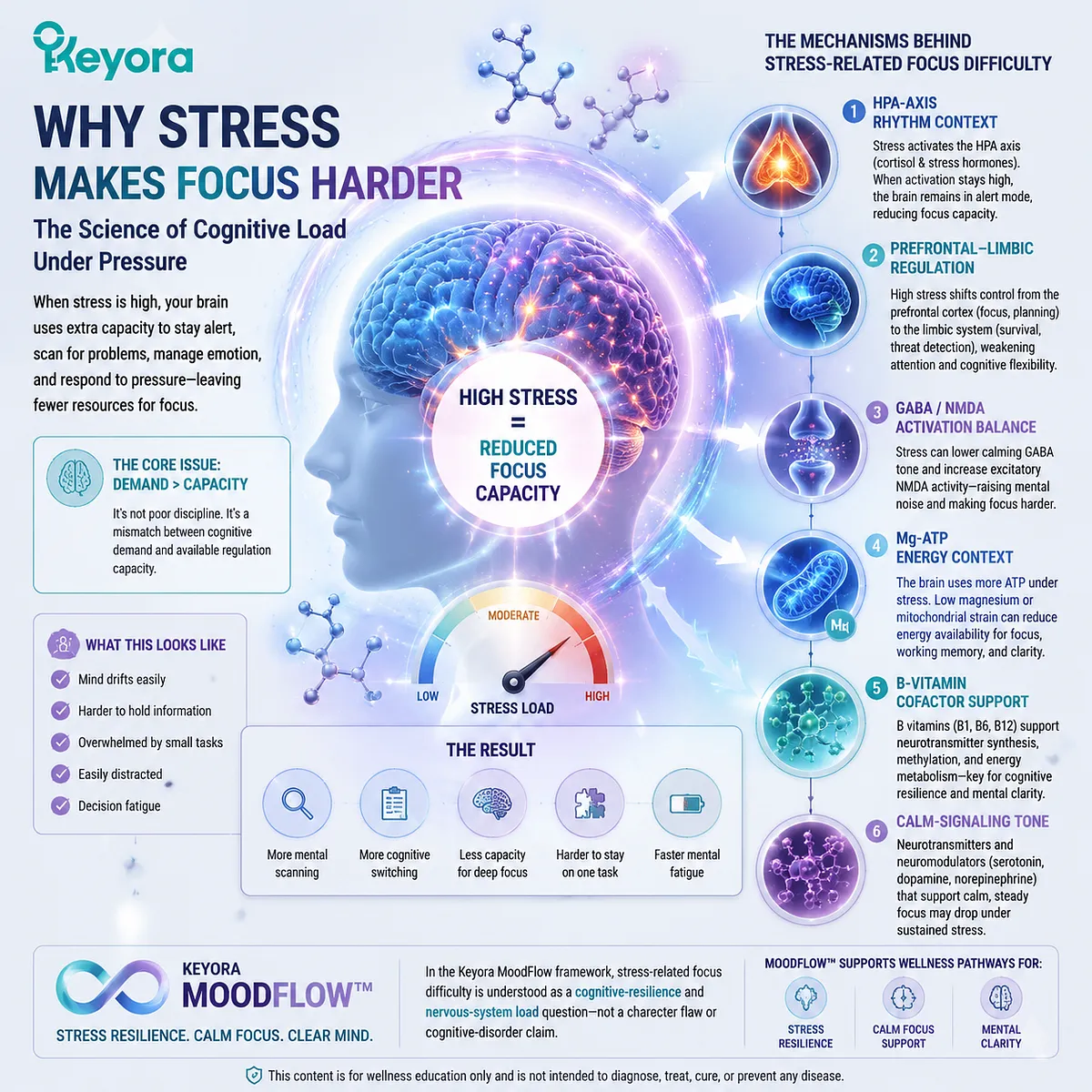
You may find it hard to focus when stressed because the brain is using extra capacity to stay alert, scan for problems, manage emotion, and respond to pressure. The core issue is not simply poor discipline. It may be a mismatch between cognitive demand and available regulation capacity.
When stress load is high, the brain has fewer resources left for sustained attention, working memory, and flexible thinking. You may want to focus, but part of your nervous system is still busy tracking risk, urgency, unfinished tasks, or emotional tension.
Mechanistically, this can involve HPA-axis rhythm context, prefrontal-limbic regulation, GABA/NMDA activation balance, Mg-ATP energy context, B-vitamin cofactor support, and calm-signaling tone.
In the Keyora MoodFlow framework, stress-related focus difficulty is understood as a cognitive-resilience and nervous-system load question, not a character flaw or cognitive-disorder claim. MoodFlow supports wellness pathways involved in stress resilience, calm focus, and mental clarity under everyday pressure.
Stress Can Steal Mental Bandwidth
Why focus becomes harder when the brain is already managing pressure.
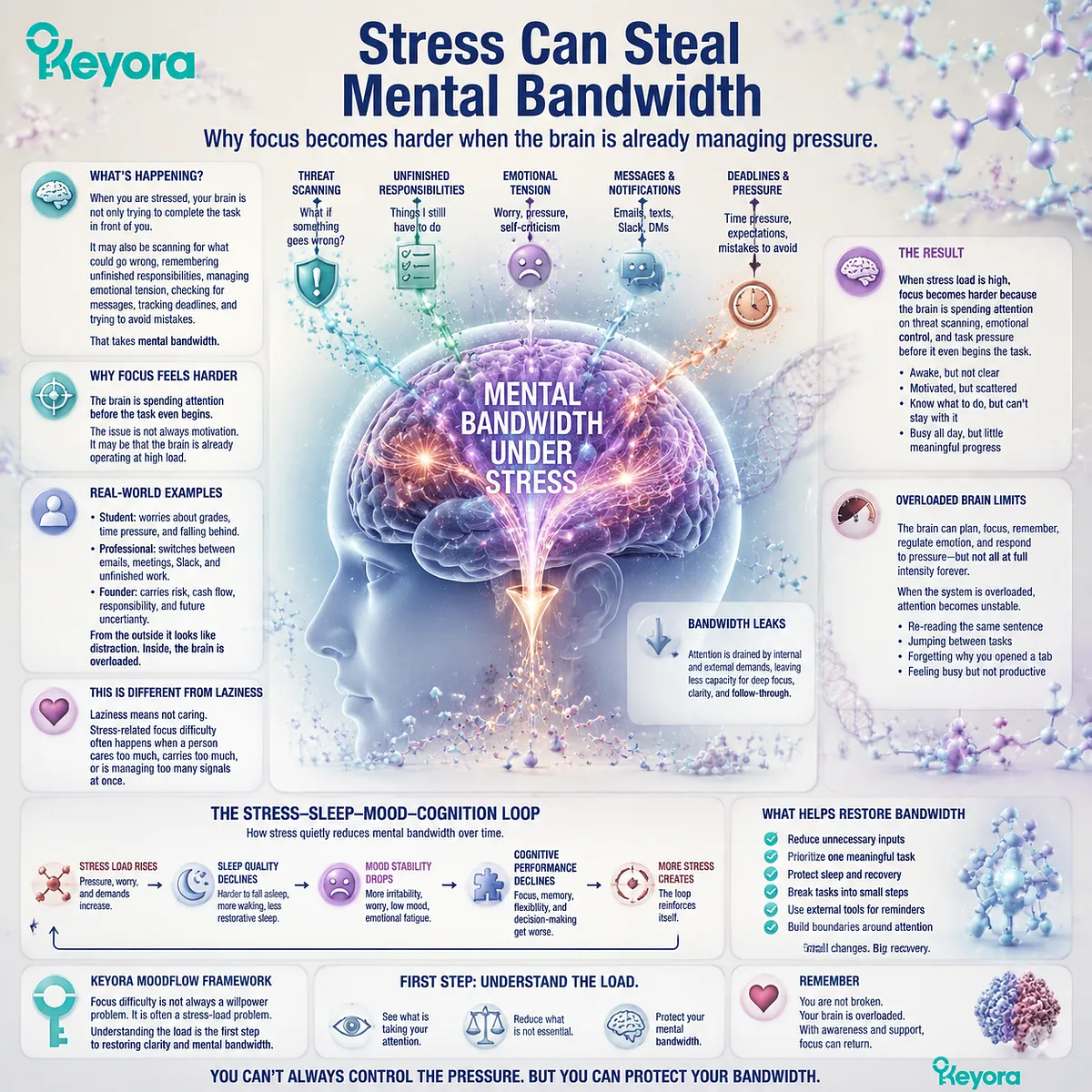
When you are stressed, your brain is not only trying to complete the task in front of you.
It may also be scanning for what could go wrong, remembering unfinished responsibilities, managing emotional tension, checking for messages, tracking deadlines, and trying to avoid mistakes.
That takes mental bandwidth.
This is why stress can make focus feel harder even when you are trying your best. The issue is not always motivation. It may be that the brain is already spending attention before the task even begins.
A student may sit down to study but keep thinking about grades, time pressure, and the fear of falling behind. A professional may open a document but keep switching between emails, meetings, Slack messages, and unfinished decisions. A founder may try to plan clearly while the brain is still carrying risk, cash flow, responsibility, and future uncertainty.
In all of these situations, the person may look distracted from the outside. Inside, the brain is overloaded.
When stress load is high, focus becomes harder because the brain is spending attention on threat scanning, emotional control, and task pressure before it even begins the task.
That is why stress-related focus difficulty can feel so frustrating.
You may be awake, but not clear. You may be motivated, but scattered. You may know what needs to be done, but feel unable to stay with it long enough to finish.
This is different from laziness.
Laziness suggests a person does not care. Stress-related focus difficulty often happens when a person cares too much, carries too much, or is trying to manage too many signals at once.
The brain has limits. It can plan, focus, remember, regulate emotion, and respond to pressure, but it cannot do all of those at full intensity forever.
When the system is overloaded, attention becomes unstable.
You may read the same sentence several times. You may start one task, jump to another, then forget why you opened a tab. You may feel busy all day but still feel like nothing meaningful was completed.
This is the mental-bandwidth problem.
In the Keyora MoodFlow framework, this type of focus difficulty belongs to the stress-sleep-mood-cognition loop. Stress does not only affect how you feel emotionally. It can also affect how clearly the brain can organize attention, hold information, and move through work.
That is why the first step is not self-blame.
The first step is understanding the load.
Why Stress Makes Concentration Feel Unstable
How high-alert signaling, prefrontal load, and GABA/NMDA balance affect attention control.
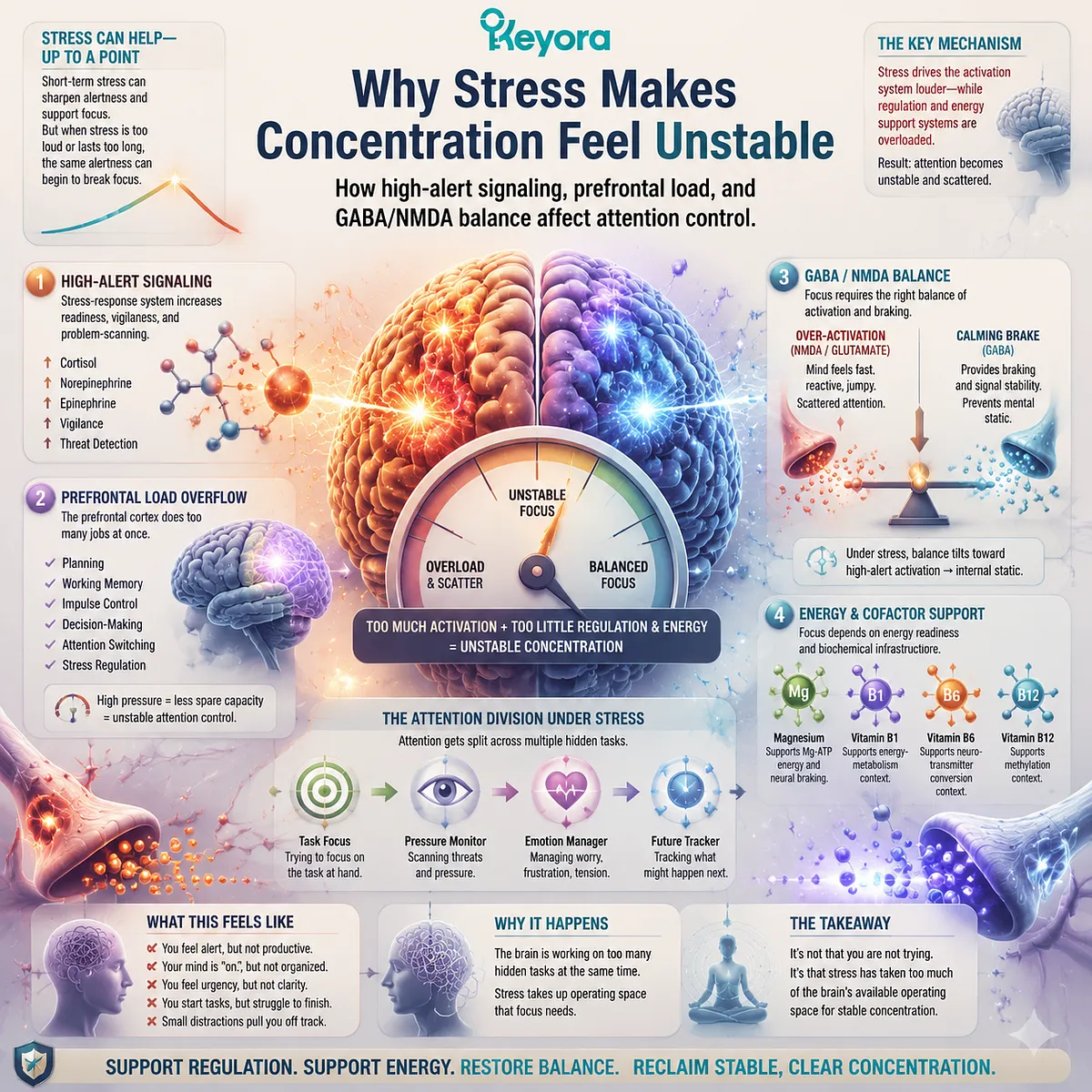
Stress can support focus in the short term. A deadline, competition, or urgent moment can make the brain more alert.
But there is a limit.
When stress becomes too loud or lasts too long, the same alertness that helped you respond can begin to interfere with concentration.
The stress-response system is designed to prepare the body for demand. It helps with readiness, energy mobilization, vigilance, and quick response. That is useful when the challenge is brief.
But if the brain stays in problem-scanning mode, attention becomes divided.
Part of the brain is trying to focus on the task. Another part is still monitoring pressure. Another part is managing emotion. Another part is tracking what might happen next.
This is where prefrontal load becomes important.
The prefrontal cortex helps with planning, working memory, impulse control, decision-making, and attention switching. It is the part of the brain that helps you hold a goal in mind and stay with it.
But the same system also helps regulate pressure.
The part of the brain that helps you focus is also the part that helps you regulate stress. When pressure is high, that system has to do too many jobs at once.
This is why concentration can feel unstable under stress.
It is not that the brain has stopped working. It is that the brain is working on too many hidden tasks at the same time.
GABA/NMDA balance also helps explain the pattern.
The brain needs activation to focus. If activation is too low, attention may feel dull. But if activation is too high, attention can become scattered. The mind may feel fast, reactive, and jumpy.
GABA can be understood as part of the calming brake context. NMDA and glutamate-related signaling belong more to the activation side. A focused brain needs both: enough activation to stay awake, and enough braking to prevent the system from becoming noisy.
Stress can tilt this balance toward high-alert activation.
That does not always create better performance. Sometimes it creates internal static.
You may feel like your brain is “on,” but not organized. You may feel alert, but not productive. You may feel urgency, but not clarity.
Energy context matters too.
Focus requires energy readiness. Working memory, decision-making, attention control, and emotional regulation all depend on the brain having enough background support to process information efficiently.
This is where Mg-ATP and B-vitamin cofactor context become relevant.
Magnesium helps explain Mg-ATP energy background and neural braking context. B1 supports energy-metabolism context. B6 supports neurotransmitter-related conversion context. B12 supports methylation context.
These are not instant focus switches. They are part of the infrastructure that helps explain why the brain may feel less resilient under stress when the load is high.
Stress-related focus difficulty often happens when the brain’s activation system is loud, but its regulation and energy-support systems are under load.
That is the key mechanism.
The problem is not that you are not trying.
The problem may be that stress has taken too much of the brain’s available operating space.
How MoodFlow Supports Calm Focus Under Stress
Why calm signaling, neural braking, stress-rhythm adaptation, and cofactor support matter for mental clarity.
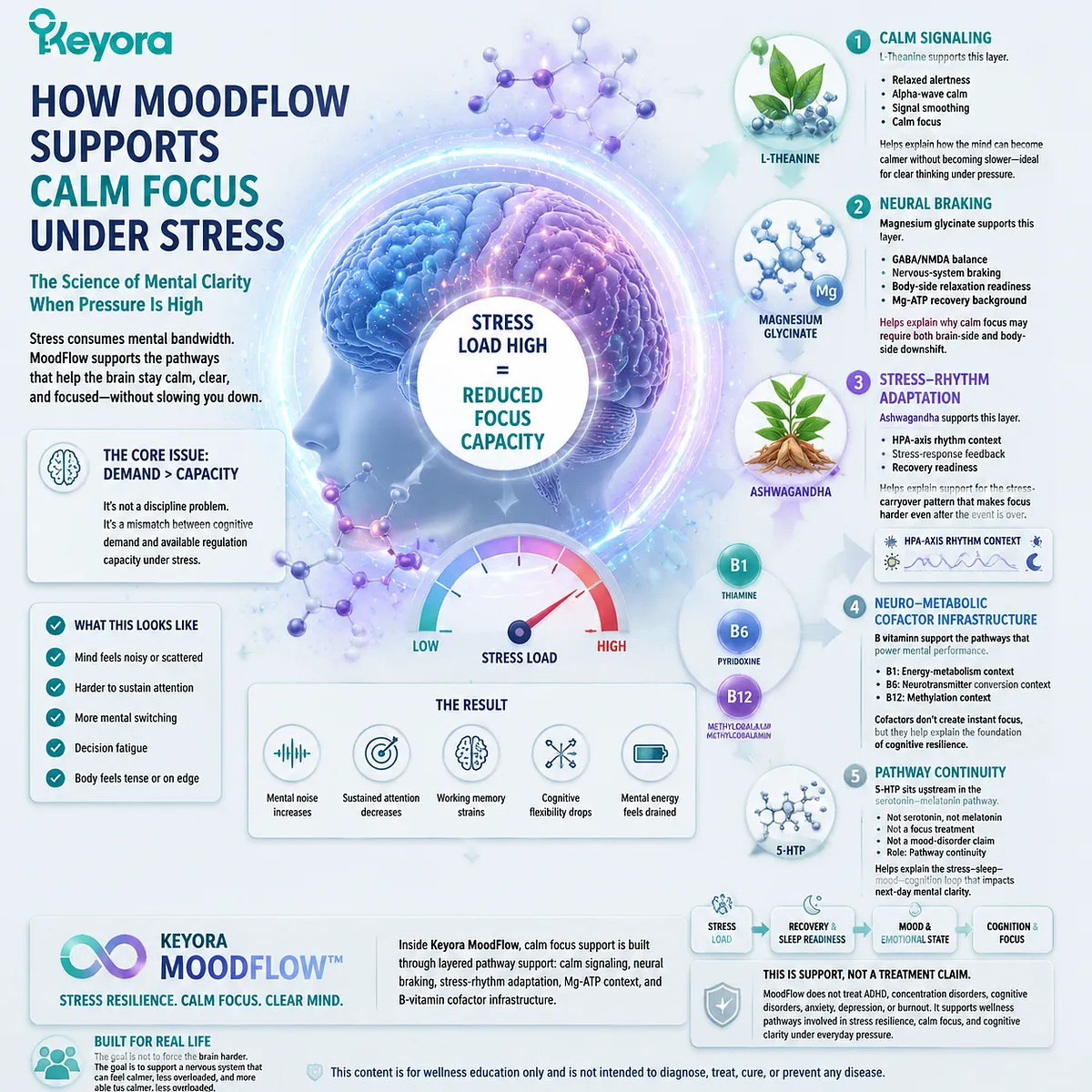
MoodFlow supports calm focus under stress by addressing several wellness pathways involved in cognitive resilience.
The first layer is calm signaling.
L-Theanine supports this layer. It helps explain relaxed alertness, alpha-wave calm, signal smoothing, and calm focus. This matters because stress-related focus difficulty often feels like a noisy mind, not a sleepy mind.
L-Theanine helps explain how the mind can become calmer without becoming slower.
That is important for students, professionals, founders, and high-load adults who need clarity under pressure. The goal is not to become drowsy. The goal is to reduce excess mental noise while preserving useful alertness.
The second layer is neural braking.
Magnesium glycinate supports this layer. It helps explain GABA/NMDA context, nervous-system braking, body-side relaxation readiness, and Mg-ATP recovery background.
This matters because focus is not only a mental event. The body can carry stress through tension, restlessness, shallow breathing, and internal urgency. When the body remains in readiness mode, the mind may find it harder to stay steady.
Magnesium glycinate helps explain why calm focus may require both brain-side and body-side downshift.
The third layer is stress-rhythm adaptation.
Ashwagandha supports this layer. In MoodFlow language, Ashwagandha helps explain HPA-axis rhythm context, stress-response feedback, and recovery readiness under everyday pressure.
This does not mean Ashwagandha treats stress disorders, burnout, anxiety, or cognitive problems. It means Ashwagandha supports the stress-rhythm layer inside the MoodFlow matrix.
This layer matters because focus often breaks down when stress keeps carrying forward. The meeting ends, but the pressure remains. The exam ends, but the nervous system stays activated. The workday ends, but the mind continues scanning.
Ashwagandha helps explain support for that stress-carryover pattern.
The fourth layer is neuro-metabolic cofactor infrastructure.
B1, B6, and B12 are especially relevant in a focus article. B1 supports energy-metabolism context. B6 supports neurotransmitter-related conversion context. B12 supports methylation context.
These B vitamins do not create instant focus and should not be described as treating attention problems. Their value is quieter but important: they help explain why cognitive resilience depends on cofactor support.
A brain under pressure needs more than motivation. It needs pathways that can support energy readiness, neurotransmitter-related conversion context, and nervous-system maintenance.
The fifth layer is pathway continuity.
5-HTP sits upstream in the serotonin-melatonin pathway. In this article, its role should remain precise. It is not serotonin, not melatonin, not a focus treatment, and not a mood-disorder claim. It helps explain pathway continuity in the stress-sleep-mood-cognition loop.
This matters because poor stress recovery and weak sleep readiness can affect next-day mental clarity. Focus under stress is not isolated from sleep, mood, or recovery.
Inside Keyora MoodFlow, calm focus support is built through layered pathway support: calm signaling, neural braking, stress-rhythm adaptation, Mg-ATP context, and B-vitamin cofactor infrastructure.
This is not a treatment claim.
MoodFlow does not treat ADHD, concentration disorders, cognitive disorders, anxiety, depression, or burnout. It supports wellness pathways involved in stress resilience, calm focus, and cognitive clarity under everyday pressure.
For people who cannot focus when stressed, the goal is not to force the brain harder.
The goal is to support a nervous system that can feel calmer, less overloaded, and more able to use its attention well.
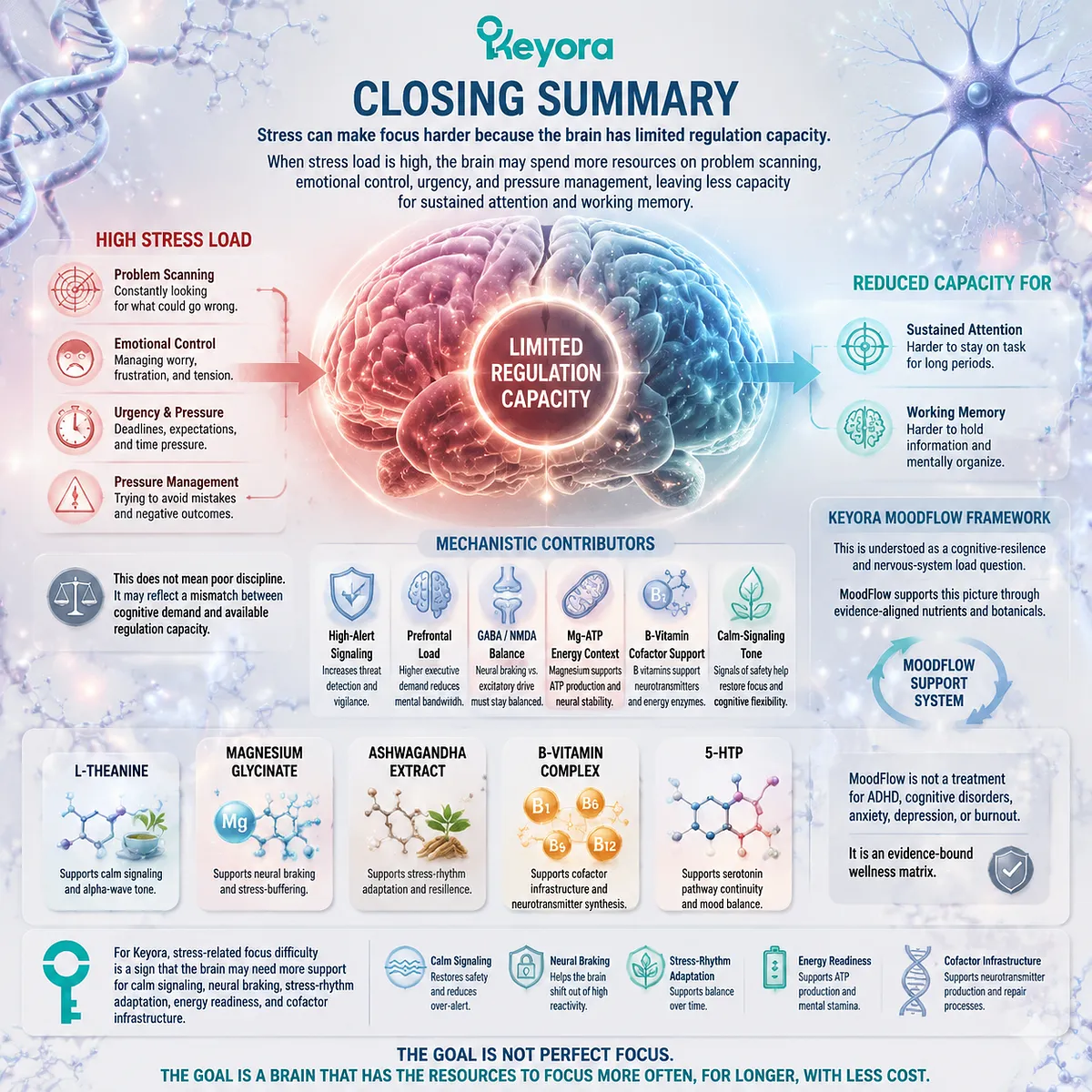
Closing Summary
Stress can make focus harder because the brain has limited regulation capacity. When stress load is high, the brain may spend more resources on problem scanning, emotional control, urgency, and pressure management, leaving less capacity for sustained attention and working memory.
This does not mean poor discipline. It may reflect a mismatch between cognitive demand and available regulation capacity.
Mechanistically, stress-related focus difficulty can involve high-alert signaling, prefrontal load, GABA/NMDA activation balance, Mg-ATP energy context, B-vitamin cofactor support, and calm-signaling tone.
In the Keyora MoodFlow framework, this is understood as a cognitive-resilience and nervous-system load question. MoodFlow supports this picture through L-Theanine for calm signaling, magnesium glycinate for neural braking, Ashwagandha for stress-rhythm adaptation, B vitamins for cofactor infrastructure, and 5-HTP for pathway continuity.
MoodFlow is not a treatment for ADHD, cognitive disorders, anxiety, depression, or burnout. It is an evidence-bound wellness matrix.
For Keyora, stress-related focus difficulty is a sign that the brain may need more support for calm signaling, neural braking, stress-rhythm adaptation, energy readiness, and cofactor infrastructure.
This article is for educational and informational purposes only. It does not provide medical advice, diagnosis, treatment, cure, prevention, disease outcome claims, hormone restoration claims, fertility outcome claims, or formula-specific clinical efficacy claims.