
How Can I Calm My Mind Without Feeling Sleepy or Groggy?
Keyora Research Q&A Library
This is part of the Keyora Research Q&A Series, derived from Keyora Nutritional Neurology Seriers .
Within the Keyora Nutritional Neurology framework, this Q&A translates complex nutrient–brain mechanisms into reader-friendly, evidence-bound answers, focusing on stress resilience, sleep quality, calm mood support, cognitive wellness, and the broader interaction between nutrition, neurochemistry, and daily nervous-system function.
First published by Keyora Research Journal: www.keyorahealth.com

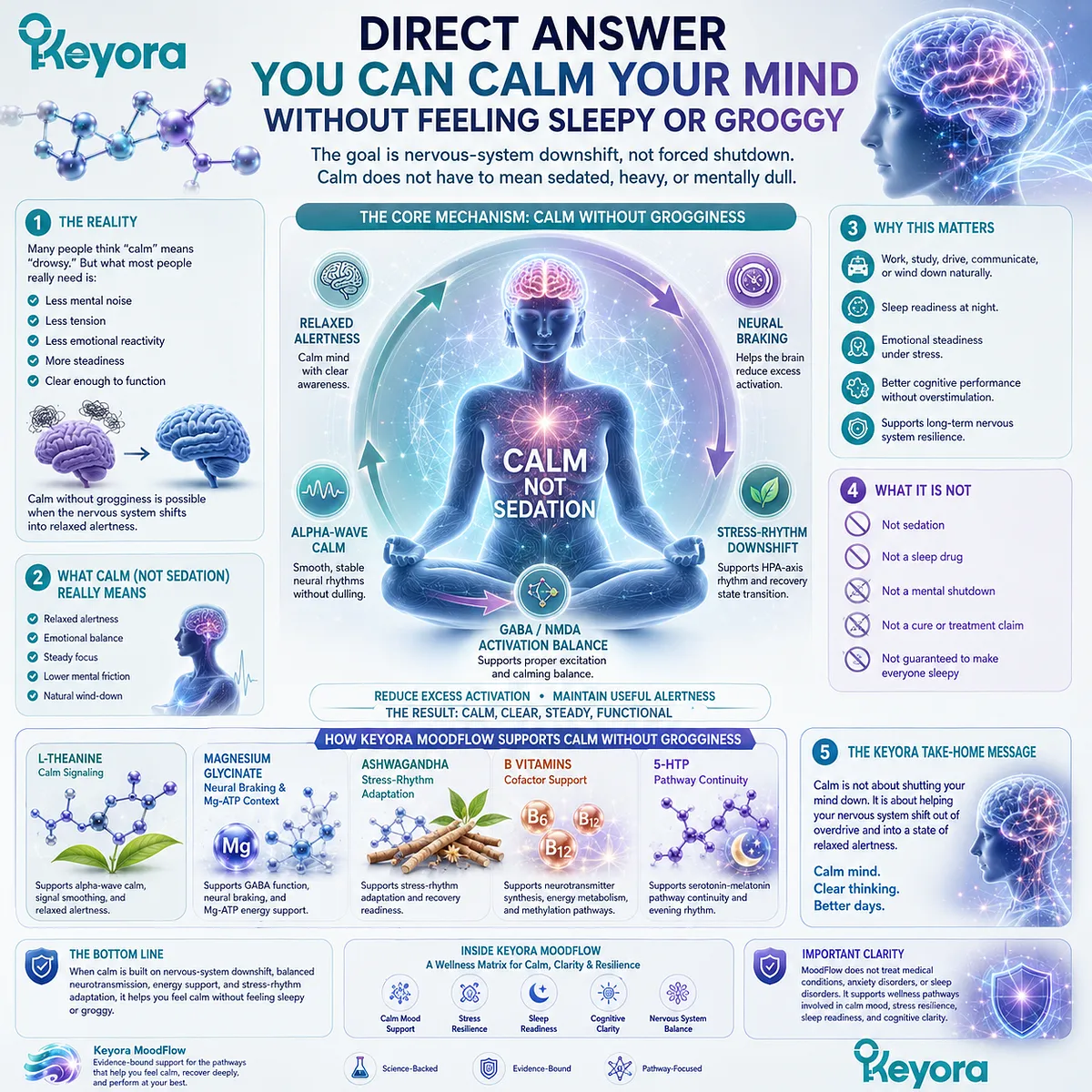
Direct Answer
You can calm your mind without feeling sleepy or groggy when the goal is nervous-system downshift, not forced shutdown. Feeling calm does not have to mean feeling sedated, heavy, slow, or mentally dull.
The core problem is that many people think “calm” means “drowsy.” But in real life, most people need something different: less mental noise, less tension, less emotional reactivity, and better steadiness while still staying clear enough to work, study, drive, communicate, or wind down naturally.
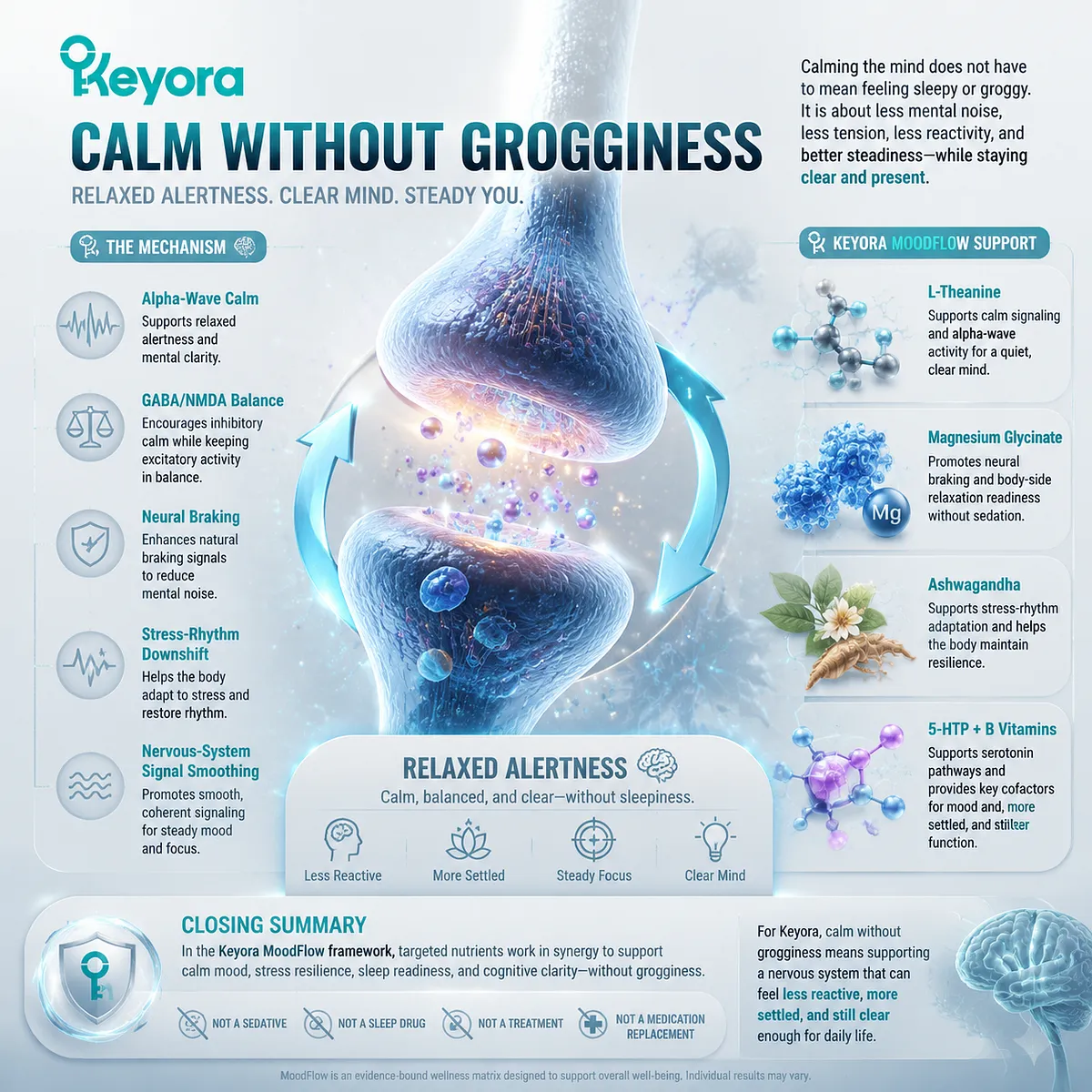
Mechanistically, calm without grogginess depends on relaxed alertness, alpha-wave calm, GABA/NMDA activation balance, neural braking, and stress-rhythm downshift. The nervous system needs to reduce excess activation without losing useful alertness.
In the Keyora MoodFlow framework, this is understood as calm-without-grogginess support: not sedation, not a sleep drug, and not a treatment claim, but support for wellness pathways involved in calm mood, stress resilience, sleep readiness, and cognitive clarity.
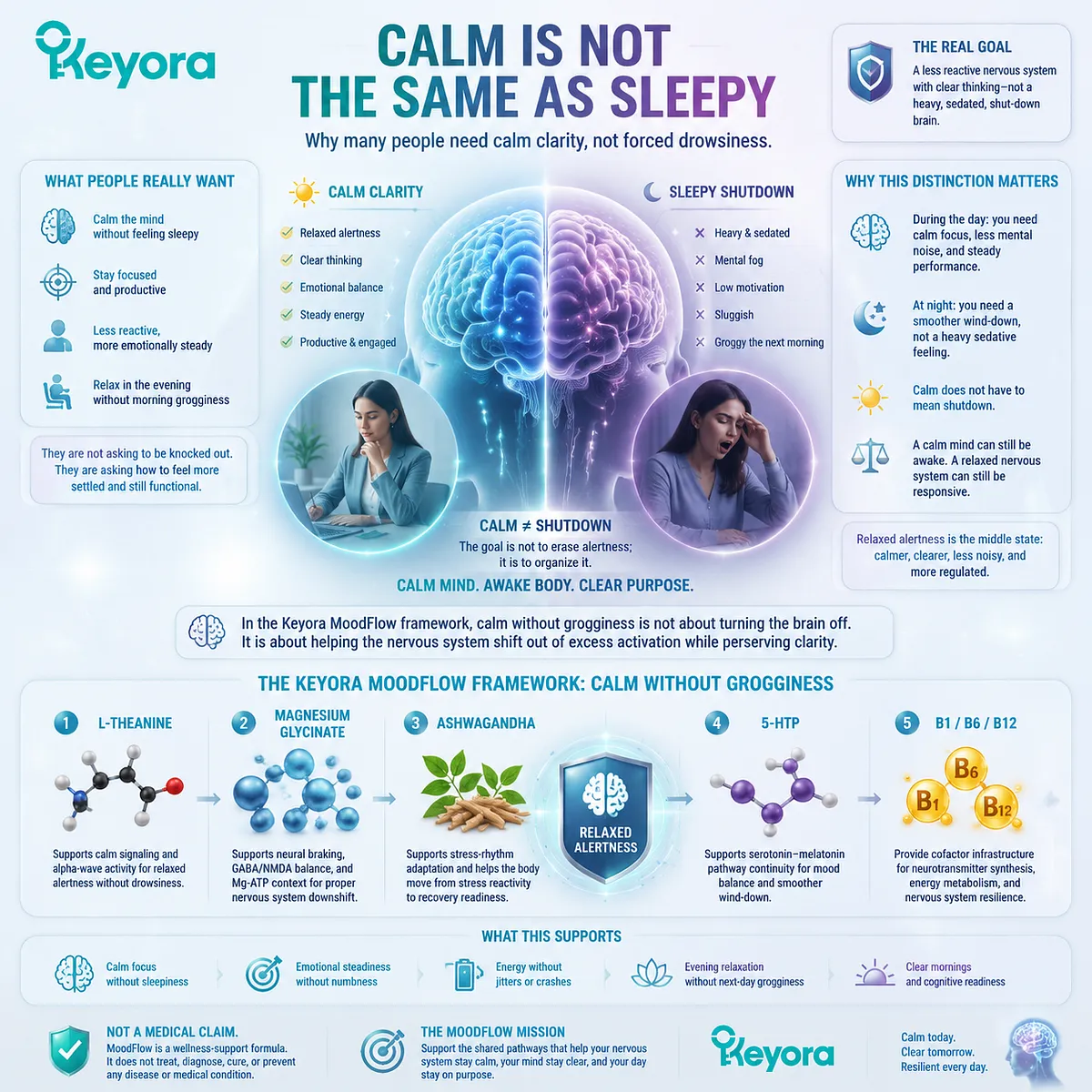
Calm Is Not the Same as Sleepy
Why many people need calm clarity, not forced drowsiness.
Many people want to calm their mind, but they do not want to feel sleepy.
They may need to calm down before a meeting, stay steady during a stressful workday, focus while studying, feel less reactive during family pressure, or relax in the evening without waking up groggy the next morning.
This is an important distinction.
The real goal is not always to make the brain heavier. The real goal is to make the nervous system less reactive while keeping the mind clear.
That is what many people are actually searching for when they type phrases like “how to calm my mind without feeling sleepy,” “calm without drowsiness,” “relax without feeling groggy,” or “stress relief without sedation.”
They are not asking to be knocked out. They are asking how to feel more settled and still functional.
This matters because not every calm-support strategy fits every situation.
During the day, people often need calm focus. They want to reduce mental noise without losing productivity. They want to feel less tense but not slow. They want emotional steadiness without fogginess.
At night, people may want a smoother wind-down, but still do not want a heavy sedative feeling. They may want to relax naturally, not feel drugged or dull. They may also worry about waking up groggy, slow, or mentally unclear the next morning.
This is where the idea of calm without grogginess becomes useful.
Calm does not have to mean shutdown.
A calm mind can still be awake. A relaxed nervous system can still be responsive. A less reactive brain can still think clearly. The goal is not to erase alertness; it is to organize it.
This is why “relaxed alertness” is such an important concept.
Relaxed alertness means the brain is not in a high-alert stress state, but it is also not pushed into sleepiness. It is a middle state: calmer, clearer, less noisy, and more regulated.
For students, this can mean being able to study without feeling overwhelmed. For professionals, it can mean handling pressure without becoming tense or scattered. For people who overthink at night, it can mean moving toward wind-down without forcing sedation.
In the Keyora MoodFlow framework, calm without grogginess is not about turning the brain off. It is about helping the nervous system shift out of excess activation while preserving clarity.
That is the foundation of this article.
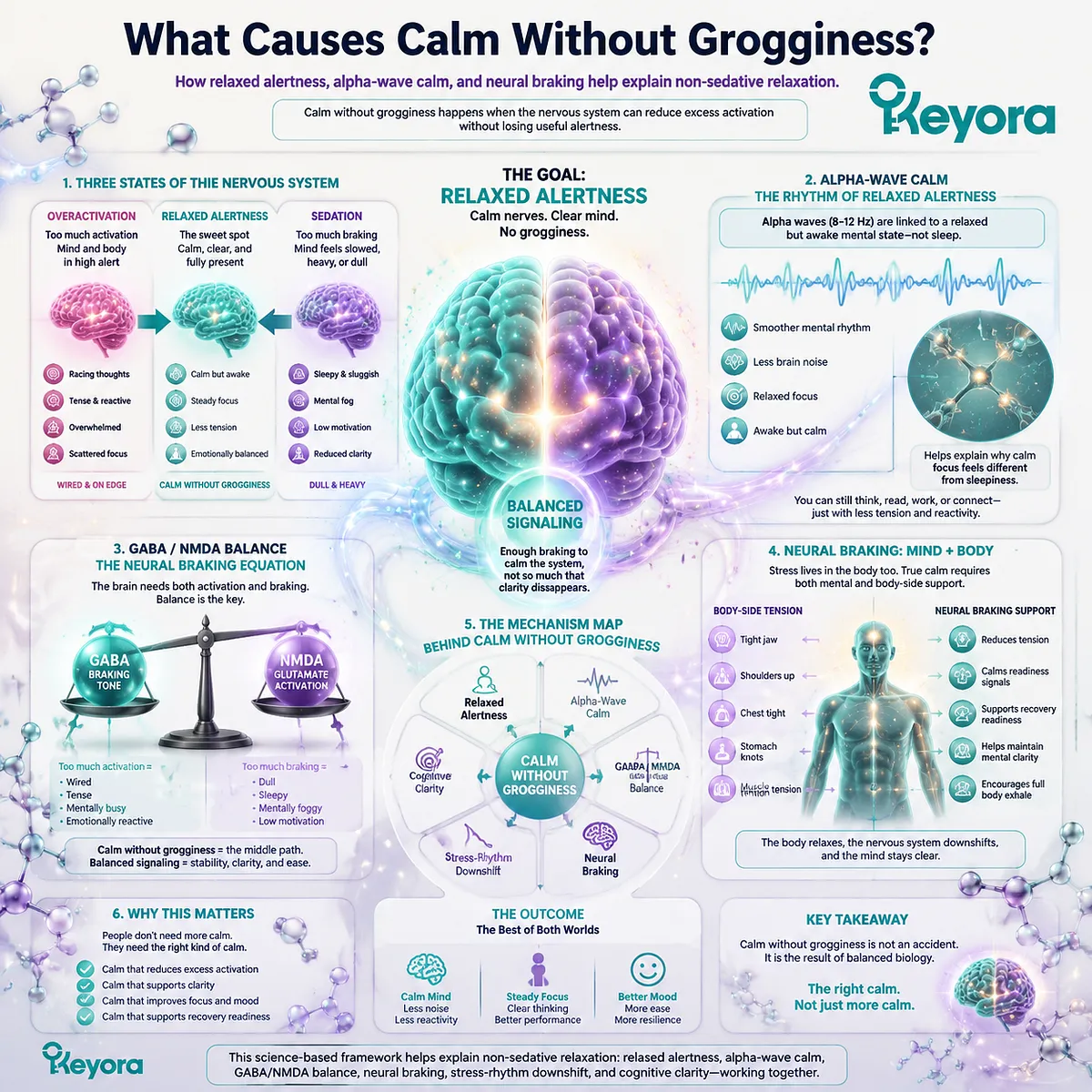
What Causes Calm Without Grogginess?
How relaxed alertness, alpha-wave calm, and neural braking help explain non-sedative relaxation.
Calm without grogginess happens when the nervous system can reduce excess activation without losing useful alertness.
To understand this, it helps to separate three states.
The first state is overactivation. This is when the mind feels fast, tense, reactive, or overloaded. Thoughts may move quickly. Small problems may feel bigger. The body may feel tight. Focus may feel scattered.
The second state is sedation. This is when the brain feels slowed down, heavy, sleepy, or dull. Sedation may reduce activation, but it can also reduce clarity.
The third state is relaxed alertness. This is the state many people actually want. The nervous system feels more settled, but the mind remains clear.
Relaxed alertness is the mechanism goal behind calm without drowsiness.
One way to explain this is through alpha-wave calm. Alpha brain-wave patterns are often associated with a relaxed but awake state. They are not the same as deep sleep. They are more like a smoother mental rhythm, where the brain is less noisy but still present.
This helps explain why calm focus feels different from being sleepy.
A person in calm focus can still answer questions, read, work, or hold a conversation. They may simply feel less rushed, less tense, and less reactive.
GABA/NMDA balance is another useful mechanism.
GABA can be understood as part of the brain’s braking tone. NMDA and glutamate-related signaling belong more to the activation side of the nervous system. The brain needs both. It needs activation to think and respond, but it also needs braking to prevent the system from becoming too loud.
When activation is too strong, people may feel wired, tense, mentally busy, or emotionally reactive.
When braking is too heavy, people may feel dull or sleepy.
Calm without grogginess is the middle path: enough braking to reduce excess activation, but not so much heaviness that clarity disappears.
This is why non-sedative relaxation is different from forced sleepiness.
The goal is not to suppress the nervous system. The goal is to support better signal balance.
Neural braking also matters at the body level. Stress is not only in the mind. The shoulders, jaw, chest, stomach, and muscles may hold tension. A person can say, “I want to relax,” but the body may still be sending readiness signals.
That is why calm without grogginess often requires both mental and body-side support.
The mind needs signal smoothing. The nervous system needs braking tone. The stress system needs to step down from high readiness. The body needs to feel less tense. The brain needs to remain clear.
This is the mechanism map behind calm without feeling sleepy or groggy:
relaxed alertness, alpha-wave calm, GABA/NMDA balance, neural braking, stress-rhythm downshift, and cognitive clarity.
This framework is useful because it solves the real problem.
People do not simply need “more calm.” They need the right kind of calm.
They need calm that does not cost them clarity.
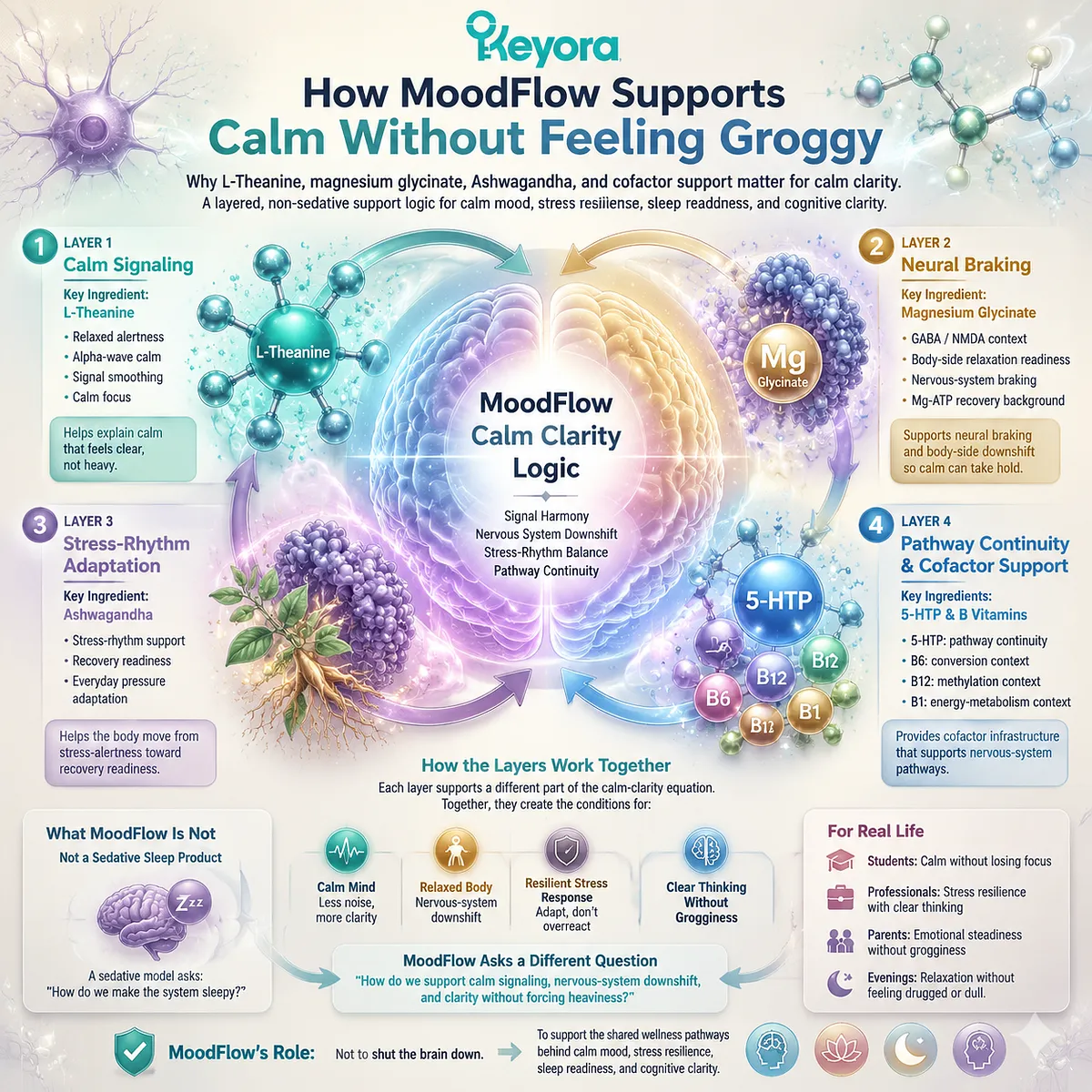
How MoodFlow Supports Calm Without Feeling Groggy
Why L-Theanine, magnesium glycinate, Ashwagandha, and cofactor support matter for calm clarity.
MoodFlow supports calm without feeling groggy by using a layered, non-sedative support logic.
The first layer is calm signaling.
L-Theanine is the key ingredient in this layer. It helps explain relaxed alertness, alpha-wave calm, signal smoothing, and calm focus. L-Theanine is not positioned as a sedative. Its value is that it helps explain how calm can feel clear instead of heavy.
This is especially useful for people who feel mentally noisy but still need to function.
They may not want a sleep aid. They may not want to feel slowed down. They may want a calmer mind for work, study, evening wind-down, or emotional steadiness.
L-Theanine helps explain that kind of calm.
The second layer is neural braking.
Magnesium glycinate supports this layer. It helps explain GABA/NMDA context, body-side relaxation readiness, nervous-system braking, and Mg-ATP recovery background.
This matters because a calm mind is harder to reach when the body remains tense. Many people try to mentally relax while their body is still holding a stress posture. The jaw is tight. The shoulders are raised. The chest feels guarded. The body is physically present, but the nervous system is still in readiness mode.
Magnesium glycinate helps explain why calm is not only a mental state. It also depends on neural braking and body-side downshift.
The third layer is stress-rhythm adaptation.
Ashwagandha supports this layer. In MoodFlow language, Ashwagandha helps explain how the body moves from stress-alertness toward recovery readiness under everyday pressure.
This is important because some people do not feel tense only in the moment. They carry stress across the day. Even after the stressful event ends, the body may keep the readiness signal running.
Ashwagandha is not a cortisol cure, hormone treatment, burnout treatment, or sleep medication. It is better understood as stress-rhythm support within the MoodFlow matrix.
The fourth layer is pathway continuity and cofactor support.
5-HTP and B vitamins support this layer. 5-HTP sits upstream in the serotonin-melatonin pathway. B6 supports conversion context. B12 supports methylation context. B1 supports energy-metabolism context.
In a calm-without-grogginess article, this layer should not be overstated. 5-HTP should not be described as serotonin, melatonin, or a mood treatment. Its role is pathway continuity. B vitamins provide cofactor infrastructure that helps explain why nervous-system pathways need support tools.
Together, these layers create MoodFlow’s calm clarity logic.
L-Theanine helps the mind feel less noisy. Magnesium glycinate supports neural braking and body-side downshift. Ashwagandha supports stress-rhythm adaptation. 5-HTP and B vitamins help explain pathway continuity and cofactor support.
This is why MoodFlow is not positioned as a sedative sleep product.
A sedative model asks, “How do we make the system sleepy?”
MoodFlow asks a different question: “How do we support calm signaling, nervous-system downshift, and clarity without forcing heaviness?”
That difference matters for real people.
A student needs calm but still needs focus. A professional needs stress resilience but still needs clear thinking. A parent may need emotional steadiness but cannot afford grogginess. A person winding down at night may want relaxation without feeling drugged or dull.
MoodFlow’s role is not to shut the brain down.
Its role is to support the shared wellness pathways behind calm mood, stress resilience, sleep readiness, and cognitive clarity.
Closing Summary
Calming the mind does not have to mean feeling sleepy or groggy. Many people are not looking for forced drowsiness. They are looking for calm clarity: less mental noise, less tension, less reactivity, and better steadiness while still feeling clear.
The mechanism behind calm without grogginess is relaxed alertness. It involves alpha-wave calm, GABA/NMDA balance, neural braking, stress-rhythm downshift, and nervous-system signal smoothing.
In the Keyora MoodFlow framework, this is supported through L-Theanine for calm signaling, magnesium glycinate for neural braking and body-side relaxation readiness, Ashwagandha for stress-rhythm adaptation, and 5-HTP with B vitamins for pathway and cofactor support.
MoodFlow is not a sedative, sleep drug, anxiety treatment, or medication replacement. It is an evidence-bound wellness matrix designed to support calm mood, stress resilience, sleep readiness, and cognitive clarity.
For Keyora, calm without grogginess means supporting a nervous system that can feel less reactive, more settled, and still clear enough for daily life.
This article is for educational and informational purposes only. It does not provide medical advice, diagnosis, treatment, cure, prevention, disease outcome claims, hormone restoration claims, fertility outcome claims, or formula-specific clinical efficacy claims.