
Why Do I Wake Up Tired Even After Sleeping?
Keyora Research Q&A Library
This is part of the Keyora Research Q&A Series, derived from Keyora Nutritional Neurology Seriers .
Within the Keyora Nutritional Neurology framework, this Q&A translates complex nutrient–brain mechanisms into reader-friendly, evidence-bound answers, focusing on stress resilience, sleep quality, calm mood support, cognitive wellness, and the broader interaction between nutrition, neurochemistry, and daily nervous-system function.
First published by Keyora Research Journal: www.keyorahealth.com

Direct Answer
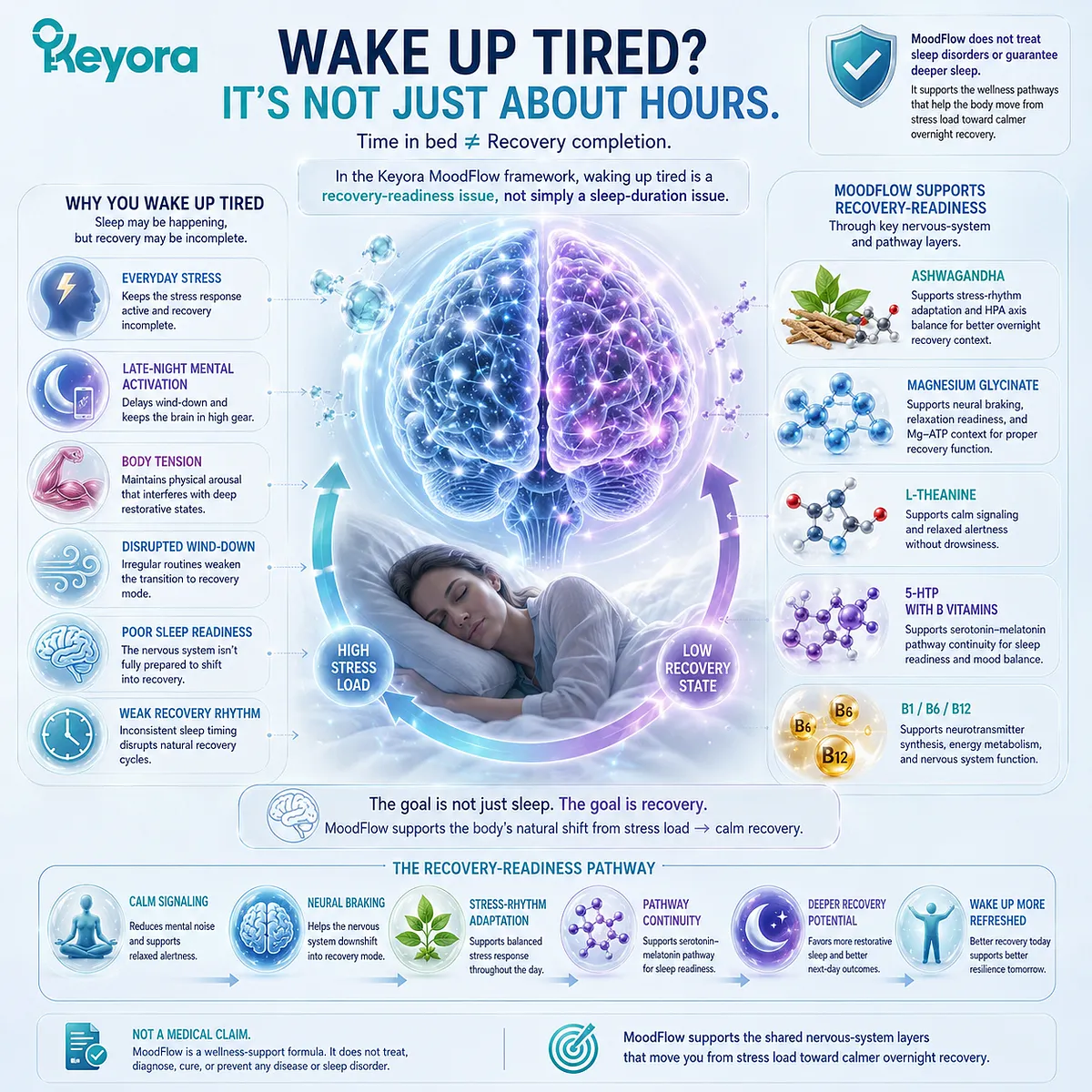
You may wake up tired even after sleeping because time in bed is not the same as recovery completion. The body may have spent enough hours asleep, but the nervous system may not have fully shifted into a restorative state.
Everyday stress, late-night mental activation, body tension, disrupted wind-down, poor sleep readiness, or weak recovery rhythm can make sleep feel less refreshing.
In the Keyora MoodFlow framework, waking up tired is understood as a recovery-readiness issue, not simply a sleep-duration issue.
MoodFlow supports this recovery-readiness picture through:
-
Ashwagandha for stress-rhythm adaptation, magnesium glycinate for neural braking and Mg-ATP context,
-
L-Theanine for calm signaling,
-
5-HTP with B vitamins for serotonin-melatonin pathway continuity.
It does not treat sleep disorders or guarantee deeper sleep. It supports the wellness pathways that help the body move from stress load toward calmer overnight recovery.
Sleep Time Is Not the Same as Recovery Quality
Why sleeping for enough hours does not always mean the nervous system finished restoring.
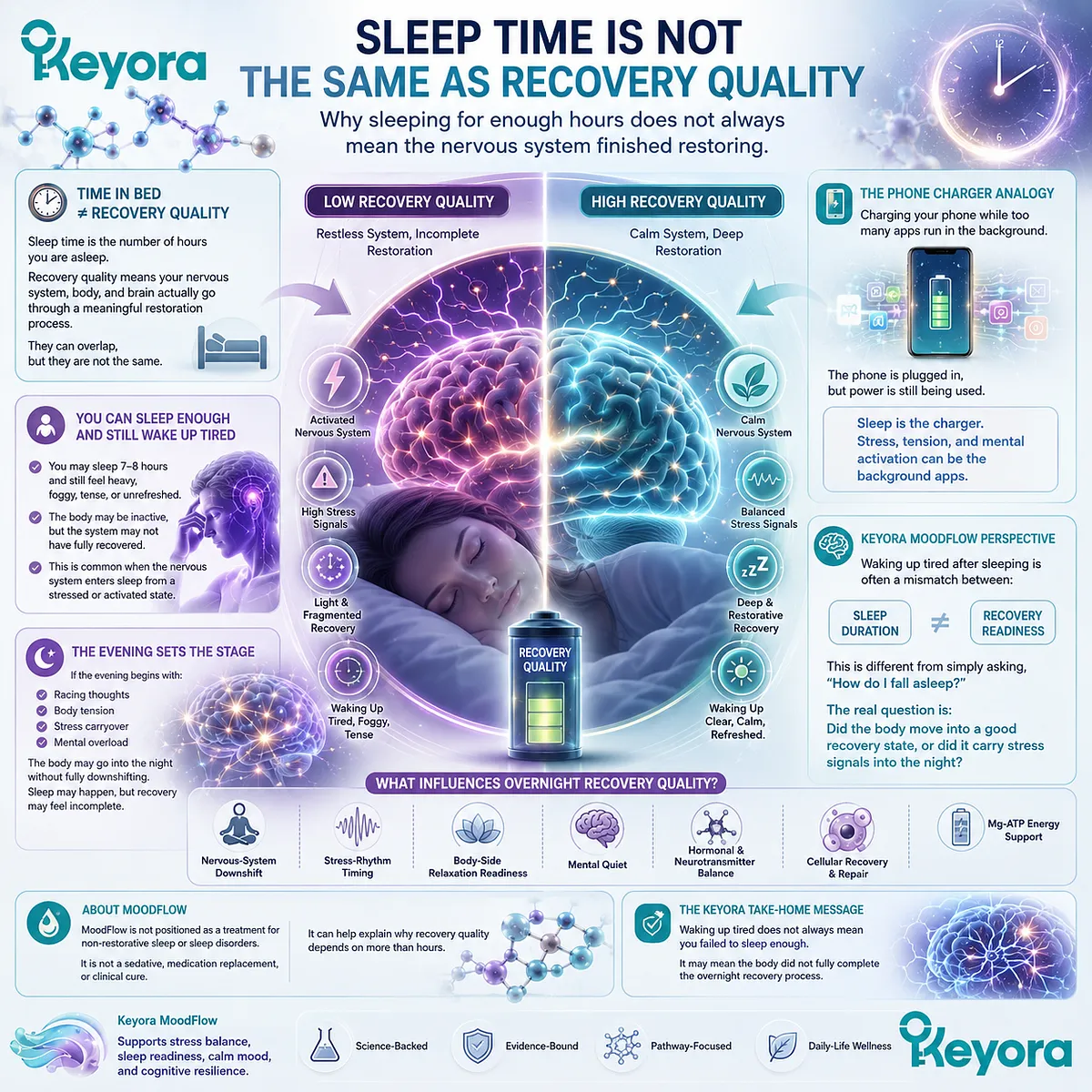
Many people measure sleep by hours. They think, “I slept seven or eight hours, so why do I still feel tired?”
That question is common because sleep time and recovery quality are not the same thing.
Sleep time means the body was in bed or asleep for a certain number of hours. Recovery quality means the nervous system, body, and brain actually moved through a useful restoration process.
Those two things can overlap, but they are not identical.
A person can sleep for enough hours but still wake up feeling heavy, foggy, tense, or unrefreshed. The body may have been inactive, but the system may not have fully recovered.
This is especially common when the nervous system enters sleep from a stressed or activated state. If the evening begins with racing thoughts, body tension, stress carryover, or mental overload, the body may go into the night without fully downshifting.
In that situation, sleep may happen, but recovery may feel incomplete.
A useful way to think about this is charging a phone while too many apps are running in the background. The phone is plugged in, but power is still being used. By morning, the battery may not feel as restored as expected.
Sleep is the charger. But stress, tension, and mental activation can be the background apps.
In the Keyora MoodFlow framework, waking up tired after sleeping is understood as a mismatch between sleep duration and recovery readiness.
This makes the topic different from simply asking, “How do I fall asleep?” A person may fall asleep and still not feel fully restored the next day.
The question becomes: did the body move into a good recovery state, or did it carry stress signals into the night?
This distinction helps explain why people may wake up tired after what looked like a normal night. The issue may not be sleep time alone. It may involve nervous-system downshift, stress-rhythm timing, body-side relaxation readiness, and energy-regulation support.
MoodFlow is not positioned as a treatment for non-restorative sleep or sleep disorders. But it can help explain why recovery quality depends on more than hours.
For Keyora, the first message is simple: waking up tired does not always mean you failed to sleep enough. It may mean the body did not fully complete the overnight recovery process.
Why Stress Can Make Sleep Feel Less Restorative
How stress-alertness, body tension, and mental load can carry into the night and affect morning recovery.
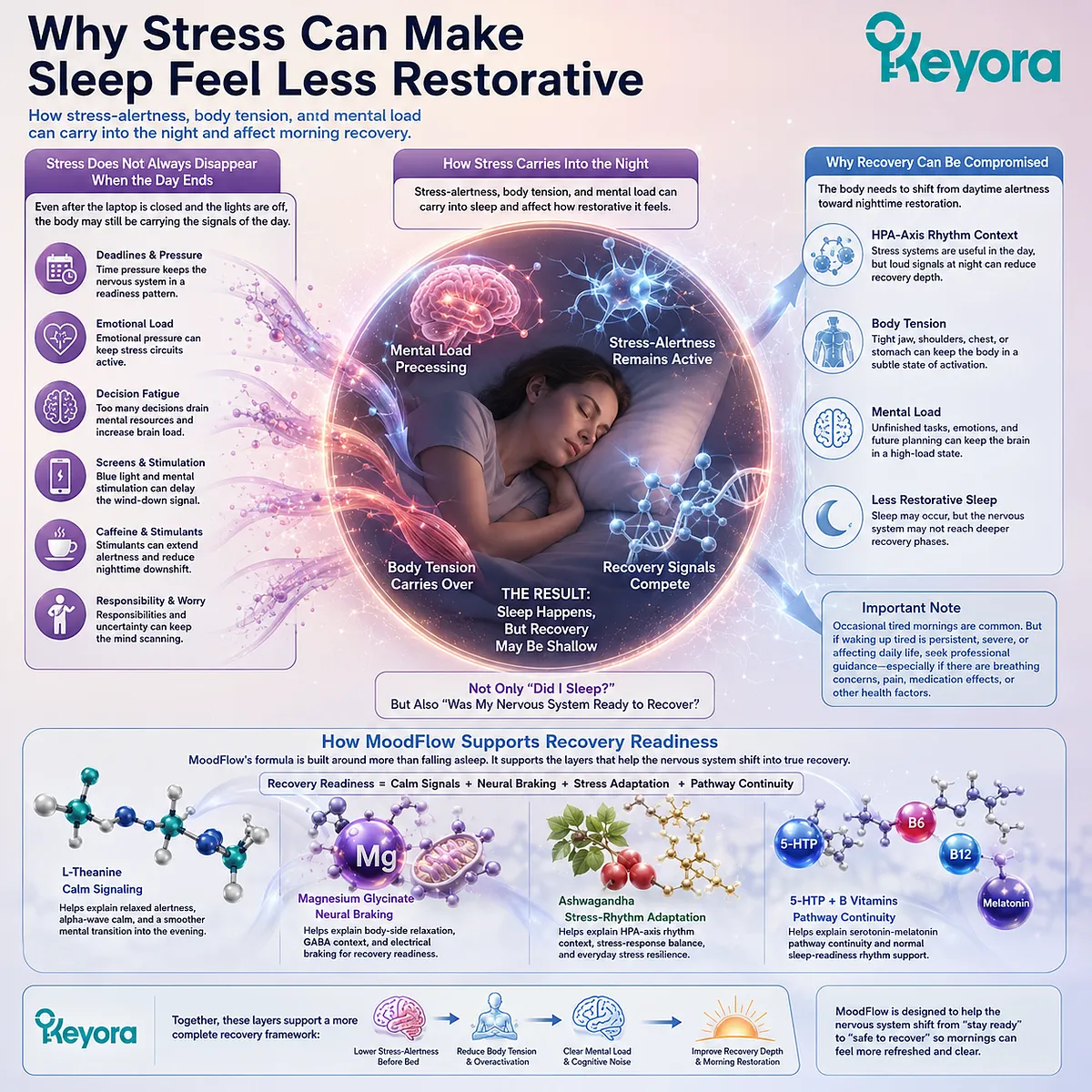
Stress does not always disappear when the day ends.
A person may close the laptop, turn off the lights, and lie down, but the body may still be carrying the signals of the day.
Deadlines, emotional pressure, decision fatigue, screens, caffeine, and responsibility can keep the nervous system in a readiness pattern.
This matters because recovery depends on more than unconsciousness. The body needs to shift from daytime alertness toward nighttime restoration.
Stress-alertness can interfere with that shift.
The HPA-axis rhythm context helps explain this in simple terms. The body has systems that help it respond to pressure. Those systems are useful during the day, when action, focus, and readiness are needed.
But if the readiness signal remains loud at night, the body may sleep without feeling deeply recovered.
This does not mean stress biology is bad. It means timing matters.
If stress says “stay ready” while sleep says “recover,” the night may feel less restorative.
Body tension can also travel into sleep. A person may not notice how tight the jaw, shoulders, chest, or stomach feels until the evening. Even if sleep happens, the body may still be carrying a subtle tone of activation.
That is why some people wake up tired and stiff, or mentally foggy even after enough hours.
Mental load is another layer. The brain may continue processing unfinished tasks, emotional conversations, tomorrow’s plans, and unresolved decisions. Even if thoughts are not fully conscious during sleep, the nervous system may have entered the night from a state of high cognitive load.
This is different from one bad night. Occasional tired mornings are common. But if waking up tired is persistent, severe, or affecting daily life, it is worth seeking professional guidance, especially if there are breathing concerns, pain, medication effects, or other health factors.
For a wellness article, the responsible explanation is this: sleep can feel less restorative when the body goes into the night still carrying stress, tension, and mental activation.
That is why MoodFlow’s support logic is not just “help the person fall asleep.” It is broader than that.
The formula is built around recovery readiness.
Ashwagandha helps explain stress-rhythm adaptation. Magnesium glycinate helps explain neural braking and body-side relaxation readiness. L-Theanine helps explain calm signaling and a softer mental transition. 5-HTP with B vitamins helps explain serotonin-melatonin pathway continuity.
Together, these layers point toward a more complete question:
Not only “Did I sleep?”
But also “Was my nervous system ready to recover?”
How MoodFlow Supports Overnight Recovery Readiness
Why calm signaling, neural braking, stress-rhythm support, and cofactor infrastructure matter when sleep does not feel refreshing.
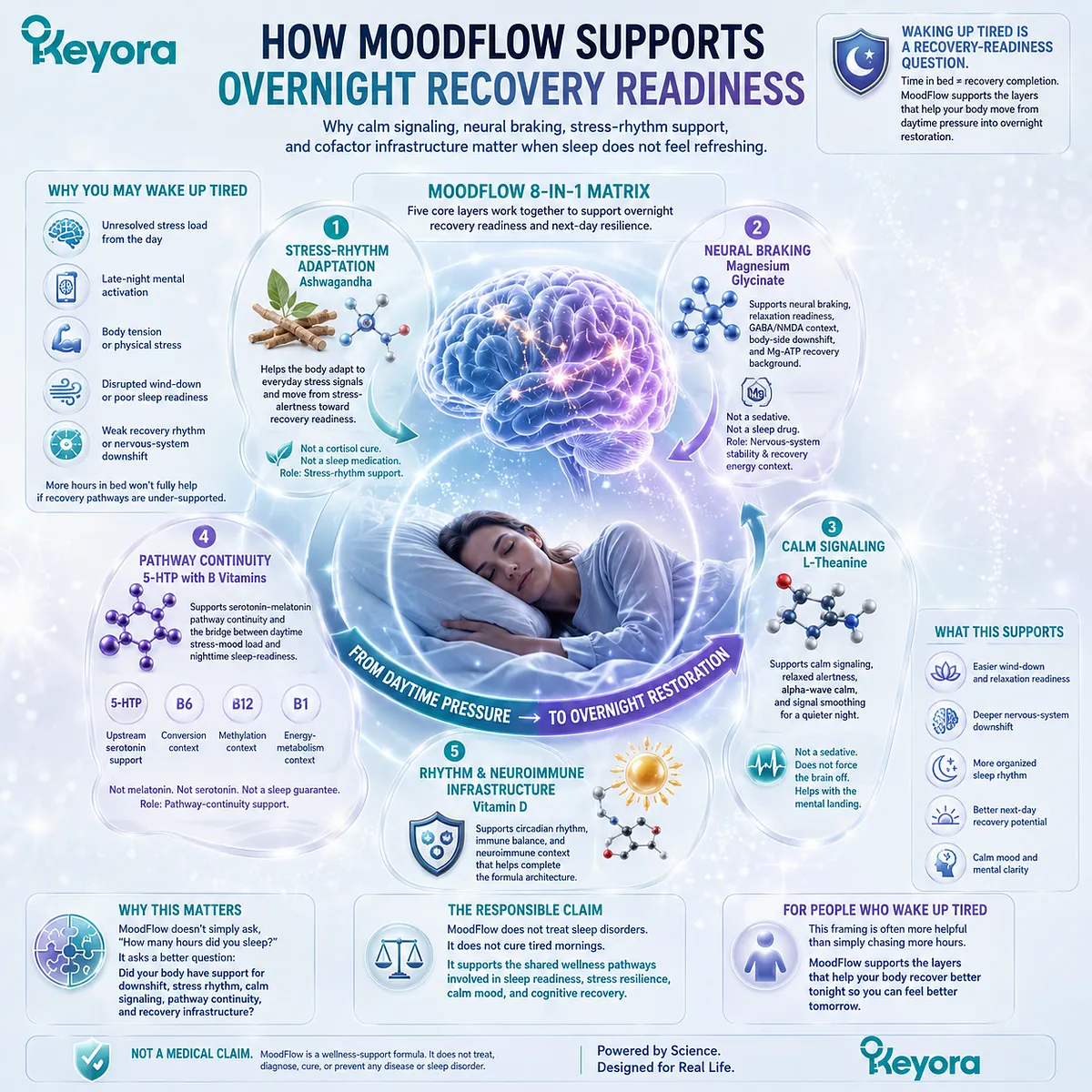
Waking up tired after sleeping is a recovery-readiness question.
This is where MoodFlow’s 8-in-1 Matrix becomes useful. It helps explain several layers that may influence how the body moves from daytime pressure into overnight restoration.
The first layer is stress-rhythm adaptation.
Ashwagandha supports this layer. In MoodFlow language, Ashwagandha helps explain how the body adapts to everyday stress signals and moves from stress-alertness toward recovery readiness. It is not a cortisol cure, adrenal fatigue treatment, or sleep medication. Its role is stress-rhythm support.
This matters because a tired morning may begin the night before, when the body never fully left the day’s pressure behind.
The second layer is neural braking.
Magnesium glycinate supports this layer. It helps explain relaxation readiness, GABA/NMDA context, body-side downshift, and Mg-ATP recovery background. This is important because recovery is not passive. The body still needs energy-regulation and nervous-system stability to restore well.
A body can be asleep but not fully relaxed. Magnesium glycinate helps explain the difference between being inactive and being in a better recovery state.
The third layer is calm signaling.
L-Theanine supports this layer. It helps explain relaxed alertness, alpha-wave calm, and signal smoothing. For people who go to bed with a fast mind or a reactive brain, calm signaling can be part of the transition into a quieter night.
L-Theanine is not a sedative. It does not force the brain off. It supports the soft mental landing that may make overnight recovery feel more organized.
The fourth layer is pathway continuity.
5-HTP with B vitamins supports this layer.
-
5-HTP is upstream in the serotonin-melatonin pathway.
-
B6 supports conversion context.
-
B12 supports methylation context.
-
B1 supports energy-metabolism context.
This does not mean 5-HTP is melatonin, serotonin, or a sleep guarantee. It means MoodFlow includes a pathway-continuity layer that helps explain the bridge between daytime stress-mood load and nighttime sleep-readiness rhythm.
Vitamin D adds broader rhythm and neuroimmune context. It is not the main character in this article, but it helps complete the formula architecture.
Together, these layers make MoodFlow different from a sleep-duration-only explanation.
MoodFlow does not simply ask, “How many hours did you sleep?”
It asks a more useful wellness question: did your body have support for downshift, stress rhythm, calm signaling, pathway continuity, and recovery infrastructure?
This is why Keyora can speak to waking up tired without claiming to treat a sleep disorder.
The responsible claim is not that MoodFlow fixes tired mornings. The responsible claim is that MoodFlow supports the shared pathways involved in sleep readiness, stress resilience, calm mood, and cognitive recovery.
For people who wake up tired even after sleeping, that framing is often more helpful than simply chasing more hours.
Closing Summary
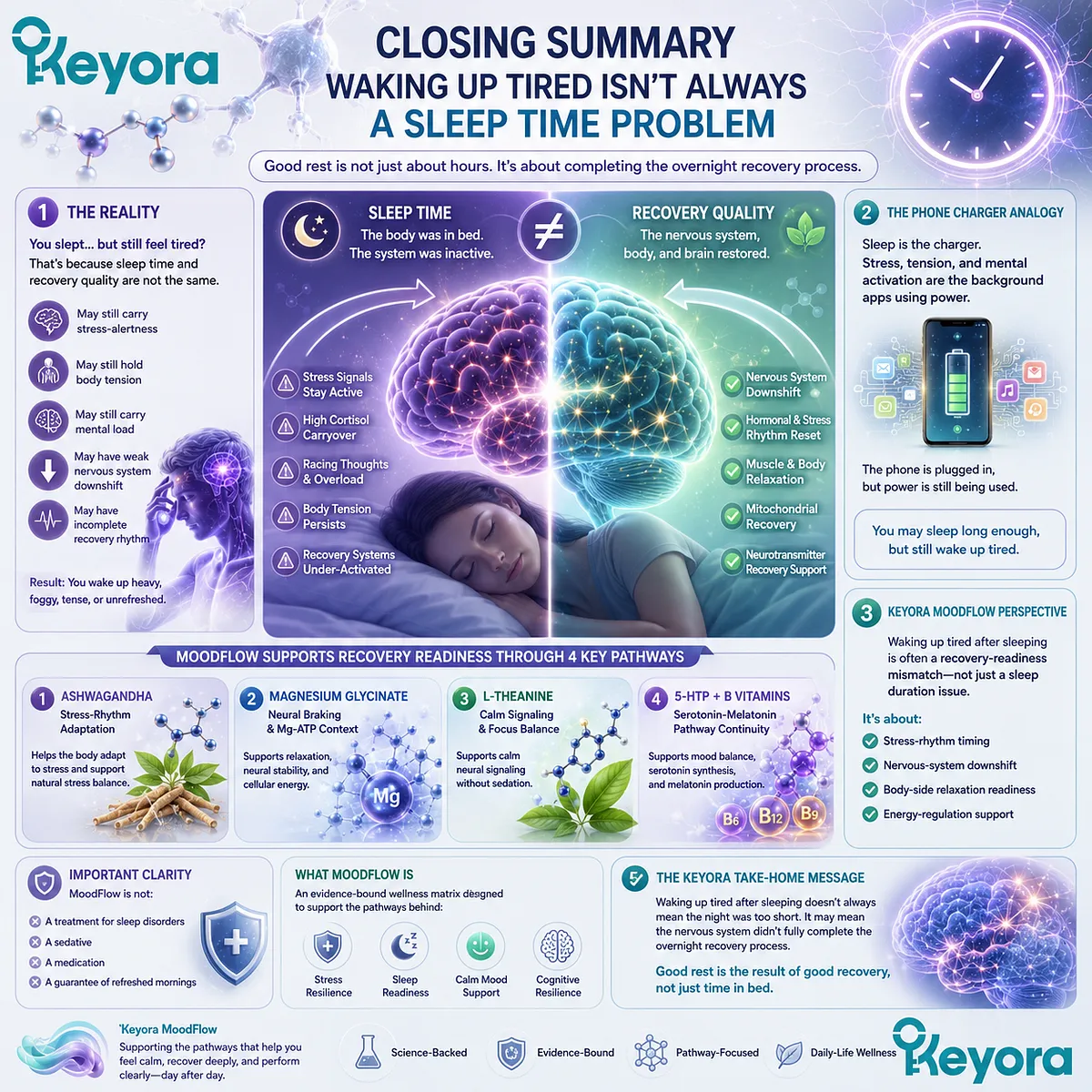
Waking up tired even after sleeping does not always mean the night was too short. Sometimes the issue is that sleep time and recovery quality did not fully match.
The body may have been asleep, but the nervous system may still have carried stress-alertness, body tension, mental load, weak downshift, or incomplete recovery rhythm into the night.
In the Keyora MoodFlow framework, this is understood as a recovery-readiness issue. MoodFlow supports this picture through Ashwagandha for stress-rhythm adaptation, magnesium glycinate for neural braking and Mg-ATP context, L-Theanine for calm signaling, and 5-HTP with B vitamins for serotonin-melatonin pathway continuity.
MoodFlow is not a treatment for sleep disorders, a sedative, or a guarantee of refreshed mornings. It is an evidence-bound wellness matrix designed to support the pathways behind stress resilience, sleep readiness, calm mood, and cognitive resilience.
For Keyora, waking up tired after sleeping shows that good rest is not only about hours; it is also about helping the nervous system complete the overnight recovery process.
This article is for educational and informational purposes only. It does not provide medical advice, diagnosis, treatment, cure, prevention, disease outcome claims, hormone restoration claims, fertility outcome claims, or formula-specific clinical efficacy claims.