
How Does 5-HTP Support the Stress-to-Sleep Transition?
Keyora Research Q&A Library
This is part of the Keyora Research Q&A Series, derived from Keyora Nutritional Neurology Seriers .
Within the Keyora Nutritional Neurology framework, this Q&A translates complex nutrient–brain mechanisms into reader-friendly, evidence-bound answers, focusing on stress resilience, sleep quality, calm mood support, cognitive wellness, and the broader interaction between nutrition, neurochemistry, and daily nervous-system function.
First published by Keyora Research Journal: www.keyorahealth.com

Direct Answer
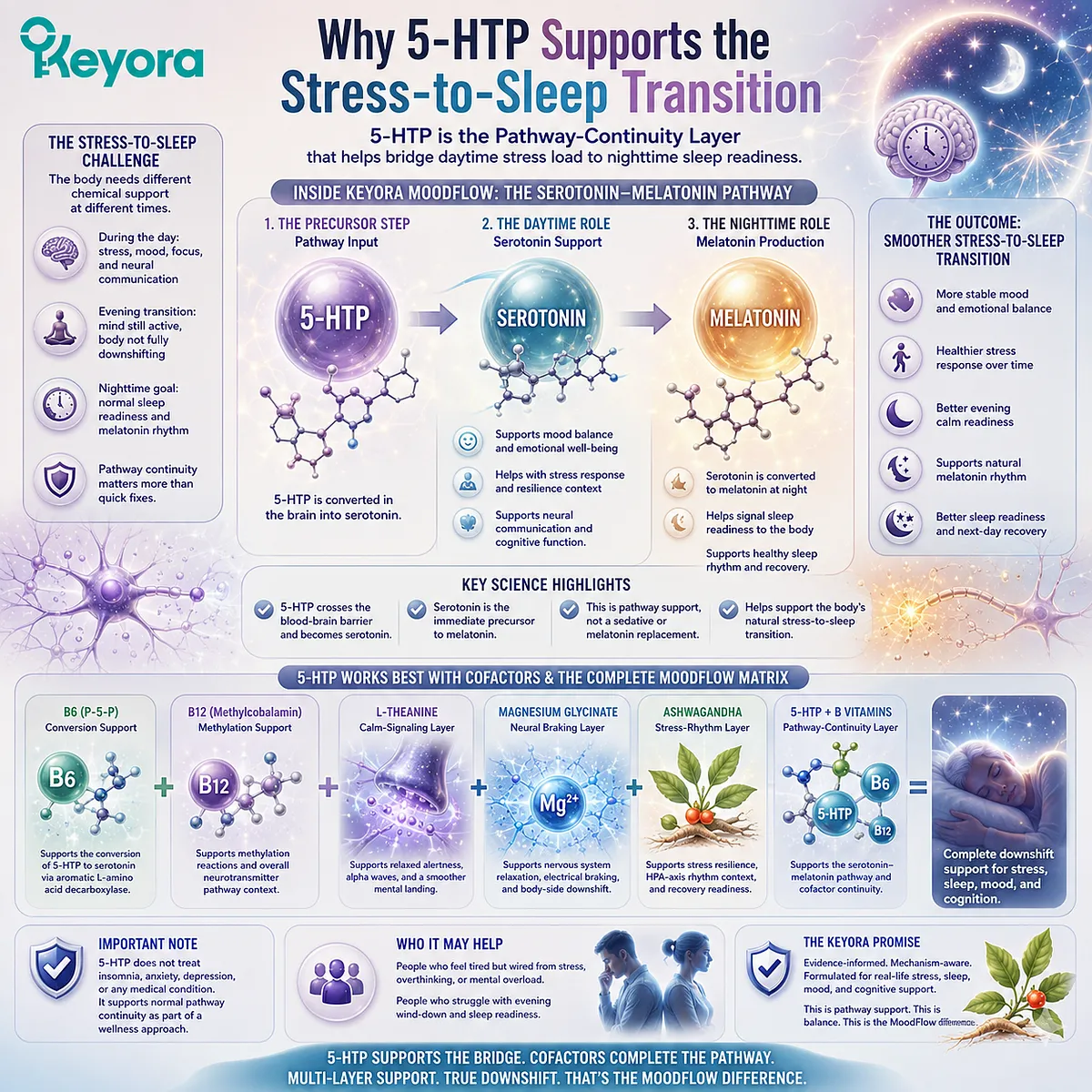
5-HTP may support the stress-to-sleep transition because it sits upstream in the serotonin-melatonin pathway.
During the day, serotonin-related pathways help explain mood, stress response, and neural communication context.
At night, serotonin can serve as part of the pathway that leads toward melatonin production.
In the Keyora MoodFlow framework, 5-HTP is positioned as the pathway-continuity layer, not as a sedative or direct melatonin replacement. It helps explain how the body may support a smoother bridge from daytime stress load toward nighttime sleep readiness.
B6 supports conversion context, while B12 supports methylation context around the pathway.
This does not mean 5-HTP treats insomnia, anxiety, depression, or any medical condition.
It means 5-HTP supports normal serotonin-melatonin pathway continuity inside MoodFlow’s broader downshift matrix.
Sleep Readiness Needs a Pathway Bridge
Why tired-but-wired support is not only about calming the mind or relaxing the body.
Tired-but-wired support is often explained through stress, thoughts, and body tension.
Those layers matter.
-
A wired brain may need calm signaling.
-
A tense body may need neural braking.
-
A stress-loaded system may need recovery-readiness support.
But there is another layer that should not be missed: pathway continuity.
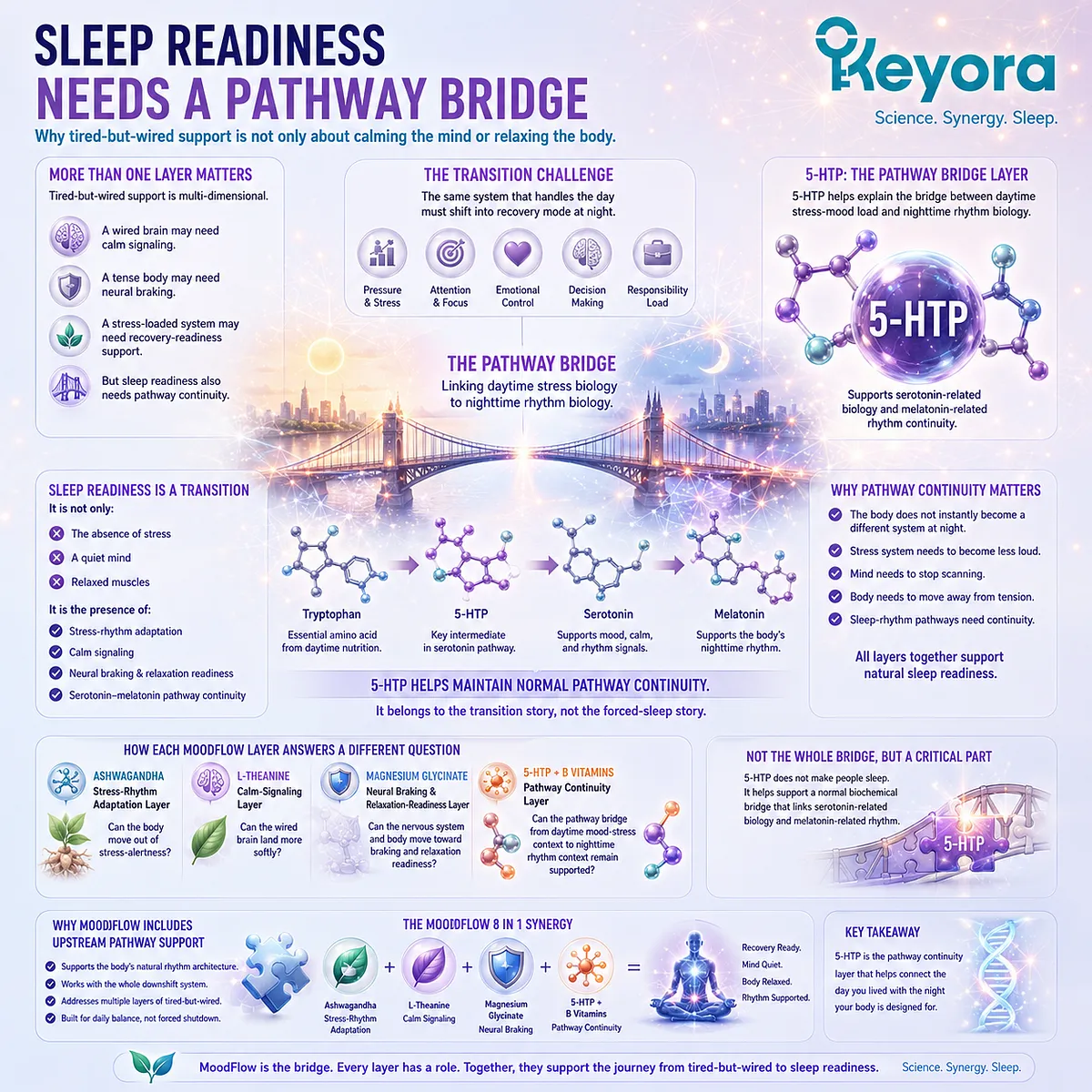
Sleep readiness is not only the absence of stress. It is not only a quiet mind. It is not only relaxed muscles. The body also needs a biochemical bridge between the day and the night.
This is where 5-HTP becomes important inside MoodFlow.
If L-Theanine softens the mental landing, magnesium glycinate supports the brake, and Ashwagandha helps the stress system stand down, 5-HTP helps explain the pathway bridge that connects daytime stress biology with nighttime rhythm biology.
That is the unique role of 5-HTP in this article.
A person may spend the day under pressure, using attention, emotional control, decision-making, and stress-response capacity. By evening, the body does not instantly become a different system. The same nervous system that handled the day must now shift into recovery mode.
This transition needs more than one signal.
For example, the stress system needs to become less loud. The mind needs to stop scanning every unfinished task. The body needs to move away from tension. But the sleep-rhythm pathway also needs continuity.
In the Keyora MoodFlow framework, 5-HTP is used to explain the pathway-continuity side of tired-but-wired support: the bridge between daytime stress-mood load and nighttime sleep-readiness rhythm.
This is different from saying 5-HTP makes people sleep. That would be too simplistic and not accurate for MoodFlow’s positioning.
A better explanation is that 5-HTP helps explain a normal pathway that links serotonin-related biology and melatonin-related rhythm support. It belongs to the transition story, not the forced-sleep story.
This matters because many people think about sleep as a single event: either they fall asleep or they do not. MoodFlow frames sleep readiness as a transition process.
That process may include stress-rhythm adaptation, calm signaling, neural braking, and serotonin-melatonin continuity. Each layer answers a different question.
-
Ashwagandha helps answer: can the body move out of stress-alertness?
-
L-Theanine helps answer: can the wired brain land more softly?
-
Magnesium glycinate helps answer: can the nervous system and body move toward braking and relaxation readiness?
-
5-HTP helps answer: can the pathway bridge from daytime mood-stress context to nighttime rhythm context remain supported?
That makes 5-HTP a bridge ingredient. It is not the whole bridge by itself, but it helps explain why MoodFlow 8 in 1 includes upstream pathway support instead of relying only on a night-time signal.
5-HTP, Serotonin, and Melatonin Continuity
How 5-HTP fits upstream of the body’s night-rhythm pathway without acting as melatonin itself.
5-HTP is often misunderstood because it sits in a pathway that people associate with serotonin and melatonin.
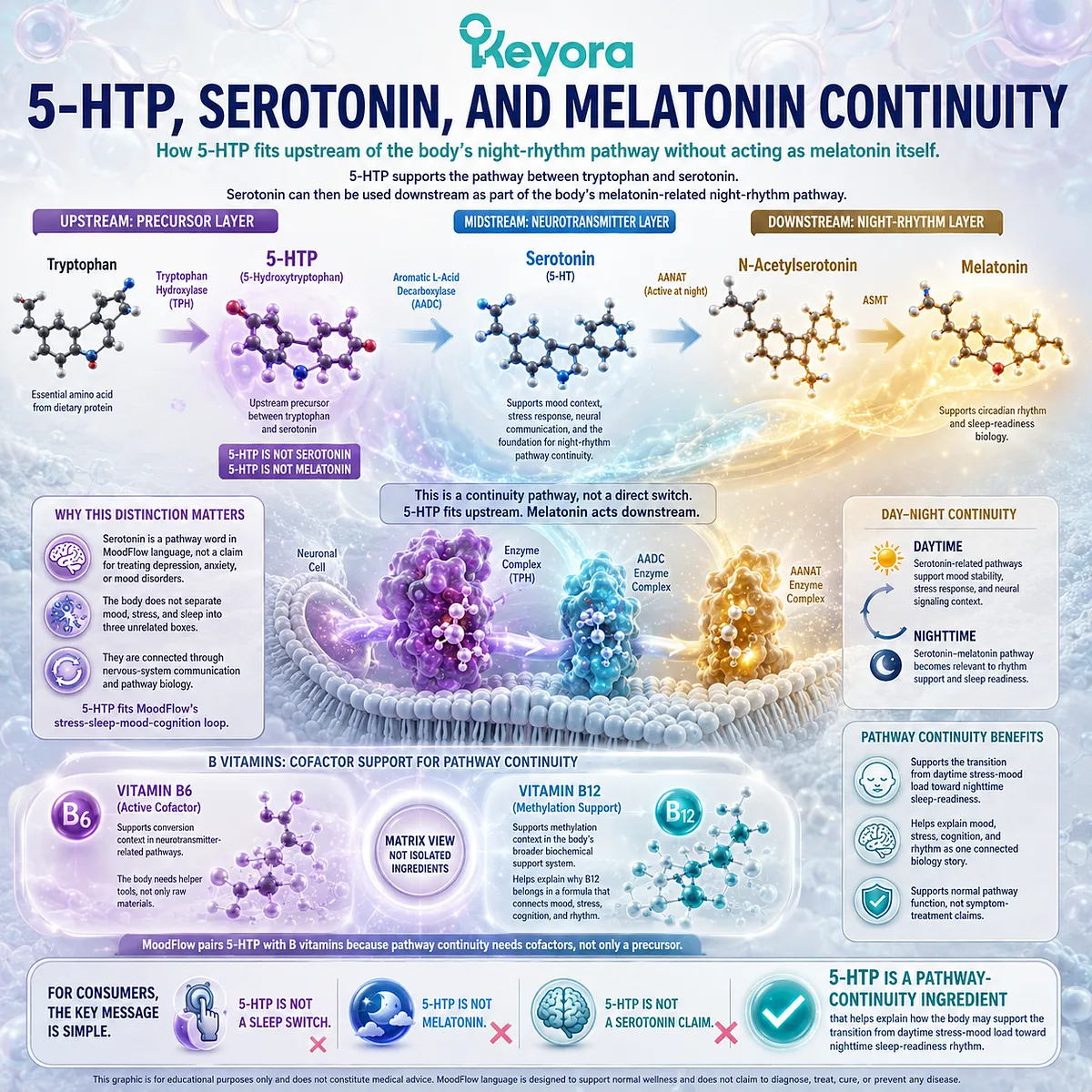
The simplest way to understand it is this: 5-HTP is upstream. It is part of the pathway between tryptophan and serotonin.
Serotonin can then be used downstream as part of the body’s melatonin-related night-rhythm pathway.
But 5-HTP is not serotonin.
And 5-HTP is not melatonin.
That distinction is essential for responsible MoodFlow language.
5-HTP helps explain pathway availability; it should not be described as “adding serotonin” or “replacing melatonin.” It is better understood as a precursor-layer ingredient that supports normal serotonin-melatonin pathway continuity.
This is why this Article is not the same as a basic 5-HTP article.
The main question here is not “What is 5-HTP?”
The main question is “Why does this pathway matter when stress has to transition into sleep readiness?”
Serotonin is often discussed in mood conversations, but MoodFlow should not use serotonin language as a disease-treatment claim.
In MoodFlow language, serotonin is not used to claim treatment of depression, anxiety, or mood disorders. It is used as a pathway word that helps connect mood, stress, neural communication, and sleep-readiness biology.
That connection matters for the stress-to-sleep transition.
During the day, serotonin-related pathways help explain part of the background of mood stability, stress response, and neural signaling context. At night, the serotonin-melatonin pathway becomes relevant to rhythm support.
This creates a continuity story: the body does not separate mood, stress, and sleep into three unrelated boxes. They are connected through nervous-system communication and pathway biology.
That is why 5-HTP fits MoodFlow’s stress-sleep-mood-cognition loop.
B vitamins help explain why this pathway belongs inside a matrix, not as an isolated ingredient.
B6, especially in its active cofactor role, helps support conversion context in neurotransmitter-related pathways.
In simple language, the body does not only need raw materials. It also needs helper tools that allow pathways to function.
B12 supports methylation context.
Methylation is part of the body’s broader biochemical support system, and it helps explain why B12 belongs in a formula that connects mood, stress, cognition, and rhythm.
MoodFlow pairs 5-HTP with B vitamins because pathway continuity needs cofactors, not only a precursor.
This is an important difference between a single-ingredient view and a matrix view.
A single-ingredient view might focus only on 5-HTP as a sleep or mood supplement. MoodFlow takes a more responsible approach: 5-HTP is part of a pathway-support layer, and B vitamins help explain the cofactor background around that pathway.
For consumers, the key message is simple.
5-HTP is not a sleep switch.
-
It is not melatonin.
-
It is not a serotonin claim.
-
It is a pathway-continuity ingredient that helps explain how the body may support the transition from daytime stress-mood load toward nighttime sleep-readiness rhythm.
Why 5-HTP Works Best After Downshift Support
Why pathway support belongs beside stress adaptation, calm signaling, and neural braking.
5-HTP should not be treated as the first hammer for every tired-but-wired problem.
This is especially important for Keyora’s positioning.
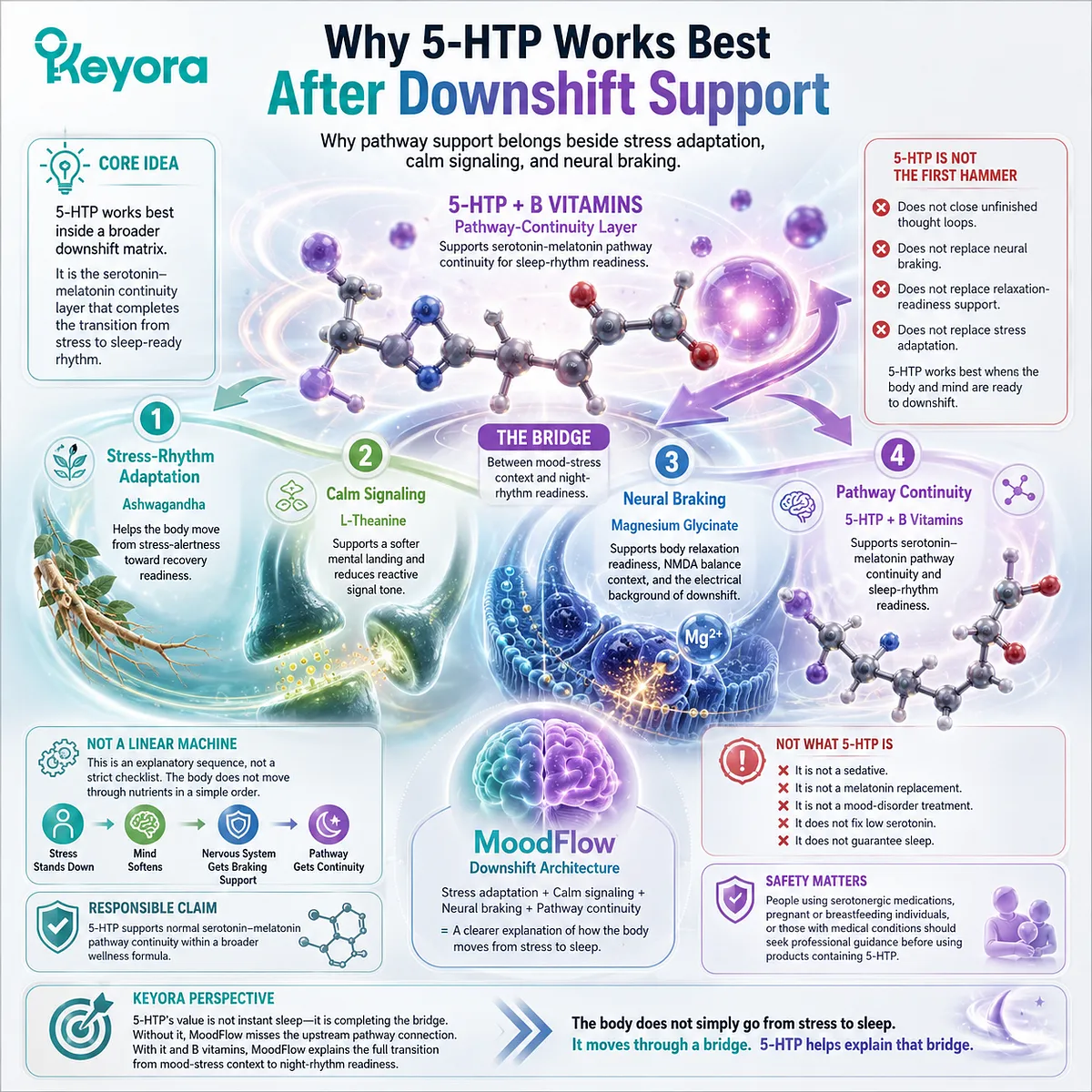
If stress-alertness is still loud, pathway support alone may not explain the whole pattern. If thought loops are still active, 5-HTP does not close unfinished tasks. If the nervous system still feels electrically switched on, 5-HTP does not replace neural braking. If the body is tense, 5-HTP does not replace relaxation-readiness support.
That is why 5-HTP works best inside a broader downshift matrix.
Inside Keyora MoodFlow, 5-HTP is not used as a stand-alone sleep shortcut; it is the serotonin-melatonin continuity layer within a broader matrix that also includes stress-rhythm adaptation, calm signaling, and neural braking.
This gives MoodFlow a clearer structure.
Ashwagandha supports the stress-rhythm adaptation layer.
It helps explain why the body may need support moving from stress-alertness toward recovery readiness after a demanding day.
L-Theanine supports the calm-signaling layer.
It helps explain why a wired brain may need a softer mental landing and less reactive signal tone.
Magnesium glycinate supports the neural braking layer.
It helps explain body-side relaxation readiness, NMDA balance context, and the electrical background of downshift.
5-HTP with B vitamins supports the pathway-continuity layer.
It helps explain how serotonin-melatonin pathway support may belong in the transition from stress and mood load toward sleep-readiness rhythm.
This is not a strict sequence like a machine. The body does not move through nutrients in a simple checklist. It is an explanatory sequence: stress needs to stand down, the mind needs to soften, the nervous system needs braking support, and the sleep-rhythm pathway needs continuity.
That is why MoodFlow does not rely on 5-HTP alone.
It also explains why 5-HTP should be described carefully.
-
It is not a sedative.
-
It is not a melatonin replacement.
-
It is not a mood-disorder treatment.
-
It is not appropriate to claim that it fixes low serotonin or guarantees sleep.
The responsible claim is narrower and stronger: 5-HTP supports normal serotonin-melatonin pathway continuity within a broader wellness formula.
This also matters for safety communication.
People using serotonergic medications, pregnant or breastfeeding individuals, or those with medical conditions should seek professional guidance before using products containing 5-HTP.
That guidance is not a weakness. It is part of responsible pathway education.
For Keyora, 5-HTP’s value is not that it promises instant sleep. Its value is that it completes the MoodFlow downshift architecture.
Without it, the formula would include stress adaptation, calm signaling, and neural braking, but miss the upstream pathway bridge between mood-stress context and night-rhythm readiness.
With 5-HTP and B vitamins, MoodFlow can explain the full transition more clearly.
The body does not simply go from stress to sleep. It moves through a bridge. 5-HTP helps explain that bridge.
Closing Summary
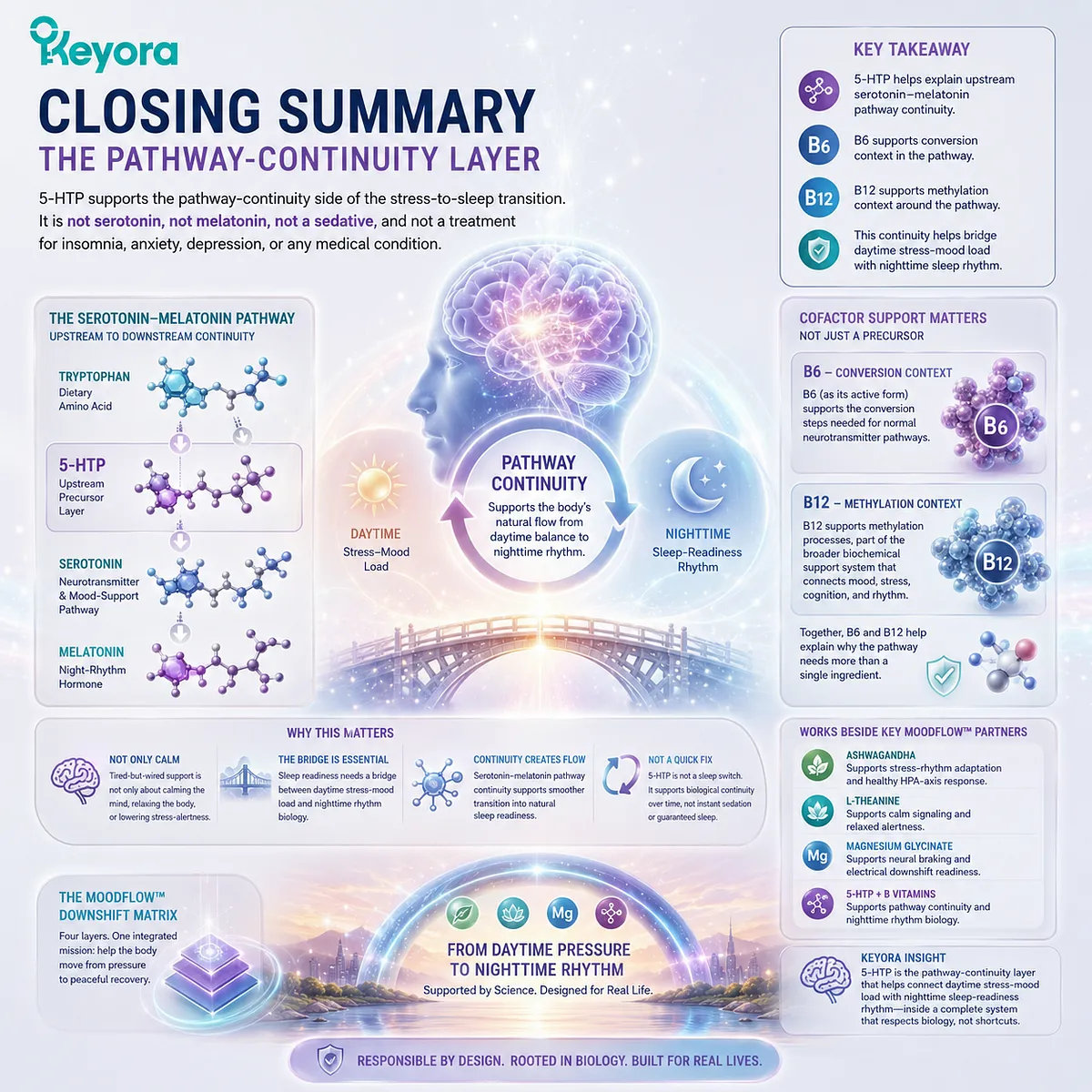
5-HTP supports the pathway-continuity side of the stress-to-sleep transition. It is not serotonin, not melatonin, not a sedative, and not a treatment for insomnia, anxiety, depression, or any medical condition.
In the Keyora MoodFlow framework, 5-HTP helps explain upstream serotonin-melatonin pathway continuity.
B6 supports conversion context, while B12 supports methylation context around the broader pathway.
This matters because tired-but-wired support is not only about calming the mind, relaxing the body, or lowering stress-alertness.
Sleep readiness also needs a bridge between daytime stress-mood load and nighttime rhythm biology.
Inside MoodFlow, 5-HTP works beside Ashwagandha for stress-rhythm adaptation, L-Theanine for calm signaling, and magnesium glycinate for neural braking.
For Keyora, 5-HTP is the pathway-continuity layer that helps connect daytime stress-mood load with nighttime sleep-readiness rhythm inside the MoodFlow downshift matrix.
This article is for educational and informational purposes only. It does not provide medical advice, diagnosis, treatment, cure, prevention, disease outcome claims, hormone restoration claims, fertility outcome claims, or formula-specific clinical efficacy claims.