
How Does Ashwagandha Support Stress-Driven Tired-But-Wired Patterns?
Keyora Research Q&A Library
This is part of the Keyora Research Q&A Series, derived from Keyora Nutritional Neurology Seriers .
Within the Keyora Nutritional Neurology framework, this Q&A translates complex nutrient–brain mechanisms into reader-friendly, evidence-bound answers, focusing on stress resilience, sleep quality, calm mood support, cognitive wellness, and the broader interaction between nutrition, neurochemistry, and daily nervous-system function.
First published by Keyora Research Journal: www.keyorahealth.com

Direct Answer
Ashwagandha may support stress-driven tired-but-wired patterns because some people do not become wired only at bedtime. They carry daytime stress-alertness into the evening. The body may feel tired, but the stress-response system may still be signaling readiness, vigilance, or pressure.
In the Keyora MoodFlow framework, Ashwagandha is positioned as the stress-rhythm adaptation layer. It helps explain HPA-axis rhythm context, stress-response feedback, withanolide-related adaptogenic support, and recovery readiness under everyday pressure.
This does not mean Ashwagandha treats insomnia, anxiety, burnout, adrenal fatigue, or hormone imbalance. It means Ashwagandha supports the body’s ability to move from stress-alertness toward calm recovery readiness.
Inside MoodFlow, Ashwagandha works beside L-Theanine’s calm signaling, magnesium glycinate’s neural braking, and 5-HTP with B vitamins’ serotonin-melatonin pathway support.
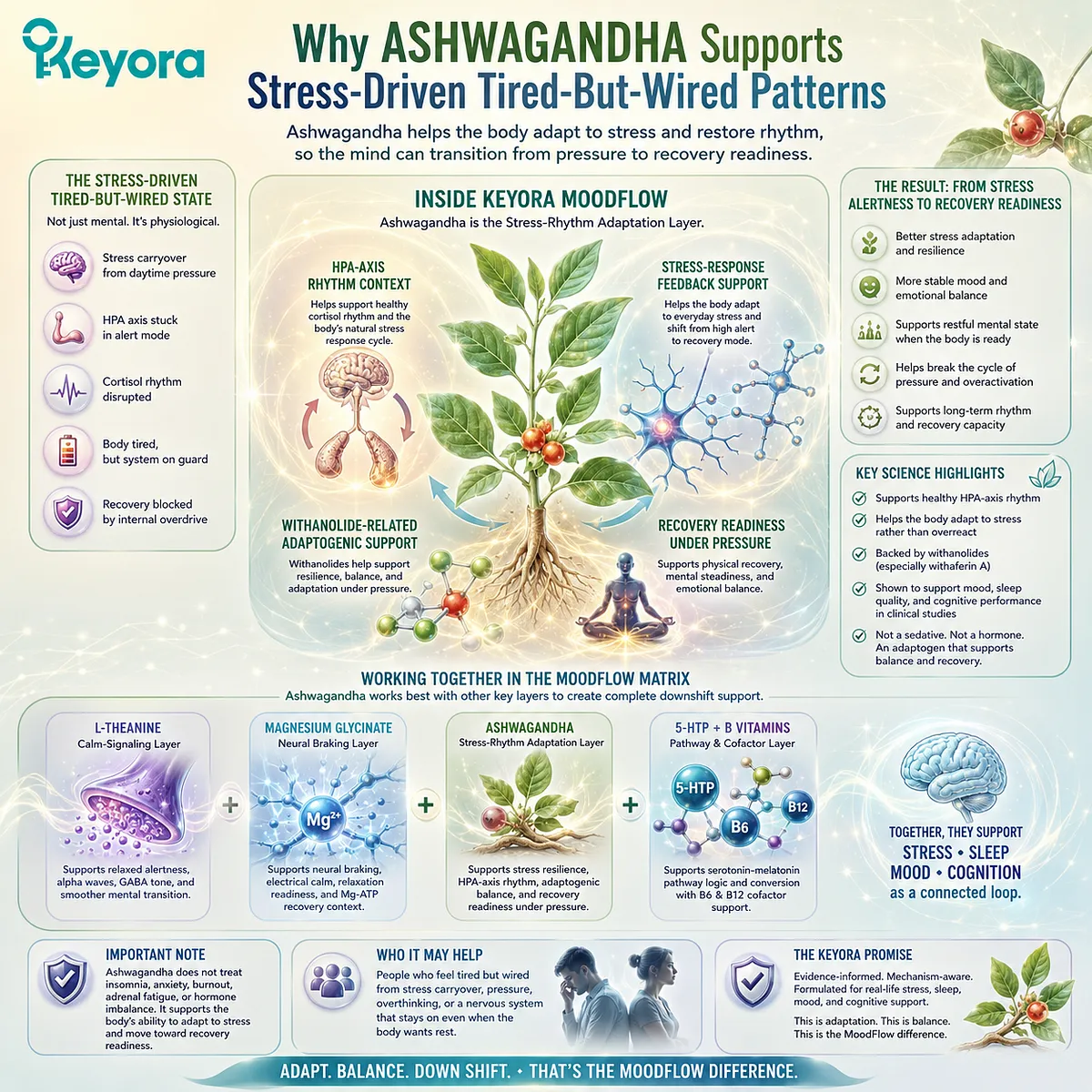
Stress Can Stay Active After the Day Ends
Why some tired-but-wired patterns come from daytime pressure carrying into the evening.
Some tired-but-wired nights do not begin at bedtime. They begin earlier, when the stress signals of the day never fully turn down.
A person may spend the whole day responding to messages, deadlines, decisions, family needs, study pressure, financial concerns, or constant notifications. The workday may end on the clock, but the body’s internal “on-call” system may still be running.
This is stress carryover.
Stress carryover means the body remains in a readiness state after the demand has passed. The person may no longer be working, studying, commuting, or handling a problem, but the nervous system still feels prepared for action.
That is why some people do not feel suddenly wired at night. They have been wired all day. Bedtime only makes it easier to notice.
The body may feel tired because energy has been used. The mind may feel loaded because attention has been stretched. But the stress-response system may still be acting as if the person needs to stay ready.
This creates a specific form of tired-but-wired. It is not only racing thoughts. It is not only body tension. It is not only a missing night-time signal. It is the feeling that the whole system has not received permission to stand down.
In the Keyora MoodFlow framework, Ashwagandha is used to explain the stress-carryover side of tired-but-wired: the part where the body is tired, but the stress-response system has not fully shifted toward recovery readiness.
This makes Ashwagandha different from L-Theanine and magnesium glycinate in the MoodFlow matrix.
L-Theanine is the calm-signaling layer. It helps explain the soft landing of a wired brain.
Magnesium glycinate is the neural braking and body-side relaxation-readiness layer. It helps explain why a depleted body can still feel tense or electrically active.
Ashwagandha owns a different role. It helps explain why the stress pattern itself may need support.
For stress-driven users, the key question is not only “Why can’t I wind down?” The deeper question may be “Why is my body still acting like the day is not over?”
That is the Ashwagandha question.
It supports the idea that recovery readiness begins before sleep. A body that has spent the entire day in pressure mode may need help shifting out of stress-alertness before calm readiness can feel natural.
This is why Ashwagandha belongs in the tired-but-wired conversation.
It is not used to force sleep.
It is used to support the stress-adaptation context behind the downshift.
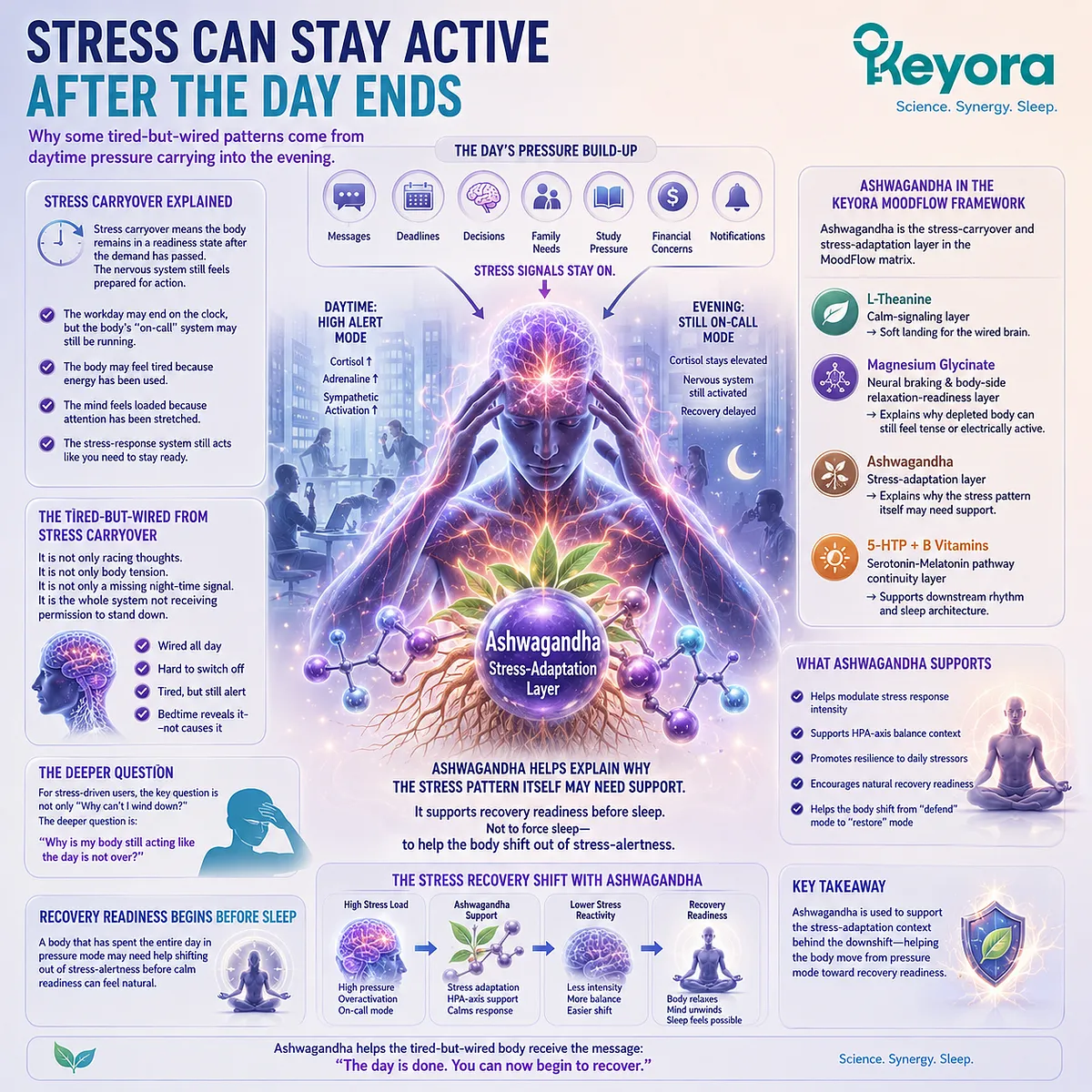
Ashwagandha and the Stress-Rhythm Layer
How HPA-axis rhythm context and stress-response feedback help explain recovery readiness.
Ashwagandha is often discussed as an adaptogenic herb.
In the MoodFlow framework, this means it helps explain everyday stress resilience and stress-rhythm support, not a medical treatment claim.
To understand this role, it helps to understand the HPA axis in simple terms.
The HPA axis is part of the body’s stress communication system. It helps coordinate how the body responds to pressure, challenge, workload, and perceived demand. It is not bad. It is not something the body should eliminate.
The HPA axis helps the body respond.
The tired-but-wired question is different: can the stress-response system shift toward recovery when the demand has passed?
This distinction is important. The goal is not to attack the stress system. The goal is to support rhythm, feedback, and recovery readiness under everyday pressure.
Cortisol is often misunderstood in the same way.
Cortisol is not simply a “bad stress hormone.” It helps support alertness, energy, and readiness at appropriate times. The issue is not cortisol itself. The issue is whether stress-alertness stays too loud when the body needs wind-down.
MoodFlow does not frame Ashwagandha as a cortisol-lowering shortcut. It frames Ashwagandha as part of stress-rhythm support.
That language matters because it keeps the claim accurate and responsible. Ashwagandha should not be described as fixing cortisol, curing burnout, balancing hormones, or repairing the HPA axis. Those phrases overstate the role of a wellness ingredient.
A better explanation is this: Ashwagandha supports the body’s adaptation to everyday stress, which may help explain recovery readiness when pressure has been high.
Ashwagandha contains withanolides, compounds often discussed in relation to its adaptogenic profile.
In consumer language, adaptogenic support means helping the body respond to stress more steadily, not forcing the body into sleep or shutting down normal alertness.
This is why Ashwagandha is especially relevant for people whose tired-but-wired pattern is stress-driven.
Their main issue may not be only mental overactivity. It may be that the body has stayed in readiness mode for too long. The evening arrives, but the system is still carrying the shape of the day.
Ashwagandha’s value in MoodFlow is not that it forces the body into sleep; it helps support the stress-adaptation context that makes recovery readiness easier to understand.
For Keyora, this is the stress-rhythm layer: the bridge between daytime pressure and evening downshift.
When stress carryover is part of the pattern, sleep readiness cannot be explained only by melatonin, mental quiet, or body relaxation. The stress-response system also needs to be included in the story.
That is where Ashwagandha fits.
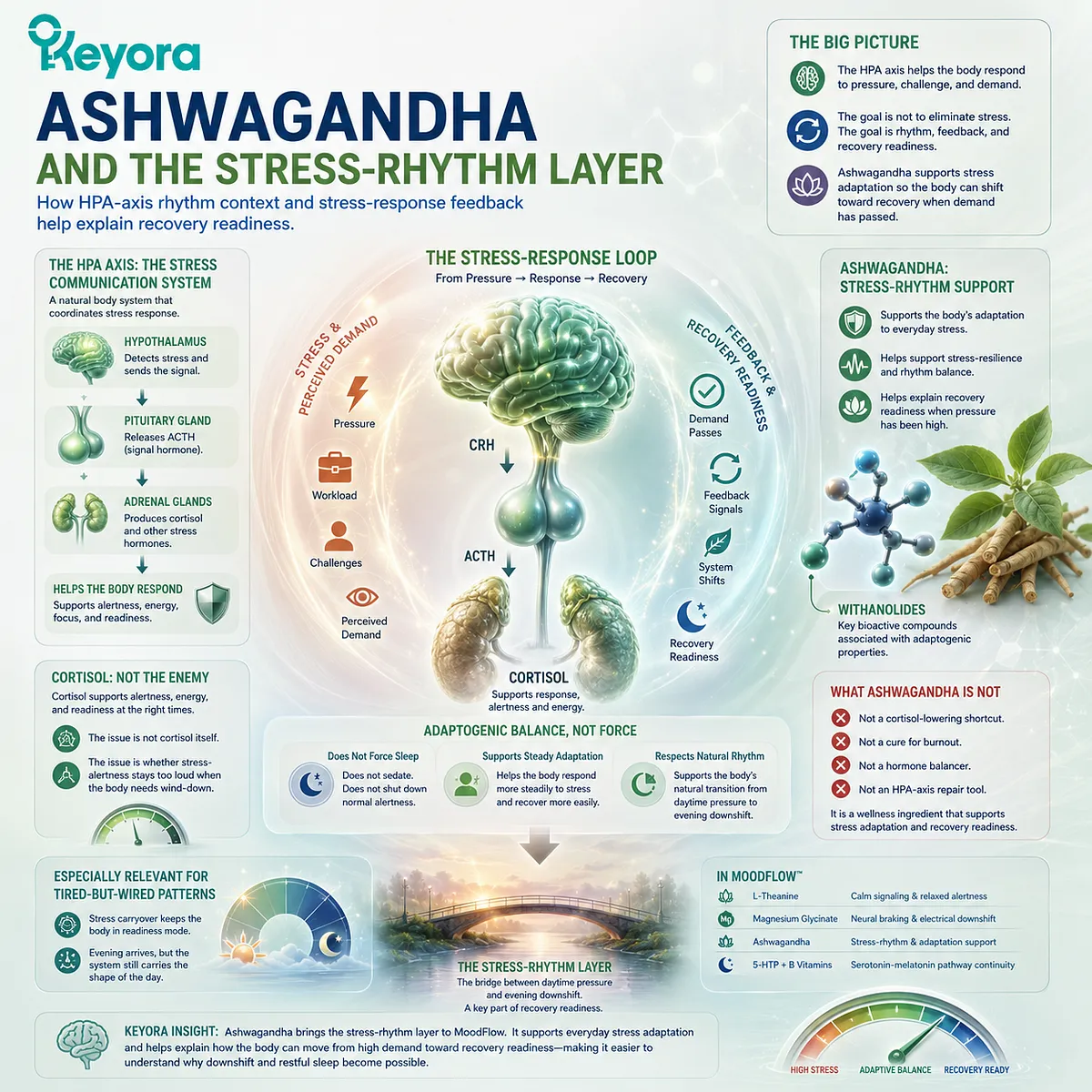
Why Ashwagandha Works Best With Calm and Braking Support
Why stress-rhythm support needs L-Theanine, magnesium glycinate, and pathway continuity around it.
Ashwagandha is important, but MoodFlow does not use it as a stand-alone stress shortcut.
Stress-driven tired-but-wired patterns usually involve more than one layer. The stress system may remain active. The mind may feel reactive. The body may remain tense. The sleep-rhythm pathway may not fully organize into wind-down.
That is why Ashwagandha works best inside a broader matrix.
Inside Keyora MoodFlow, Ashwagandha is not used as a stand-alone stress shortcut; it is the stress-rhythm adaptation layer within a broader downshift matrix that also includes calm signaling, neural braking, and serotonin-melatonin continuity.
Ashwagandha is the main character in this article because it explains the stress-carryover pattern.
When the whole day has been demanding, the body may need support moving out of readiness mode and toward recovery readiness.
But if stress makes the mind reactive, calm signaling also matters. This is where L-Theanine fits. L-Theanine helps support relaxed alertness and a softer mental landing. It helps explain why the mind may need smoother signaling, not forced shutdown.
If stress leaves the body tense, neural braking also matters. This is where magnesium glycinate fits.
Magnesium glycinate supports relaxation readiness, body-side downshift, and the braking context around activation. It helps explain why a tired body may still feel switched on.
If stress disrupts the evening transition, pathway continuity also matters. This is where 5-HTP and B vitamins fit.
5-HTP supports upstream serotonin-melatonin pathway logic. B6 and B12 support conversion and methylation context. This is not a sleep guarantee. It is sleep-readiness pathway support.
Together, these layers make MoodFlow different from an Ashwagandha-only stress formula.
-
An Ashwagandha-only message might focus only on stress.
-
A melatonin-only message might focus only on the night signal.
-
A magnesium-only message might focus mainly on braking and body relaxation.
-
A theanine-only message might focus mainly on calm mental tone.
MoodFlow connects the layers.
For stress-driven tired-but-wired users, that matters because the experience is usually not one-dimensional. Stress carryover can keep the mind alert, the body tense, and the sleep transition incomplete at the same time.
Ashwagandha helps explain the stress-rhythm part of that loop, while the rest of the matrix supports the surrounding downshift needs.
This is why MoodFlow should not be described as a sedative, sleep drug, or cortisol solution. Its value is more precise: it supports the transition from stress-alertness to calm recovery readiness through multiple wellness pathways.
For Keyora, Ashwagandha gives the formula a stress-adaptation foundation. It helps explain why tired-but-wired support must often begin earlier than bedtime, with the body’s ability to move out of stress mode.
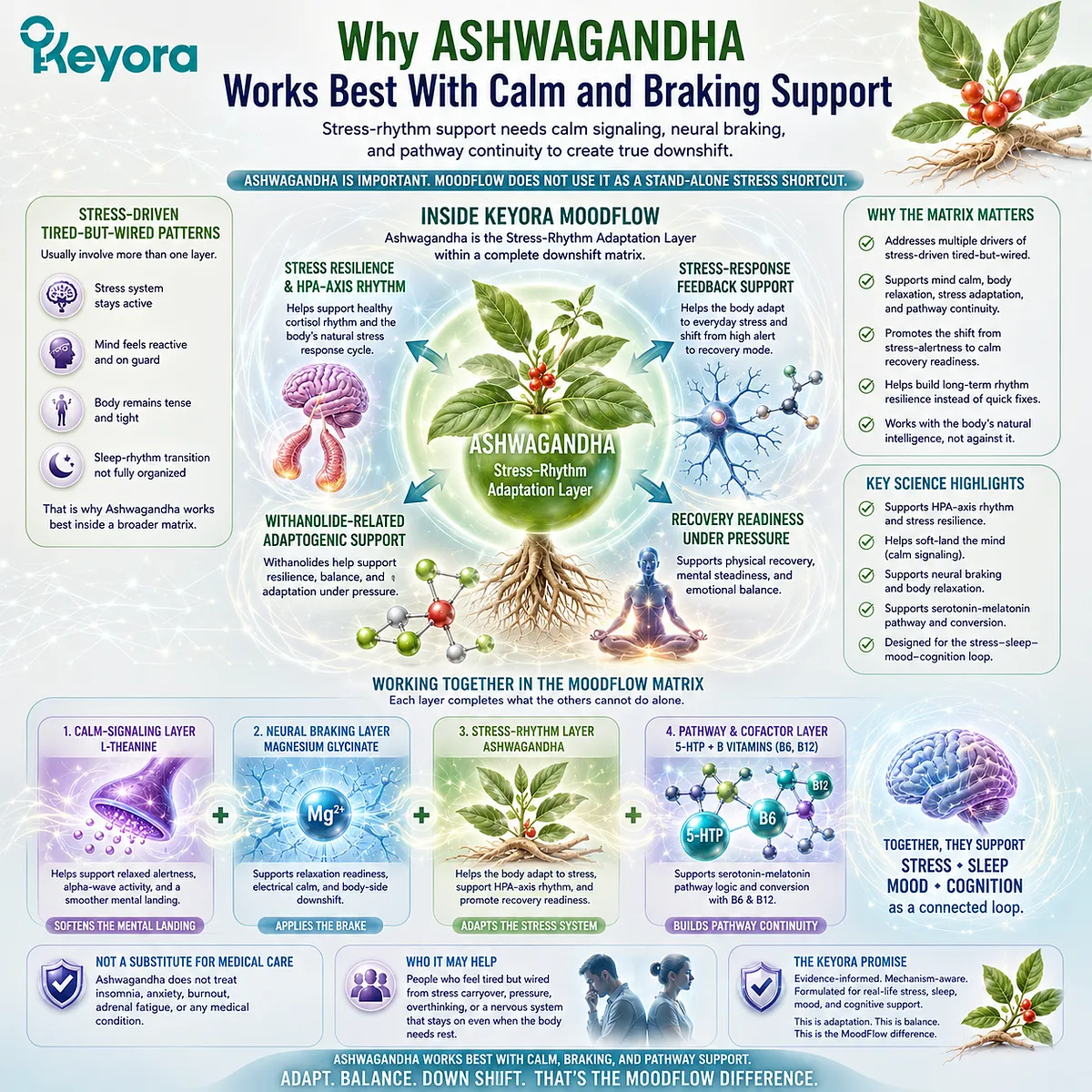
Closing Summary
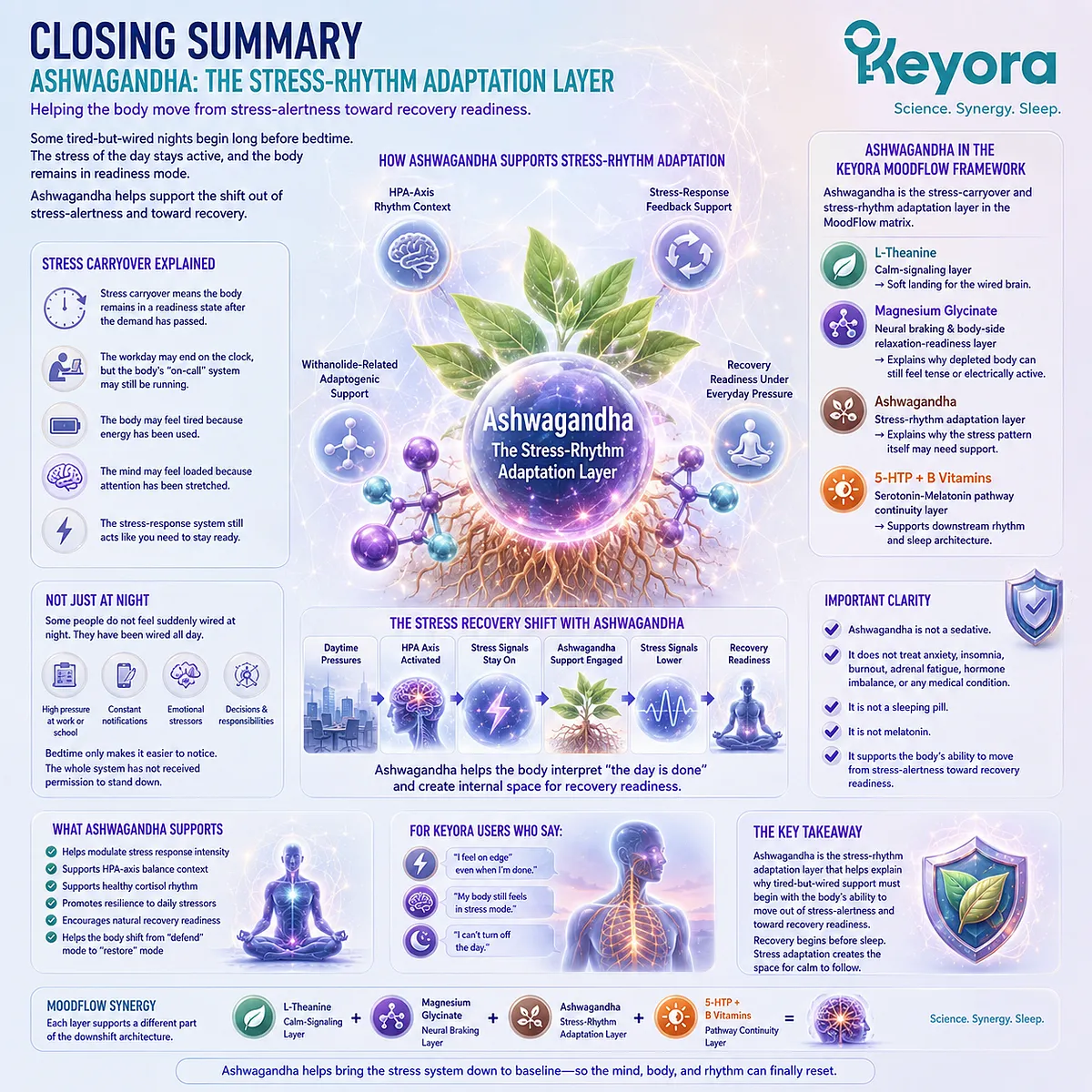
Ashwagandha supports the stress-carryover side of tired-but-wired patterns. Some tired-but-wired nights do not begin at bedtime. They begin with daytime pressure that stays active into the evening.
In the Keyora MoodFlow framework, Ashwagandha is the stress-rhythm adaptation layer. It helps explain HPA-axis rhythm context, stress-response feedback, withanolide-related adaptogenic support, and recovery readiness under everyday pressure.
This does not mean Ashwagandha treats anxiety, insomnia, burnout, adrenal fatigue, hormone imbalance, or any medical condition. It means Ashwagandha supports the body’s ability to move from stress-alertness toward recovery readiness.
Inside MoodFlow, Ashwagandha works with L-Theanine for calm signaling, magnesium glycinate for neural braking, and 5-HTP with B vitamins for serotonin-melatonin pathway continuity.
For Keyora, Ashwagandha is the stress-rhythm adaptation layer that helps explain why tired-but-wired support must begin with the body’s ability to move out of stress-alertness and toward recovery readiness.
This article is for educational and informational purposes only. It does not provide medical advice, diagnosis, treatment, cure, prevention, disease outcome claims, hormone restoration claims, fertility outcome claims, or formula-specific clinical efficacy claims.