
How Does Magnesium Glycinate Support Tired-But-Wired Patterns?
Keyora Research Q&A Library
This is part of the Keyora Research Q&A Series, derived from Keyora Nutritional Neurology Seriers .
Within the Keyora Nutritional Neurology framework, this Q&A translates complex nutrient–brain mechanisms into reader-friendly, evidence-bound answers, focusing on stress resilience, sleep quality, calm mood support, cognitive wellness, and the broader interaction between nutrition, neurochemistry, and daily nervous-system function.
First published by Keyora Research Journal: www.keyorahealth.com

Direct Answer
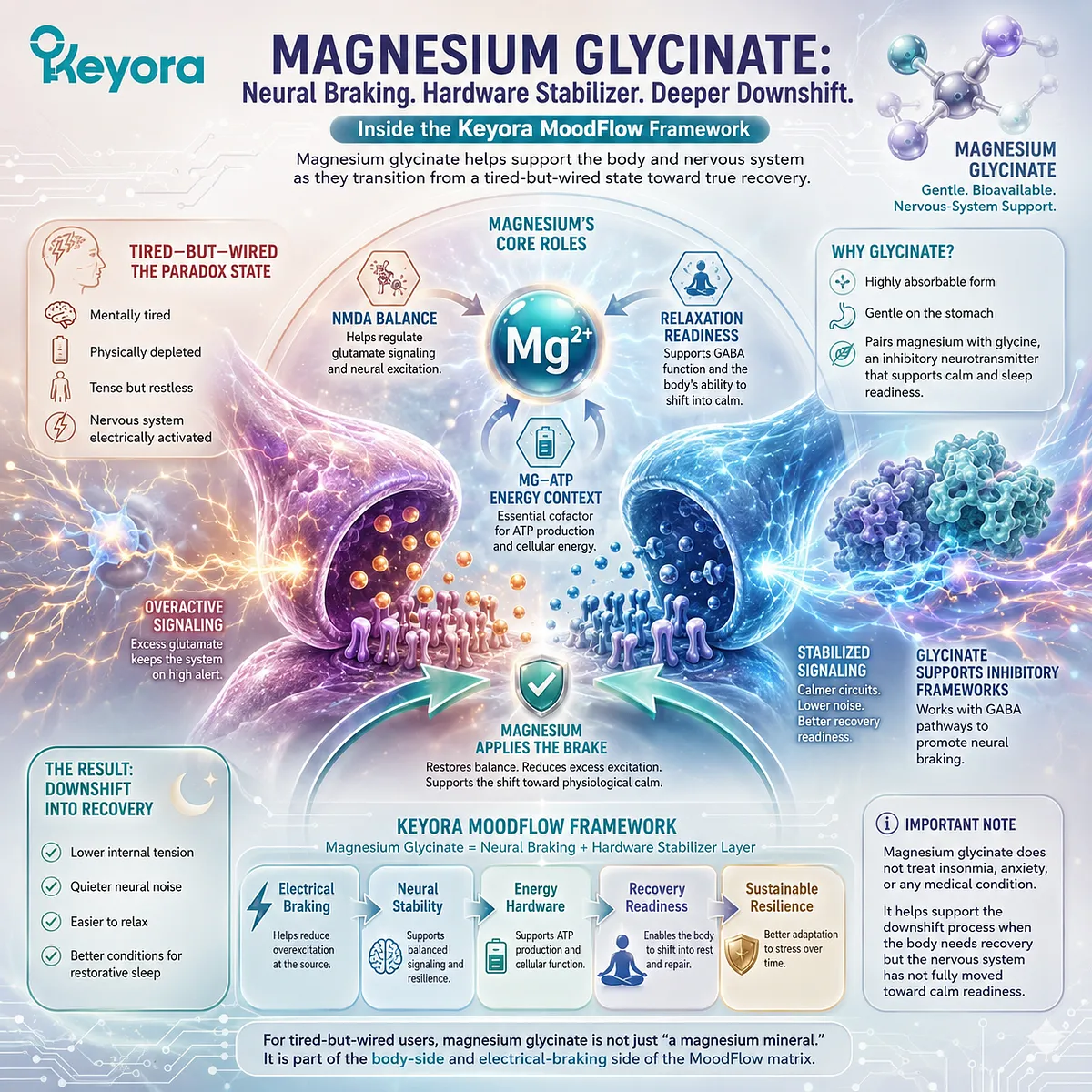
Magnesium glycinate may support tired-but-wired patterns because this state often involves more than mental activity. The body may feel depleted, tense, or unable to relax, while the nervous system remains electrically activated.
In the Keyora MoodFlow framework, magnesium glycinate is positioned as the neural braking and hardware-stabilizer layer.
Magnesium helps explain NMDA balance, relaxation readiness, and Mg-ATP energy context, while the glycinate form is valued for gentle daily nervous-system support.
This does not mean magnesium glycinate treats insomnia, anxiety, or any medical condition. It means magnesium glycinate helps support the downshift process when the body needs recovery but the nervous system has not fully moved toward calm readiness.
For tired-but-wired users, magnesium glycinate is not just “a magnesium mineral.” It is part of the body-side and electrical-braking side of the MoodFlow matrix.
Tired But Wired Is Not Only in the Mind
Why body tension, electrical activation, and recovery demand matter.
When people describe tired-but-wired, they often focus on the mind. They say their thoughts will not stop, their brain feels awake, or they cannot stop planning, replaying, or scanning.
That is one part of the pattern. But tired-but-wired is not only in the mind.
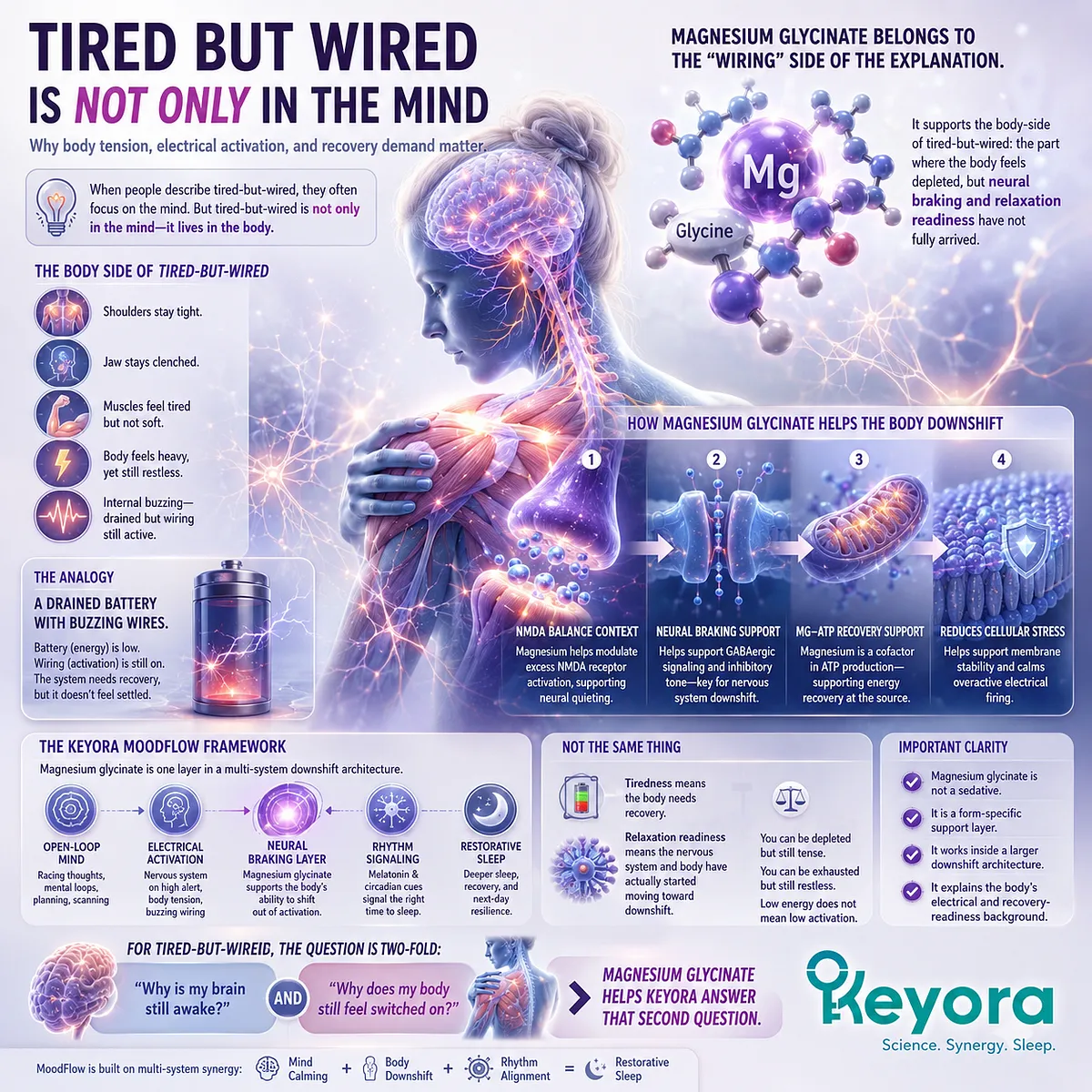
Many people also feel it in the body. The shoulders stay tight. The jaw stays clenched. The muscles feel tired but not soft. The body feels heavy, yet still restless. There may be an internal buzzing feeling, as if the body is drained but the wiring is still active.
This is where magnesium glycinate becomes especially relevant.
A tired body is not always a relaxed body.
Tiredness means the body needs recovery.
Relaxation readiness means the nervous system and body have actually started moving toward downshift. These are not the same thing.
Someone can be depleted but still tense. Someone can be exhausted but still physically restless. Someone can feel low on energy while the nervous system still feels activated.
A useful analogy is a drained battery with buzzing wires. The battery is low, so the system needs recovery. But the wiring is still active, so the system does not feel settled.
Magnesium glycinate belongs to the “wiring” side of the explanation.
In the Keyora MoodFlow framework, magnesium glycinate is used to explain the body-side of tired-but-wired: the part where the body feels depleted, but neural braking and relaxation readiness have not fully arrived.
This is different from a racing-thoughts article, where the focus is the open-loop mind. It is also different from a melatonin article, where the focus is rhythm signaling. Magnesium glycinate helps explain the body’s electrical and recovery-readiness background.
That matters because sleep readiness is not only about feeling mentally calm. It can also involve physical tension, nervous-system stability, and the body’s ability to shift away from activation.
For a tired-but-wired user, the question is not only “Why is my brain still awake?” It may also be “Why does my body still feel switched on?”
Magnesium glycinate helps Keyora answer that second question.
It supports the formula’s neural braking layer.
It helps explain why the body may need support for relaxation readiness, NMDA balance context, and Mg-ATP recovery background.
It also helps explain why MoodFlow uses magnesium glycinate specifically, rather than treating all magnesium forms as interchangeable.
This does not make magnesium glycinate a sedative or a treatment. It makes it a form-specific support layer inside a larger downshift architecture.
Magnesium Glycinate and Neural Braking
How NMDA balance, GABA context, and Mg-ATP support help explain downshift readiness.
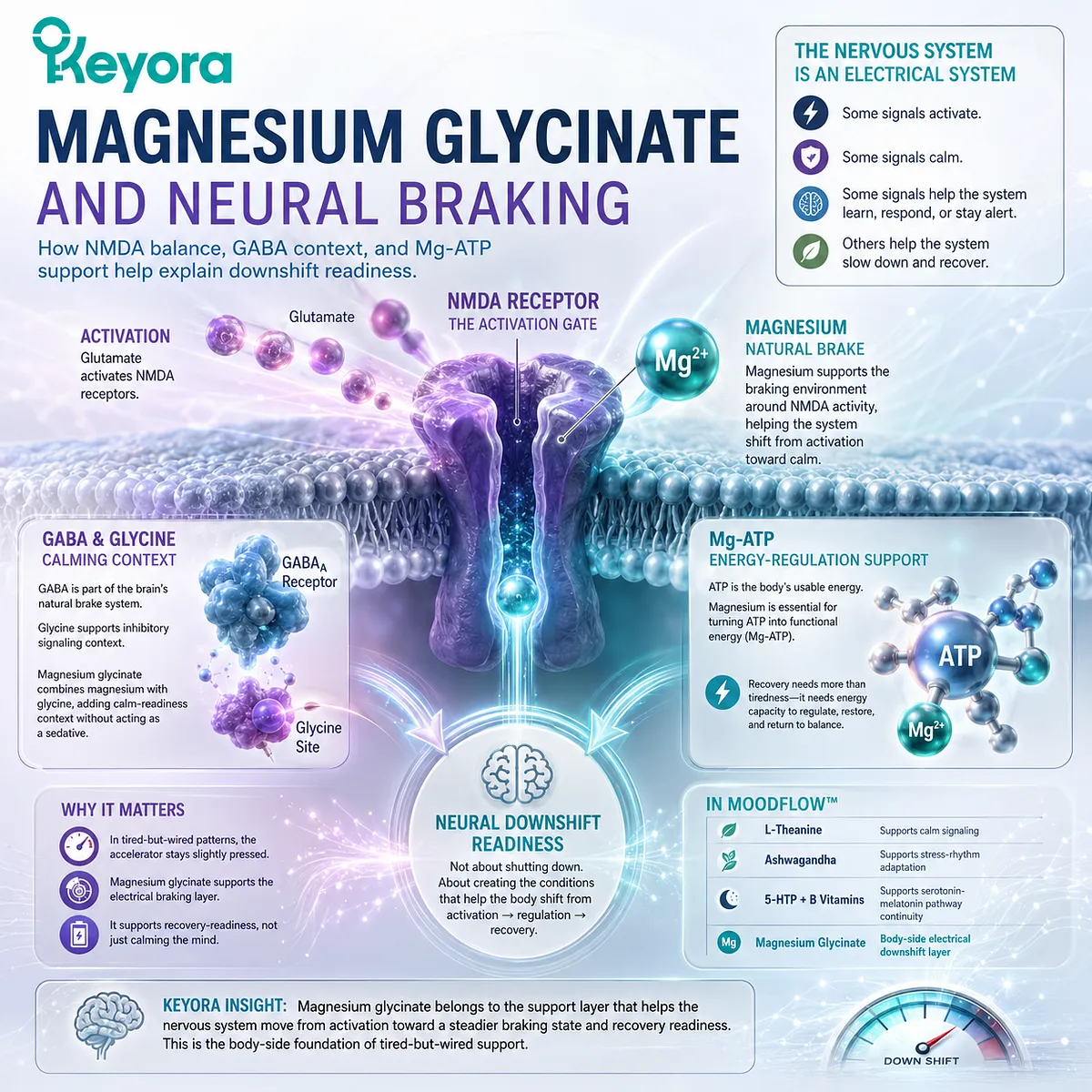
To understand why magnesium glycinate matters for tired-but-wired patterns, it helps to think about the nervous system as an electrical system.
The brain and nerves use signals.
-
Some signals activate.
-
Some signals calm.
-
Some signals help the system learn, respond, or stay alert.
-
Others help the system slow down and recover.
NMDA receptors are part of the activation side of this system. They are involved in glutamate-related signaling and can be understood as activation gates. This does not make NMDA “bad.” The brain needs activation to think, learn, and respond.
The problem in tired-but-wired patterns is not that activation exists. The problem is that activation may remain too loud when the body needs downshift.
Magnesium helps explain why the nervous system needs an electrical braking context, not only a mental calm signal.
In simple language, magnesium is relevant to the braking environment around NMDA-related activation. This does not mean magnesium glycinate clinically blocks NMDA or treats neurological excitability. The safer and more accurate explanation is that magnesium supports neural braking context and helps explain why downshift depends on more than tiredness.
This is why magnesium glycinate pairs well with the tired-but-wired scenario. The body may be tired, but the nervous system may still feel as if the accelerator is lightly pressed.
Magnesium belongs to the support layer that helps the system move toward a steadier braking state.
GABA and glycine-related context add another layer.
-
GABA is often discussed as part of the brain’s calming brake system.
-
Glycine is also connected with inhibitory signaling context.
Magnesium glycinate combines magnesium with glycine, which makes the form especially relevant to calm-readiness positioning.
The glycinate form adds a calm-readiness context without making the ingredient a sedative.
This is important.
Keyora should not describe magnesium glycinate as forcing sleep or shutting down the nervous system. Its value is more subtle: it supports the conditions that help the body move from activation toward relaxation readiness.
Mg-ATP is the third part of this story.
ATP is the body’s usable energy currency, and magnesium is closely tied to ATP biology. In many body processes, energy is not simply ATP alone; magnesium helps explain the functional energy context often referred to as Mg-ATP.
This matters for tired-but-wired patterns because recovery requires regulation. The body does not recover just because it is exhausted. It still needs energy-handling capacity to regulate, restore, and return toward balance.
Mg-ATP helps explain why tired-but-wired support is not only about calming the mind; it is also about supporting the energy-regulation background needed for recovery.
That is why magnesium glycinate can be understood as both a braking layer and a recovery-readiness layer.
In MoodFlow, magnesium glycinate does not stand alone. L-Theanine supports calm signaling. Ashwagandha supports stress-rhythm adaptation. 5-HTP with B vitamins supports serotonin-melatonin pathway continuity. But magnesium glycinate owns a very specific role: the body-side electrical downshift layer.
For Keyora, that role is central to tired-but-wired support.
Why Glycinate Is the Right Magnesium Form for MoodFlow
Why gentle tolerance matters when a formula is designed for daily nervous-system support.
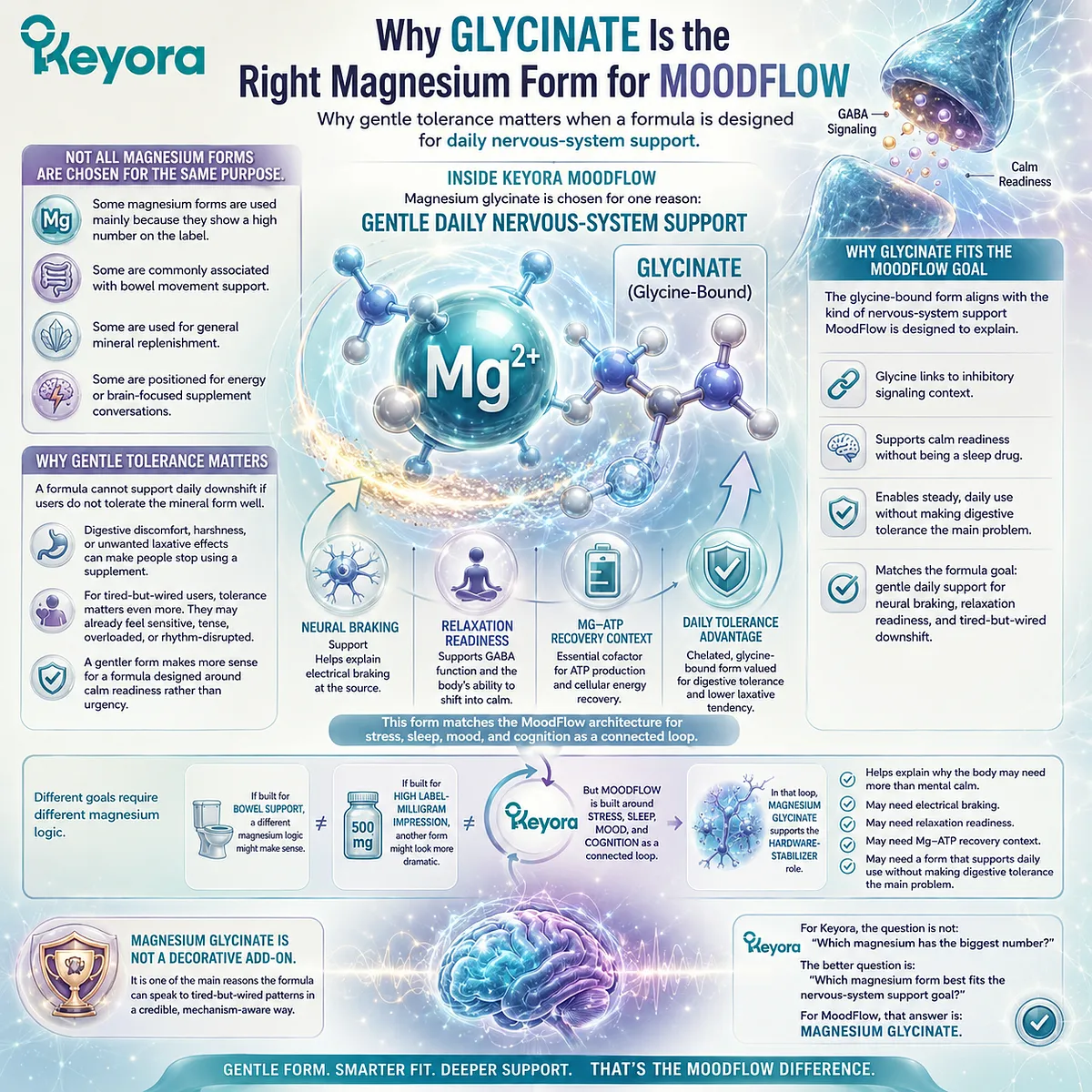
Not all magnesium forms are chosen for the same purpose.
-
Some magnesium forms are used mainly because they show a high number on the label.
-
Some are commonly associated with bowel movement support.
-
Some are used for general mineral replenishment.
-
Some are positioned for energy or brain-focused supplement conversations.
MoodFlow has a different goal.
MoodFlow is not trying to use magnesium as a harsh mineral hit. It is not trying to create a bowel-focused effect. It is not choosing a form simply because the label number looks large.
The goal is gentle daily nervous-system support.
That is why magnesium glycinate fits the MoodFlow architecture. It is a chelated, glycine-bound form of magnesium that is commonly valued for digestive tolerance and lower laxative tendency compared with some other forms. This matters because a stress-sleep formula needs to be usable consistently.
A formula cannot support daily downshift if users do not tolerate the mineral form well.
Digestive discomfort, harshness, or unwanted laxative effects can make people stop using a supplement before it becomes part of a steady wellness routine.
For tired-but-wired users, tolerance matters even more. These users may already feel sensitive, tense, overloaded, or rhythm-disrupted. A gentler form makes more sense for a formula designed around calm readiness rather than urgency.
Inside Keyora MoodFlow, magnesium glycinate is chosen not because all magnesium forms are the same, but because this form matches the formula goal: gentle daily support for neural braking, relaxation readiness, and tired-but-wired downshift.
The glycine-bound form also fits the calm-readiness story. Glycine gives the form a meaningful link to inhibitory signaling context. This does not mean magnesium glycinate is a sleep drug. It means the form aligns with the kind of nervous-system support MoodFlow is designed to explain.
This is where form selection becomes formula architecture.
If MoodFlow were built for bowel support, a different magnesium logic might make sense.
If it were built for a high label-milligram impression, another form might look more dramatic.
But MoodFlow is built around stress, sleep, mood, and cognition as a connected loop.
In that loop, magnesium glycinate supports the hardware-stabilizer role.
-
It helps explain why the body may need more than mental calm. It may need electrical braking.
-
It may need relaxation readiness.
-
It may need Mg-ATP recovery context.
-
It may need a form that supports daily use without making digestive tolerance the main problem.
This is why magnesium glycinate is not a decorative add-on in MoodFlow. It is one of the main reasons the formula can speak to tired-but-wired patterns in a credible, mechanism-aware way.
For Keyora, the question is not “Which magnesium has the biggest number?”
The better question is “Which magnesium form best fits the nervous-system support goal?”
For MoodFlow, that answer is magnesium glycinate.
Closing Summary
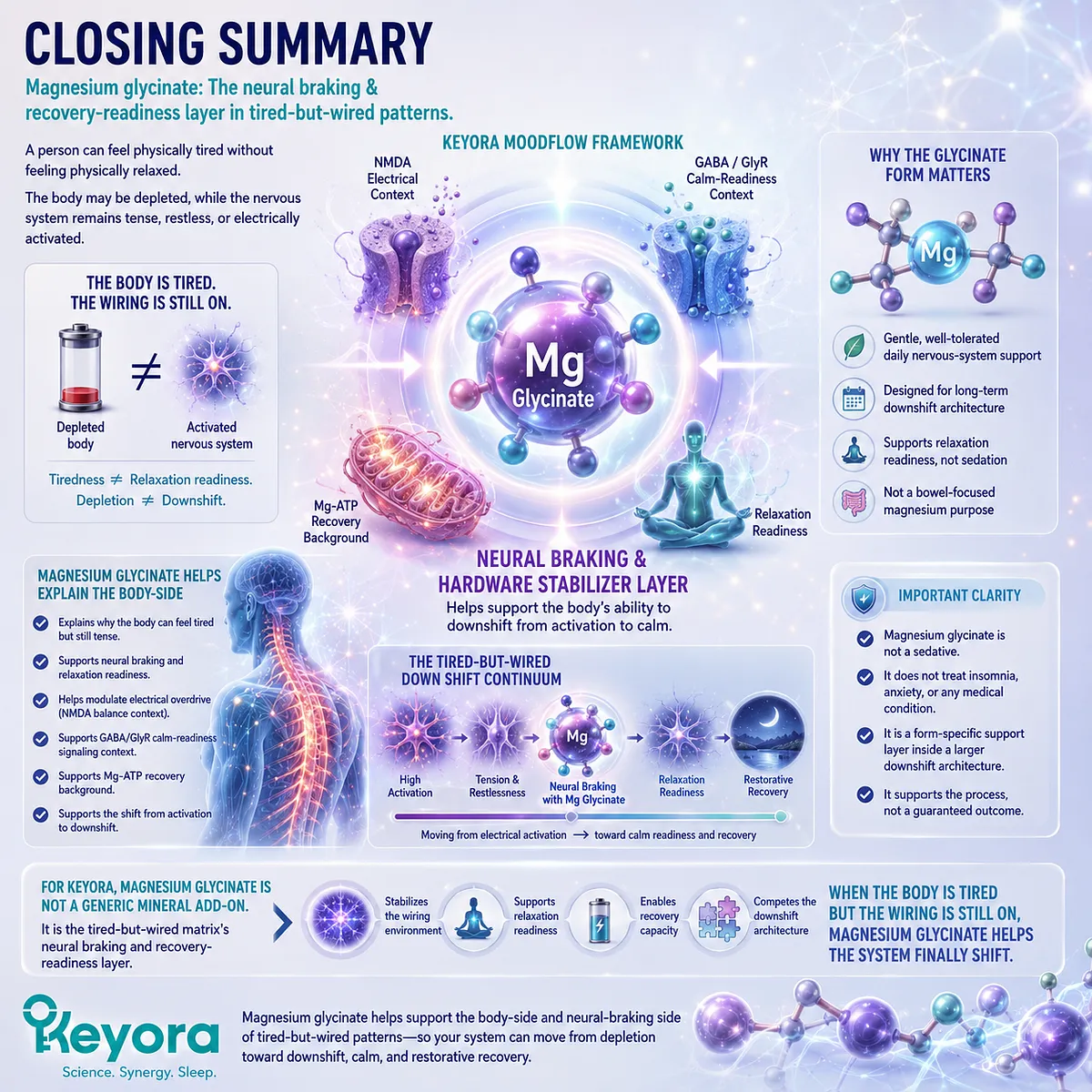
Magnesium glycinate supports the body-side and neural-braking side of tired-but-wired patterns. A person can feel physically tired without feeling physically relaxed. The body may be depleted, while the nervous system remains tense, restless, or electrically activated.
In the Keyora MoodFlow framework, magnesium glycinate is the neural braking and hardware-stabilizer layer. It helps explain NMDA electrical context, GABA/GlyR calm-readiness context, Mg-ATP recovery background, and relaxation readiness.
The glycinate form matters because MoodFlow is designed for gentle daily nervous-system support, not a harsh mineral effect or a bowel-focused magnesium purpose.
This does not mean magnesium glycinate treats insomnia, anxiety, or any medical condition. It means magnesium glycinate helps support the downshift process when the body needs recovery but the nervous system has not fully moved toward calm readiness.
For Keyora, magnesium glycinate is not a generic mineral add-on; it is the tired-but-wired matrix’s neural braking and recovery-readiness layer.
This article is for educational and informational purposes only. It does not provide medical advice, diagnosis, treatment, cure, prevention, disease outcome claims, hormone restoration claims, fertility outcome claims, or formula-specific clinical efficacy claims.