
Is Tired But Wired the Same as Insomnia?
Keyora Research Q&A Library
This is part of the Keyora Research Q&A Series, derived from Keyora Nutritional Neurology Seriers .
Within the Keyora Nutritional Neurology framework, this Q&A translates complex nutrient–brain mechanisms into reader-friendly, evidence-bound answers, focusing on stress resilience, sleep quality, calm mood support, cognitive wellness, and the broader interaction between nutrition, neurochemistry, and daily nervous-system function.
First published by Keyora Research Journal: www.keyorahealth.com

Direct Answer
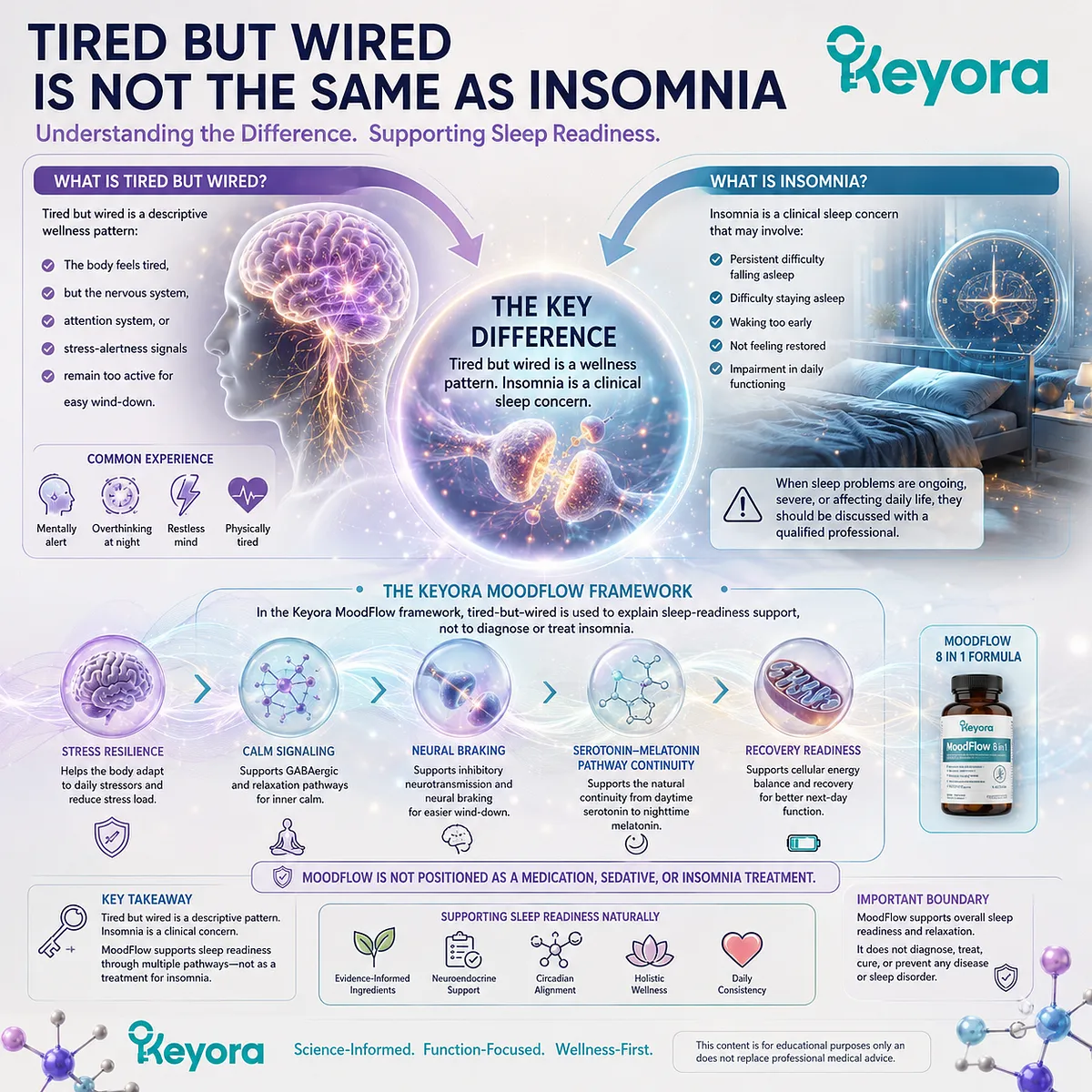
Tired but wired is not the same as insomnia. Tired but wired is a descriptive wellness pattern: the body feels tired, but the nervous system, attention system, or stress-alertness signals remain too active for easy wind-down.
Insomnia is a clinical sleep concern that may involve persistent difficulty falling asleep, staying asleep, waking too early, or not feeling restored.
When sleep problems are ongoing, severe, or affecting daily life, they should be discussed with a qualified professional.
In the Keyora MoodFlow framework, tired-but-wired is used to explain sleep-readiness support, not to diagnose or treat insomnia.
MoodFlow supports stress resilience, calm signaling, neural braking, serotonin-melatonin pathway continuity, and recovery readiness. It is not positioned as a medication, sedative, or insomnia treatment.
Tired But Wired Is a Pattern, Not a Diagnosis
Why this phrase describes an experience rather than a medical condition.
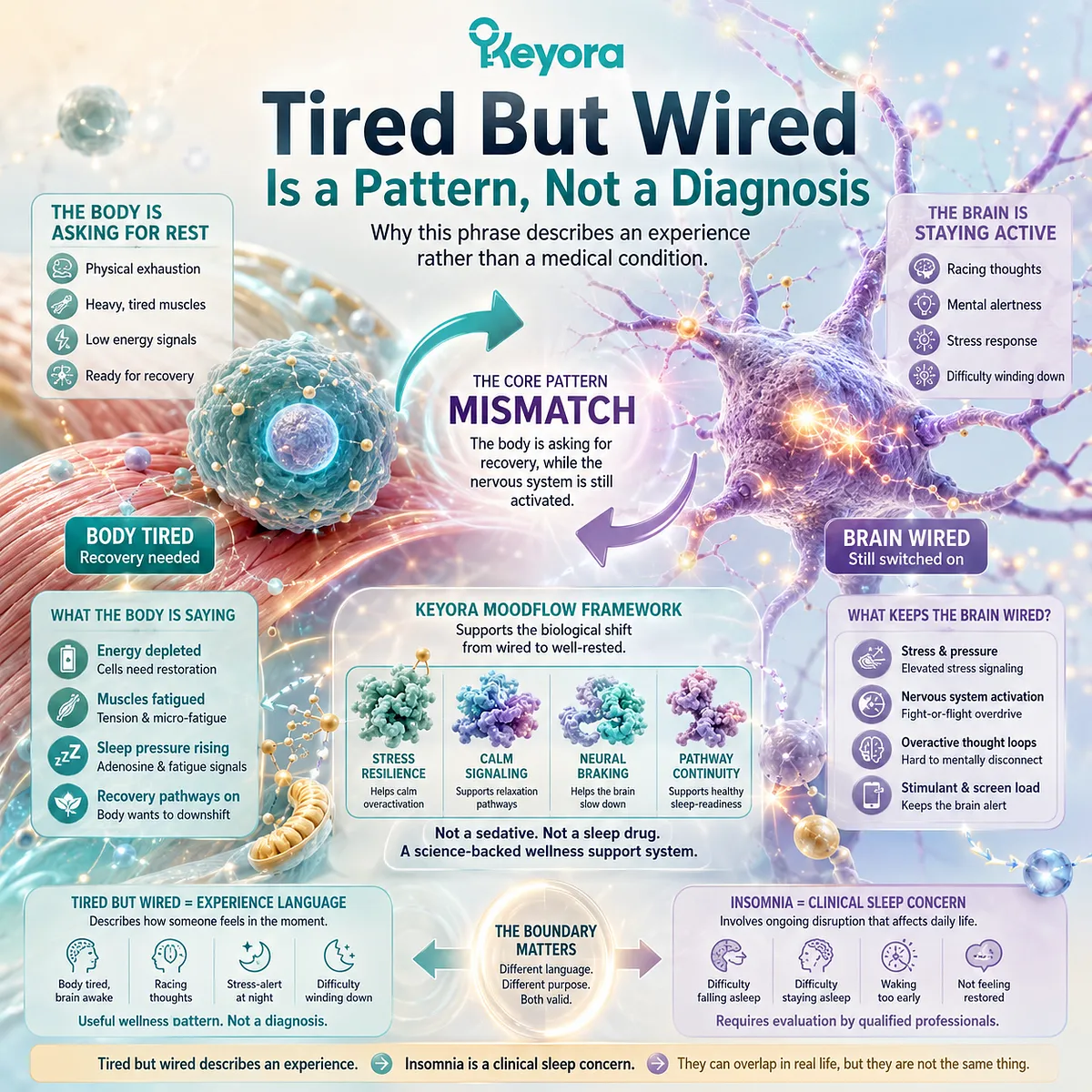
“Tired but wired” is a phrase people use when their body feels ready to rest, but their mind or nervous system still feels active. It is experience language. It describes how someone feels.
A person may say, “My body is exhausted, but my brain will not stop.” Another person may say, “I am tired, but I feel too alert to settle down.” Someone else may describe racing thoughts, body tension, or a feeling of being mentally switched on at night.
These are real experiences. But the phrase “tired but wired” is not a diagnosis.
It does not automatically mean insomnia. It does not automatically mean a sleep disorder. It does not explain every possible reason someone has difficulty resting.
Instead, tired-but-wired is a useful wellness pattern. It describes a mismatch: the body is asking for recovery, while the nervous system still feels activated.
In the Keyora MoodFlow framework, tired-but-wired is used as wellness pattern language, not as a diagnosis or disease label.
This distinction is important because consumer language and clinical language are not the same thing. Consumer language helps people describe what they feel. Clinical language is used by qualified professionals to evaluate patterns, duration, severity, causes, and impact.
Tired-but-wired language may include body tired, brain awake, racing thoughts before bed, stress-alertness at night, or difficulty winding down. It points to the experience of incomplete downshift.
Insomnia language is different. It may involve ongoing difficulty falling asleep, difficulty staying asleep, waking too early, or not feeling restored in a way that affects daily life. That kind of pattern deserves careful evaluation, especially when it persists.
For Keyora, this boundary matters. MoodFlow can help explain sleep-readiness support. It can help explain why stress resilience, calm signaling, neural braking, and pathway continuity may matter when someone feels tired but wired.
But MoodFlow should not be described as treating insomnia.
That is not a weakness in the formula. It is responsible language. A wellness formula should describe what it can support without turning everyday pattern education into medical claims.
So the simplest distinction is this: tired but wired describes an experience. Insomnia is a clinical sleep concern. They can overlap in real life, but they should not be treated as the same thing.
When Sleep Problems Need More Than Wellness Support
Why persistent or disruptive sleep difficulty should not be handled only with supplements.
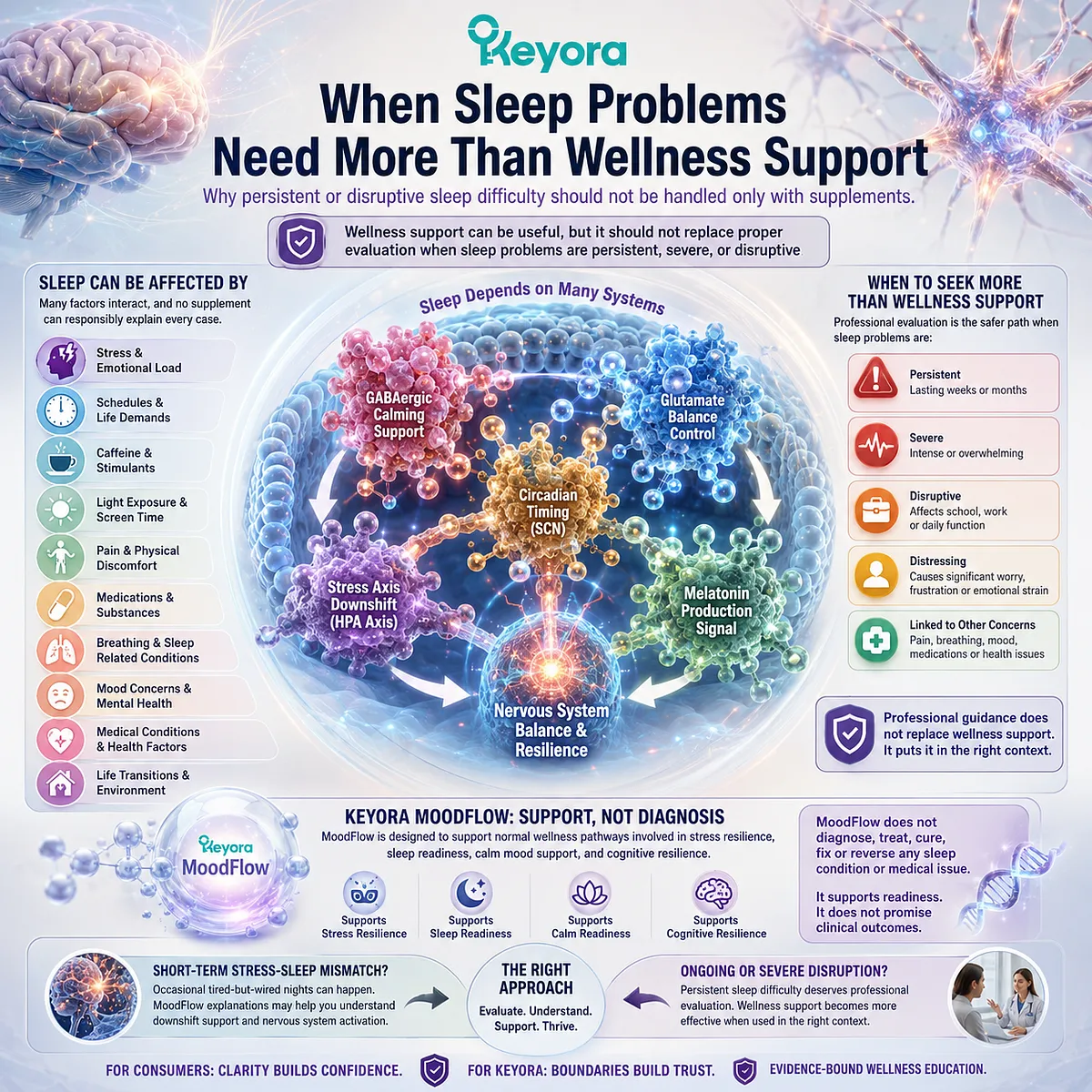
Wellness support can be useful, but it should not replace proper evaluation when sleep problems are persistent, severe, or disruptive.
This is especially important for sleep.
Sleep can be affected by many factors: stress, schedules, caffeine, light exposure, pain, medications, breathing issues, mood concerns, medical conditions, life transitions, and environmental changes.
A supplement cannot responsibly explain every case.
That is why persistent sleep difficulty should not be reduced to one ingredient, one pathway, or one product.
A person who occasionally feels tired but wired after a stressful day may be describing a common stress-sleep mismatch.
But if sleep difficulty continues, becomes intense, affects school or work, causes major distress, or appears alongside other health concerns, professional guidance is the safer path.
A responsible wellness formula should help explain support pathways, but it should not ask consumers to ignore persistent or serious sleep concerns.
This boundary also protects the meaning of MoodFlow.
Keyora MoodFlow is designed to support normal wellness pathways involved in stress resilience, sleep readiness, calm mood support, and cognitive resilience. It is not designed to diagnose why a specific person cannot sleep.
That difference matters.
If someone has a short-term tired-but-wired pattern, the MoodFlow explanation may help them understand downshift support. The article can explain why the nervous system may still feel activated even when the body is tired.
But if someone is dealing with ongoing sleep disruption, the conversation should include professional evaluation. That does not make nutritional support irrelevant. It simply places it in the right context.
Keyora’s role is evidence-bound wellness education. It can explain patterns like pre-sleep hyperarousal, racing thoughts before bed, stress-sleep mismatch, and body-tired-brain-awake experiences. It can explain why sleep readiness depends on more than one night-time signal.
But it should not promise clinical outcomes.
This is especially important when discussing insomnia. Words like “treat,” “cure,” “fix,” or “reverse” do not belong in MoodFlow Q&A articles.
The safer and more accurate language is support: supports sleep readiness, supports wind-down readiness, supports calm readiness, supports stress resilience.
For consumers, that clarity is valuable. It helps them understand what a product is designed to do and what it is not designed to do.
For Keyora, trust comes from drawing the line clearly.
What MoodFlow Can Responsibly Support
How Keyora frames sleep readiness without claiming to treat insomnia.
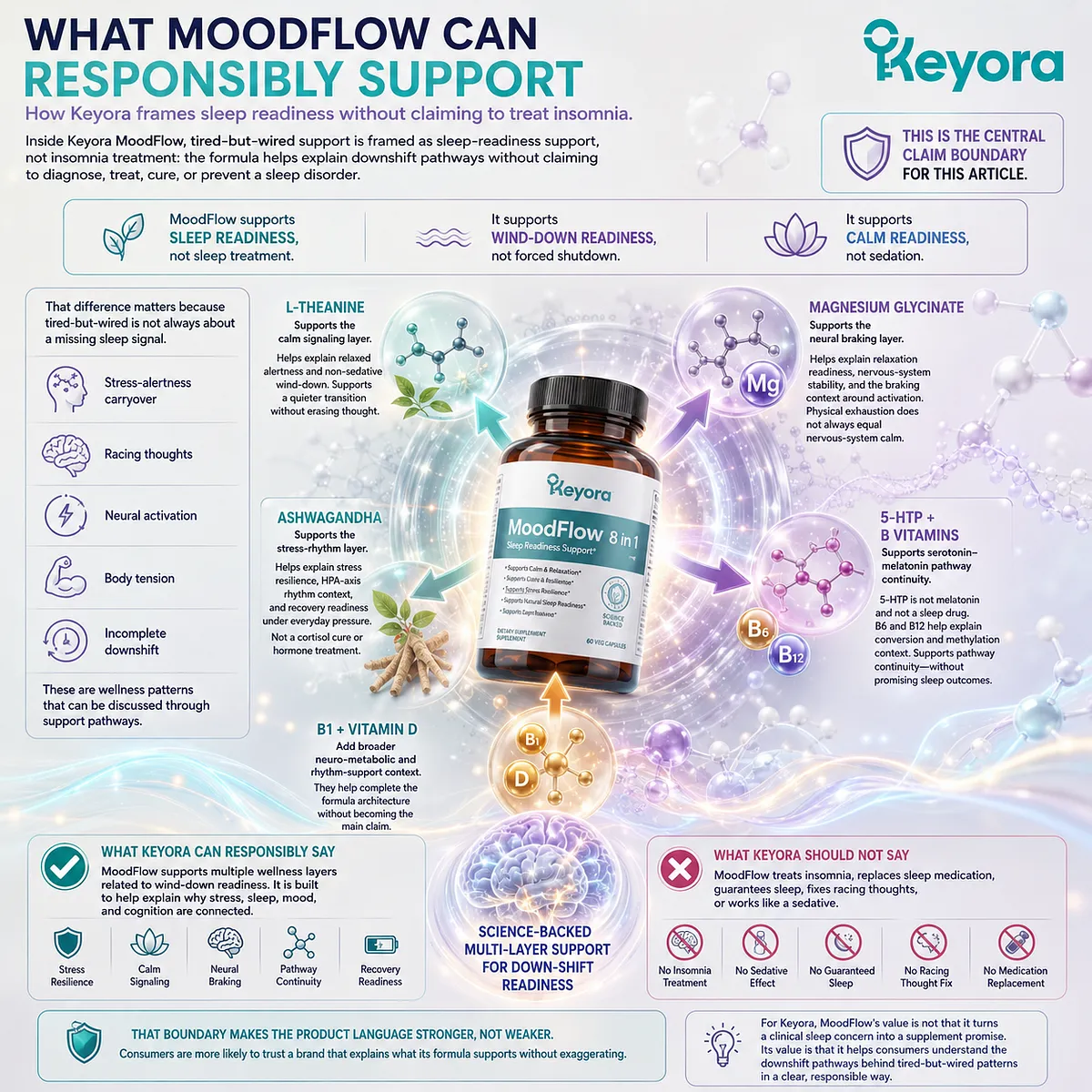
Inside Keyora MoodFlow, tired-but-wired support is framed as sleep-readiness support, not insomnia treatment: the formula helps explain downshift pathways without claiming to diagnose, treat, cure, or prevent a sleep disorder.
This is the central claim boundary for this article.
MoodFlow supports sleep readiness, not sleep treatment.
-
It supports wind-down readiness, not forced shutdown.
-
It supports calm readiness, not sedation.
That difference matters because tired-but-wired is not always about a missing sleep signal. It may involve stress-alertness carryover, racing thoughts, neural activation, body tension, or incomplete downshift. These are wellness patterns that can be discussed through support pathways.
L-Theanine supports the calm signaling layer.
It helps explain relaxed alertness and non-sedative wind-down. For someone whose mind feels busy, the goal is not to erase thought. The goal is to support a quieter transition.
Magnesium glycinate supports the neural braking layer.
It helps explain relaxation readiness, nervous-system stability, and the braking context around activation. For tired-but-wired users, this matters because physical exhaustion does not always equal nervous-system calm.
Ashwagandha supports the stress-rhythm layer.
It helps explain stress resilience, HPA-axis rhythm context, and recovery readiness under everyday pressure. It is not a cortisol cure or hormone treatment.
5-HTP with B vitamins supports serotonin-melatonin pathway continuity.
5-HTP is not melatonin and not a sleep drug. B6 and B12 help explain conversion and methylation context. Together, they help describe pathway support without promising sleep outcomes.
B1 and Vitamin D add broader neuro-metabolic and rhythm-support context.
They help complete the formula architecture without becoming the main claim.
This is what Keyora can responsibly say: MoodFlow supports multiple wellness layers related to wind-down readiness. It is built to help explain why stress, sleep, mood, and cognition are connected.
This is what Keyora should not say: MoodFlow treats insomnia, replaces sleep medication, guarantees sleep, fixes racing thoughts, or works like a sedative.
That boundary makes the product language stronger, not weaker. Consumers are more likely to trust a brand that explains what its formula supports without exaggerating.
For Keyora, MoodFlow’s value is not that it turns a clinical sleep concern into a supplement promise. Its value is that it helps consumers understand the downshift pathways behind tired-but-wired patterns in a clear, responsible way.
Closing Summary
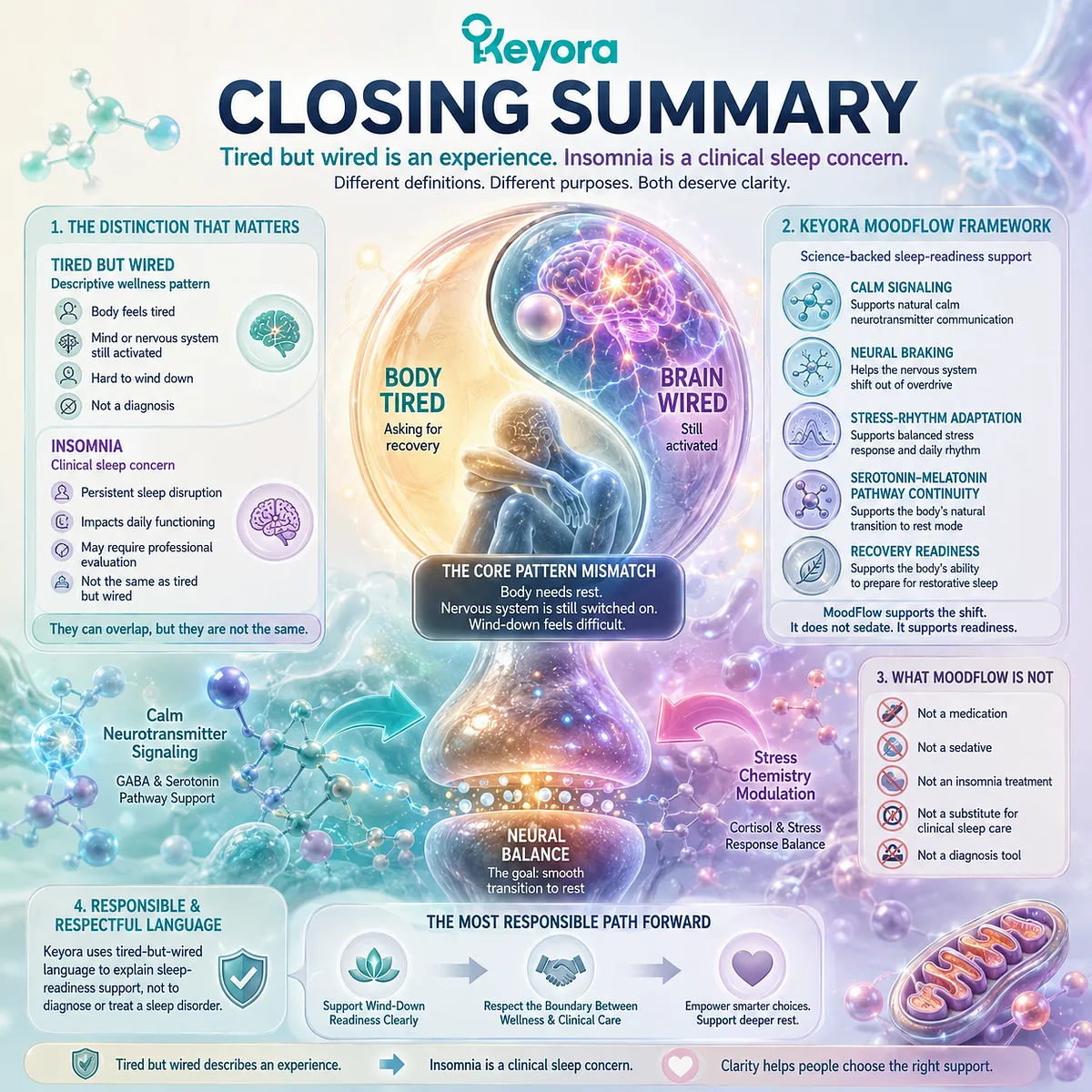
Tired but wired and insomnia should not be treated as the same thing. Tired but wired is a descriptive wellness pattern: the body feels tired, but the nervous system remains too activated for easy wind-down. Insomnia is a clinical sleep concern that may require professional evaluation when it is persistent, severe, or disruptive.
Keyora MoodFlow uses tired-but-wired language to explain sleep-readiness support, not to diagnose or treat a sleep disorder.
MoodFlow supports calm signaling, neural braking, stress-rhythm adaptation, serotonin-melatonin pathway continuity, and recovery readiness. It is not a medication, sedative, insomnia treatment, or substitute for clinical sleep care.
For Keyora, the most responsible way to discuss tired-but-wired sleep is to support wind-down readiness clearly while respecting the boundary between wellness education and clinical sleep care.
This article is for educational and informational purposes only. It does not provide medical advice, diagnosis, treatment, cure, prevention, disease outcome claims, hormone restoration claims, fertility outcome claims, or formula-specific clinical efficacy claims.