
Why Is Melatonin Not Always Enough When You Feel Tired But Wired?
Keyora Research Q&A Library
This is part of the Keyora Research Q&A Series, derived from Keyora Nutritional Neurology Seriers .
Within the Keyora Nutritional Neurology framework, this Q&A translates complex nutrient–brain mechanisms into reader-friendly, evidence-bound answers, focusing on stress resilience, sleep quality, calm mood support, cognitive wellness, and the broader interaction between nutrition, neurochemistry, and daily nervous-system function.
First published by Keyora Research Journal: www.keyorahealth.com

Direct Answer
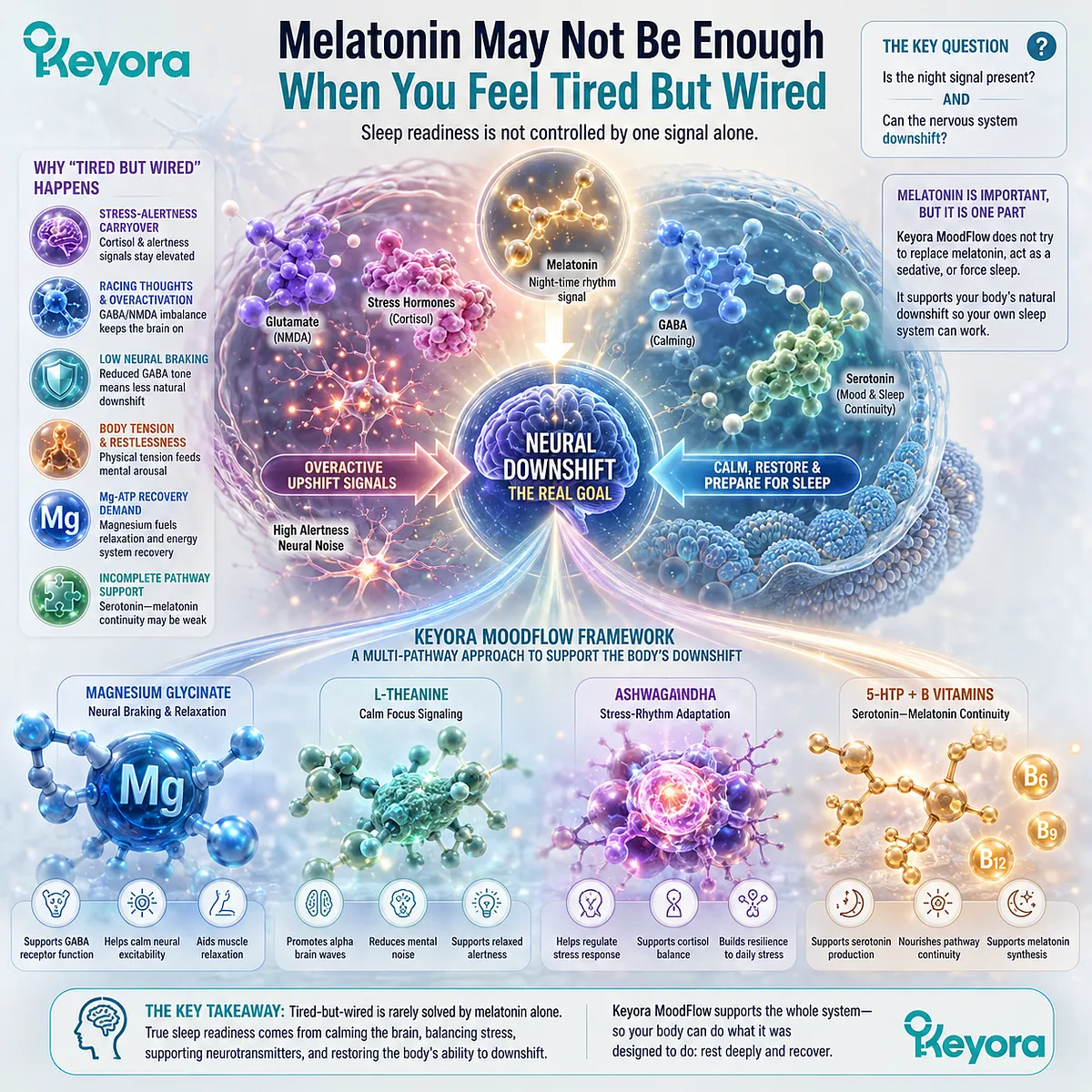
Melatonin may not be enough when you feel tired but wired because sleep readiness is not controlled by one signal alone.
Melatonin helps represent night-time rhythm, but a tired-but-wired pattern may also involve stress-alertness carryover, racing thoughts, GABA/NMDA activation, low neural braking, body tension, Mg-ATP recovery demand, and incomplete pathway support.
In the Keyora MoodFlow framework, melatonin is understood as one part of the sleep-rhythm story, not the whole story.
MoodFlow does not try to replace melatonin, act as a sedative, or force sleep.
Instead, Keyora MoodFlow supports the broader downshift process through magnesium glycinate for neural braking,
L-Theanine for calm signaling, Ashwagandha for stress-rhythm adaptation, and 5-HTP with B vitamins for serotonin-melatonin continuity.
For tired-but-wired users, the key question is not only “Is the night signal present?” It is also “Can the nervous system downshift?”
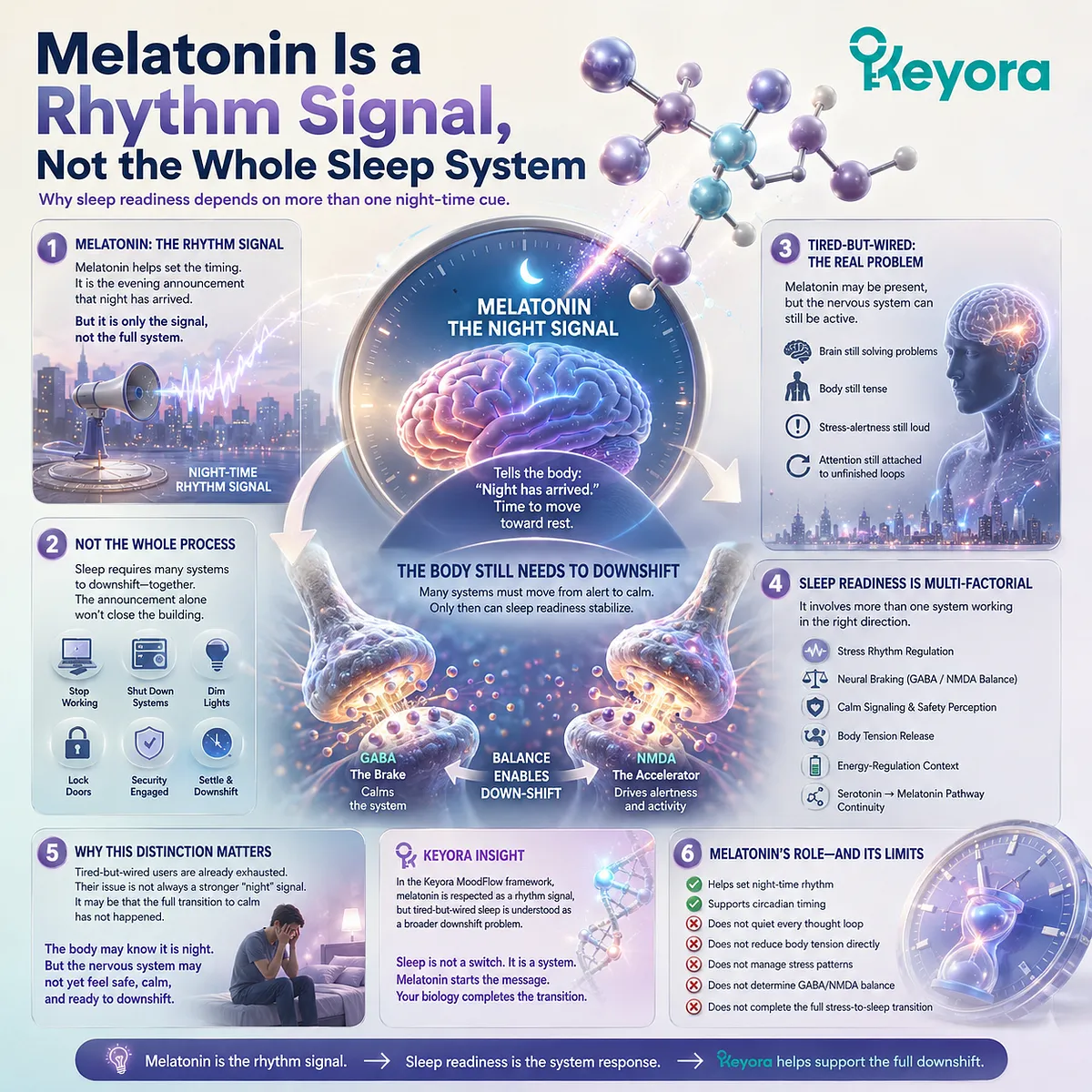
Melatonin Is a Rhythm Signal, Not the Whole Sleep System
Why sleep readiness depends on more than one night-time cue.
Melatonin is important, but it is often misunderstood.
Many people think of melatonin as the sleep switch. They assume that if melatonin is present, sleep should happen automatically. But the body’s sleep-readiness system is more layered than that.
Melatonin is better understood as a night-time rhythm signal. It helps tell the body that night has arrived and that the system should move toward rest. That signal matters.
But a signal is not the same as the whole process.
A useful analogy is a building closing announcement. Melatonin is like the evening message that says, “The building is closing.” But the building still needs people to stop working, computers to shut down, lights to dim, doors to lock, and the security system to settle.
If everyone inside the building keeps working, the announcement alone may not be enough.
That is similar to tired-but-wired sleep. The night signal may be present, but the nervous system may still be active. The brain may still be solving problems. The body may still feel tense. Stress-alertness may still be loud. Attention may still be attached to unfinished loops.
This is why melatonin should not be dismissed, but it also should not be treated as the whole sleep system.
In the Keyora MoodFlow framework, melatonin is respected as a rhythm signal, but tired-but-wired sleep is understood as a broader downshift problem.
This distinction matters because tired-but-wired users often already feel exhausted. Their issue is not always that they need a stronger “night” message. Their issue may be that the body and brain have not completed the transition from alertness into calm readiness.
Sleep readiness requires more than time on the clock. It can involve stress rhythm, neural braking, calm signaling, body tension release, energy-regulation context, and serotonin-melatonin pathway continuity.
Melatonin belongs to the rhythm part of that story. But it does not automatically quiet every open thought loop. It does not directly explain body tension. It does not fully describe the brake-and-accelerator relationship of GABA and NMDA. It does not cover the whole stress-to-sleep transition.
For Keyora, this is why a melatonin-only explanation can be too narrow for tired-but-wired patterns. The body may know it is night, but the nervous system may not yet feel safe, calm, and ready to downshift.
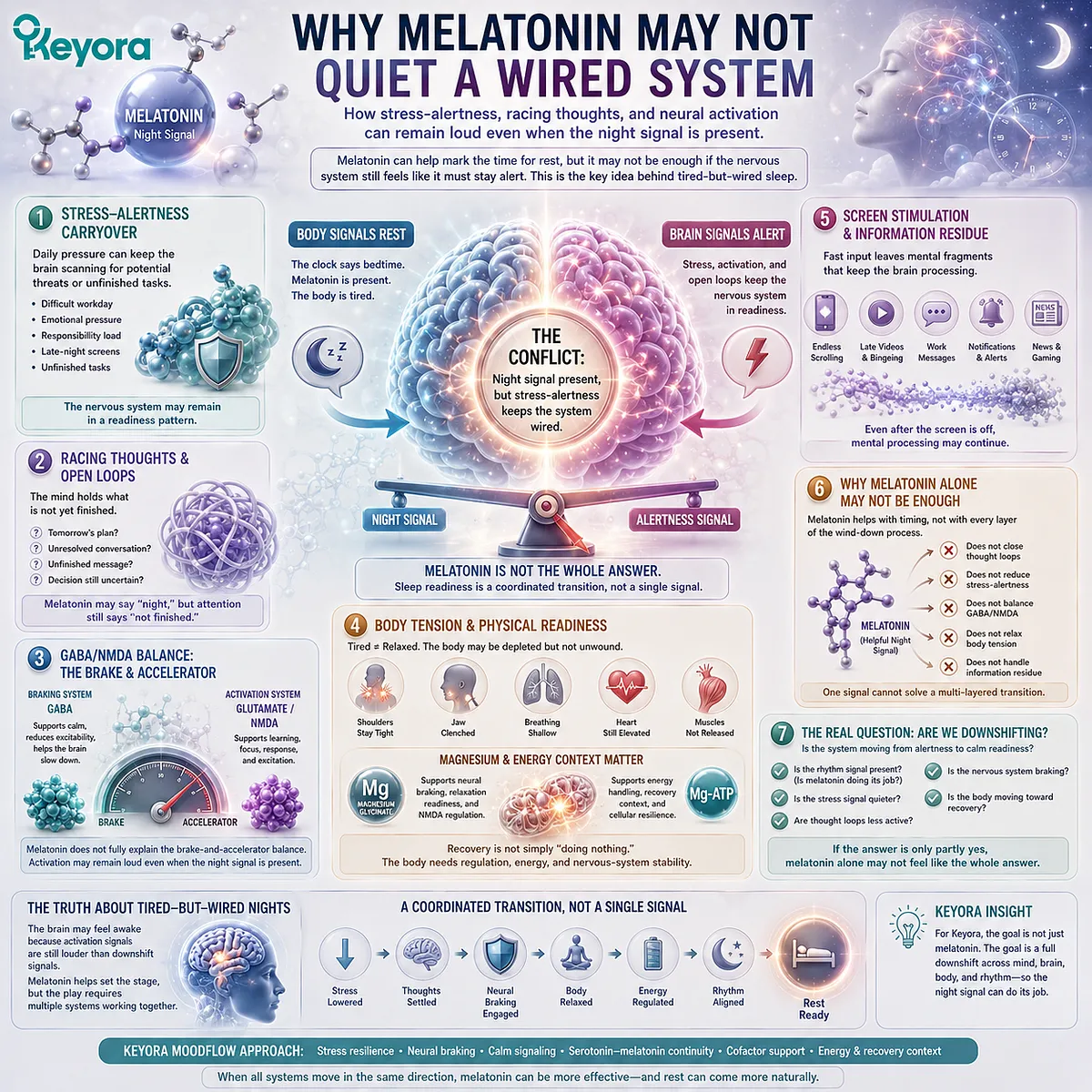
Why Melatonin May Not Quiet a Wired System
How stress-alertness, racing thoughts, and neural activation can remain loud even when the night signal is present.
Melatonin can help mark the time for rest, but it may not be enough if the nervous system still feels like it must stay alert.
This is the key idea behind tired-but-wired sleep.
The body may receive a night-time rhythm signal, but stress may still be sending another message: “Stay ready.”
When those signals compete, a person can feel confused. The body is tired, the clock says bedtime, but the mind and nervous system still feel active.
This is not because melatonin is useless. It is because melatonin is not designed to solve every layer of the wind-down process.
Stress-alertness carryover is one reason. A difficult workday, emotional pressure, unfinished tasks, late-night screens, or responsibility load can keep the brain scanning. The nervous system may remain in a readiness pattern even when the body needs rest.
Racing thoughts are another example. If the mind is holding open loops, a rhythm signal alone may not close them. Tomorrow’s plan, an unresolved conversation, an unfinished message, or a decision that still feels uncertain can continue to pull attention.
Melatonin may say “night,” but the attention system may still say “not finished.”
GABA/NMDA balance is another layer. GABA can be understood as part of the brain’s calming brake system. Glutamate and NMDA receptors are part of the activation system. A tired-but-wired brain may feel as if the activation gate is still open while the braking system has not fully engaged.
Melatonin does not fully explain that brake-and-accelerator relationship. A person may have a night-time signal present, but still feel mentally overactive because neural activation remains loud.
Body tension also matters. Some people feel physically tired but not physically relaxed.
The shoulders stay tight.
The jaw stays clenched. Breathing stays shallow.
The body is depleted, but it has not fully softened into recovery.
This is where magnesium-related neural braking and Mg-ATP context become important in the MoodFlow framework. Recovery is not simply “doing nothing.” The body still needs regulation, energy handling, and nervous-system stability to move toward rest.
This is why a tired-but-wired night can feel so frustrating.
The user may think, “I did the sleep thing.
Why is my brain still on?”
But sleep readiness is not one signal. It is a coordinated transition.
For Keyora, the melatonin question is really a downshift question. Is the rhythm signal present? Is the stress signal quieter? Are thought loops less active? Is the nervous system braking? Is the body moving toward recovery?
If the answer is only partly yes, melatonin alone may not feel like the whole answer.
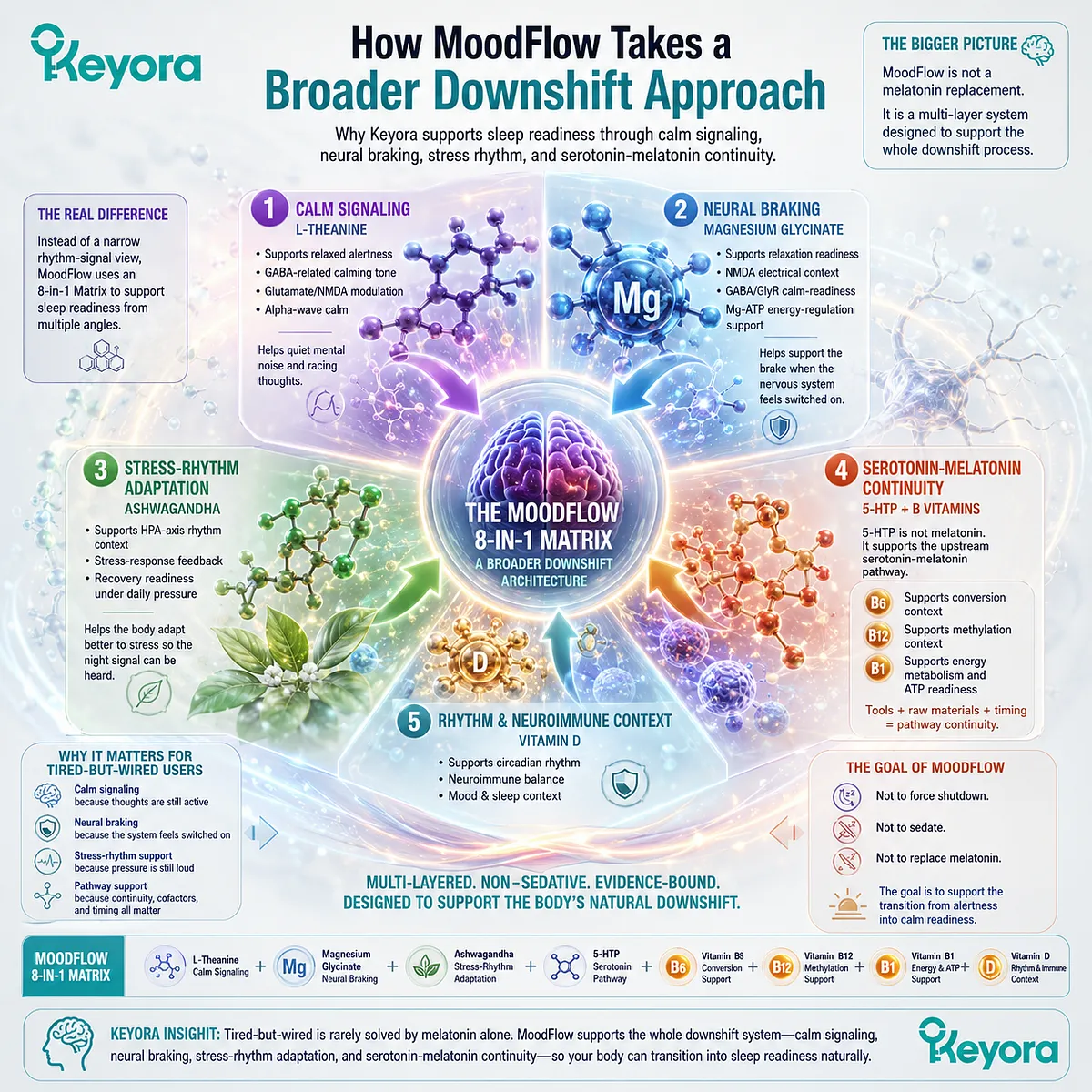
How MoodFlow Takes a Broader Downshift Approach
Why Keyora supports sleep readiness through calm signaling, neural braking, stress rhythm, and serotonin-melatonin continuity.
Inside Keyora MoodFlow, the tired-but-wired pattern is not approached as a melatonin-only problem; it is supported through a broader downshift architecture that includes calm signaling, neural braking, stress-rhythm adaptation, and serotonin-melatonin continuity.
This is the main difference between a narrow rhythm-signal view and the MoodFlow 8-in-1 Matrix.
L-Theanine supports the calm signaling layer.
It is especially relevant when the issue is mental noise, racing thoughts, or the feeling that the mind will not stop. L-Theanine is often discussed in relation to relaxed alertness, GABA-related calming tone, glutamate/NMDA modulation, and alpha-wave calm.
In plain language, L-Theanine helps explain a quieter mental transition without forcing a heavy sedative feeling.
Magnesium glycinate supports the neural braking layer.
This matters when the body feels tired but tense, or when the nervous system feels electrically active. Magnesium glycinate helps explain relaxation readiness, NMDA electrical context, GABA/GlyR calm-readiness context, and Mg-ATP energy-regulation support.
If L-Theanine helps smooth the signal, magnesium glycinate helps support the brake.
Ashwagandha supports the stress-rhythm layer.
This matters when stress-alertness competes with the night signal. Ashwagandha helps explain HPA-axis rhythm context, stress-response feedback, and recovery readiness under everyday pressure. It is not a cortisol cure or hormone treatment. Its role is stress-adaptation support.
5-HTP with B vitamins supports the serotonin-melatonin continuity layer.
This part must be explained carefully. 5-HTP is not melatonin. It does not replace melatonin. It supports the upstream serotonin-melatonin substrate pathway.
-
B6 supports conversion context.
-
B12 supports methylation context.
-
B1 supports energy metabolism and ATP readiness.
These cofactors help explain why sleep-rhythm pathways need support tools as well as raw materials.
Vitamin D adds broader rhythm and neuroimmune context.
It is not the main character in this article, but it helps complete the overall architecture.
This broader approach is why MoodFlow should not be described as a melatonin replacement. It is not trying to compete with melatonin as a single night signal. It is trying to explain a different question: what else may need support when the body is tired but the nervous system remains wired?
For Keyora, the answer is the downshift system.
A tired-but-wired user may need calm signaling because thoughts are still active.
-
They may need neural braking because the nervous system feels switched on.
-
They may need stress-rhythm support because pressure is still loud.
-
They may need pathway support because sleep readiness depends on continuity, cofactors, and timing.
MoodFlow brings those layers together in a non-sedative, evidence-bound sleep-readiness architecture.
The goal is not to force shutdown. The goal is to support the transition from alertness into calm readiness.
Closing Summary
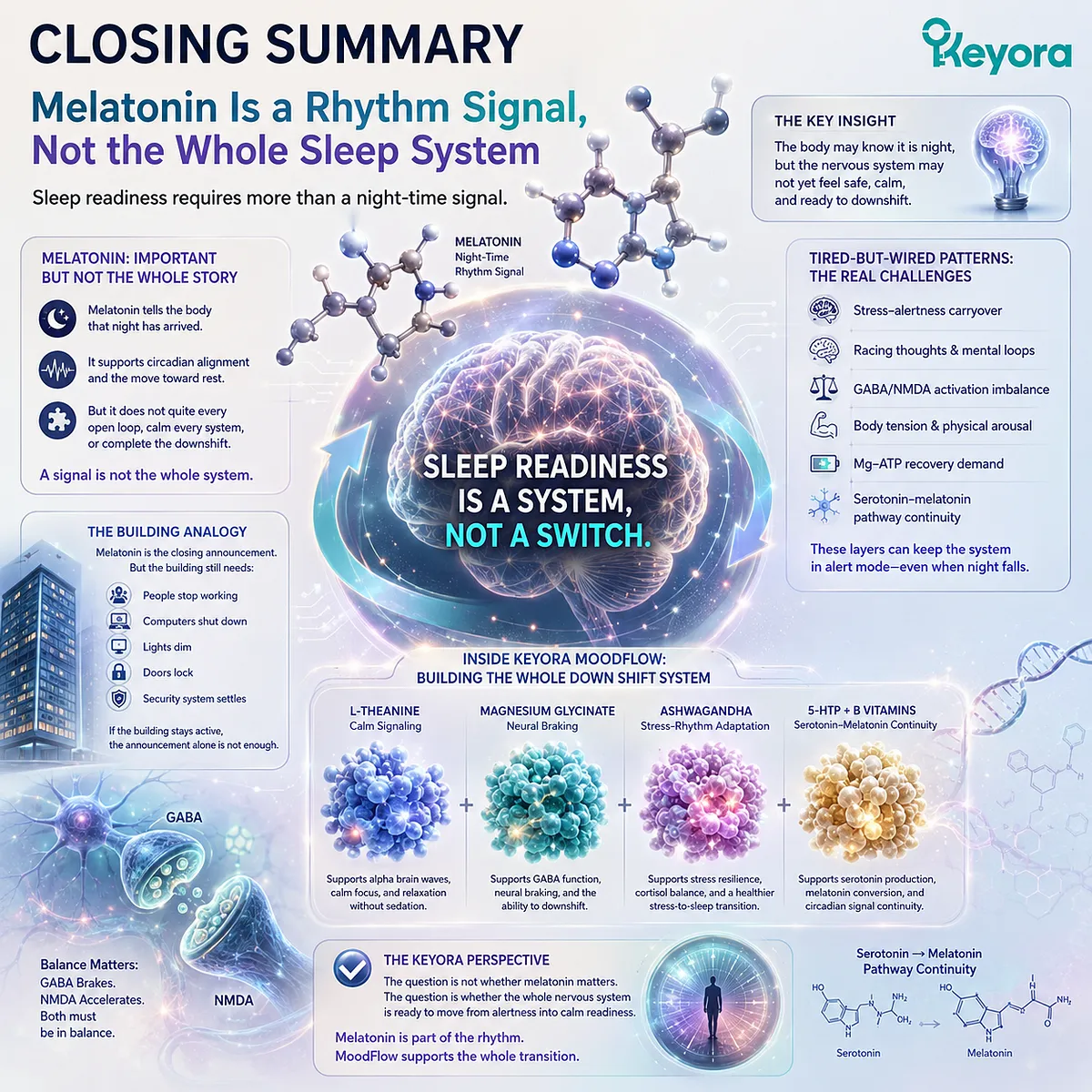
Melatonin may be helpful as a night-time rhythm signal, but tired-but-wired sleep often involves more than a missing night signal. The body may know it is night, while the nervous system still feels alert, tense, mentally busy, or unable to downshift.
This does not mean melatonin has no value. It means melatonin is one part of a larger sleep-readiness system.
Tired-but-wired patterns may involve stress-alertness carryover, racing thoughts, GABA/NMDA activation, body tension, Mg-ATP recovery demand, and serotonin-melatonin pathway continuity.
Inside Keyora MoodFlow, L-Theanine supports calm signaling, magnesium glycinate supports neural braking, Ashwagandha supports stress-rhythm adaptation, and 5-HTP with B vitamins supports serotonin-melatonin continuity.
For Keyora, the question is not whether melatonin matters; the question is whether the whole nervous system is ready to move from alertness into calm readiness.
This article is for educational and informational purposes only. It does not provide medical advice, diagnosis, treatment, cure, prevention, disease outcome claims, hormone restoration claims, fertility outcome claims, or formula-specific clinical efficacy claims.