
Why Does My Mind Race When I Try to Sleep?
Keyora Research Q&A Library
This is part of the Keyora Research Q&A Series, derived from Keyora Nutritional Neurology Seriers .
Within the Keyora Nutritional Neurology framework, this Q&A translates complex nutrient–brain mechanisms into reader-friendly, evidence-bound answers, focusing on stress resilience, sleep quality, calm mood support, cognitive wellness, and the broader interaction between nutrition, neurochemistry, and daily nervous-system function.
First published by Keyora Research Journal: www.keyorahealth.com

Direct Answer
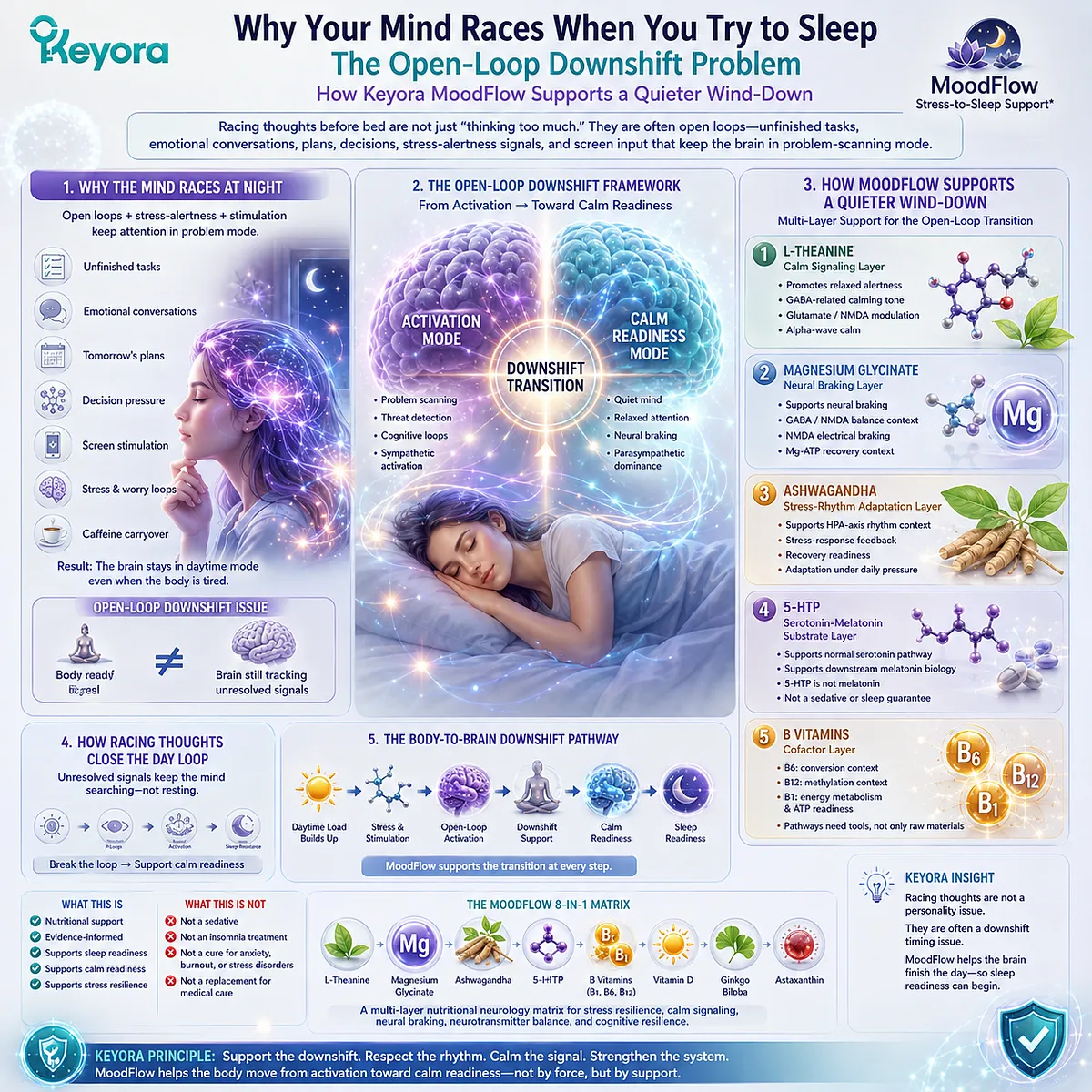
Your mind may race when you try to sleep because the brain has not finished closing the day. Unfinished tasks, emotional conversations, tomorrow’s plans, decision pressure, screen input, and stress-alertness signals can keep attention in problem-scanning mode.
In the Keyora MoodFlow framework, racing thoughts before bed are understood as an open-loop downshift issue: the body may be ready for rest, but the brain is still tracking unresolved signals.
This pattern is not simply “thinking too much.” It often reflects attention loops that remain open when the nervous system should be shifting toward calm readiness.
MoodFlow supports this transition through L-Theanine for calm signaling, magnesium glycinate for neural braking, Ashwagandha for stress-rhythm adaptation, and 5-HTP with B vitamins for serotonin-melatonin pathway continuity. The goal is not to force the mind off, but to support a quieter wind-down.
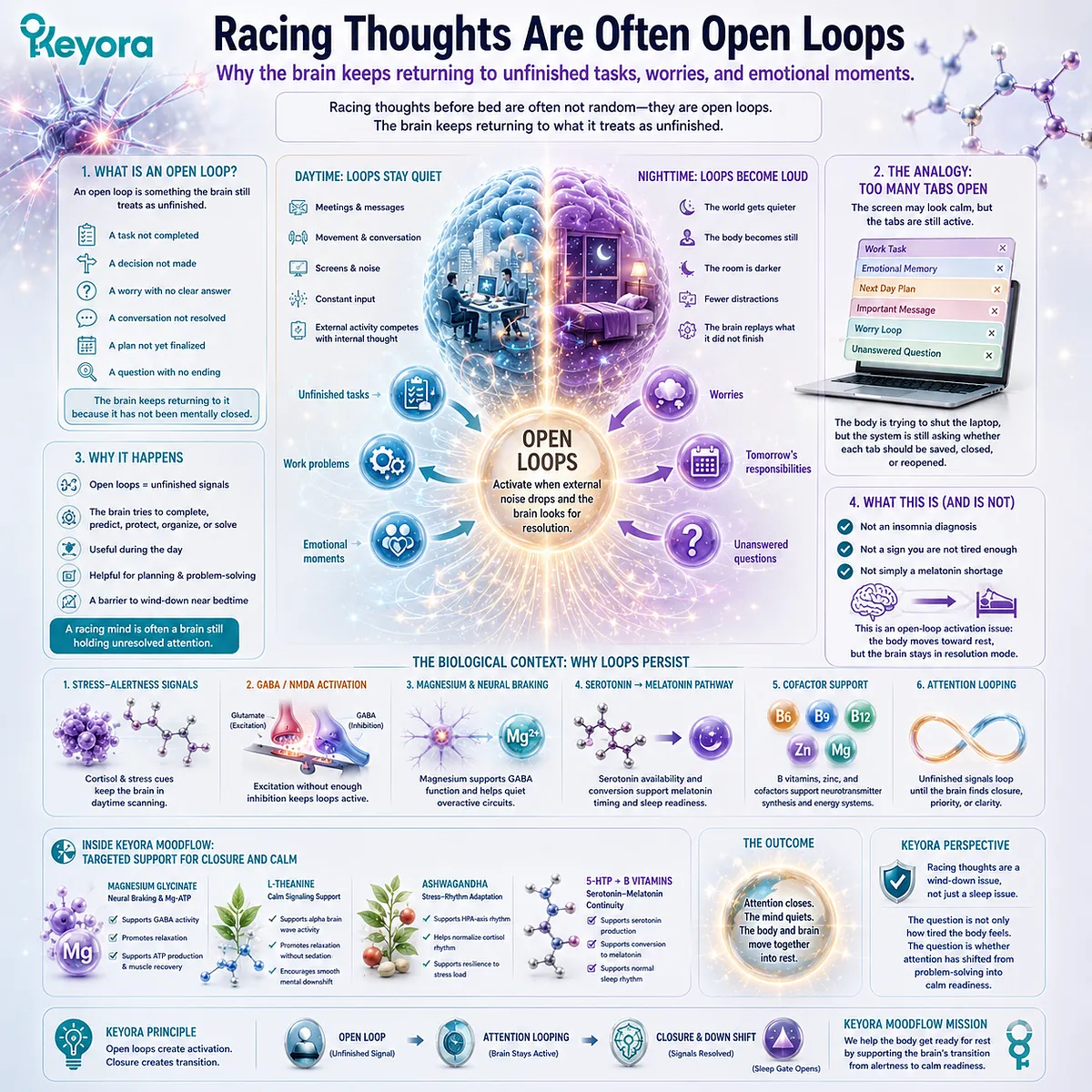
Racing Thoughts Are Often Open Loops
Why the brain keeps returning to unfinished tasks, worries, and emotional moments.
Racing thoughts before bed often feel random.
One moment, you are thinking about tomorrow’s schedule. Then you remember an unfinished message. Then a work problem returns. Then an emotional conversation replays. Before long, the mind feels crowded.
But these thoughts are often not random. They are open loops.
An open loop is something the brain still treats as unfinished. It may be a task, a decision, a worry, a conversation, a plan, or a question with no clear ending. The brain keeps returning to it because it has not been mentally closed.
During the day, these loops may not feel as loud. There are meetings, messages, movement, noise, screens, conversations, and constant input. External activity competes with internal thought.
At night, the outside world becomes quieter. The body is still. The room is darker. There are fewer distractions. That is when the brain may begin replaying what it did not finish processing.
This is why racing thoughts often appear at bedtime. It is not always because the brain suddenly became more active. It may be because the background noise of the day finally dropped low enough for unfinished loops to become obvious.
A useful analogy is a browser with too many tabs open. The screen may look calm, but the tabs are still active in the background.
Some tabs are work tasks. Some are emotional memories. Some are tomorrow’s responsibilities. Some are worries that have no clear answer.
Racing thoughts are like those open tabs. The body is trying to shut the laptop, but the system is still asking whether each tab should be saved, closed, or reopened.
In the Keyora MoodFlow framework, racing thoughts before bed are understood as open-loop activation: the body is moving toward rest, but the brain is still trying to resolve unfinished signals.
This matters because “just stop thinking” is not a helpful explanation. The brain is not misbehaving on purpose. It is trying to complete, predict, protect, organize, or solve.
That can be useful during the day.
Problem-scanning helps people prepare, plan, and respond. But near bedtime, the same scanning can become a barrier to wind-down.
The practical meaning is simple: a racing mind is often a brain still holding unresolved attention. The body may want rest, but the mind has not completed cognitive closure.
For Keyora, this makes racing thoughts a wind-down issue, not just a sleep issue. The question is not only how tired the body feels. The question is whether attention has shifted from problem-solving into calm readiness.
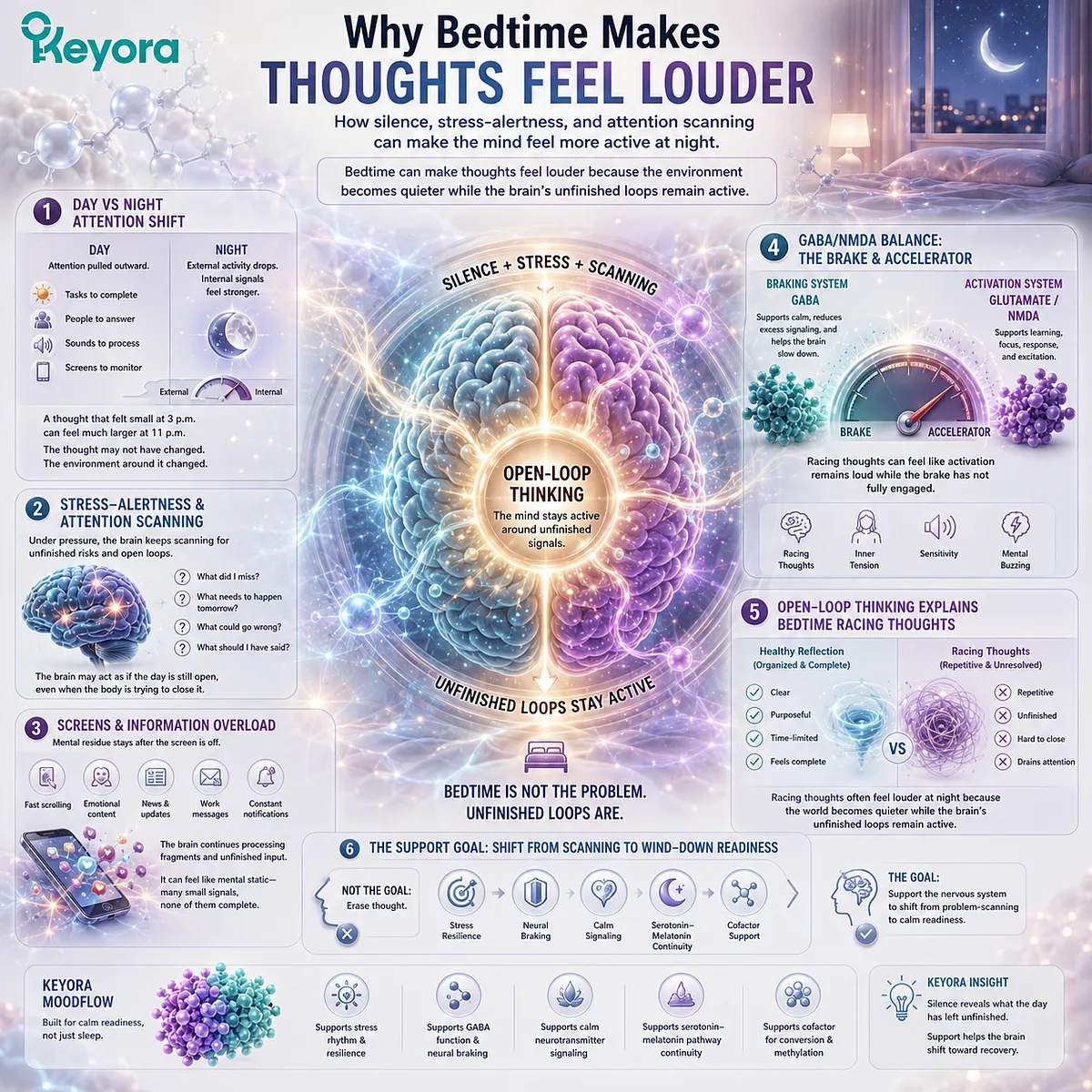
Why Bedtime Makes Thoughts Feel Louder
How silence, stress-alertness, and attention scanning can make the mind feel more active at night.
Bedtime can make thoughts feel louder because the environment becomes quieter while the brain’s unfinished loops remain active.
During the day, attention is pulled outward. There are tasks to complete, people to answer, sounds to process, and screens to monitor. The brain may still carry worries, but they are mixed with constant activity.
At night, that external activity drops. The mind has fewer outside signals to process, so internal signals can feel stronger.
This is why a thought that felt small at 3 p.m. can feel much larger at 11 p.m. The thought may not have changed. The environment around it changed.
Stress-alertness also plays a role. When the body has been under pressure, the brain may keep scanning for unfinished risks.
It may ask:
-
What did I miss?
-
What needs to happen tomorrow?
-
What could go wrong?
-
What should I have said?
This type of scanning is not automatically bad. It is part of how the brain prepares and protects. But near bedtime, it can keep attention pointed toward problem-solving instead of recovery.
The brain may act as if the day is still open, even when the body is trying to close it.
GABA/NMDA balance can help explain this without turning the experience into a diagnosis.
GABA can be understood as part of the brain’s calming brake system.
Glutamate and NMDA receptors are part of the activation system.
Racing thoughts can feel like activation remains loud while the brake has not fully engaged.
This does not mean the brain needs to be shut down. It means the system may need support moving from active scanning toward relaxed alertness.
Screens and information overload can also leave mental residue.
Fast scrolling, emotional content, news, work messages, unfinished videos, and constant notifications can keep attention moving quickly.
Even after the screen is off, the brain may continue processing fragments.
This is different from one clear worry. It can feel like mental static: many small signals, none of them complete.
That is why racing thoughts before bed can feel exhausting. The person may not be doing physical work, but the brain is still spending attention. It is still sorting, replaying, comparing, predicting, and preparing.
In this article, the key idea is open-loop thinking. The mind is not simply active. It is active around unfinished signals.
That is what makes bedtime racing thoughts different from healthy reflection. Healthy reflection can feel organized and complete.
Racing thoughts feel repetitive, unresolved, and difficult to close.
For Keyora MoodFlow, this points to a clear support goal.
The goal is not to erase thought.
The goal is to support the nervous system’s ability to move attention away from problem-scanning and toward wind-down readiness.
Racing thoughts often feel louder at night because the world becomes quieter while the brain’s unfinished loops remain active.
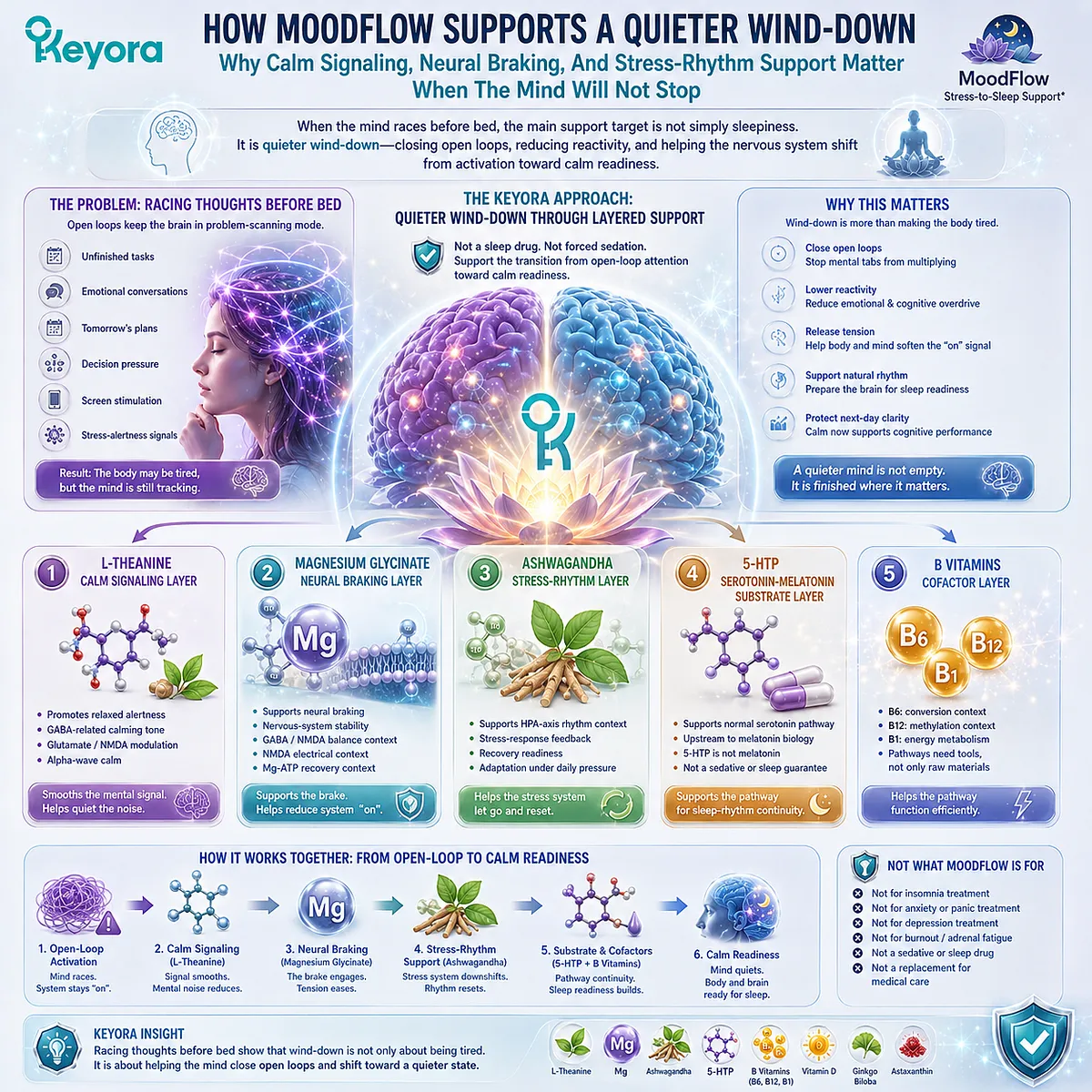
How MoodFlow Supports a Quieter Wind-Down
Why calm signaling, neural braking, and stress-rhythm support matter when the mind will not stop.
When the mind races before bed, the main support target is not simply sleepiness. It is quieter wind-down.
This is why this article focuses especially on L-Theanine and magnesium glycinate. Both fit the problem of mental overactivity, but they do so from different sides.
Inside Keyora MoodFlow, racing thoughts before bed are supported primarily through calm signaling and neural braking: L-Theanine helps support relaxed alertness, while magnesium glycinate supports the braking context that helps the nervous system move toward wind-down readiness.
L-Theanine is important because it helps explain calm without sedation.
A racing mind does not always need to be forced into sleep. Often, it needs the mental signal to become smoother, quieter, and less reactive.
L-Theanine is often discussed in relation to relaxed alertness, GABA-related calming tone, glutamate/NMDA modulation, and alpha-wave calm. In consumer language, it supports the feeling of being mentally calmer without feeling heavy or shut down.
That matters because many people with racing thoughts still want to feel like themselves. They do not want fog. They do not want to feel knocked out. They want the mental tabs to stop multiplying.
Magnesium glycinate supports a different layer: neural braking.
It helps explain nervous-system stability, relaxation readiness, and the electrical context around NMDA activation. In the MoodFlow architecture, magnesium glycinate acts more like a hardware-stabilizer layer.
If L-Theanine helps smooth the signal, magnesium glycinate helps support the brake.
This pairing is especially relevant for bedtime thought loops.
Racing thoughts are not only a mental story. They often come with body tension, jaw tightness, shallow breathing, restlessness, or a sense that the system is still “on.” Magnesium glycinate helps explain support for the body-side of downshift.
Ashwagandha adds stress-rhythm support.
If the mind keeps scanning because the stress system is still active, Ashwagandha helps explain support for HPA-axis rhythm context, stress-response feedback, and recovery readiness. It is not a cortisol cure or hormone treatment. It is the stress-adaptation layer.
5-HTP with B vitamins provides a supporting sleep-rhythm layer.
5-HTP supports upstream serotonin-melatonin substrate continuity.
-
B6 supports conversion context.
-
B12 supports methylation context.
These ingredients help explain sleep-readiness pathway support, but they are not the main focus of this racing-thoughts article.
That distinction is important. Not every MoodFlow article should explain every ingredient equally. In this question, the user’s core experience is “my mind will not stop.” So the strongest focus belongs to calm signaling, neural braking, and stress-rhythm support.
MoodFlow does not try to force a mental blackout. It supports the transition from open-loop attention toward calm readiness.
For Keyora, racing thoughts before bed show that wind-down is not only about making the body tired. It is also about helping the mind close open loops and shift toward a quieter state.
Closing Summary
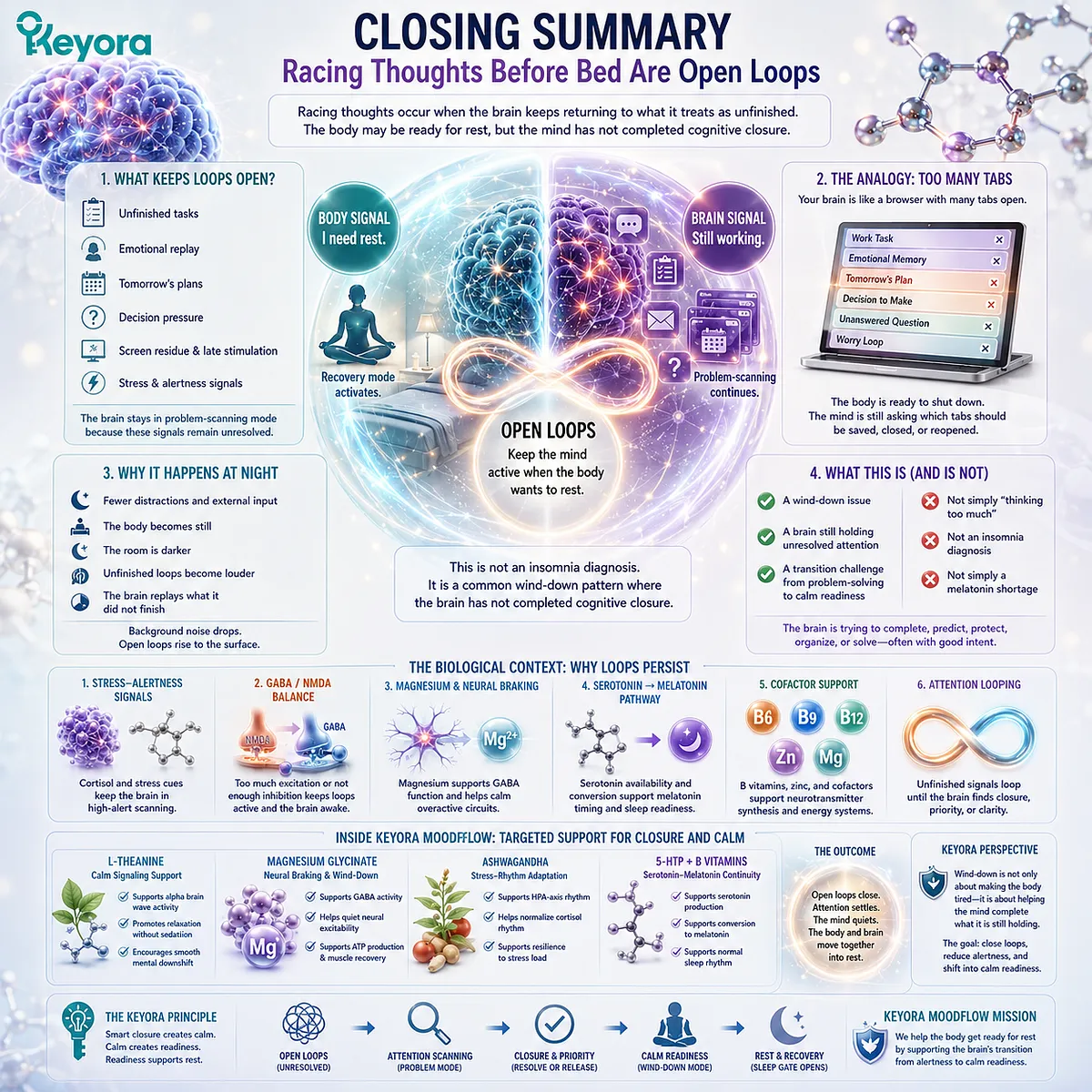
Racing thoughts before bed often mean the brain is still holding open loops. Unfinished tasks, emotional replay, tomorrow’s plans, decision pressure, screen residue, and stress-alertness signals can keep attention in problem-scanning mode.
This is not simply “thinking too much,” and it is not an insomnia diagnosis. It is a common wind-down pattern where the body may be ready for rest, but the mind has not completed cognitive closure.
Inside Keyora MoodFlow, L-Theanine supports calm signaling and relaxed alertness, while magnesium glycinate supports neural braking and wind-down readiness. Ashwagandha adds stress-rhythm support, and 5-HTP with B vitamins supports serotonin-melatonin pathway continuity.
For Keyora, racing thoughts before bed show that wind-down is not only about making the body tired; it is also about helping the mind close open loops and shift toward calm readiness.
This article is for educational and informational purposes only. It does not provide medical advice, diagnosis, treatment, cure, prevention, disease outcome claims, hormone restoration claims, fertility outcome claims, or formula-specific clinical efficacy claims.