
What Is Pre-Sleep Hyperarousal?
Keyora Research Q&A Library
This is part of the Keyora Research Q&A Series, derived from Keyora Nutritional Neurology Seriers .
Within the Keyora Nutritional Neurology framework, this Q&A translates complex nutrient–brain mechanisms into reader-friendly, evidence-bound answers, focusing on stress resilience, sleep quality, calm mood support, cognitive wellness, and the broader interaction between nutrition, neurochemistry, and daily nervous-system function.
First published by Keyora Research Journal: www.keyorahealth.com

Direct Answer
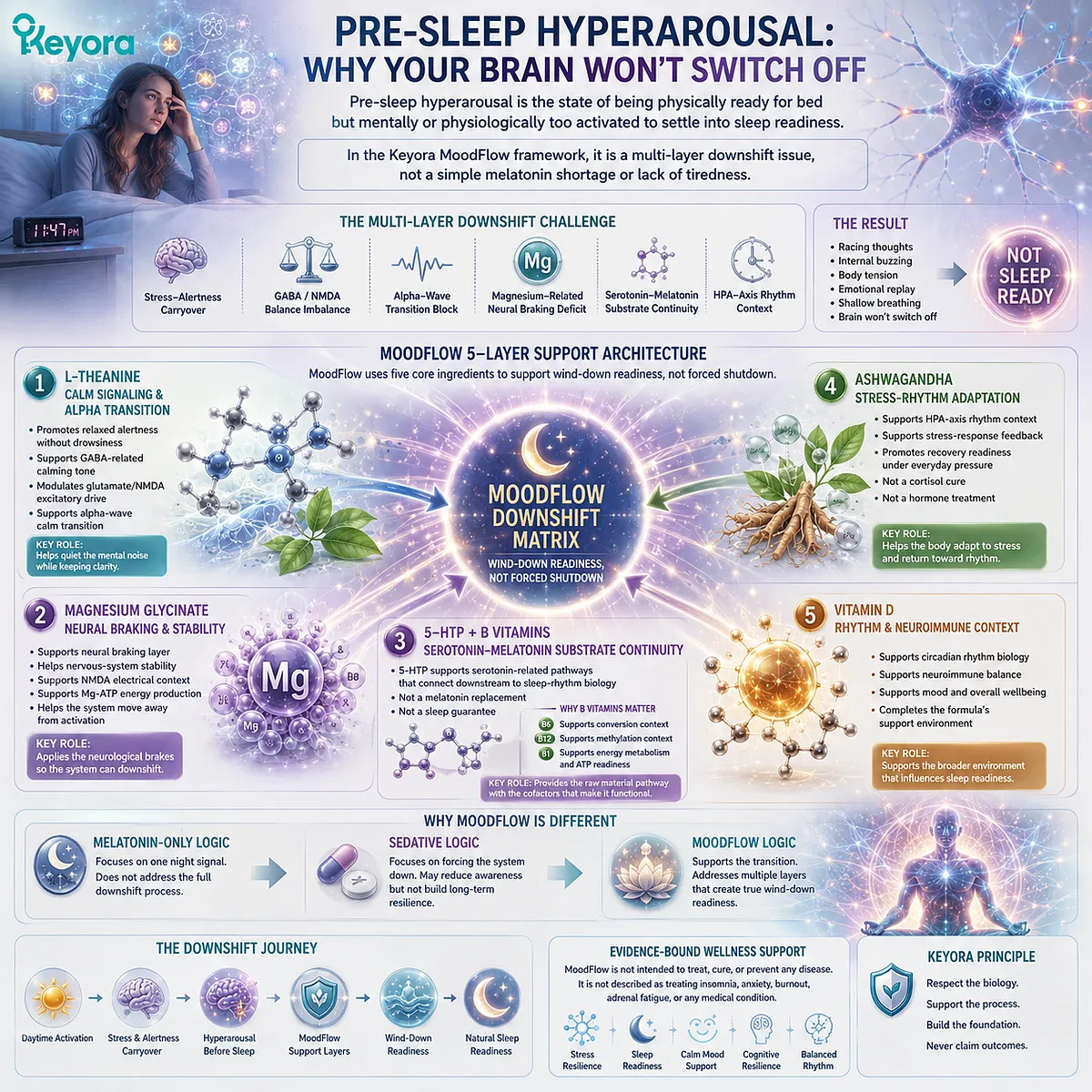
Pre-sleep hyperarousal is the state of being physically ready for bed but mentally or physiologically too activated to settle into sleep readiness.
It can feel like racing thoughts, internal buzzing, body tension, emotional replay, shallow breathing, or a brain that will not switch off.
In the Keyora MoodFlow framework, pre-sleep hyperarousal is not explained as a simple melatonin shortage or a lack of tiredness.
It is a multi-layer downshift issue involving stress-alertness carryover, GABA/NMDA balance, alpha-wave transition, magnesium-related neural braking, serotonin-melatonin substrate continuity, and HPA-axis rhythm context.
MoodFlow uses L-Theanine, magnesium glycinate, 5-HTP with B vitamins, Ashwagandha, and Vitamin D to map these support layers in a non-sedative sleep-readiness architecture.
The goal is wind-down readiness, not forced shutdown.
Sleep Readiness Starts Before Sleep
Why the bedtime problem often begins before the lights go out.
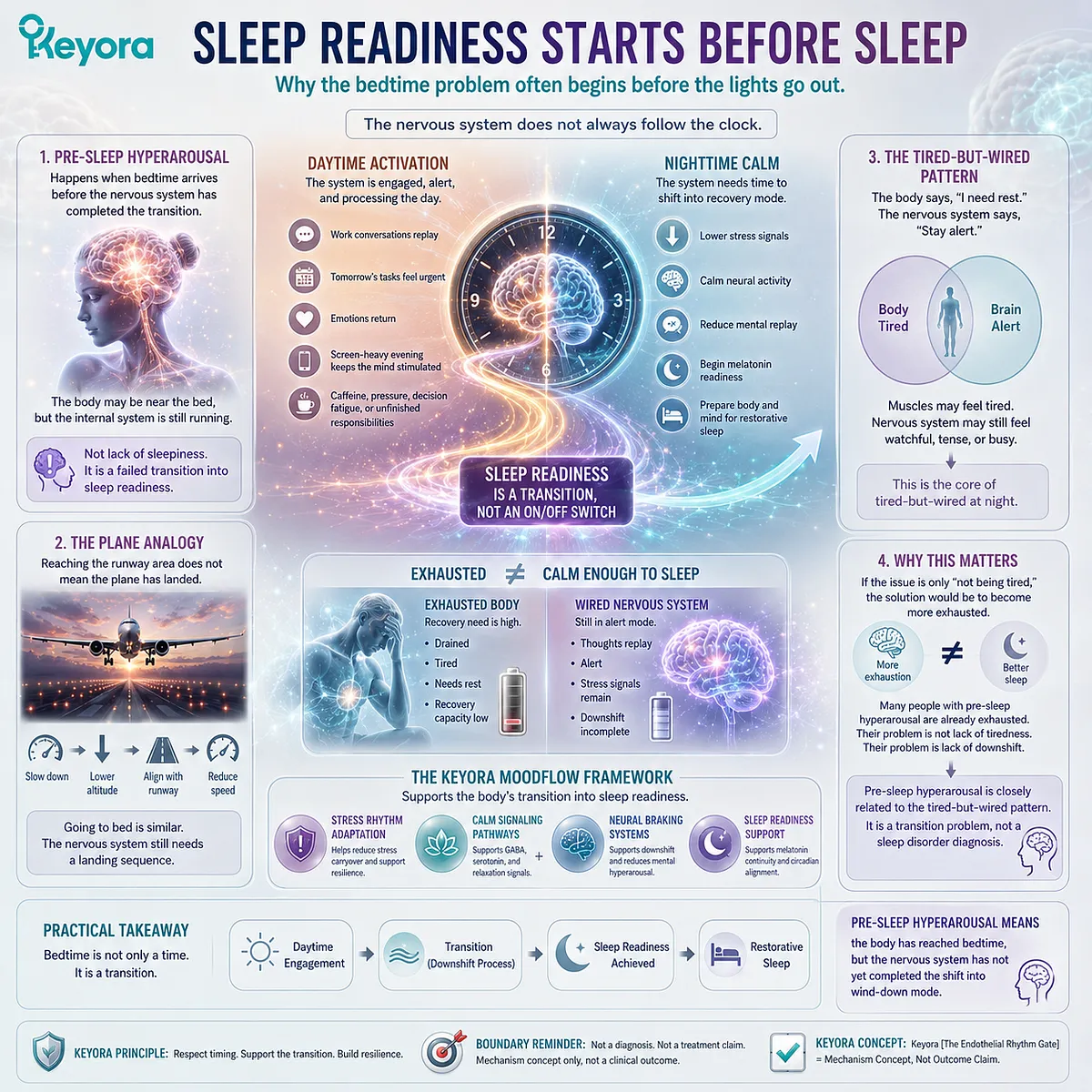
Many people think sleep begins when they get into bed. The lights go off, the phone goes down, and the day is supposed to end.
But the nervous system does not always follow the clock.
A person may arrive at bedtime physically tired, but the brain may still be processing the day.
Work conversations may replay.
Tomorrow’s tasks may feel urgent. Emotional moments may return. A screen-heavy evening may keep the mind stimulated.
Caffeine, pressure, decision fatigue, or unfinished responsibilities may keep the system in alert mode.
This is why sleep readiness starts before sleep. The body needs time to move from daytime activation into nighttime calm. That transition is not instant.
Pre-sleep hyperarousal happens when bedtime arrives before the nervous system has completed that transition. The body may be near the bed, but the internal system is still running.
A useful analogy is a plane approaching a runway.
Reaching the runway area does not mean the plane has landed. It still needs a landing sequence: slowing down, lowering altitude, aligning with the runway, and reducing speed.
Going to bed is similar. The body may be near sleep, but the nervous system still needs a landing sequence.
Pre-sleep hyperarousal means the system has reached the runway area but is still flying too fast to land smoothly.
This is why “I’m exhausted, so why can’t I sleep?” is such a common question.
Exhaustion tells us the body needs recovery. It does not always tell us that the nervous system is calm enough to enter sleep readiness.
In the Keyora MoodFlow framework, pre-sleep hyperarousal is understood as a failed transition into sleep readiness, not as a simple lack of sleepiness.
That distinction matters. If the issue is only “not being tired,” then the solution would be to become more exhausted. But many people with pre-sleep hyperarousal are already exhausted. Their problem is not lack of tiredness. Their problem is lack of downshift.
This is also why pre-sleep hyperarousal is closely related to the tired-but-wired pattern. The body feels ready to stop, but the brain still feels switched on. The muscles may feel tired, but the nervous system may still feel watchful, tense, or busy.
Keyora MoodFlow does not frame this as a sleep disorder diagnosis. It frames it as a wellness pattern that helps explain why stress resilience, calm signaling, neural braking, and sleep-readiness support may need to work together.
The practical takeaway is simple: bedtime is not only a time. It is a transition. Pre-sleep hyperarousal means the body has reached bedtime, but the nervous system has not yet completed the shift into wind-down mode.
When the Brain Cannot Downshift
How racing thoughts, stress signals, glutamate/NMDA activity, and low calm tone can affect wind-down.
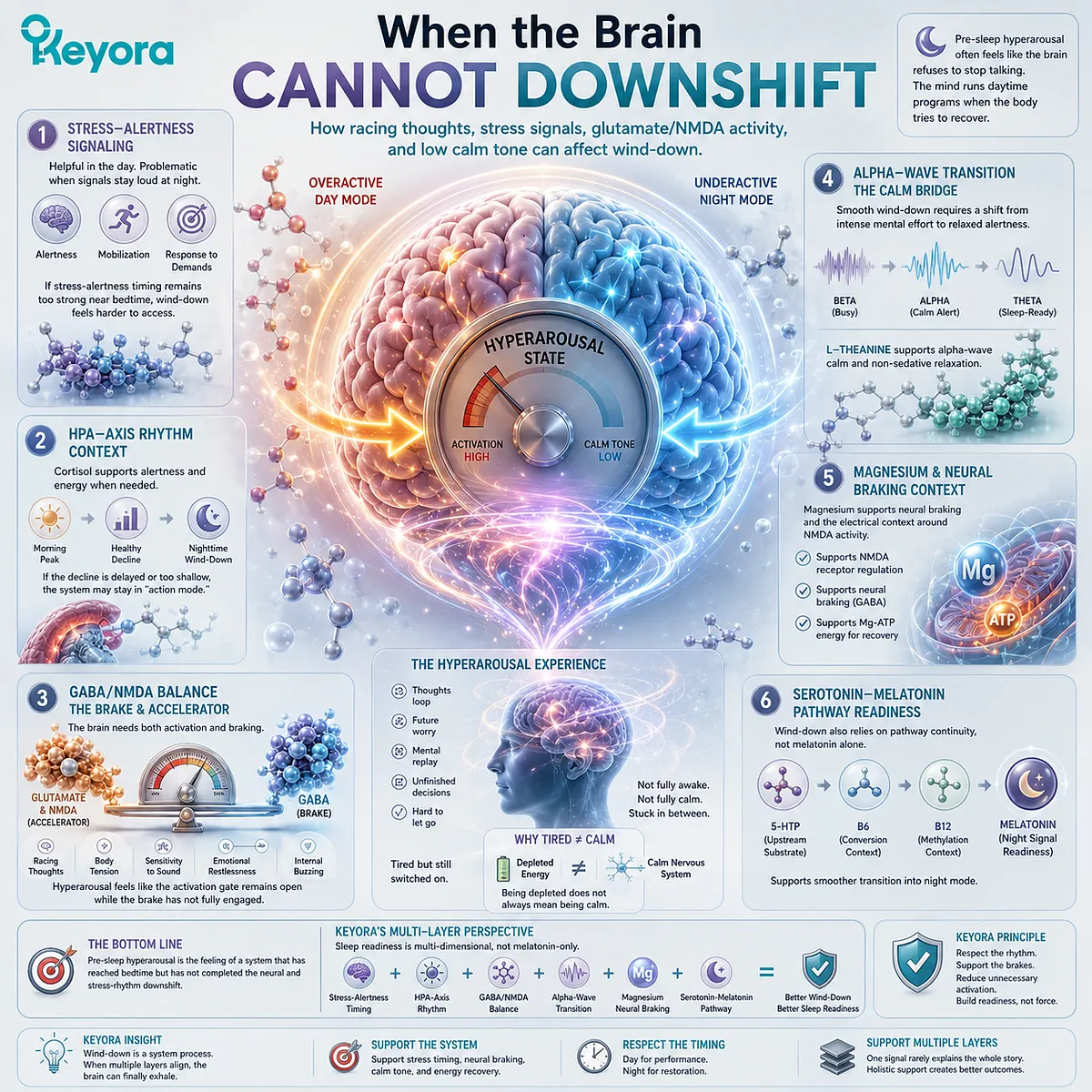
Pre-sleep hyperarousal often feels like the brain refuses to stop talking.
Thoughts keep looping. Tomorrow’s tasks become louder. A small worry becomes a full conversation. The brain may scan for problems, replay social interactions, or return to unfinished decisions.
This can be understood as mental overactivation, not as a diagnosis. It is the feeling that the mind is still running daytime programs when the body is trying to enter nighttime recovery.
Stress-alertness signaling is one part of this pattern.
During the day, stress signals can be useful. They help the body stay alert, mobilize energy, and respond to demands.
The problem begins when those signals stay loud at night. The body may be in bed, but the stress system may still be acting as if action is required.
This is where HPA-axis rhythm context becomes relevant.
Cortisol is not automatically bad. It supports alertness and energy when the body needs to respond. But if stress-alertness timing remains too strong near bedtime, wind-down may feel harder to access.
GABA/NMDA balance adds another layer.
GABA can be understood as part of the brain’s calming brake system.
Glutamate and NMDA receptors are part of the activation system.
The brain needs both activation and braking.
Pre-sleep hyperarousal often feels like the activation gate remains open while the brake has not fully engaged.
This may feel like racing thoughts, body tension, sensitivity to sound, emotional restlessness, or an internal buzzing sensation.
The person may not feel fully awake in a fresh, energetic way. Instead, the system feels tired but still switched on.
Alpha-wave transition is another useful concept.
Alpha waves are often discussed in relation to relaxed alertness. This is the state where the brain feels calm but not sedated, clear but not overworked.
A smooth wind-down often needs a shift away from intense mental effort toward a calmer rhythm.
L-Theanine is relevant here because it is often connected with alpha-wave calm and non-sedative relaxation support.
Magnesium glycinate supports another side of the same story.
Magnesium is involved in neural braking and the electrical context around NMDA activity. It also connects to Mg-ATP energy support, which matters because recovery is not just the absence of activity. Recovery also requires energy regulation.
This is why the body can feel tired while the nervous system remains activated. Being depleted does not always mean being calm.
Pre-sleep hyperarousal is the feeling of a system that has reached bedtime but has not completed the neural and stress-rhythm downshift.
For Keyora, this is exactly why sleep readiness should not be explained only through melatonin.
Melatonin is one rhythm signal, but bedtime wind-down may also involve stress timing, GABA/NMDA balance, alpha-wave transition, magnesium-related neural braking, and serotonin-melatonin pathway readiness.
How MoodFlow Explains Wind-Down Support
Why L-Theanine, magnesium glycinate, 5-HTP, and Ashwagandha each support a different sleep-readiness layer.
Pre-sleep hyperarousal is multi-layered.
That is why MoodFlow explains wind-down through multiple support layers rather than one sedative pathway.
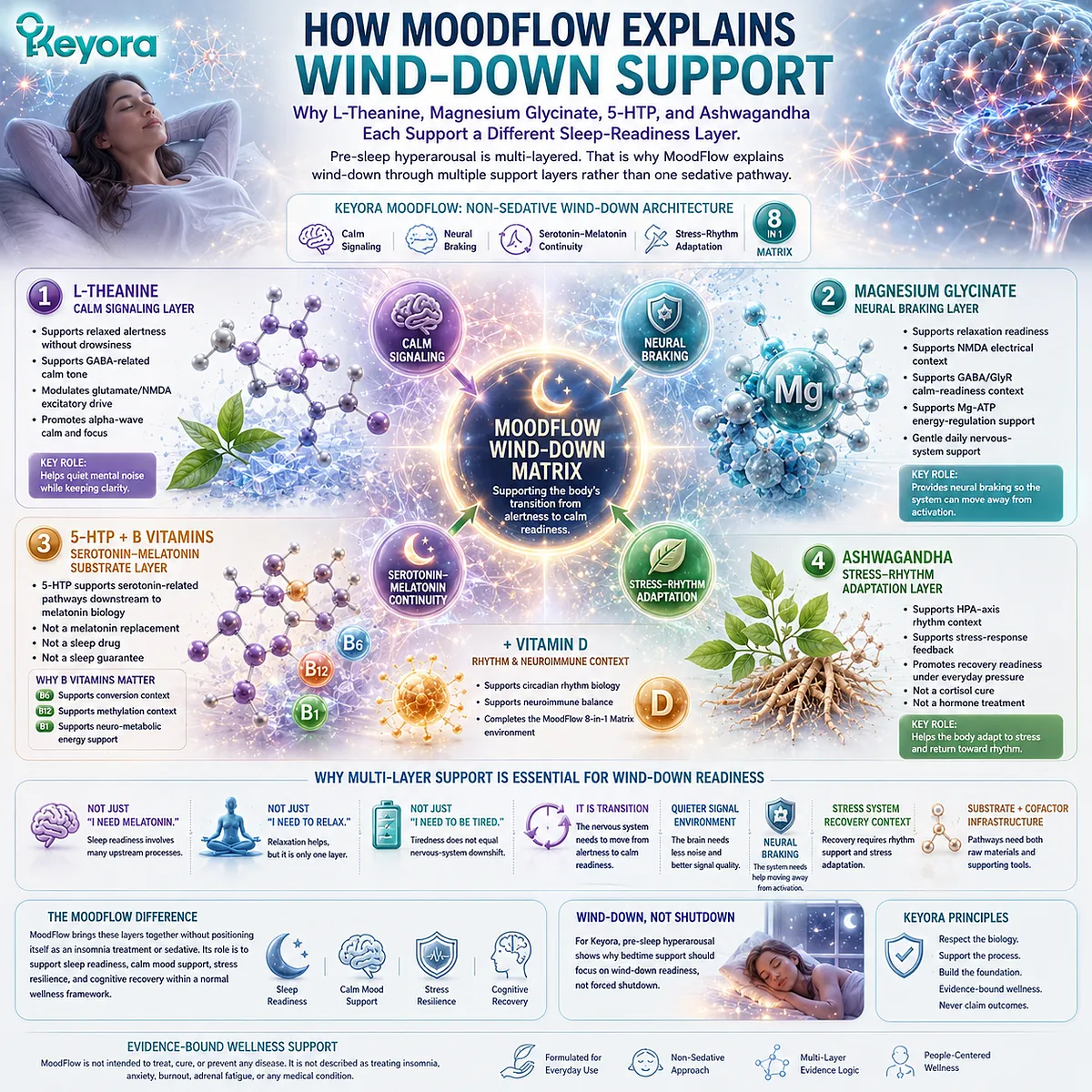
Inside Keyora MoodFlow, pre-sleep hyperarousal is supported through a non-sedative wind-down architecture: L-Theanine supports calm signaling, magnesium glycinate supports neural braking, 5-HTP with B vitamins supports serotonin-melatonin continuity, and Ashwagandha supports stress-rhythm adaptation.
L-Theanine supports the calm signaling layer.
It helps explain relaxed alertness, GABA-related calm tone, glutamate/NMDA modulation, and alpha-wave calm. This makes it especially relevant for people who want the mind to feel less noisy without feeling knocked out.
Magnesium glycinate supports the neural braking layer. It helps explain relaxation readiness, NMDA electrical context, GABA/GlyR calm-readiness context, and Mg-ATP energy-regulation support.
In MoodFlow, magnesium glycinate is not used as a harsh or bowel-focused magnesium form. It is selected for gentle daily nervous-system support.
5-HTP supports the serotonin-melatonin substrate layer.
It helps explain how the body supports normal serotonin-related pathways that can connect downstream to melatonin biology. But 5-HTP is not melatonin, not a sleep drug, and not a sleep guarantee.
That is why B vitamins matter.
-
B6 supports conversion context.
-
B12 supports methylation context.
-
B1 supports neuro-metabolic energy support.
These cofactors help explain why sleep-readiness pathways need tools as well as raw materials.
Ashwagandha supports the stress-adaptation layer.
It helps explain HPA-axis rhythm context, stress-response feedback, and recovery readiness under everyday pressure.
It should not be described as a cortisol cure or hormone treatment. Its role is stress-rhythm support within an evidence-bound wellness framework.
Vitamin D adds broader rhythm and neuroimmune context. It is not the main driver of this article, but it helps complete the MoodFlow 8-in-1 Matrix.
This layered explanation is important because pre-sleep hyperarousal is not usually solved by one idea.
It is not always just “I need melatonin.”
It is not always just “I need to relax.” It is not always just “I need to be more tired.”
Often, the issue is transition.
-
The nervous system needs to move from alertness to calm readiness.
-
The brain needs a quieter signal environment.
-
The body needs neural braking.
-
The stress system needs recovery context.
-
The sleep-rhythm pathway needs substrate and cofactor support.
MoodFlow brings these layers together without positioning itself as an insomnia treatment or sedative. Its role is to support sleep readiness, calm mood support, stress resilience, and cognitive recovery within a normal wellness framework.
For Keyora, pre-sleep hyperarousal shows why bedtime support should focus on wind-down readiness, not forced shutdown.
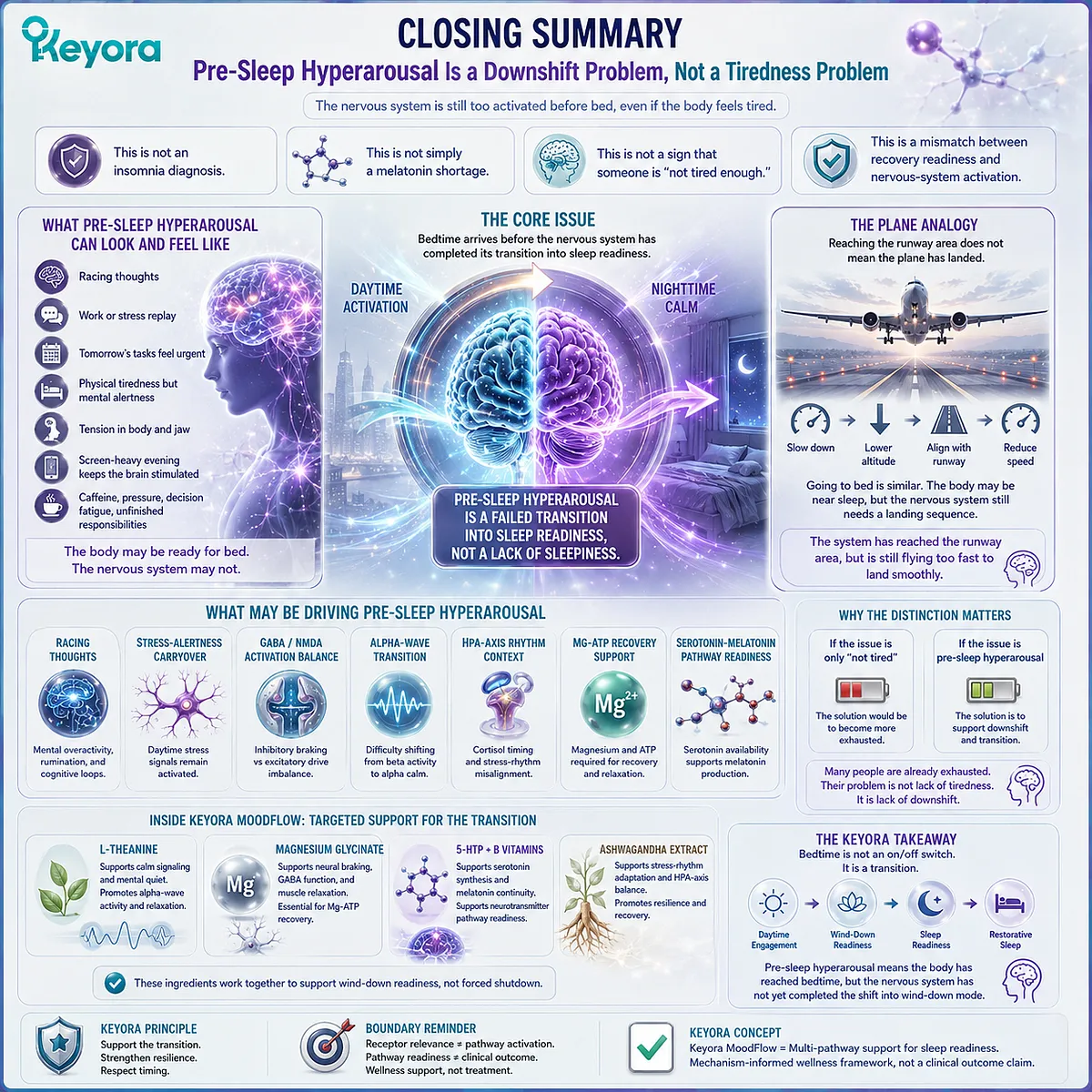
Closing Summary
Pre-sleep hyperarousal means the nervous system is still too activated before bed, even if the body feels tired.
It is not an insomnia diagnosis, not simply a melatonin shortage, and not a sign that someone is not tired enough.
This pattern may involve racing thoughts, stress-alertness carryover, GABA/NMDA activation balance, alpha-wave transition, HPA-axis rhythm context, Mg-ATP recovery support, and serotonin-melatonin pathway readiness.
Inside Keyora MoodFlow, L-Theanine supports calm signaling, magnesium glycinate supports neural braking, 5-HTP with B vitamins supports serotonin-melatonin continuity, and Ashwagandha supports stress-rhythm adaptation.
For Keyora, pre-sleep hyperarousal shows why bedtime support should focus on wind-down readiness, not forced shutdown.
This article is for educational and informational purposes only. It does not provide medical advice, diagnosis, treatment, cure, prevention, disease outcome claims, hormone restoration claims, fertility outcome claims, or formula-specific clinical efficacy claims.