
What Does Tired But Wired Mean?
Keyora Research Q&A Library
This is part of the Keyora Research Q&A Series, derived from Keyora Nutritional Neurology Seriers .
Within the Keyora Nutritional Neurology framework, this Q&A translates complex nutrient–brain mechanisms into reader-friendly, evidence-bound answers, focusing on stress resilience, sleep quality, calm mood support, cognitive wellness, and the broader interaction between nutrition, neurochemistry, and daily nervous-system function.
First published by Keyora Research Journal: www.keyorahealth.com

Direct Answer
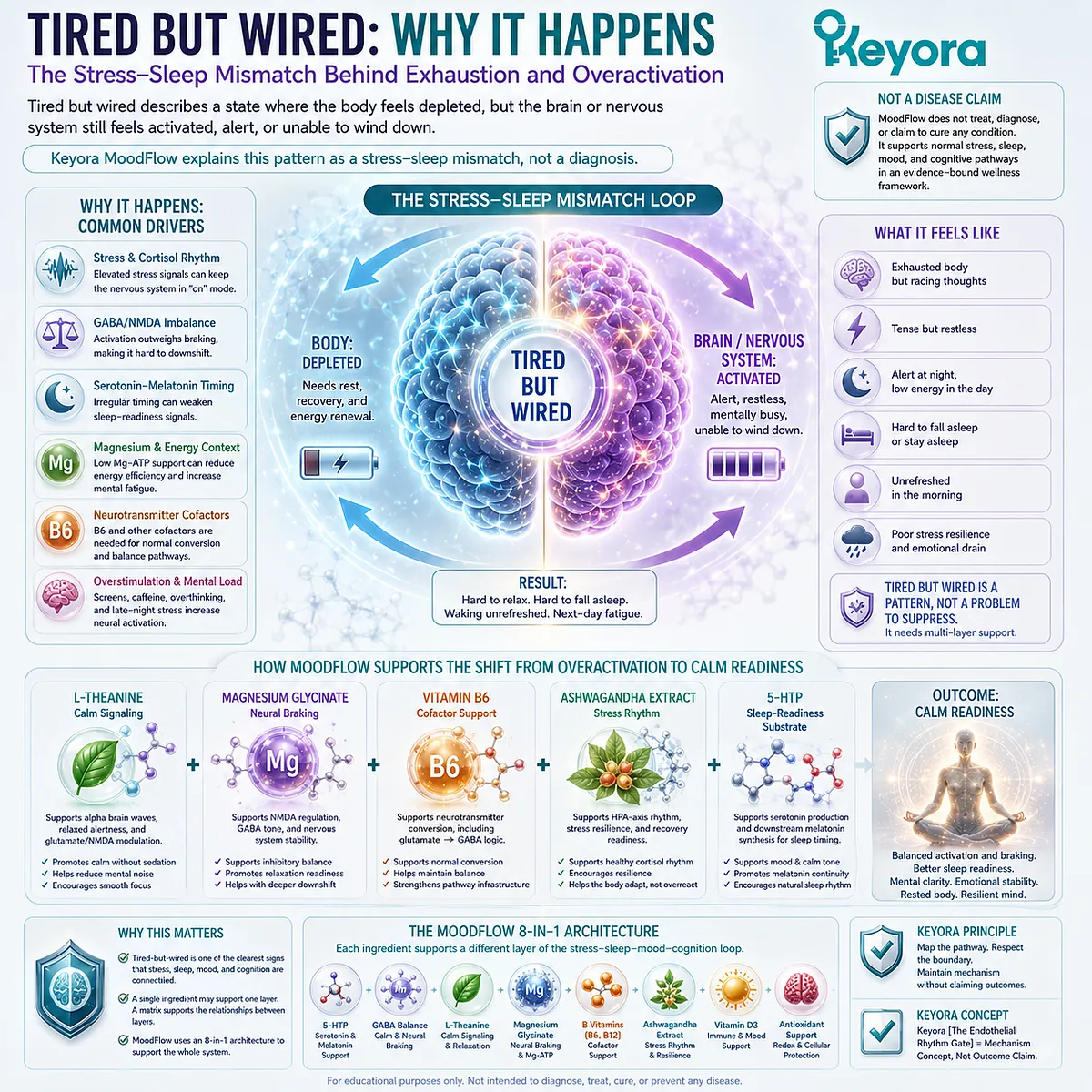
“Tired but wired” describes a state where the body feels depleted, but the brain or nervous system still feels activated.
A person may feel physically exhausted, yet mentally alert, restless, tense, or unable to wind down.
In the Keyora MoodFlow framework, this pattern is explained as a stress-sleep mismatch rather than a single symptom.
The body may need recovery, while stress signals, GABA/NMDA activation balance, cortisol rhythm, serotonin-melatonin pathway timing, or Mg-ATP energy support may still be pulling the system toward alertness.
MoodFlow does not frame tired-but-wired as a disease or as a sleep disorder treatment. It uses the pattern to explain why stress resilience, neural braking, sleep readiness, calm signaling, and cofactor support may need to work together.
Tired-but-wired is one of the clearest examples of why stress, sleep, mood, and cognition are connected.
Why the Body Can Feel Tired While the Brain Stays On
The everyday meaning of the tired-but-wired pattern.
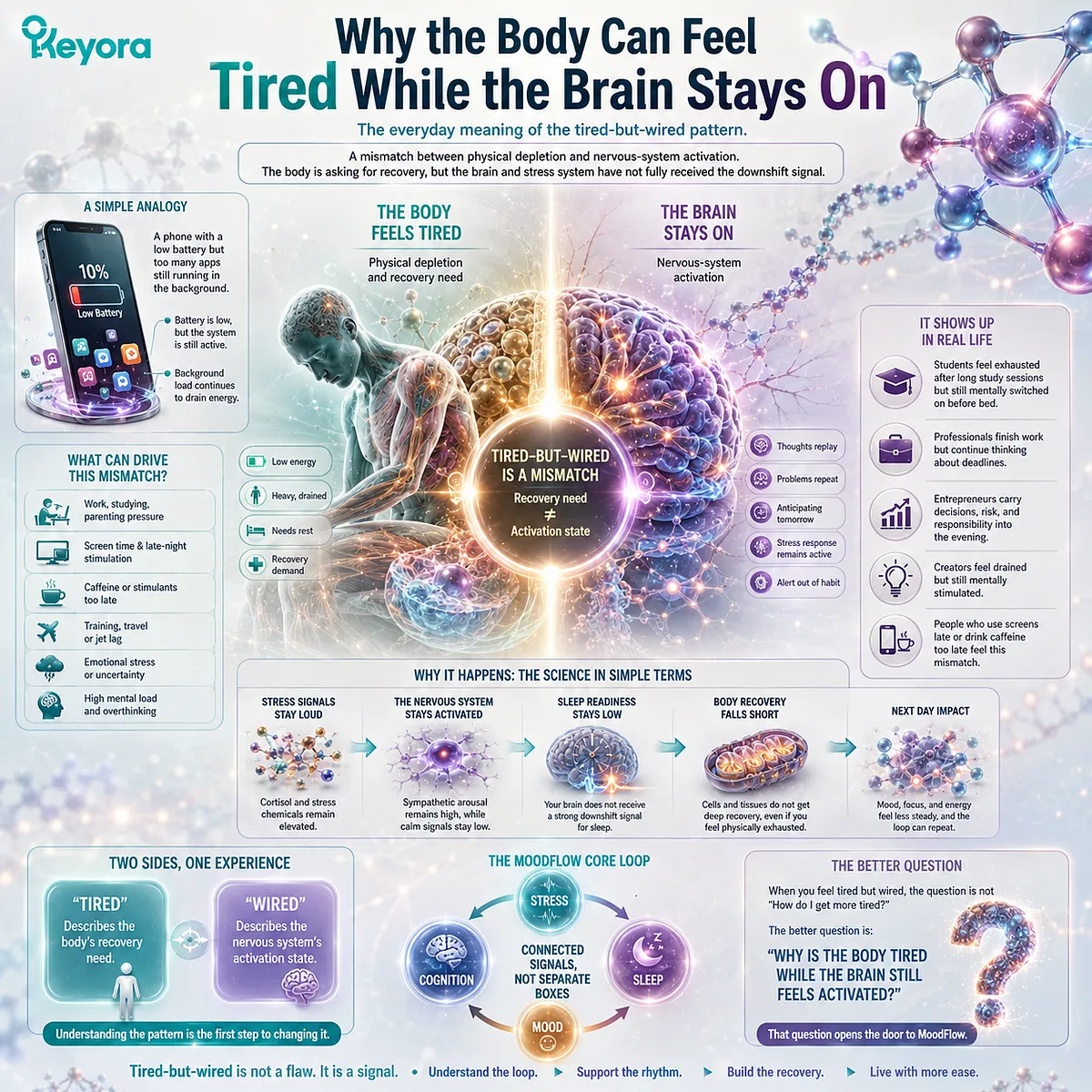
Many people assume that if they are tired enough, sleep or relaxation should come easily. But real life often feels different.
The body may feel heavy, drained, or low on energy, while the mind keeps running. Thoughts replay. Problems repeat. The body wants rest, but the brain still acts as if something needs attention.
This is the tired-but-wired pattern.
It is not simply “being tired.” It is a mismatch between physical depletion and nervous-system activation. The body is asking for recovery, but the brain and stress system have not fully received the downshift signal.
A simple analogy is a phone with a low battery but too many apps still running in the background. The battery is low, but the system is still active. The screen may dim, the device may feel slow, but the background load continues to drain energy.
The same idea can apply to the nervous system.
A person may be physically tired from work, studying, parenting, screen use, training, travel, or emotional pressure. But the brain may still be processing information, anticipating tomorrow, responding to stress, or staying alert out of habit.
This is why physical tiredness does not always equal sleep readiness. The body can be depleted while the nervous system remains activated.
In the Keyora MoodFlow framework, tired-but-wired is understood as a mismatch between recovery need and nervous-system activation, not as a simple lack of tiredness.
This pattern is common in high-load modern life.
-
Students may feel exhausted after long study sessions but still mentally switched on before bed.
-
Professionals may finish work but continue thinking about deadlines.
-
Entrepreneurs may carry decisions, risk, and responsibility into the evening.
-
Creators may feel drained but still mentally stimulated.
-
People who use screens late at night or drink caffeine too late may also notice this mismatch.
Tired-but-wired is a useful phrase because it captures both sides of the experience.
-
“Tired” describes the body’s recovery need.
-
“Wired” describes the nervous system’s activation state.
The goal is not to label this as a disease.
The goal is to understand the pattern.
When a person feels tired but wired, the question is not only “How do I get more tired?”
The better question is “Why is the body tired while the brain still feels activated?”
That question opens the door to MoodFlow’s core logic. Stress, sleep, mood, and cognition are not separate boxes. They are connected signals.
When stress rhythm stays too loud, sleep readiness can feel harder.
When sleep recovery is weaker, mood and focus can feel less steady the next day.
Tired-but-wired is one of the most relatable ways to explain that loop.
The Stress-Sleep Mismatch
How cortisol rhythm, neural excitability, serotonin-melatonin pathways, and Mg-ATP support may be involved.
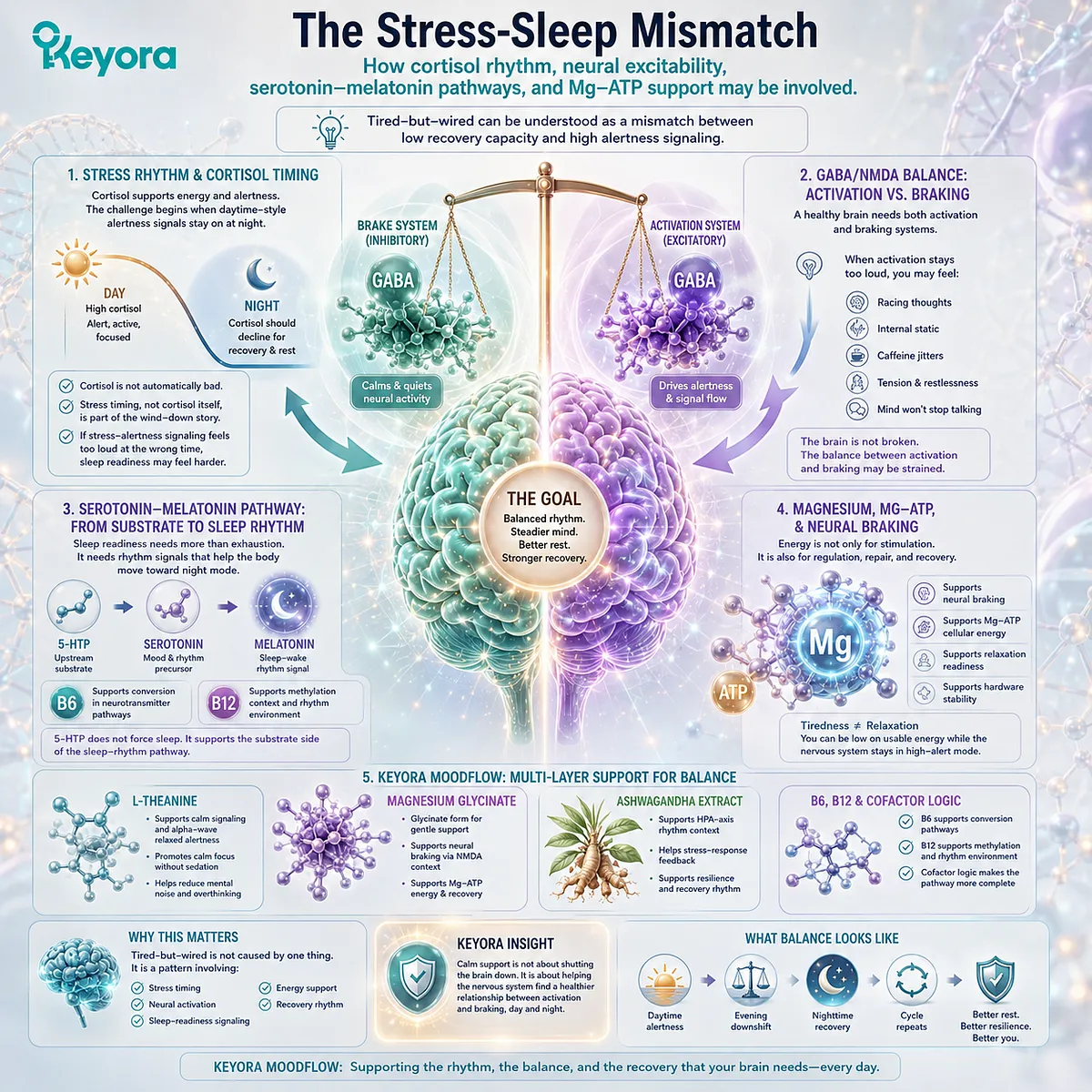
Tired-but-wired can be understood as a mismatch between low recovery capacity and high alertness signaling.
One part of this story is stress rhythm.
During the day, the body uses alertness signals to help you respond, focus, and stay active. That is normal. The stress response is not bad by itself.
The challenge begins when the body keeps receiving a daytime-style alertness signal at night. The day is over, but the nervous system has not fully shifted into recovery mode.
This is where cortisol rhythm can help explain the pattern. Cortisol is not automatically bad. It supports energy, alertness, and response capacity. But if stress-alertness signaling feels too loud at the wrong time, sleep readiness may feel harder to access.
This does not mean cortisol “causes insomnia.” It means stress timing can be part of the wind-down story.
Another layer is GABA/NMDA balance. GABA can be understood as part of the brain’s calming brake system. Glutamate and NMDA receptors are part of the activation system. A healthy brain needs both.
When activation stays too loud, the mind may feel busy, tense, or electrically “on.” People may describe racing thoughts, internal static, caffeine jitters, or the sense that the brain will not stop talking.
This does not mean the brain is broken. It means the balance between activation and braking may feel strained.
The serotonin-melatonin pathway is another part of the story. Sleep readiness is not only about feeling exhausted. The body also needs rhythm signals that help it move toward night mode.
5-HTP supports the upstream serotonin-melatonin substrate pathway, while B6 and B12 help explain conversion and methylation context.
This does not mean 5-HTP forces sleep. It means the sleep-rhythm pathway has a substrate side, a cofactor side, and a timing side.
Magnesium adds another important layer through Mg-ATP and neural braking.
Many people think energy support means stimulation. But the body also needs energy to regulate, repair, and recover. If cellular energy support feels strained, the person may feel depleted while the nervous system remains active.
This can feel confusing. A person may think, “If I am so tired, why can’t I relax?” But tiredness and relaxation are not the same thing.
The body can be low on usable energy while the nervous system remains in high-alert mode. That is the mismatch.
Magnesium glycinate helps explain this because it connects to both relaxation readiness and energy context. Magnesium is involved in Mg-ATP biology, and glycinate is often selected for gentle nervous-system support. In MoodFlow, magnesium glycinate is not just a mineral. It is part of the neural braking and hardware-stabilizer layer.
L-Theanine helps explain another side of the same pattern.
It supports calm signaling and relaxed alertness without being positioned as a sedative. For someone who feels mentally wired, that non-sedative calm-focus support is important.
Ashwagandha contributes the stress-adaptation layer.
If the stress system stays activated for too long, the body may have difficulty returning toward recovery. Ashwagandha helps explain HPA-axis rhythm context and stress-response feedback in the MoodFlow architecture.
Together, these pathways show why tired-but-wired should not be reduced to one molecule or one ingredient. It is a pattern involving stress timing, neural activation, sleep-readiness signaling, energy support, and recovery rhythm.
MoodFlow’s Multi-Layer Explanation
Why this pattern usually needs more than one nutrient pathway to explain it.
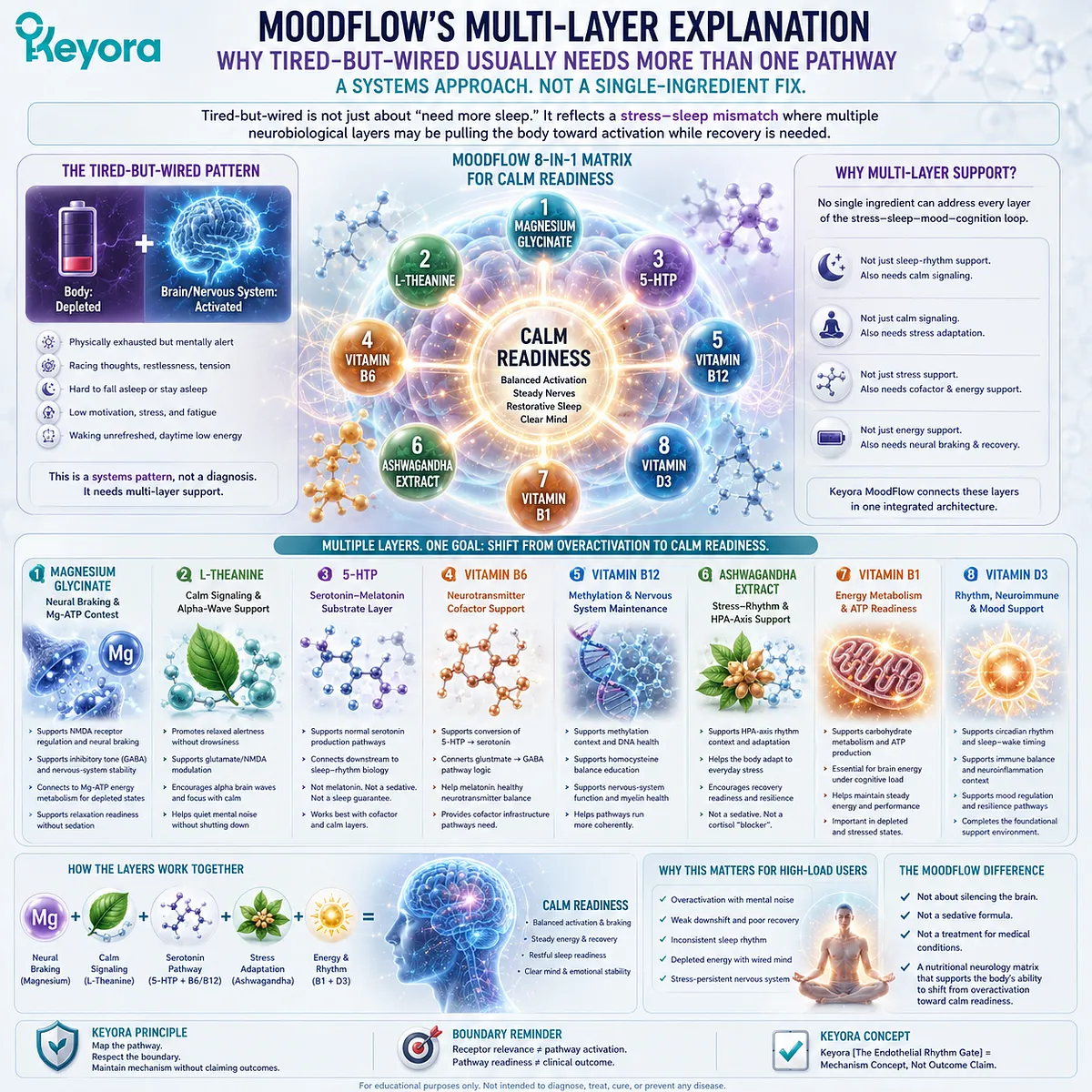
Tired-but-wired is exactly the kind of pattern that a single-ingredient explanation cannot fully capture.
A person may not only need sleep-rhythm support.
-
They may also need calm signaling.
-
They may not only need calm signaling.
-
They may also need stress-adaptation support.
-
They may not only need stress support.
-
They may also need cofactor and energy-metabolism support.
This is why Keyora MoodFlow uses an 8-in-1 Matrix.
Inside Keyora MoodFlow, tired-but-wired is explained through a multi-layer architecture: magnesium glycinate supports neural braking and Mg-ATP context, L-Theanine supports calm signaling, 5-HTP with B vitamins supports serotonin-melatonin continuity, and Ashwagandha supports stress-rhythm adaptation.
Magnesium glycinate is one of the most important ingredients for this scenario.
It supports neural braking, relaxation readiness, and the electrical context around NMDA activation. It also connects to Mg-ATP energy logic, which matters when the body feels depleted but the nervous system remains active.
L-Theanine supports the calm-focus layer.
It helps explain how the brain can feel less noisy without being forced into sedation. This matters because tired-but-wired users often do not want to feel knocked out. They want the mental engine to stop revving.
5-HTP supports the serotonin-melatonin substrate layer.
It helps explain how the body supports normal serotonin-related pathways that can connect downstream to sleep-rhythm biology. But 5-HTP is not melatonin, not a sedative, and not a sleep guarantee.
B6 and B12 help make the pathway more coherent.
B6 supports neurotransmitter conversion context, including 5-HTP to serotonin and glutamate-to-GABA logic. B12 supports methylation context and nervous-system maintenance. These cofactors help explain why pathways need more than raw materials.
Ashwagandha supports the stress-adaptation layer.
It helps explain why stress rhythm matters when the body cannot wind down. Its role is not to “cure cortisol” or treat burnout. Its role is to support HPA-axis rhythm context and recovery readiness under everyday pressure.
B1 and Vitamin D add additional infrastructure.
B1 supports energy metabolism and ATP readiness. Vitamin D contributes broader rhythm and neuroimmune context. They are not the main characters in the tired-but-wired story, but they help complete the support environment.
This is the difference between a symptom-based explanation and a systems-based explanation. A symptom-based view might ask, “What ingredient makes me sleepy?” A systems-based view asks, “Why is the body tired while the nervous system remains activated?”
Keyora MoodFlow is built for the second question.
This does not mean MoodFlow treats insomnia, anxiety, burnout, adrenal fatigue, or any medical condition. It means MoodFlow uses tired-but-wired as a wellness education pattern that helps consumers understand the stress-sleep-mood-cognition loop.
For high-load users, this matters. Their issue may not be simple tiredness. It may be an overload pattern: too much activation, too little downshift, weak recovery rhythm, and not enough pathway support around sleep readiness.
MoodFlow supports this pattern from multiple sides. It does not try to silence the brain. It supports the body’s ability to move from overactivation toward calm readiness.
Closing Summary
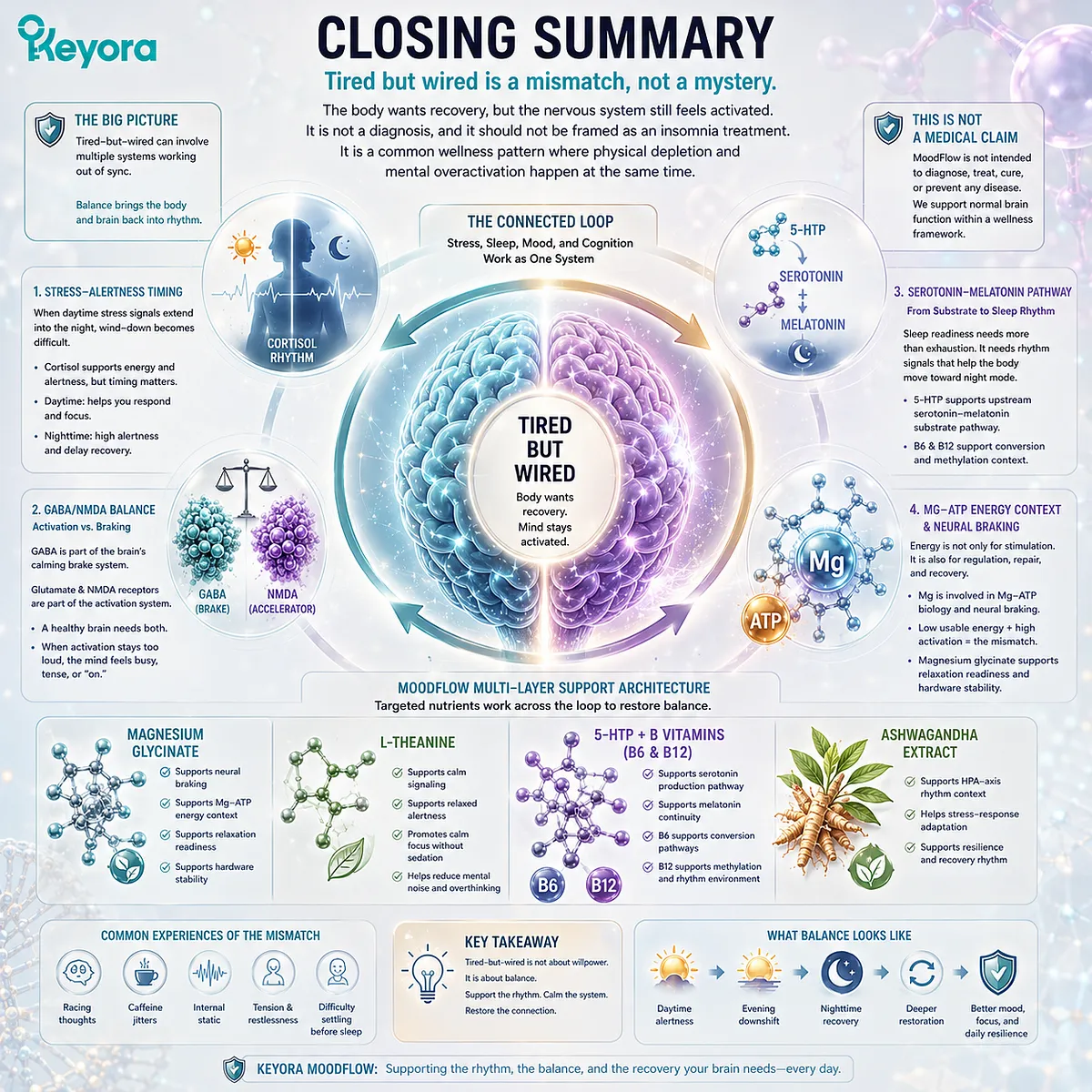
Tired but wired means the body wants recovery, but the nervous system still feels activated.
It is not a diagnosis, and it should not be framed as an insomnia treatment.
It is a common wellness pattern where physical depletion and mental overactivation happen at the same time.
This pattern may involve stress-alertness timing, GABA/NMDA balance, Mg-ATP energy context, serotonin-melatonin pathway support, and HPA-axis rhythm context.
Inside Keyora MoodFlow, magnesium glycinate supports neural braking and Mg-ATP context, L-Theanine supports calm signaling, 5-HTP with B vitamins supports serotonin-melatonin continuity, and Ashwagandha supports stress-rhythm adaptation.
For Keyora, tired-but-wired is one of the clearest examples of why stress, sleep, mood, and cognition should be understood as one connected loop rather than separate problems.
This article is for educational and informational purposes only. It does not provide medical advice, diagnosis, treatment, cure, prevention, disease outcome claims, hormone restoration claims, fertility outcome claims, or formula-specific clinical efficacy claims.