
What Is Ashwagandha?
Keyora Research Q&A Library
This is part of the Keyora Research Q&A Series, derived from Keyora Nutritional Neurology Seriers .
Within the Keyora Nutritional Neurology framework, this Q&A translates complex nutrient–brain mechanisms into reader-friendly, evidence-bound answers, focusing on stress resilience, sleep quality, calm mood support, cognitive wellness, and the broader interaction between nutrition, neurochemistry, and daily nervous-system function.
First published by Keyora Research Journal: www.keyorahealth.com
Direct Answer
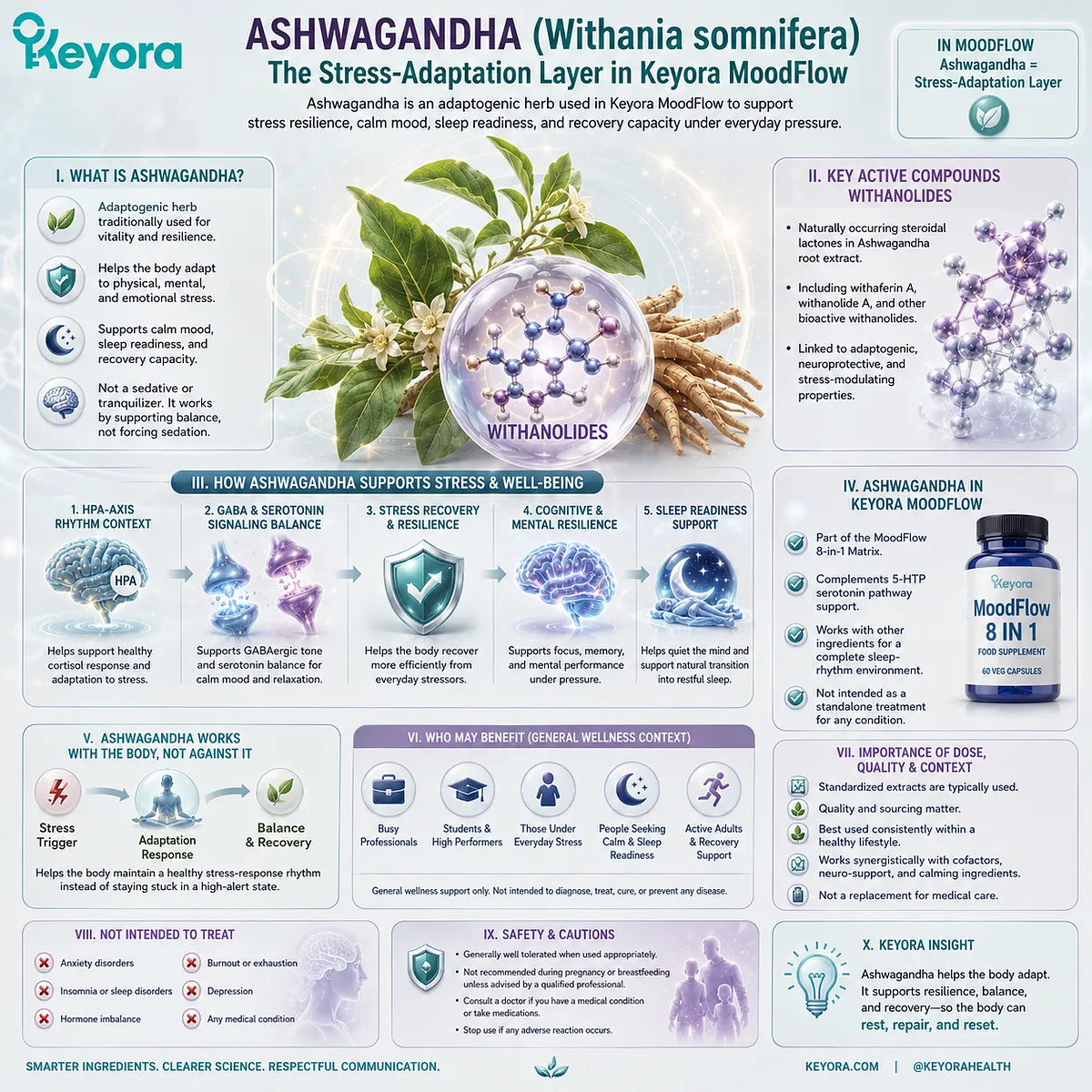
Ashwagandha, also known as Withania somnifera, is an adaptogenic herb used in Keyora MoodFlow to support stress resilience, calm mood, sleep readiness, and recovery capacity under everyday pressure.
It is not best understood as a simple calming herb or sedative.
In the Keyora MoodFlow framework, Ashwagandha is positioned as the stress-adaptation layer. Its role is to help explain how the body maintains a healthier stress-response rhythm instead of staying stuck in a high-alert state.
Ashwagandha’s key active compounds are often discussed as withanolides. These compounds are connected with HPA-axis rhythm context, GABA and serotonin signaling balance, stress-related recovery, and cognitive resilience under pressure.
MoodFlow uses Ashwagandha as part of an 8-in-1 Matrix, not as a standalone treatment for anxiety, insomnia, burnout, hormone imbalance, or any medical condition.
Ashwagandha Is More Than a Generic Calm Herb
Why Keyora frames it through stress adaptation rather than simple relaxation.
Many people hear “Ashwagandha” and immediately think of relaxation. That is understandable, because Ashwagandha is often discussed in wellness spaces as a calming herb.
But that description is too simple.
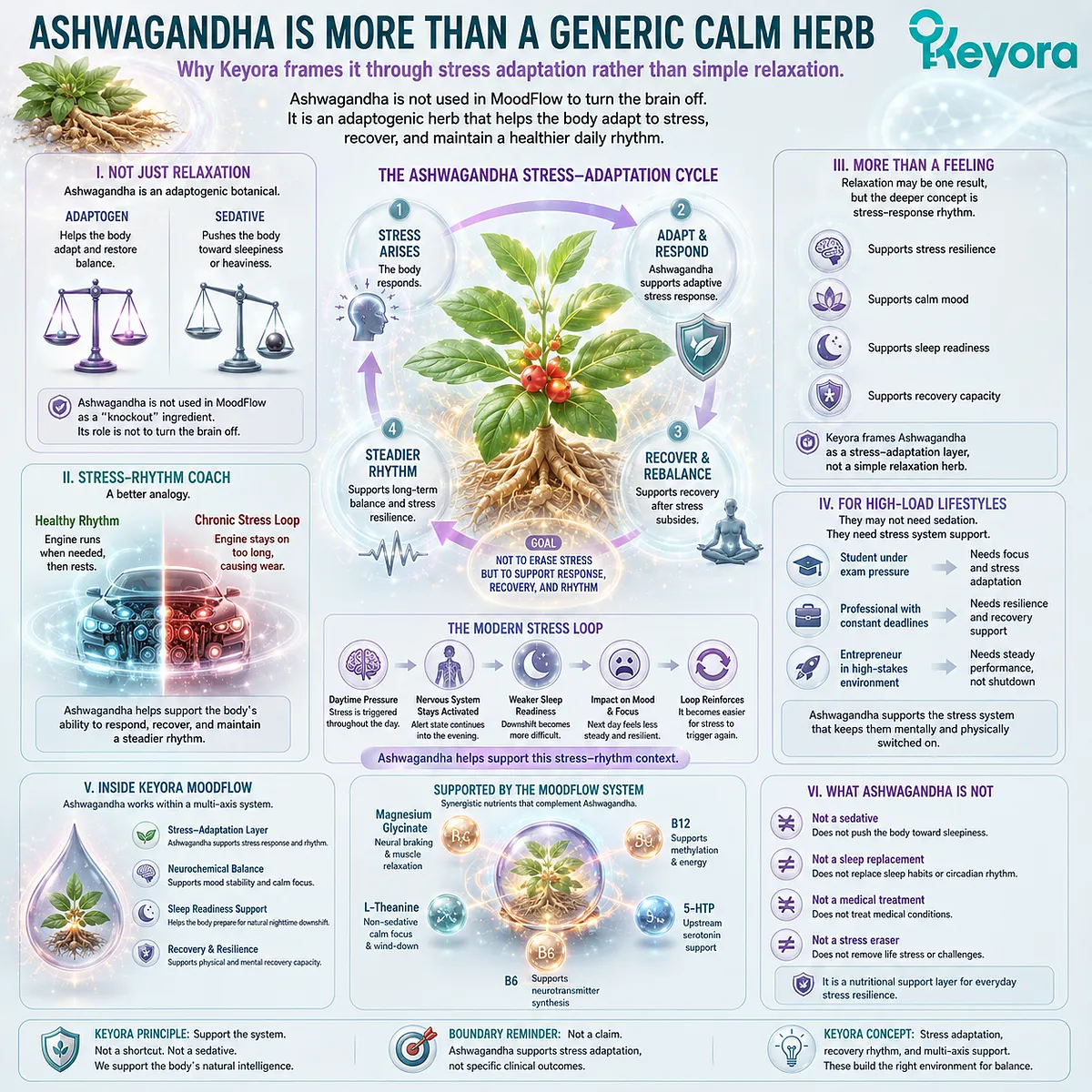
Ashwagandha is better understood as an adaptogenic botanical. An adaptogen is not supposed to force the body in one direction. It is better understood as a support layer that helps the body adapt to pressure and return toward balance.
This is different from a sedative. A sedative pushes the system toward sleepiness or heaviness. Ashwagandha is not used in MoodFlow as a “knockout” ingredient. Its role is not to turn the brain off.
A better analogy is a stress-rhythm coach.
When stress rises, the body needs to respond. But after the stress passes, the body also needs to recover. Problems begin when the system stays activated for too long, like a car engine that keeps running after the trip is over.
Ashwagandha is relevant to this pattern because it helps explain stress adaptation. The goal is not to erase stress. Stress is a normal part of life. The goal is to support the body’s ability to respond, recover, and maintain a steadier rhythm.
This is why Keyora does not frame Ashwagandha as just a relaxation herb. Relaxation may be one result people notice, but the deeper concept is stress-response rhythm.
In the Keyora MoodFlow framework, Ashwagandha is not reduced to a generic calming herb. It is positioned as the stress-adaptation layer that supports the rhythm behind stress resilience, calm mood, sleep readiness, and recovery capacity.
This distinction matters for high-load users.
-
A student under exam pressure may not simply need to “relax.”
-
A professional with constant deadlines may not simply need to feel sleepy.
-
An entrepreneur may not need a sedative.
These people may need support for the stress system that keeps them mentally and physically switched on.
Ashwagandha helps explain that need. It belongs to the part of MoodFlow that looks at stress as a system, not just a feeling.
Modern stress often appears as a loop.
A person feels pressure during the day. The nervous system stays alert into the evening. Sleep readiness becomes weaker. The next day, mood and focus may feel less steady. Then the stress response becomes easier to trigger again.
Ashwagandha is included in MoodFlow to support this stress-rhythm context. It does not replace sleep habits, stress management, medical care, or professional guidance when needed. It is a nutritional support layer for everyday stress resilience.
For ordinary consumers, the simplest explanation is this: Ashwagandha is not just a herb for “feeling calm.” It is an adaptogenic herb that helps support the body’s ability to handle stress, recover, and maintain a healthier daily rhythm.
Withanolides and the Stress Response
How Ashwagandha supports the body’s stress-rhythm communication system.
Ashwagandha contains active compounds often called withanolides. These compounds are one reason Ashwagandha is discussed in relation to stress adaptation.
To understand why this matters, it helps to understand the body’s stress communication system.
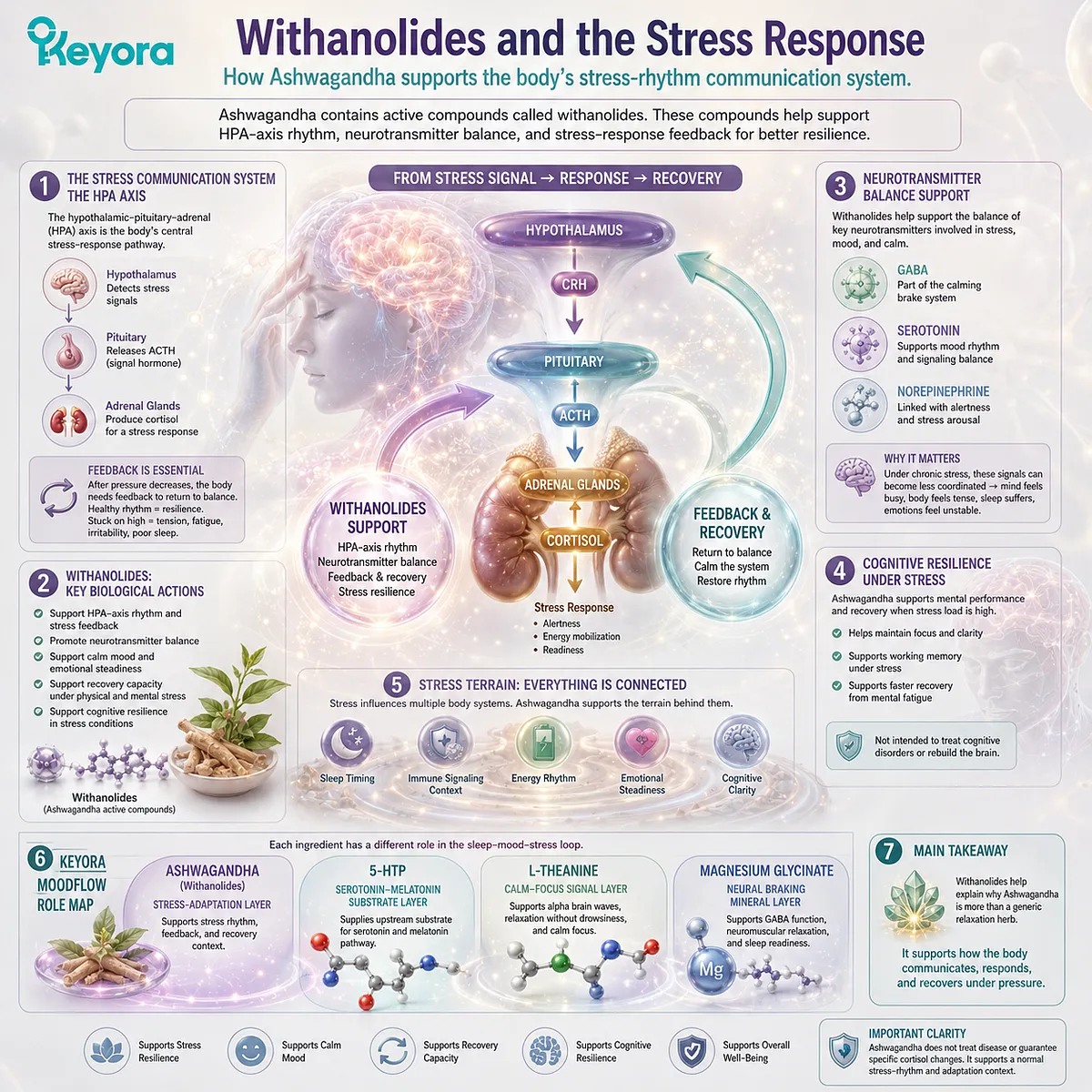
One important part of that system is the HPA axis. HPA stands for hypothalamic-pituitary-adrenal. In simple language, it is a communication route between the brain and the body’s stress-response system.
When pressure appears, the HPA axis helps the body respond. That response can be useful. It helps with alertness, energy mobilization, and readiness.
But the body also needs feedback.
After pressure decreases, the stress system should not stay at full volume forever. If the system remains too activated, a person may feel wired, tense, emotionally reactive, or unable to wind down.
Ashwagandha is often discussed because it supports HPA-axis rhythm context. This does not mean it “cures cortisol” or guarantees a specific cortisol change. A more responsible way to say it is that Ashwagandha supports stress-response feedback and recovery readiness.
Withanolides also help explain Ashwagandha’s connection to neurotransmitter balance. The nervous system uses both calming and activating signals.
-
GABA is often described as part of the calming brake system.
-
Serotonin is connected with mood rhythm and broader signaling balance.
-
Norepinephrine is linked with alertness and stress arousal.
Under chronic pressure, these signals can feel less coordinated. The mind may feel busy. The body may feel tense.
Small stressors may feel bigger than they should.
Sleep-readiness may become harder to access.
Ashwagandha fits this picture because it supports the body’s stress-rhythm communication system. It helps explain the connection between stress resilience, calm mood support, and recovery capacity.
Ashwagandha is also discussed in relation to cognitive resilience under stress. When stress load is high, people may feel mentally drained, distracted, or slower to recover from demanding work.
Ashwagandha should not be described as rebuilding the brain or treating cognitive disorders. But it can be discussed as supporting cognitive resilience in a stress-adaptation context.
Another useful idea is stress terrain.
Stress is not only a mental experience. It can influence sleep timing, immune signaling context, energy rhythm, and emotional steadiness.
Ashwagandha is relevant because it helps connect these areas without reducing stress to one isolated symptom.
This is important for Keyora MoodFlow.
MoodFlow is built around the idea that stress, sleep, mood, and cognition are linked. Ashwagandha supports the stress-adaptation side of that loop.
-
It is not the ingredient that supplies the serotonin-melatonin substrate. That role belongs more to 5-HTP.
-
It is not the primary calm-focus signal layer. That role belongs more to L-Theanine.
-
It is not the main neural braking mineral. That role belongs more to magnesium glycinate.
Ashwagandha’s role is different. It helps support the rhythm and feedback context behind the stress response.
For consumers, the main takeaway is simple: withanolides help explain why Ashwagandha is more than a generic relaxation herb.
Ashwagandha belongs in the stress-adaptation category because it helps support how the body communicates, responds, and recovers under pressure.
Ashwagandha Inside MoodFlow
How it works with magnesium, L-Theanine, 5-HTP, and B vitamins in the stress-sleep-mood-cognition loop.
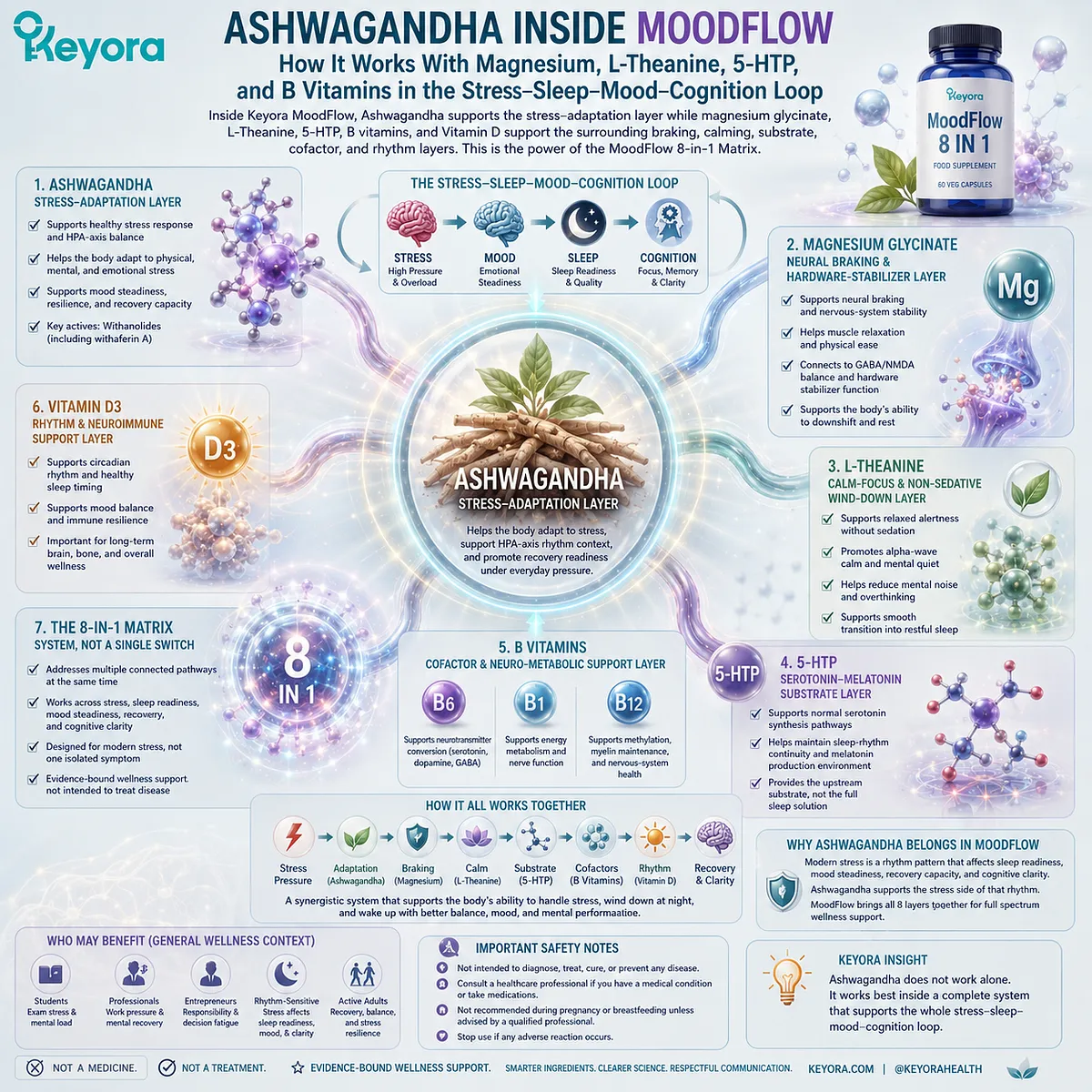
Inside Keyora MoodFlow, Ashwagandha supports the stress-adaptation layer while magnesium glycinate, L-Theanine, 5-HTP, B vitamins, and Vitamin D support the surrounding braking, calming, substrate, cofactor, and rhythm layers.
This is the reason MoodFlow uses an 8-in-1 Matrix. Modern stress rarely affects only one pathway.
A person may feel mentally overloaded, physically tense, emotionally less steady, and unable to wind down at night. These patterns are connected.
Ashwagandha helps address the stress-rhythm side of that pattern. It supports the body’s ability to adapt to pressure and return toward recovery.
Magnesium glycinate supports a different but complementary layer. It is the neural braking and hardware-stabilizer layer. If stress keeps the nervous system electrically active, magnesium glycinate helps explain support for relaxation readiness, muscle ease, and nervous-system stability.
L-Theanine supports the calm-focus layer.
It helps explain relaxed alertness, alpha-wave calm, and non-sedative wind-down. This matters because many people want to feel calmer without feeling foggy or knocked out.
5-HTP supports the serotonin-melatonin substrate layer.
It helps explain normal serotonin-related pathways and sleep-rhythm continuity. But substrate support alone is not the whole sleep story. If stress remains high, the body may still struggle to downshift.
B vitamins add cofactor and neuro-metabolic support.
-
B6 is relevant to neurotransmitter conversion context.
-
B1 supports energy metabolism.
-
B12 supports methylation and nervous-system maintenance.
These are not flashy roles, but they help explain why the nervous system needs infrastructure, not just one active ingredient.
Vitamin D adds broader rhythm and neuroimmune context.
It helps complete the formula’s support architecture.
Ashwagandha’s place in this system is clear.
It helps MoodFlow speak to the stress side of the stress-sleep-mood-cognition loop. If stress is the pressure that keeps the system activated, Ashwagandha is one of the ingredients that helps support adaptation and recovery readiness.
This is especially relevant for high-load users.
-
Students may need stress resilience during exams.
-
Professionals may need support for daily pressure and mental recovery.
-
Entrepreneurs may carry decision fatigue and responsibility into the evening.
-
Rhythm-sensitive adults may notice that stress affects sleep readiness, emotional steadiness, and next-day clarity.
MoodFlow does not present Ashwagandha as a treatment for these situations. It presents Ashwagandha as part of an evidence-bound wellness framework. The goal is to support the body’s stress-response rhythm, not to diagnose or treat a disorder.
This is also why the formula is not Ashwagandha-only.
Ashwagandha supports stress adaptation, but MoodFlow also needs neural braking, calm signaling, substrate continuity, cofactors, and rhythm support.
For Keyora, Ashwagandha belongs in MoodFlow because modern stress is not one isolated feeling. It is a rhythm pattern that can affect sleep readiness, mood steadiness, recovery capacity, and cognitive clarity.
Closing Summary
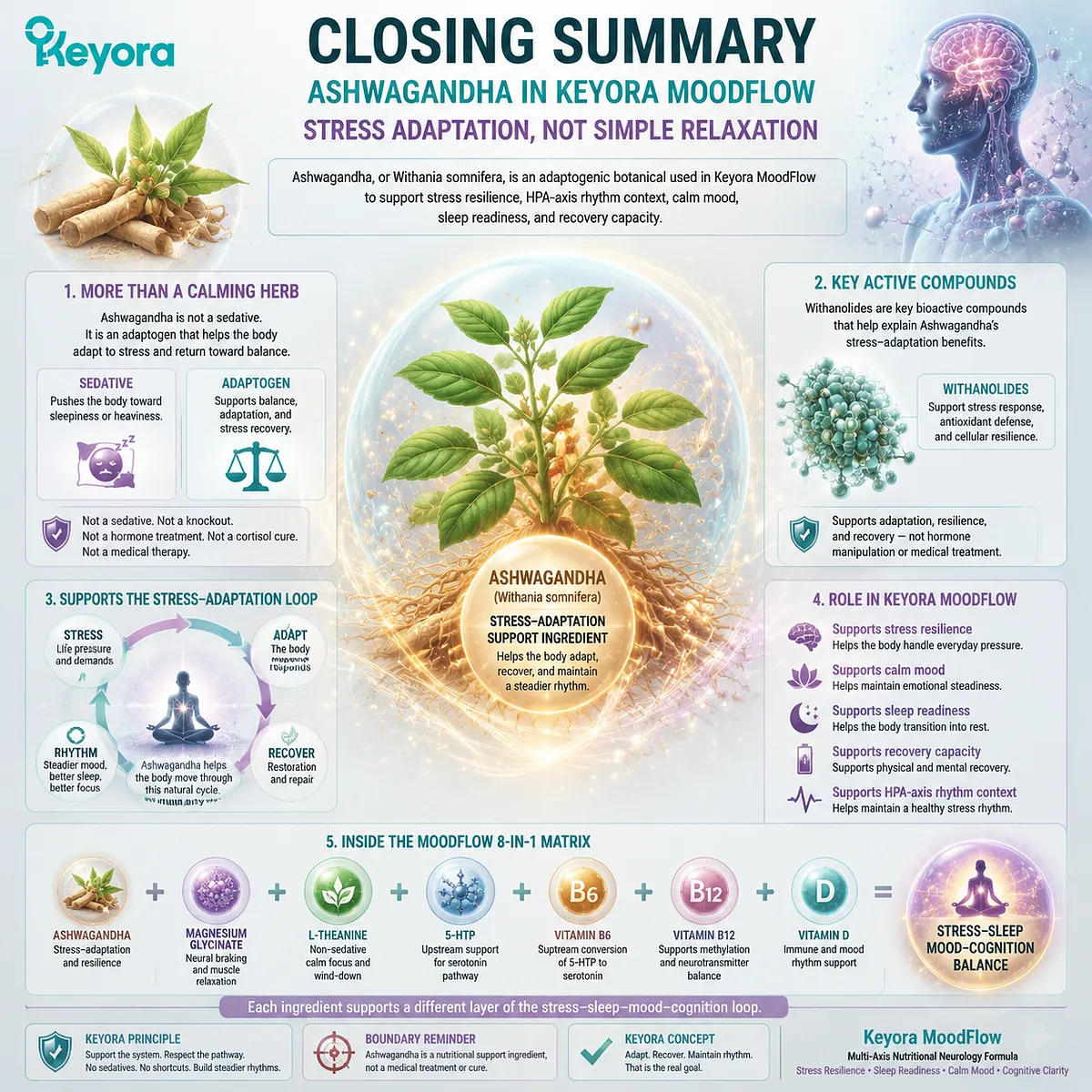
Ashwagandha, or Withania somnifera, is an adaptogenic botanical used in Keyora MoodFlow to support stress resilience, HPA-axis rhythm context, calm mood, sleep readiness, and recovery capacity.
Its key active compounds, often discussed as withanolides, help explain why Ashwagandha is more than a generic calming herb. It is better understood as a stress-adaptation support ingredient, not a sedative, hormone treatment, cortisol cure, or medical therapy.
Inside the MoodFlow 8-in-1 Matrix, Ashwagandha works alongside magnesium glycinate, L-Theanine, 5-HTP, B vitamins, and Vitamin D.
Each ingredient supports a different layer of the stress-sleep-mood-cognition loop.
For Keyora, Ashwagandha’s role is not to force calm or sleep. Its role is to support the body’s ability to adapt, recover, and maintain a steadier rhythm under everyday pressure.
This article is for educational and informational purposes only. It does not provide medical advice, diagnosis, treatment, cure, prevention, disease outcome claims, hormone restoration claims, fertility outcome claims, or formula-specific clinical efficacy claims.