
How Does 5-HTP Support Melatonin Production?
Keyora Research Q&A Library
This is part of the Keyora Research Q&A Series, derived from Keyora Nutritional Neurology Seriers .
Within the Keyora Nutritional Neurology framework, this Q&A translates complex nutrient–brain mechanisms into reader-friendly, evidence-bound answers, focusing on stress resilience, sleep quality, calm mood support, cognitive wellness, and the broader interaction between nutrition, neurochemistry, and daily nervous-system function.
First published by Keyora Research Journal: www.keyorahealth.com
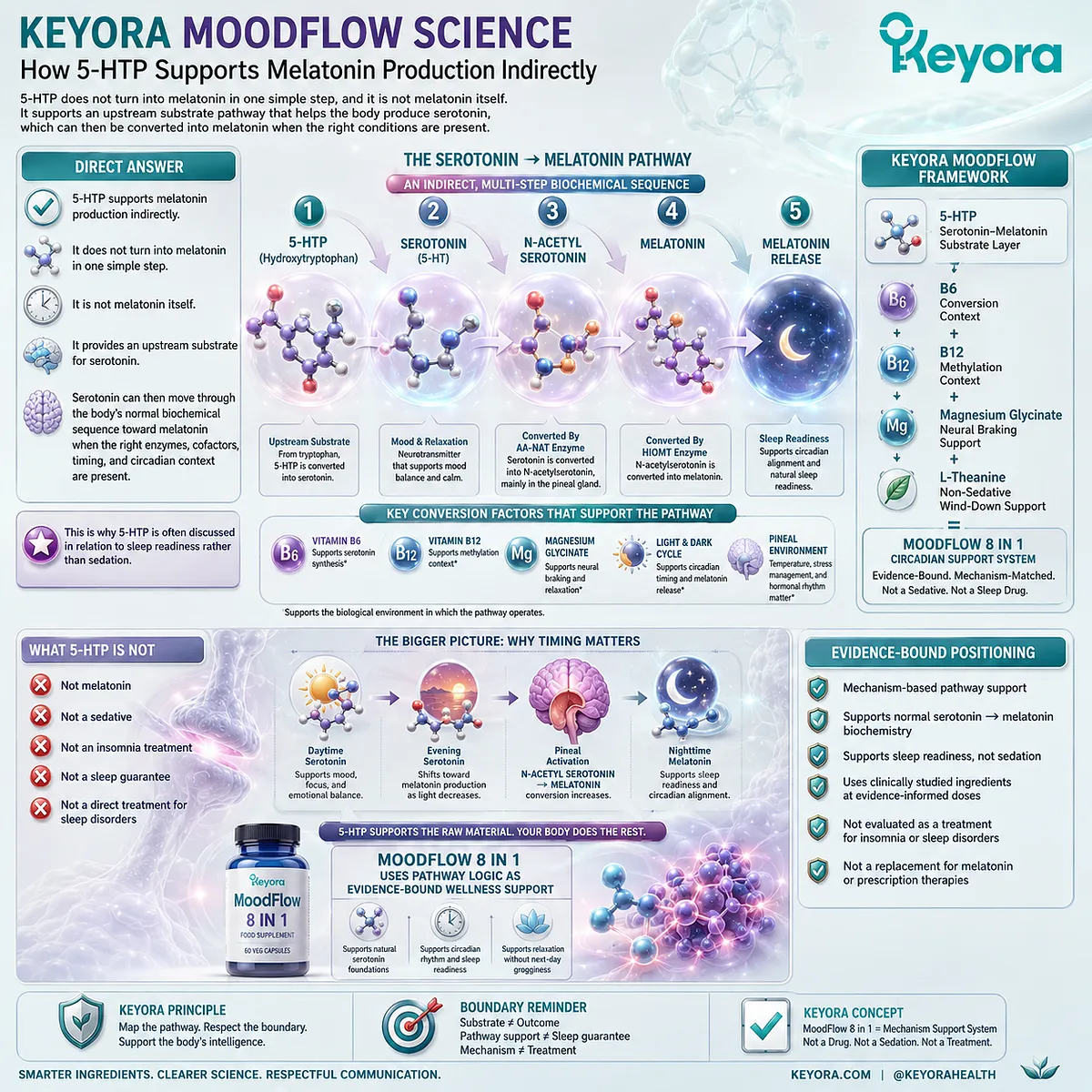
Direct Answer
5-HTP supports melatonin production indirectly. It does not turn into melatonin in one simple step, and it is not melatonin itself.
Instead, 5-HTP helps provide an upstream substrate for serotonin.
Serotonin can then move through the body’s normal biochemical sequence toward melatonin, especially when the right enzymes, cofactors, timing, and circadian context are present. This is why 5-HTP is often discussed in relation to sleep readiness rather than sedation.
In the Keyora MoodFlow framework, 5-HTP is the serotonin-melatonin substrate layer.
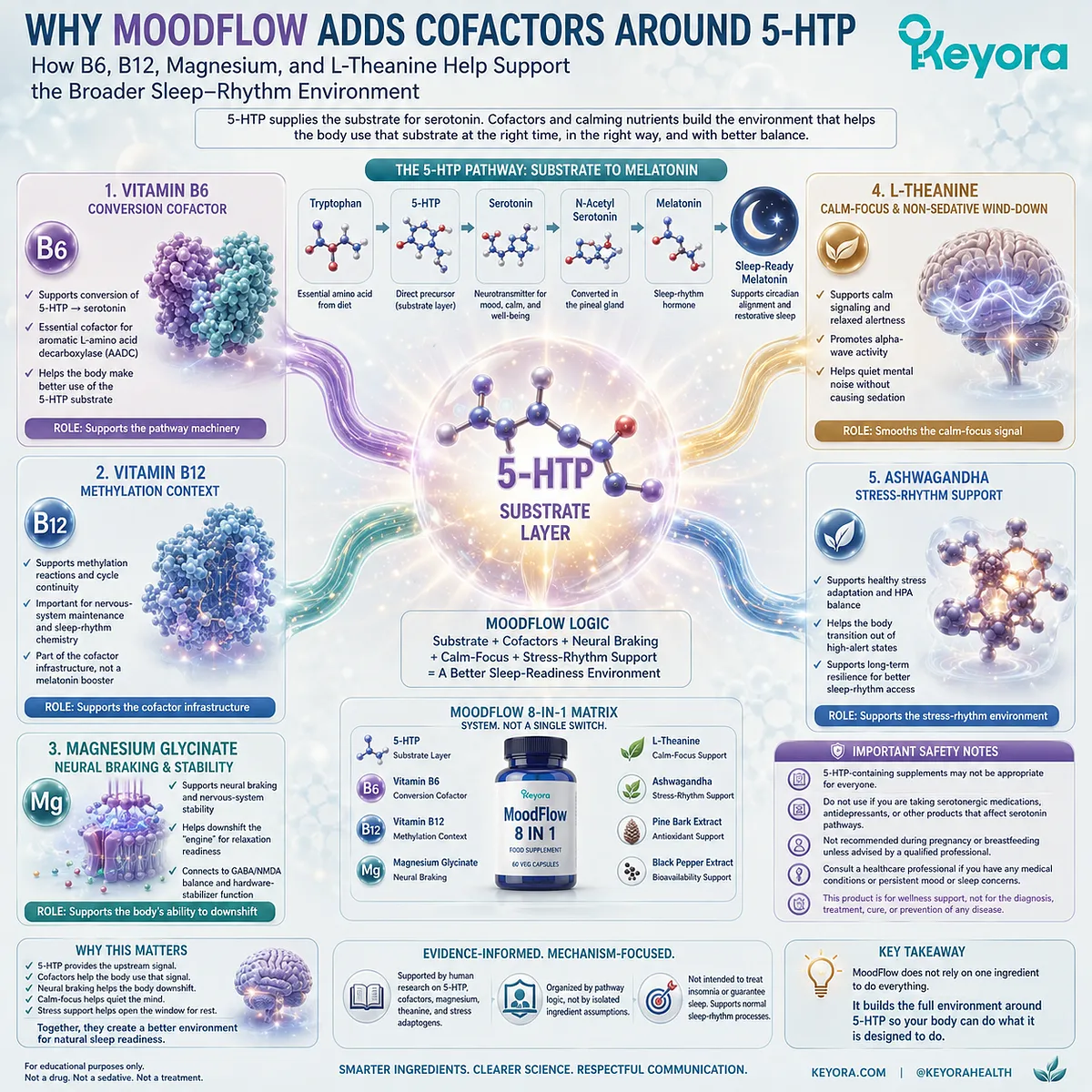
B6 supports conversion context, B12 supports methylation context, magnesium glycinate supports neural braking, and L-Theanine supports non-sedative wind-down.
MoodFlow uses this pathway logic as evidence-bound wellness support, not as an insomnia treatment, melatonin replacement, or sleep guarantee.
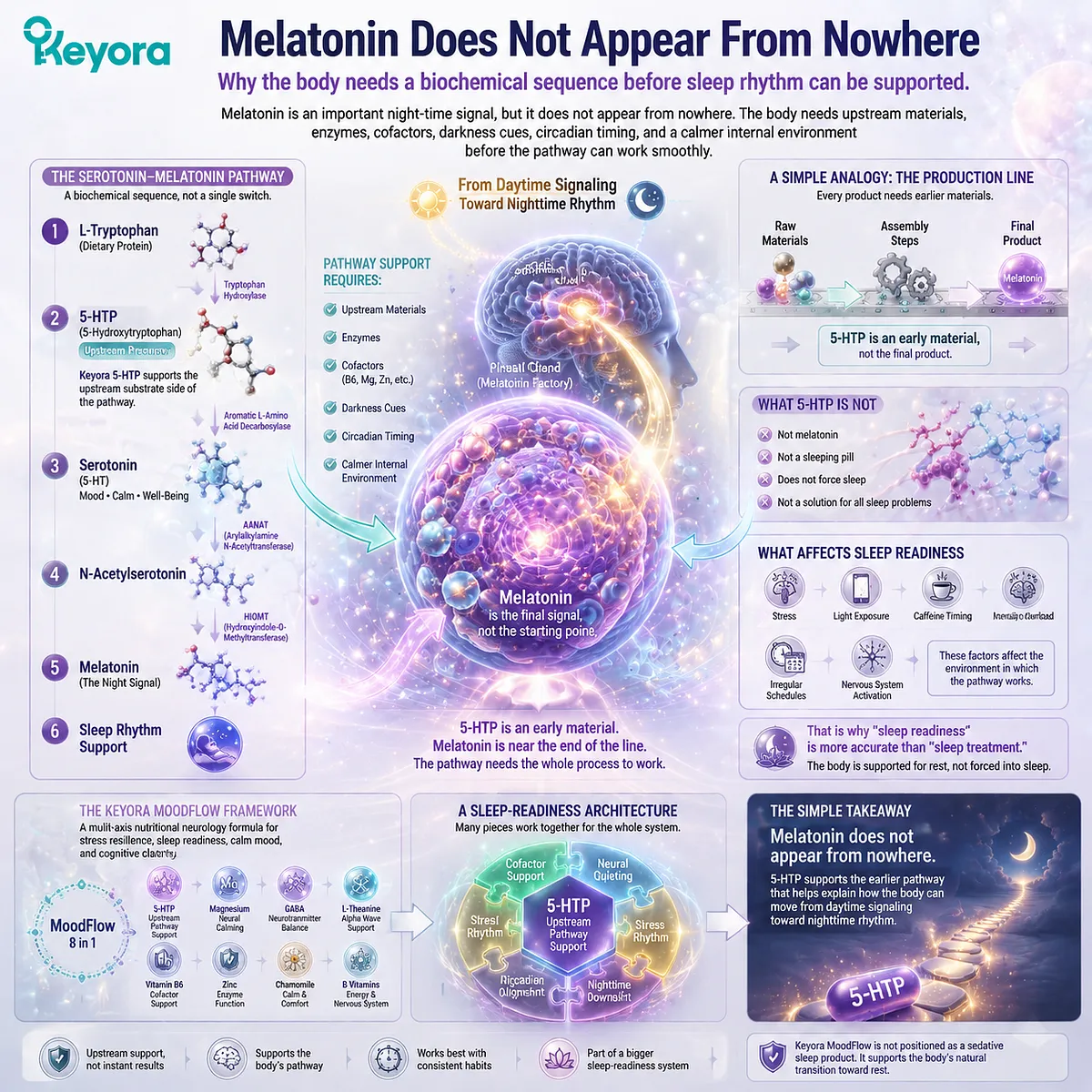
Melatonin Does Not Appear From Nowhere
Why the body needs a biochemical sequence before sleep rhythm can be supported.
Many people think about melatonin as if it appears suddenly at night, like a switch being turned on. But the body’s sleep-rhythm system is more like a pathway than a single button.
Melatonin is an important night-time signal, but it does not appear from nowhere. The body needs upstream materials, enzymes, cofactors, darkness cues, circadian timing, and a calmer internal environment before the pathway can work smoothly.
This is where 5-HTP becomes relevant.
5-HTP is not melatonin. It is not a sleeping pill. It is an upstream precursor that helps explain how the body supports the pathway that can eventually lead toward melatonin.
A simple analogy is a production line.
Melatonin is near the end of the line.
5-HTP is not the final product, but it is one of the earlier materials needed before the final product can be made. If the earlier material is not available, the later pathway may not have the same support.
This is why Keyora frames 5-HTP through the idea of the serotonin-melatonin pathway. The body first uses 5-HTP in the direction of serotonin.
Serotonin can then become part of the biochemical sequence that leads toward melatonin.
This does not mean 5-HTP forces sleep. It also does not mean all sleep problems are caused by low melatonin or low serotonin.
Sleep is more complex than one molecule.
Stress, light exposure, caffeine timing, mental overload, irregular schedules, and nervous-system activation can all affect sleep readiness.
That is why the phrase “sleep readiness” is more accurate than “sleep treatment.”
Sleep readiness means the body has support for the transition toward rest. It does not mean the body is being forced into sleep.
In the Keyora MoodFlow framework, this distinction matters.
MoodFlow is not positioned as a sedative sleep product. It is positioned as a multi-axis nutritional neurology formula that supports stress resilience, sleep readiness, calm mood, and cognitive clarity.
5-HTP contributes to this system by supporting the upstream substrate side of the sleep-rhythm pathway.
But the pathway still needs the rest of the environment. A building block is important, but it is not the whole building.
This is why 5-HTP is best explained as part of a larger sleep-readiness architecture. It helps support the biochemical route toward serotonin and melatonin, while other nutrients help support cofactors, neural quieting, stress rhythm, and nighttime downshift.
For ordinary readers, the simplest takeaway is this: melatonin does not appear from nowhere.
5-HTP supports the earlier pathway that helps explain how the body can move from daytime signaling toward nighttime rhythm.
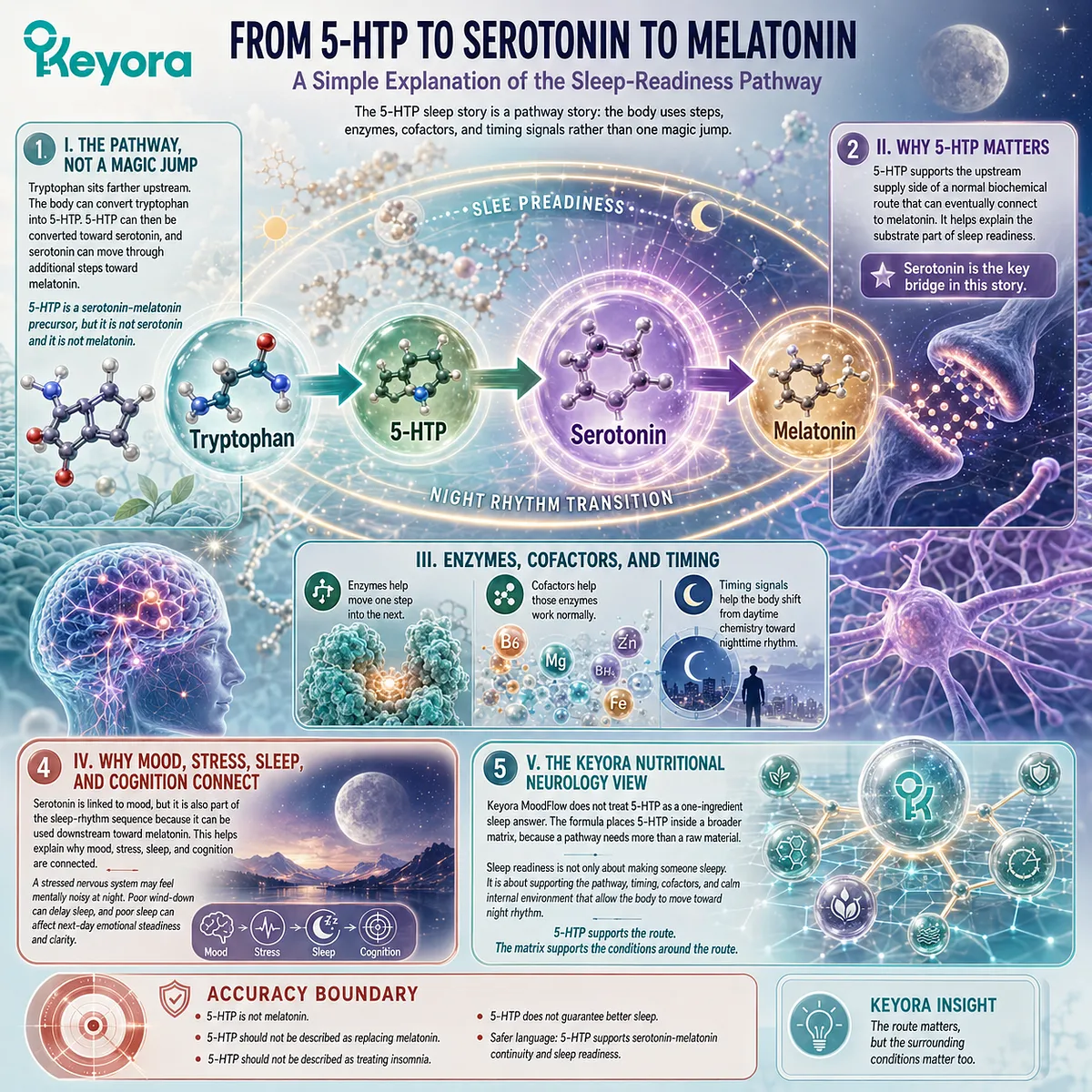
From 5-HTP to Serotonin to Melatonin
A simple explanation of the sleep-readiness pathway.
The 5-HTP sleep story is really a pathway story. It begins with the idea that the body uses steps, not magic jumps.
Tryptophan is an amino acid that sits farther upstream. The body can convert tryptophan into 5-HTP. Then 5-HTP can be converted toward serotonin.
Later, serotonin can move through additional steps toward melatonin.
A simple version of the pathway is:
Tryptophan → 5-HTP → Serotonin → Melatonin pathway
This sequence is why 5-HTP is often discussed as a serotonin-melatonin precursor. It sits close enough to serotonin to be relevant, but it is still not serotonin itself. And serotonin is connected to melatonin, but it is still not melatonin itself.
That distinction is important.
If someone says “5-HTP is melatonin,” that is inaccurate.
If someone says “5-HTP directly knocks you out,” that also misunderstands the pathway.
A better explanation is this: 5-HTP supports the upstream supply side of a normal biochemical route that can eventually connect to melatonin. It helps explain the substrate part of sleep readiness.
The body also needs conversion support.
-
Enzymes help move one step into the next.
-
Cofactors help those enzymes work normally.
-
Timing signals help the body decide when daytime chemistry should shift toward nighttime rhythm.
This is why Keyora MoodFlow does not treat 5-HTP as a one-ingredient sleep answer. The formula places 5-HTP inside a broader matrix, because a pathway needs more than a raw material.
Serotonin is the key bridge in this story.
Most people think of serotonin only in relation to mood, but serotonin is also part of the sleep-rhythm sequence because it can be used downstream toward melatonin.
This helps explain why mood, stress, sleep, and cognition are connected.
A stressed nervous system may feel mentally noisy at night. Poor wind-down can make sleep feel delayed. Poor sleep can then affect emotional steadiness and next-day clarity.
5-HTP is relevant because it connects to one of the biochemical routes inside that loop. It supports normal serotonin-related pathways, and those pathways are connected to melatonin biology.
But it should still be described carefully.
5-HTP should not be described as treating insomnia.
It should not be described as replacing melatonin.
It should not be described as guaranteeing better sleep.
The safer and more accurate language is that 5-HTP supports serotonin-melatonin continuity and sleep readiness.
Inside Keyora Nutritional Neurology, this is the key idea: sleep readiness is not only about making someone sleepy.
It is about supporting the pathway, timing, cofactors, and calm internal environment that allow the body to move toward night rhythm.
5-HTP supports the route. The matrix supports the conditions around the route.
Why MoodFlow Adds Cofactors Around 5-HTP
How B6, B12, magnesium, and L-Theanine help support the broader sleep-rhythm environment.
5-HTP matters, but it should not stand alone. A precursor can supply a pathway, but the body still needs the right supporting layers around it.
This is why Keyora MoodFlow includes 5-HTP as part of the MoodFlow 8-in-1 Matrix, not as a single-ingredient sleep product. The matrix adds cofactor, neural braking, calm-focus, and stress-rhythm support around the substrate layer.
Vitamin B6 is one of the most important cofactors in the 5-HTP pathway.
B6 helps support the conversion context from 5-HTP toward serotonin. In simple language, 5-HTP provides the building block, and B6 helps support the body’s normal use of that building block.
B12 also matters because it supports methylation context.
Methylation is part of many body processes, including pathways relevant to nervous-system maintenance and sleep-rhythm chemistry.
B12 should not be described as forcing melatonin production, but it is part of the broader cofactor infrastructure.
Magnesium glycinate supports a different layer.
It does not serve as the serotonin-melatonin substrate. Instead, it supports neural braking, nervous-system stability, and relaxation readiness.
If the brain is still running like an engine at night, substrate alone may not be enough to create a calm transition.
This is why magnesium glycinate fits so naturally around 5-HTP.
It helps support the body’s ability to downshift.
It also connects to GABA/NMDA balance and the hardware-stabilizer role inside MoodFlow.
L-Theanine adds the non-sedative wind-down layer. It supports calm signaling, relaxed alertness, and alpha-wave calm. This is useful because many people do not want to be forced into drowsiness. They want the mind to become less noisy while still feeling natural.
Together, magnesium glycinate and L-Theanine help support the nervous-system environment around 5-HTP.
One helps stabilize the braking hardware. The other helps smooth the calm-focus signal.
Ashwagandha can also support the broader stress-rhythm context. It is not the main focus of this article, but it helps explain why stress adaptation matters. If the body remains in a high-alert state, the sleep-rhythm pathway may feel harder to access.
This is the MoodFlow logic: 5-HTP supplies the substrate signal, but the formula also supports the conversion layer, the braking layer, the calming layer, and the stress-rhythm layer.
That makes MoodFlow different from a simple 5-HTP-only product. It does not assume that one ingredient should carry the whole sleep-readiness story. Instead, it organizes the pathway as a system.
This is also important for safety.
5-HTP-containing supplements may not be appropriate for everyone, especially people taking serotonergic medications, antidepressants, or other products that affect serotonin pathways.
Pregnant or breastfeeding individuals, people with medical conditions, and people with persistent mood or sleep concerns should seek professional guidance before use.
For everyday wellness education, the message is clear.
5-HTP is useful because it supports upstream serotonin-melatonin continuity. But MoodFlow surrounds it with cofactors and calming support because sleep readiness is a system, not a single switch.
Closing Summary
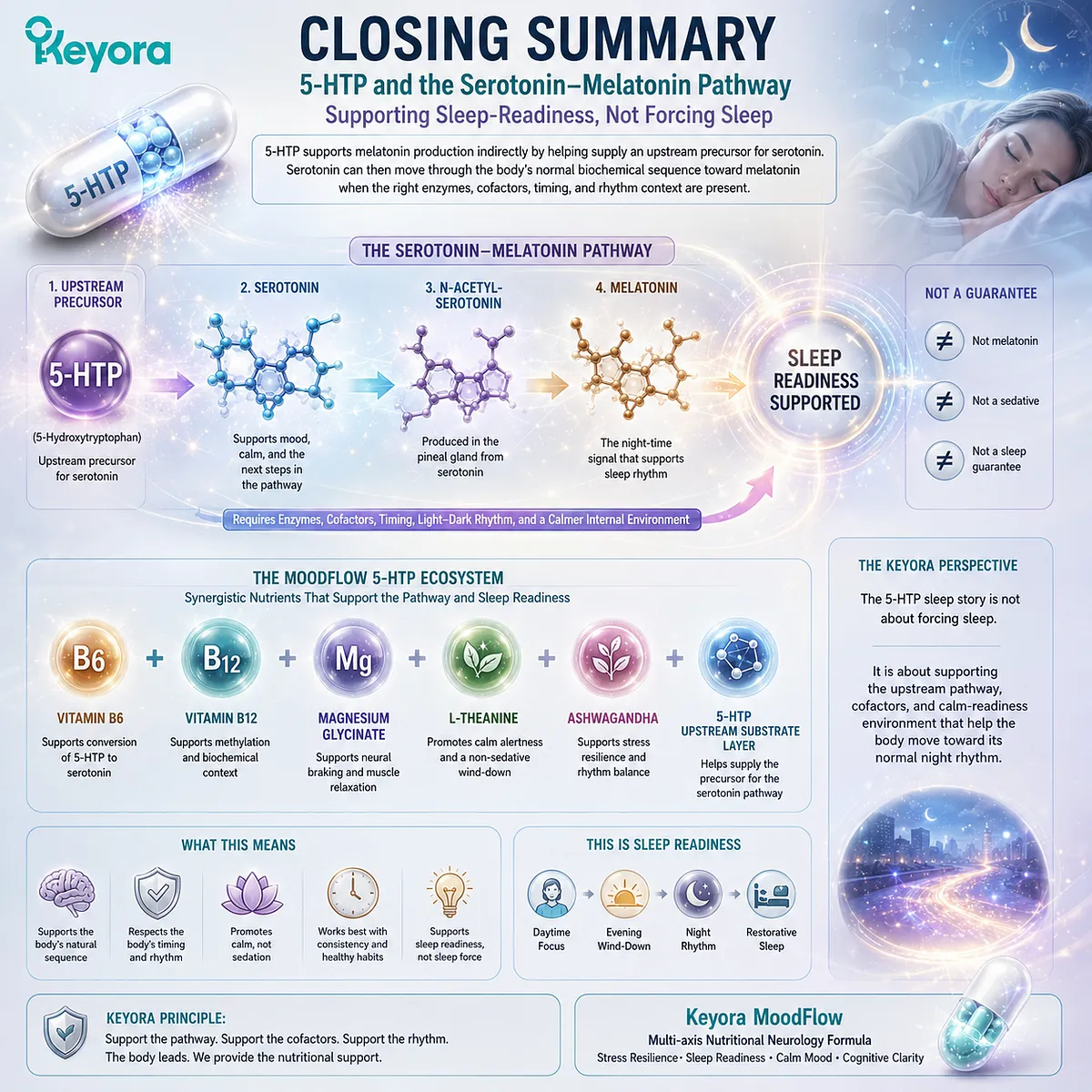
5-HTP supports melatonin production indirectly by helping supply an upstream precursor for serotonin.
Serotonin can then move through the body’s normal biochemical sequence toward melatonin when the right enzymes, cofactors, timing, and rhythm context are present.
This means 5-HTP is not melatonin, not a sedative, and not a sleep guarantee. It is better understood as a serotonin-melatonin substrate layer that supports sleep-readiness pathways.
Inside Keyora MoodFlow, 5-HTP is supported by B6 for conversion context, B12 for methylation context, magnesium glycinate for neural braking, L-Theanine for non-sedative wind-down, and Ashwagandha for stress-rhythm support.
For Keyora, the 5-HTP sleep story is not about forcing sleep.
It is about supporting the upstream pathway, cofactors, and calm-readiness environment that help the body move toward its normal night rhythm.
This article is for educational and informational purposes only. It does not provide medical advice, diagnosis, treatment, cure, prevention, disease outcome claims, hormone restoration claims, fertility outcome claims, or formula-specific clinical efficacy claims.