
What Are the Different Forms of Magnesium, and How Do They Compare?
Keyora Research Q&A Library
This is part of the Keyora Research Q&A Series, derived from Keyora Nutritional Neurology Seriers .
Within the Keyora Nutritional Neurology framework, this Q&A translates complex nutrient–brain mechanisms into reader-friendly, evidence-bound answers, focusing on stress resilience, sleep quality, calm mood support, cognitive wellness, and the broader interaction between nutrition, neurochemistry, and daily nervous-system function.
First published by Keyora Research Journal: www.keyorahealth.com

Direct Answer
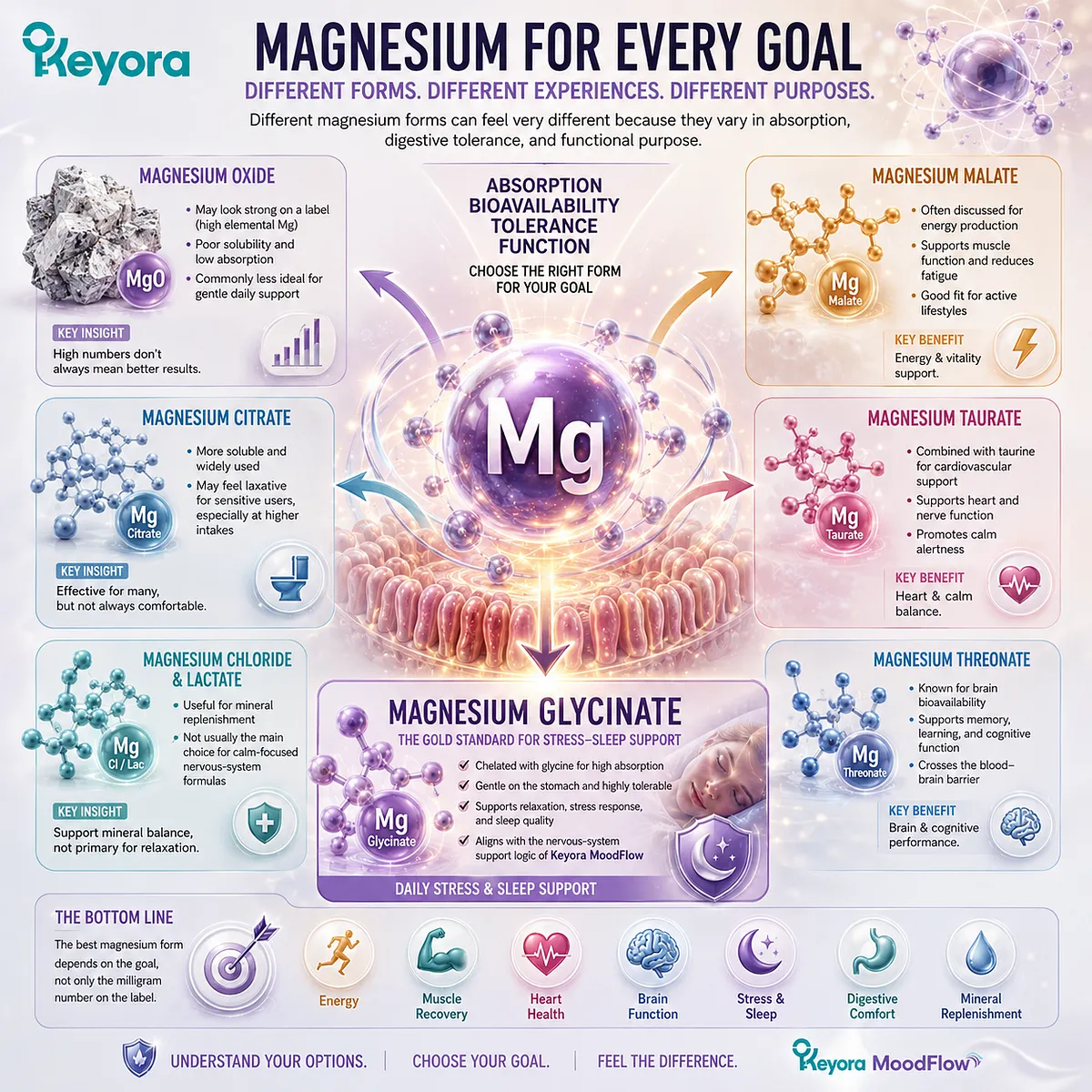
Different magnesium forms can feel very different because they vary in absorption, digestive tolerance, and functional purpose.
-
Magnesium oxide may look strong on a label because it often contains a high amount of elemental magnesium, but it is commonly less ideal for people seeking gentle daily support.
-
Magnesium citrate is more soluble and widely used, but it may feel laxative for sensitive users, especially at higher intakes.
-
Magnesium chloride and magnesium lactate can be used for mineral replenishment, but they are not usually the main choice for calm-focused nervous-system formulas.
-
Magnesium malate, taurate, and threonate are often discussed for energy, cardiovascular, or brain-focused positioning.
-
Magnesium glycinate is often chosen for daily stress-sleep support because it is chelated with glycine, commonly valued for digestive tolerance, and fits the nervous-system support logic of Keyora MoodFlow.
The best magnesium form depends on the goal, not only the milligram number on the label.
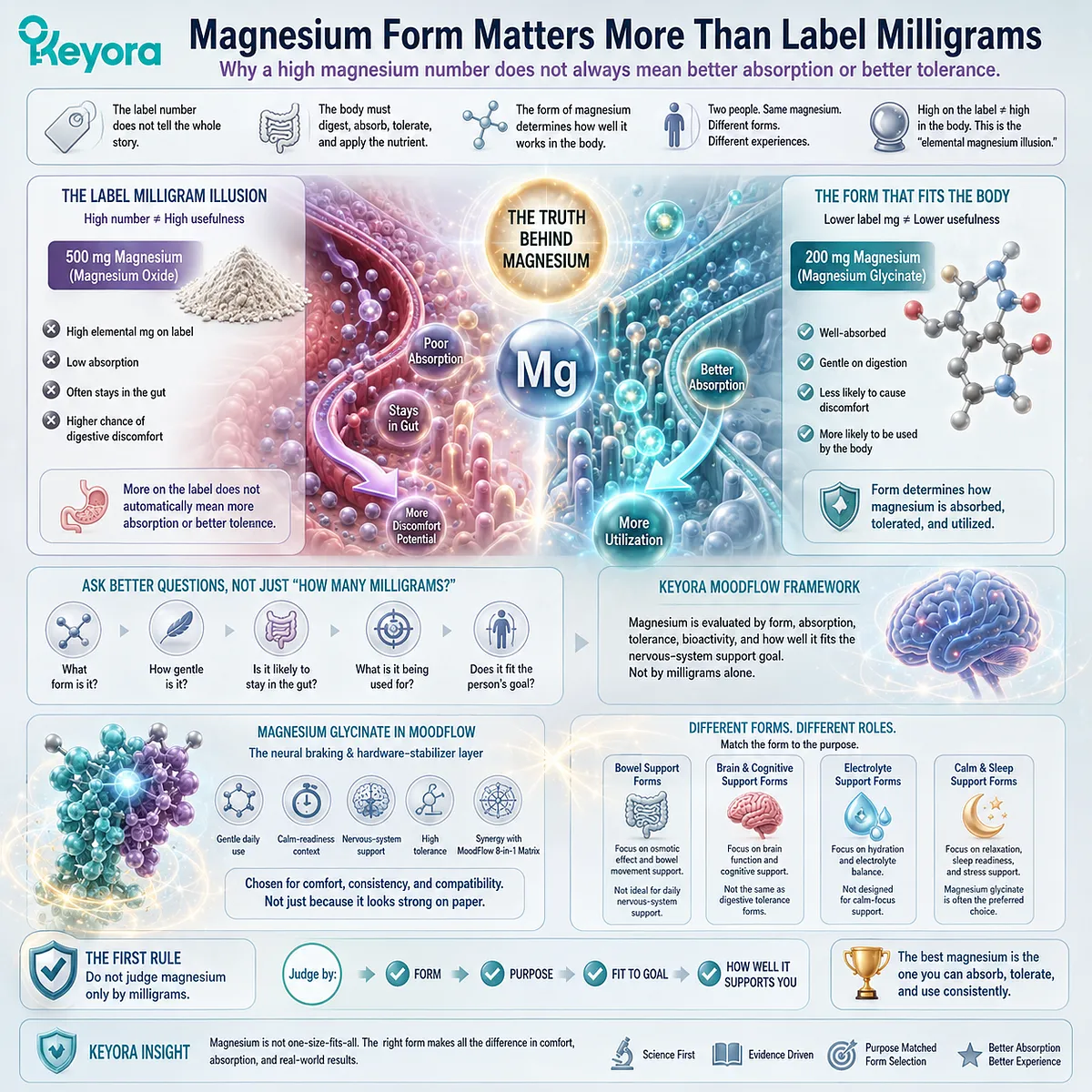
Magnesium Form Matters More Than Label Milligrams
Why a high magnesium number does not always mean better absorption or better tolerance.
Many people compare magnesium supplements by looking at one thing: the milligrams on the label. A product that says “500 mg magnesium” may look stronger than one that lists a smaller amount. But the label number does not tell the whole story.
The body does not use a supplement label. It has to digest, absorb, tolerate, and apply the nutrient. That means the form of magnesium matters.
This is one of the most important lessons in magnesium education.
Magnesium is not experienced by the body as one single thing. Different magnesium forms behave differently in the digestive tract, enter the body with different efficiency, and fit different wellness goals.
This is why two people may have completely different experiences with magnesium.
-
One person may take magnesium oxide and feel digestive discomfort.
-
Another may take magnesium glycinate and feel it is much easier to use daily.
Both products may say “magnesium,” but their forms are not the same.
A useful phrase here is “elemental magnesium illusion.”
Some forms show a high amount of elemental magnesium on the label, but that does not automatically mean the body will absorb more or tolerate it better. More on the label does not always mean more useful support.
For daily wellness support, the better questions are simple.
-
What form is it?
-
How gentle is it?
-
Is it likely to stay in the gut? Is it being used for mineral replenishment, bowel support, energy metabolism, or nervous-system support?
-
Does it fit the person’s goal?
In the Keyora MoodFlow framework, magnesium is not evaluated by milligrams alone. It is evaluated by form, absorption, tolerance, bioactivity, and whether it fits the nervous-system support goal.
This is especially important for stress-sleep-mood-cognition support. A formula designed for calm mood support and sleep readiness should not choose a magnesium form only because it looks strong on paper. It should choose a form that people can use comfortably and consistently.
That is why magnesium glycinate has a special role in MoodFlow.
It is not treated as a generic magnesium source. It is positioned as the neural braking and hardware-stabilizer layer: a form chosen for gentle daily use, calm-readiness context, and compatibility with the broader MoodFlow 8-in-1 Matrix.
This does not mean every other magnesium form is useless.
Different forms can have different roles.
The point is not to rank every form from “good” to “bad.” The point is to match the form to the purpose.
A magnesium form used mainly for bowel movement support may not be the best form for someone who wants gentle daily nervous-system support.
-
A form marketed for brain focus may not be the same as a form selected for digestive tolerance.
-
A form used in electrolyte contexts may not be designed for calm-focus support.
For consumers, the first rule is simple: do not judge magnesium only by milligrams. Judge it by form, purpose, and how well it fits the wellness goal.
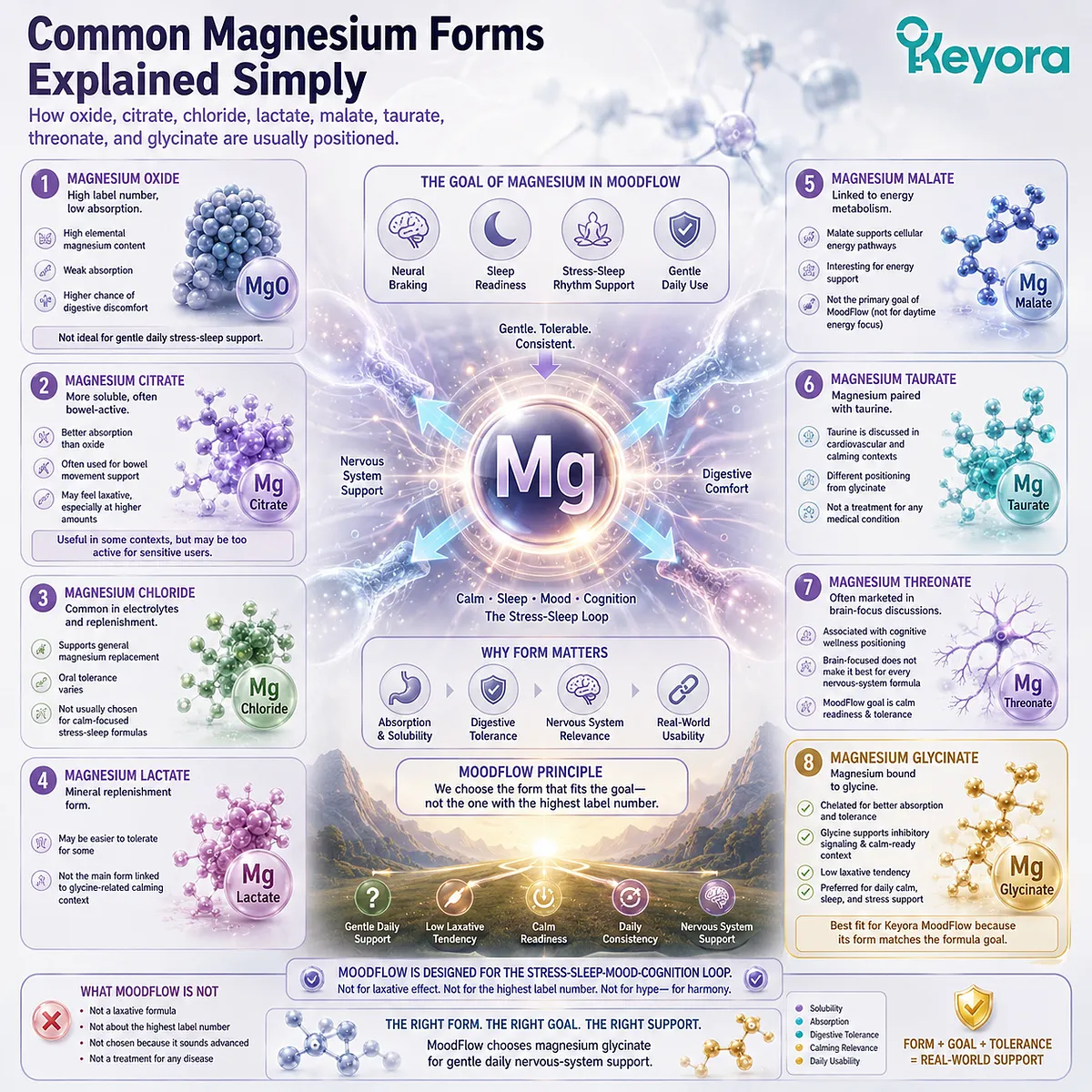
Common Magnesium Forms Explained Simply
How oxide, citrate, chloride, lactate, malate, taurate, threonate, and glycinate are usually positioned.
Magnesium oxide is one of the most common forms. It often contains a high percentage of elemental magnesium, so the label can look powerful.
However, it is commonly discussed as a form with weaker absorption and a greater chance of digestive discomfort for some users.
This is why magnesium oxide may not be the best fit for gentle daily stress-sleep support. It may be inexpensive and widely available, but a high label number does not always mean better real-world usability.
Magnesium citrate is another common form. It is generally more soluble than oxide and is often used when bowel movement support is part of the goal. Some users tolerate it well, but others may find that it feels laxative, especially at higher amounts.
For this reason, magnesium citrate can be useful in certain contexts, but it may not be the ideal form for people who want the gentlest long-term nervous-system support. If someone is sensitive to digestive changes, citrate may feel too active in the gut.
-
Magnesium chloride is often discussed in electrolyte and replenishment contexts. It can be useful when the goal is general magnesium replacement, but oral tolerance may vary. It is not usually the main form chosen for calm-focused stress-sleep formulas.
-
Magnesium lactate is another form sometimes discussed for mineral replenishment. It may be easier for some people to tolerate than harsher forms, but it is not usually the form most associated with the glycine-linked calming context that makes magnesium glycinate relevant to MoodFlow.
-
Magnesium malate is often discussed in relation to energy metabolism because malate is connected with cellular energy pathways. This makes it interesting for people thinking about energy support.
However, in MoodFlow, the magnesium goal is not simply daytime energy. The goal is neural braking, sleep readiness, and stress-sleep rhythm support.
Magnesium taurate is magnesium paired with taurine.
Taurine is often discussed in cardiovascular and calming-context supplement conversations. This does not mean magnesium taurate should be described as treating heart disease or any medical condition. It simply means its form has a different positioning from glycinate.
Magnesium threonate is often marketed in brain-focused supplement discussions. It is commonly associated with cognitive wellness positioning.
However, brain-focused positioning does not automatically make it the best form for every nervous-system formula. For MoodFlow, the central magnesium goal is calm readiness, digestive tolerance, neural braking, and daily usability.
Magnesium glycinate is magnesium bound to glycine.
This chelated structure is the reason it stands out for daily calm-support formulas. Glycine is not just a carrier. It has its own relevance to inhibitory signaling and calm-readiness context.
This is why magnesium glycinate is often chosen by people who want magnesium without a strong bowel-focused effect. It is commonly valued for digestive tolerance, lower laxative tendency, and nervous-system support.
For Keyora MoodFlow, magnesium glycinate is the best fit not because every other form is useless, but because its form matches the formula goal: gentle daily nervous-system support.
The MoodFlow goal is not to create a laxative effect.
It is not to chase the highest label number.
It is not to choose a magnesium form only because it sounds advanced.
The goal is to support the stress-sleep-mood-cognition loop through a form that fits calm, tolerance, and daily consistency.
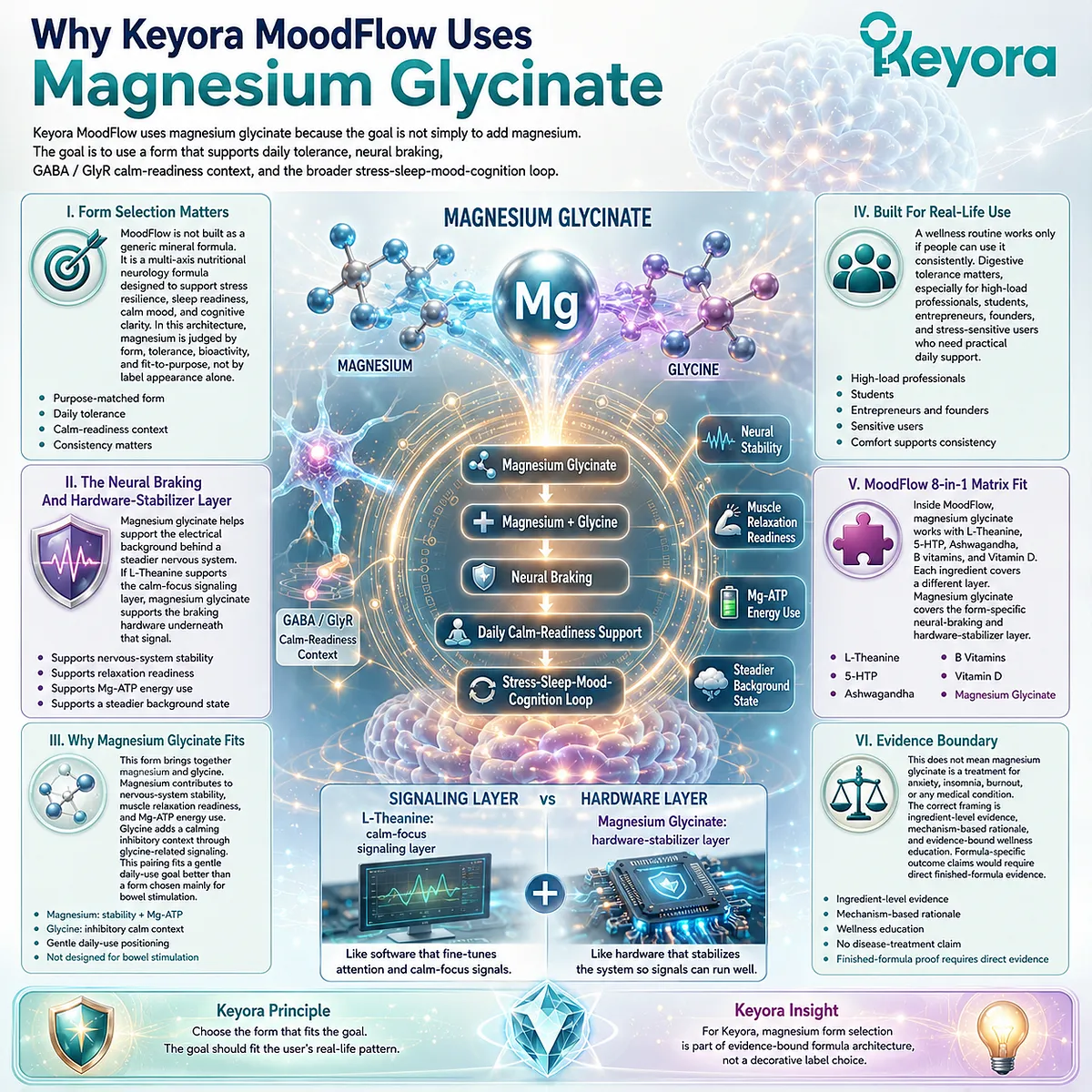
Why Keyora MoodFlow Uses Magnesium Glycinate
How form selection supports the neural braking and hardware-stabilizer layer.
Keyora MoodFlow uses magnesium glycinate because the goal is not simply to add magnesium. The goal is to use a form that supports daily tolerance, neural braking, GABA/GlyR calm-readiness context, and the broader stress-sleep-mood-cognition loop.
This is where magnesium glycinate fits the MoodFlow 8-in-1 Matrix.
MoodFlow is not built as a single-ingredient sleep product or a generic mineral formula. It is designed as a multi-axis nutritional neurology formula that supports stress resilience, sleep readiness, calm mood, and cognitive clarity.
In that architecture, magnesium glycinate acts like a hardware-stabilizer. It helps support the electrical conditions behind a steadier nervous system. If L-Theanine supports the calm-focus signaling layer, magnesium glycinate supports the braking hardware underneath that signal.
A simple analogy is useful.
-
L-Theanine helps lower mental noise, like improving the software of calm focus.
-
Magnesium glycinate helps stabilize the electrical background, like supporting the hardware that lets the system run smoothly.
This is especially relevant for people who feel physically tense, mentally busy, or unable to downshift at night. Their goal is not necessarily to feel sedated. Their goal is to support the body’s natural ability to move from stress activation toward calm readiness.
Magnesium glycinate supports this role because it brings together magnesium and glycine. Magnesium is involved in nervous-system stability, muscle relaxation readiness, and Mg-ATP energy use. Glycine adds a calming inhibitory context through glycine-related signaling.
This pairing makes magnesium glycinate different from a magnesium form chosen mainly for bowel stimulation. MoodFlow is not trying to create digestive activity. It is trying to support a calm, steady, daily foundation.
That is also why digestive tolerance matters so much. A supplement cannot support a long-term wellness routine if people cannot tolerate it. If a magnesium form causes unnecessary digestive discomfort, users may stop taking it before it can become part of a consistent routine.
-
For high-load professionals, consistency is important.
-
For students, a supplement must be simple and practical.
-
For entrepreneurs and founders, the body may already be under irregular stress.
-
For sensitive users, harsh digestive effects can make a formula feel less supportive.
Magnesium glycinate fits these users because it is commonly chosen for daily use. It supports Keyora’s form-selection logic: the ingredient should match the purpose, and the purpose should match the user’s real-life pattern.
This does not mean magnesium glycinate is a treatment for anxiety, insomnia, burnout, or any medical condition. It also does not mean MoodFlow has finished-formula clinical proof unless such evidence is specifically provided. The correct framing is ingredient-level evidence, mechanism-based rationale, and evidence-bound wellness education.
Inside MoodFlow, magnesium glycinate works with L-Theanine, 5-HTP, Ashwagandha, B vitamins, and Vitamin D.
Each ingredient covers a different layer.
Magnesium glycinate covers the form-specific, neural-braking, hardware-stabilizer layer.
For Keyora, magnesium form selection is part of evidence-bound formula architecture, not a decorative label choice.
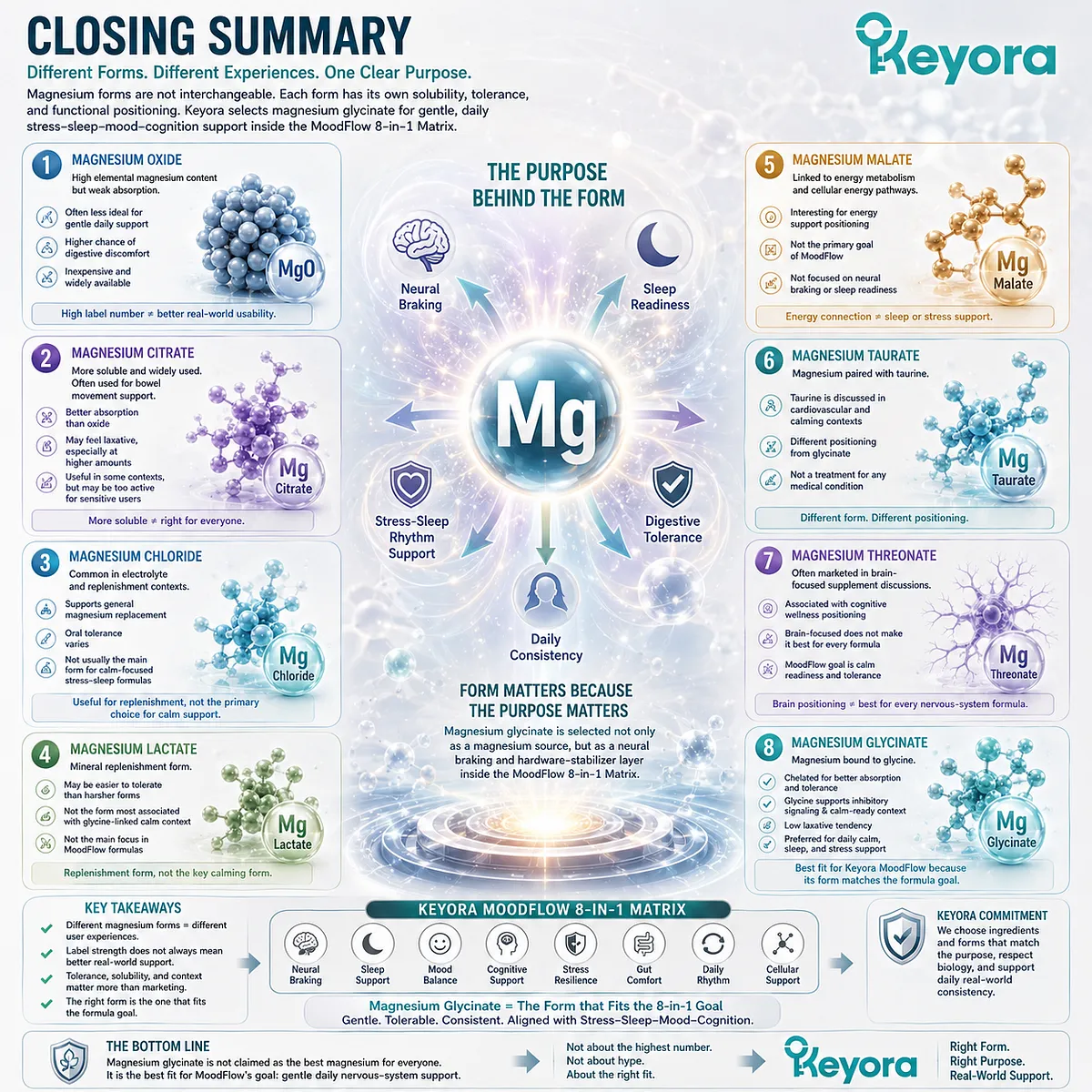
Closing Summary
Different magnesium forms are not interchangeable in user experience. Magnesium oxide may look strong on the label, but it is often less ideal for gentle daily support.
-
Magnesium citrate is widely used and more soluble, but it may feel laxative for some sensitive users.
-
Magnesium chloride and lactate are often discussed for mineral replenishment, while malate, taurate, and threonate have their own functional positioning.
-
Magnesium glycinate stands out in the Keyora MoodFlow framework because it is chelated with glycine, commonly valued for digestive tolerance, and aligned with nervous-system support.
Its role is not to be the “best magnesium for everyone,” but to fit the MoodFlow goal: gentle daily stress-sleep-mood-cognition support.
For Keyora, the form matters because the purpose matters.
Magnesium glycinate is selected not only as a magnesium source, but as a neural braking and hardware-stabilizer layer inside the MoodFlow 8-in-1 Matrix.
This article is for educational and informational purposes only. It does not provide medical advice, diagnosis, treatment, cure, prevention, disease outcome claims, hormone restoration claims, fertility outcome claims, or formula-specific clinical efficacy claims.