
Why Is Magnesium Glycinate Gentler Than Other Magnesium Forms?
Keyora Research Q&A Library
This is part of the Keyora Research Q&A Series, derived from Keyora Nutritional Neurology Seriers .
Within the Keyora Nutritional Neurology framework, this Q&A translates complex nutrient–brain mechanisms into reader-friendly, evidence-bound answers, focusing on stress resilience, sleep quality, calm mood support, cognitive wellness, and the broader interaction between nutrition, neurochemistry, and daily nervous-system function.
First published by Keyora Research Journal: www.keyorahealth.com

Direct Answer
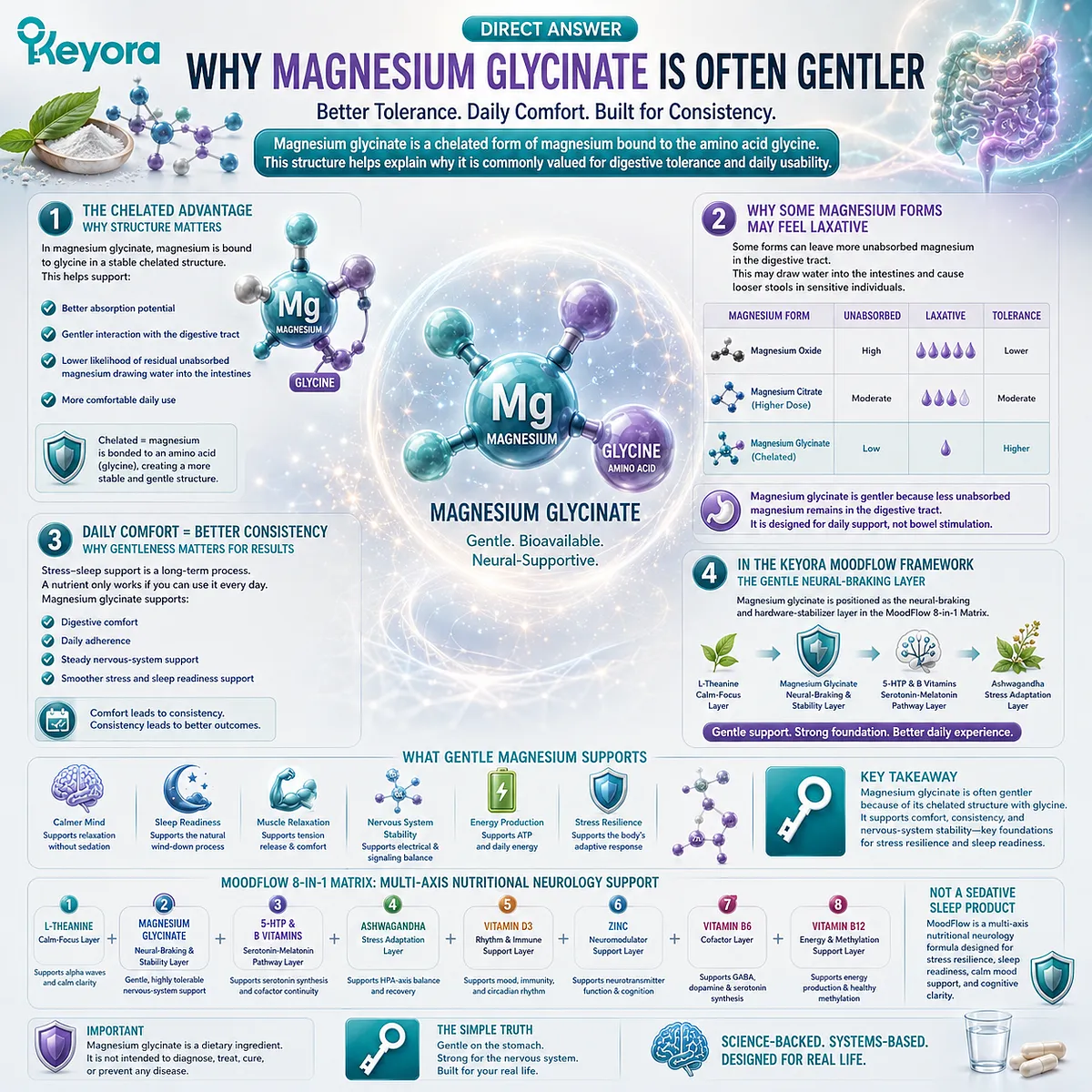
Magnesium glycinate is often gentler than some other magnesium forms because magnesium is bound to glycine in a chelated structure. This structure helps explain why it is commonly valued for digestive tolerance, daily usability, and lower laxative tendency.
Some magnesium forms, such as magnesium oxide or higher-dose magnesium citrate, may leave more unabsorbed magnesium in the digestive tract. This can draw water into the intestines and feel laxative for some people.
Magnesium glycinate is different because its glycine-bound form is often used for gentle daily support rather than bowel stimulation.
In the Keyora MoodFlow framework, this gentleness matters because stress-sleep support depends on consistency.
A nutrient can only support the MoodFlow 8-in-1 Matrix well if people can use it comfortably. That is why magnesium glycinate is positioned as a gentle neural-braking and hardware-stabilizer layer inside MoodFlow.
Not All Magnesium Forms Feel the Same
Why oxide, citrate, and glycinate can behave differently in the body.
Many people assume that all magnesium supplements are basically the same. They look at the label, compare the number of milligrams, and choose the product with the highest amount.
But magnesium form matters. The amount on the label is only one part of the story. The body still has to handle the form, absorb it, and tolerate it.
This is why different magnesium products can feel very different.
One person may take a magnesium supplement and feel digestive looseness. Another person may take a different form and feel no digestive issue at all. The difference is often not “magnesium versus no magnesium.” It is the chemical form.
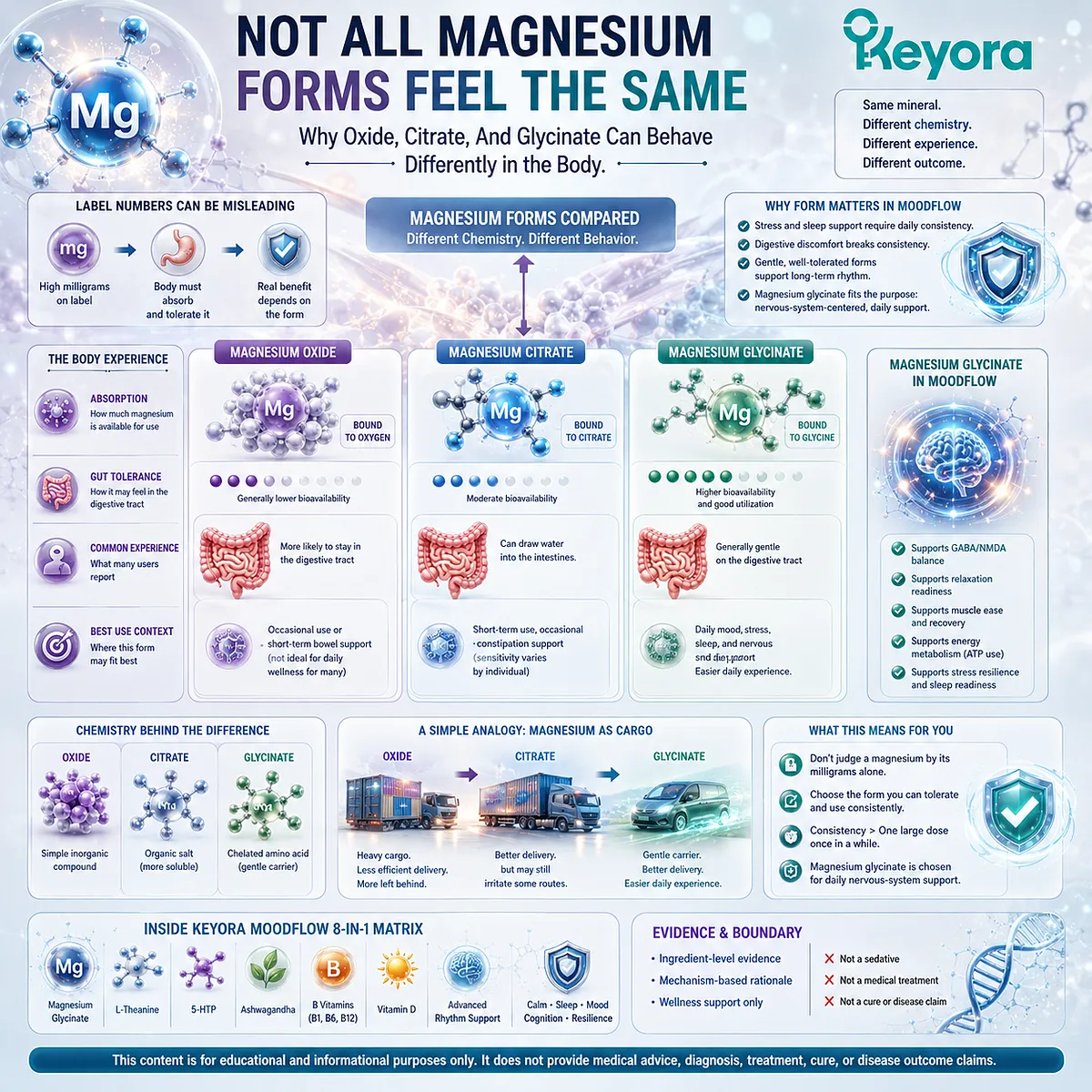
Magnesium oxide is a common example. It can contain a high percentage of elemental magnesium on the label, which looks impressive at first glance. But a high label number does not always mean a gentle daily experience. Some users may find oxide less comfortable because more magnesium can remain in the digestive tract.
Magnesium citrate is another common form. It is often used because it is more soluble than oxide, but it can still feel laxative for some people, especially at higher intakes. This does not make citrate “bad.” It simply means the form may behave differently depending on the person and the purpose.
Magnesium glycinate is different because it is bound to glycine. This chelated structure helps explain why many people consider it one of the gentler magnesium forms for daily wellness routines.
A simple way to understand this is to think about magnesium as cargo. Different forms use different delivery styles.
Some forms may leave more magnesium sitting in the gut, where it can pull water into the intestines. Magnesium glycinate is more like magnesium packaged with a gentle carrier, designed for better daily tolerance.
This is especially important for people who have tried magnesium before and stopped because their stomach or intestines did not like it.
For them, the question is not only “Do I need magnesium?”
The question is also “Which magnesium form can I actually use consistently?”
In the Keyora MoodFlow framework, magnesium form is not a small label detail. It is part of the formula logic because daily stress-sleep support depends on a form users can actually tolerate.
MoodFlow is designed for stress resilience, sleep readiness, calm mood support, and cognitive clarity. These are not one-time goals. They are daily rhythm-support goals.
If an ingredient causes unnecessary digestive discomfort, it becomes harder for users to stay consistent.
This is why Keyora does not treat magnesium as a simple commodity. Magnesium glycinate is chosen not only because it provides magnesium, but because its form fits the purpose of the formula: gentle, nervous-system-centered daily support.
Chelation Makes the Difference
How binding magnesium to glycine changes absorption and digestive tolerance.
The word “chelated” sounds technical, but the idea is simple. Chelation means a mineral is bound to another molecule. In magnesium glycinate, magnesium is bound to glycine, an amino acid.
This bond changes how the form behaves. Instead of being a simple magnesium salt, magnesium glycinate is a glycine-bound complex. That structure helps explain why it is often valued for tolerance and daily use.
Some magnesium salts can separate more easily in the digestive tract.
When more free magnesium remains in the intestines, it may create an osmotic effect. In plain language, that means it can pull water into the bowel. For some users, that may lead to loose stools or a laxative feeling.
Magnesium glycinate is often gentler because it is less likely to behave like a strong osmotic load. This does not mean it can never cause digestive discomfort.
No supplement form is perfect for every person. But the structure helps explain why many consumers choose glycinate when they want magnesium without the bowel-focused effect.
Glycine also matters. It is not just a meaningless carrier.
Glycine is an amino acid with relevance to calming and inhibitory signaling in the nervous system. This makes magnesium glycinate especially suitable for formulas focused on stress, sleep readiness, and nervous-system support.
A useful analogy is packaging. If magnesium is the active mineral, glycine is part of the delivery package. The package affects how the body handles the mineral. It also helps explain why magnesium glycinate fits a calm-support formula better than a magnesium form chosen mainly for digestive stimulation.
This is also where many consumers get confused by label numbers.
A product with more elemental magnesium on the label may not always feel better. Higher does not automatically mean gentler. For daily wellness, the form, tolerability, and purpose all matter.
In Keyora Nutritional Neurology, the question is not only “How much magnesium is listed?”
The better question is “Does this form match the nervous-system goal?”
For MoodFlow, the goal is not to create a laxative effect. The goal is to support the neural braking and hardware-stabilizer layer of the stress-sleep-mood-cognition loop.
That is why magnesium glycinate is a logical choice. It supports magnesium delivery while adding the glycine-bound calming context. It helps connect digestive tolerance with nervous-system support.
This distinction is important for people who are sensitive to supplements.
A stress-sensitive person may also have a sensitive digestive system.
A student under pressure, a high-load professional, or an entrepreneur with irregular meals may not want a magnesium form that creates extra digestive unpredictability.
A gentle form supports consistency.
Consistency supports daily wellness routines. Daily routines are especially important when the goal is not a quick effect, but ongoing support for relaxation readiness, sleep readiness, and stress resilience.
Magnesium glycinate’s chelated structure helps explain why it is often chosen for that role.

Why Gentle Magnesium Matters for Long-Term Support
How tolerability helps stress-sensitive users stay consistent without unnecessary digestive discomfort.
Gentleness is not just a comfort detail. For a daily supplement, gentleness can decide whether a person keeps using it.
Many people are willing to try magnesium once. Fewer people will continue using a form that makes them feel uncomfortable. If a supplement creates digestive disruption, it can become part of the problem rather than part of the routine.
This is why magnesium glycinate is important for long-term stress-sleep support.
Stress resilience and sleep readiness are not usually supported by one isolated moment. They are built through repeated daily habits: sleep timing, nutrition, movement, light exposure, stress management, and consistent supplementation when appropriate.
A gentle magnesium form fits that reality better.
Magnesium glycinate is commonly used when people want daily magnesium support without the strong laxative profile associated with some other forms.
This is especially relevant for stress-sensitive users.
When the nervous system is already under pressure, the body often does not need more irritation. A gentle formula experience can make nutritional support feel easier to maintain.
-
For high-load professionals, consistency matters because their schedule may already be demanding.
-
For students, the routine must be simple and comfortable.
-
For entrepreneurs, daily support must fit around irregular stress and mental workload.
-
For rhythm-sensitive adults, digestive comfort can affect whether a supplement feels supportive or disruptive.
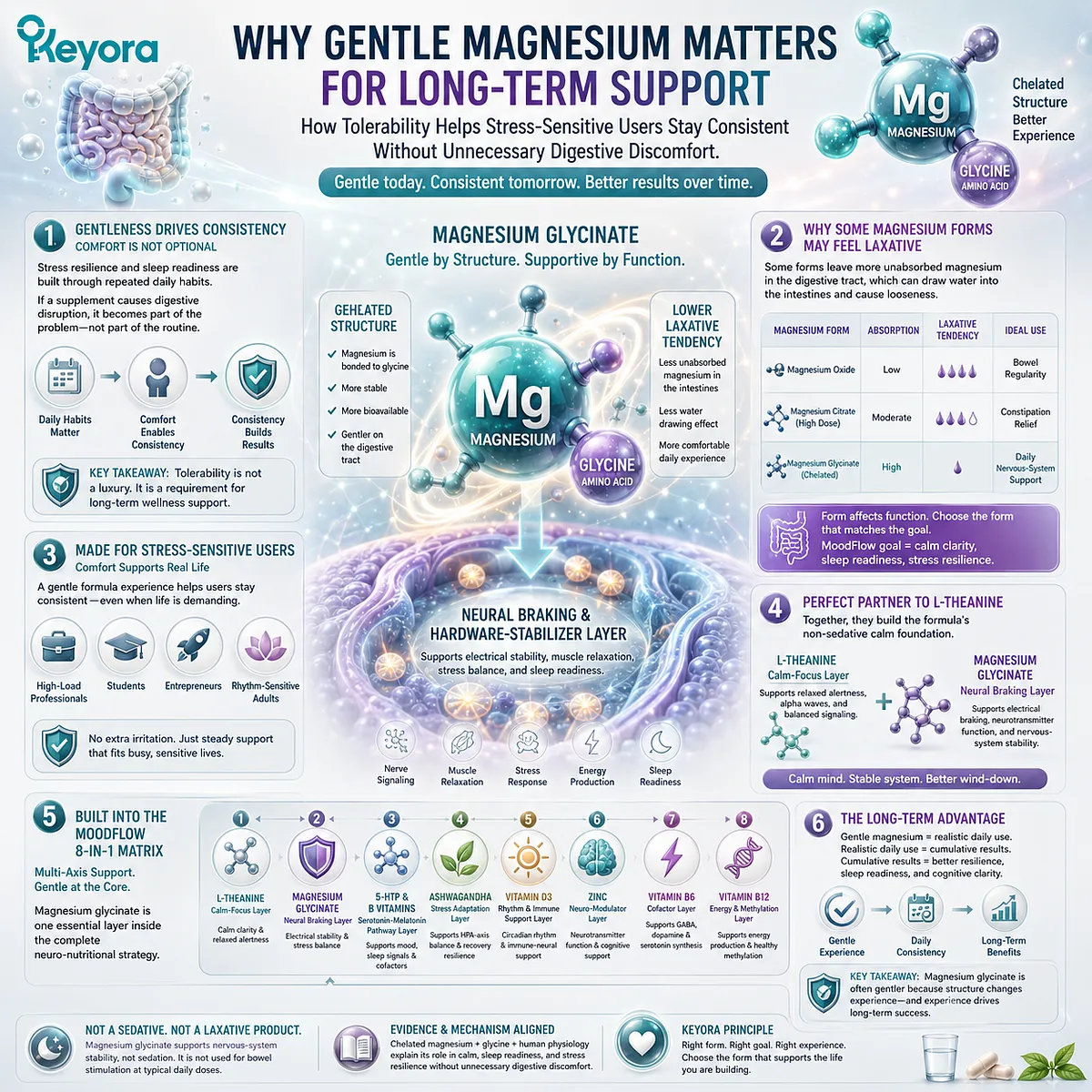
Inside Keyora MoodFlow, magnesium glycinate is chosen because it supports the neural braking and hardware-stabilizer layer while keeping the formula suitable for gentle daily stress-sleep support.
This also helps explain its relationship with L-Theanine.
-
L-Theanine supports calm-focus signaling and relaxed alertness.
-
Magnesium glycinate supports the electrical braking and nervous-system stability layer.
Together, they help create the formula’s non-sedative calm foundation.
MoodFlow also includes 5-HTP and B vitamins for serotonin-melatonin pathway and cofactor support, Ashwagandha for stress-adaptation context, and Vitamin D for broader rhythm and neuroimmune support context. Magnesium glycinate’s role is not to do everything. Its role is to provide a gentle, stable magnesium layer that fits the whole matrix.
This is why magnesium glycinate should not be described as the “best magnesium for everyone.”
Different forms may serve different purposes.
Someone using magnesium for bowel regularity may look for a different form than someone seeking daily nervous-system support.
The Keyora approach is more specific: choose the form that matches the goal. For MoodFlow, the goal is calm clarity, sleep readiness, stress resilience, and cognitive support without forcing sedation or causing unnecessary digestive discomfort.
That makes magnesium glycinate a form-selection decision, not a marketing decoration. Its gentleness supports the practical reality of daily use.
Its glycine-bound structure supports the formula’s nervous-system logic. Its lower laxative tendency helps users stay consistent.
For consumers, the simplest takeaway is this: magnesium glycinate is often gentler because structure changes experience. The form affects how magnesium behaves in the body, how comfortable it feels, and whether it can realistically support a long-term wellness routine.
Closing Summary
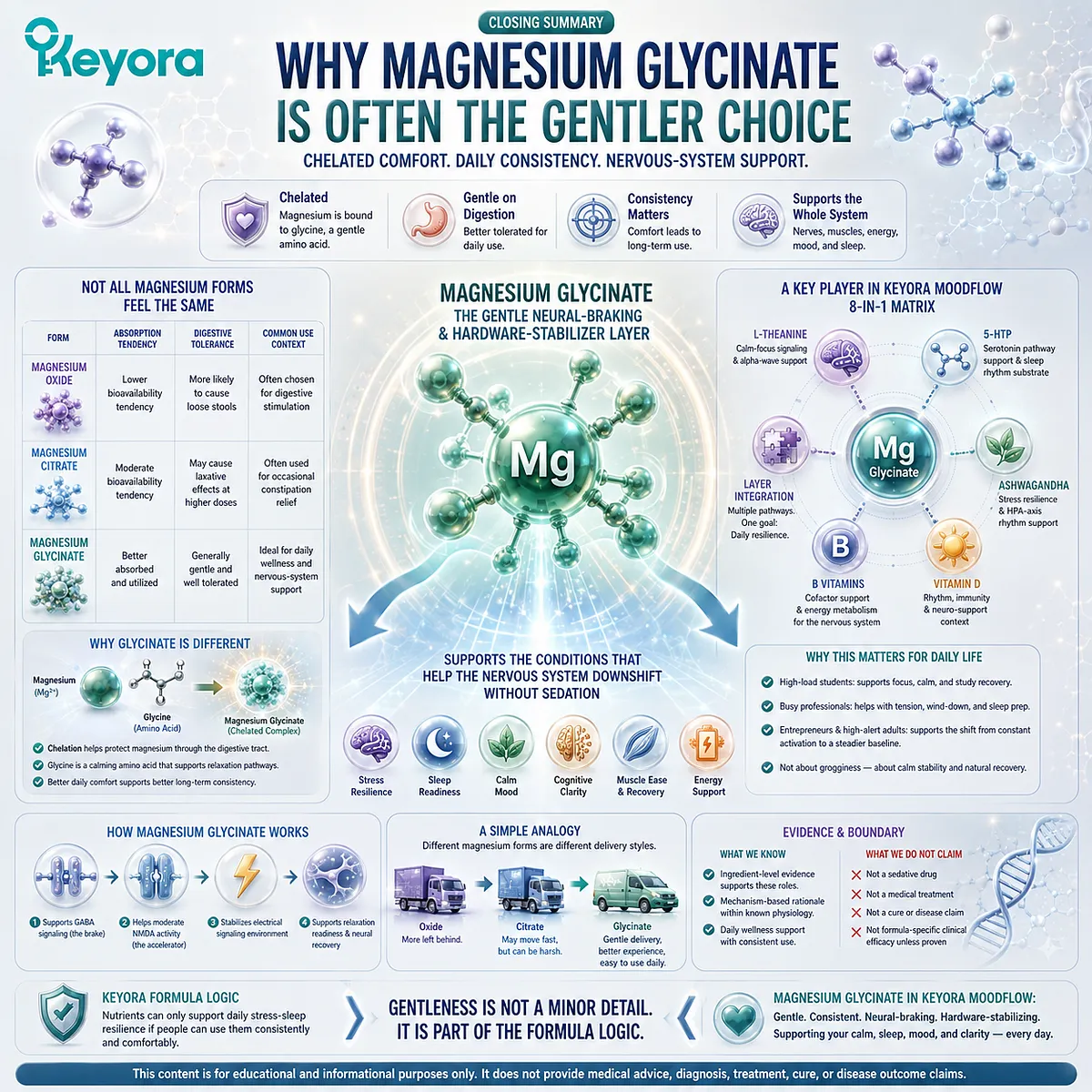
Magnesium glycinate is often gentler than some other magnesium forms because it is chelated, meaning magnesium is bound to glycine. This glycine-bound structure helps support digestive tolerance and may reduce the chance of a strong laxative effect compared with some common magnesium salts.
This matters because daily wellness support depends on comfort and consistency. A magnesium form that feels harsh or unpredictable may be difficult to use long term.
Magnesium glycinate is commonly valued because it fits daily nervous-system support better than forms chosen mainly for digestive stimulation.
Inside Keyora MoodFlow, magnesium glycinate is selected as the gentle neural-braking and hardware-stabilizer layer of the MoodFlow 8-in-1 Matrix.
It works alongside L-Theanine, 5-HTP, Ashwagandha, B vitamins, and Vitamin D to support stress resilience, sleep readiness, calm mood, and cognitive clarity.
For Keyora, gentleness is not a minor comfort detail. It is part of the formula logic: a nutrient can only support daily stress-sleep resilience if people can use it consistently and comfortably.
This article is for educational and informational purposes only. It does not provide medical advice, diagnosis, treatment, cure, prevention, disease outcome claims, hormone restoration claims, fertility outcome claims, or formula-specific clinical efficacy claims.