
What Is Magnesium Glycinate?
Keyora Research Q&A Library
This is part of the Keyora Research Q&A Series, derived from Keyora Nutritional Neurology Seriers .
Within the Keyora Nutritional Neurology framework, this Q&A translates complex nutrient–brain mechanisms into reader-friendly, evidence-bound answers, focusing on stress resilience, sleep quality, calm mood support, cognitive wellness, and the broader interaction between nutrition, neurochemistry, and daily nervous-system function.
First published by Keyora Research Journal: www.keyorahealth.com

Direct Answer
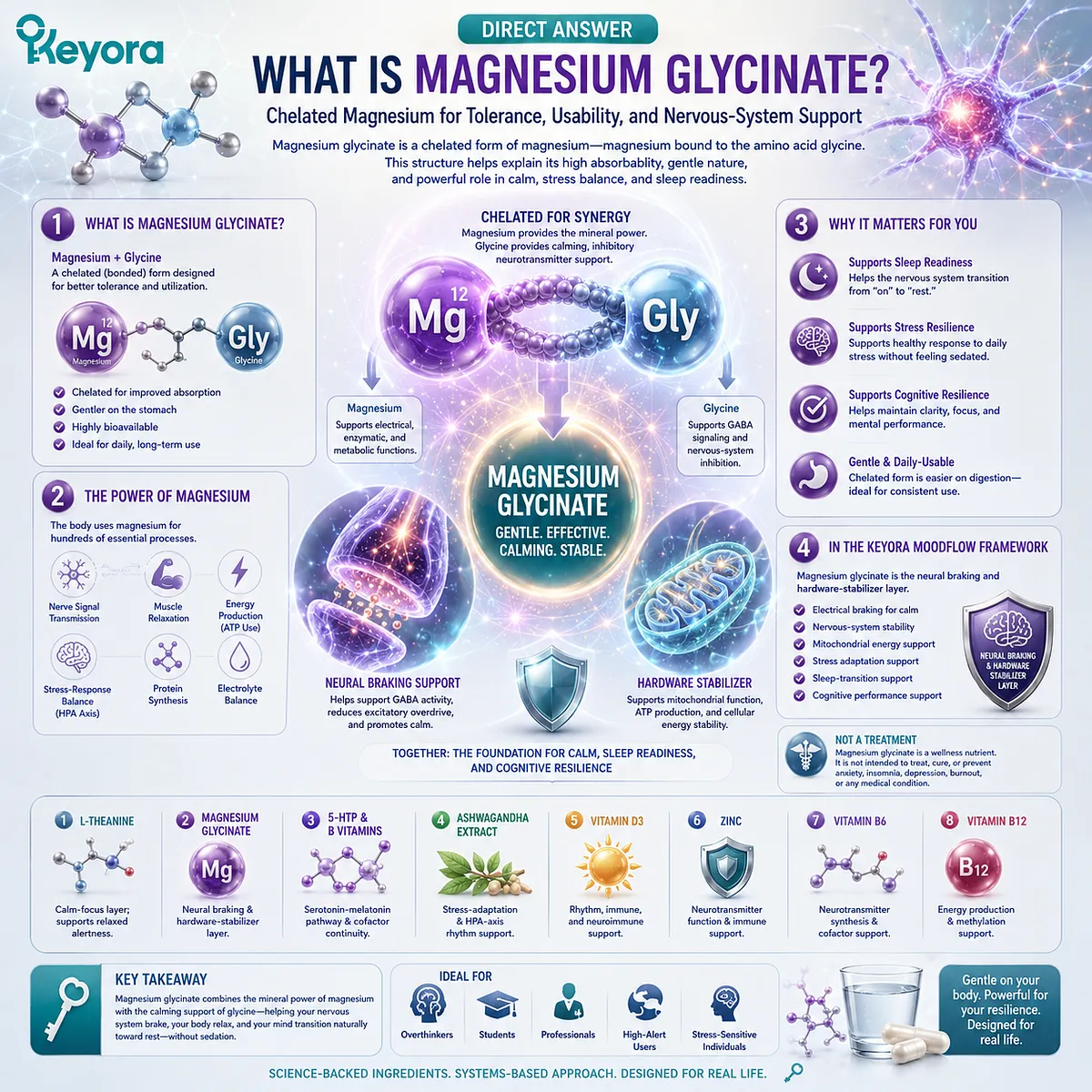
Magnesium glycinate is a chelated form of magnesium, meaning magnesium is bound to the amino acid glycine. This structure helps explain why it is often valued for digestive tolerance, daily usability, and nervous-system support.
Magnesium itself is involved in many important functions, including nerve signaling, muscle relaxation, energy use, and stress-response balance. Glycine adds a calming context because it is also connected with inhibitory signaling in the nervous system.
In the Keyora MoodFlow framework, magnesium glycinate is positioned as the neural braking and hardware-stabilizer layer.
It helps support the electrical and metabolic conditions behind calm, sleep readiness, and cognitive resilience.
It works alongside L-Theanine, 5-HTP, Ashwagandha, B vitamins, and Vitamin D as part of the MoodFlow 8-in-1 Matrix.
Magnesium glycinate should be understood as wellness support, not as a treatment for anxiety, insomnia, burnout, or any medical condition.
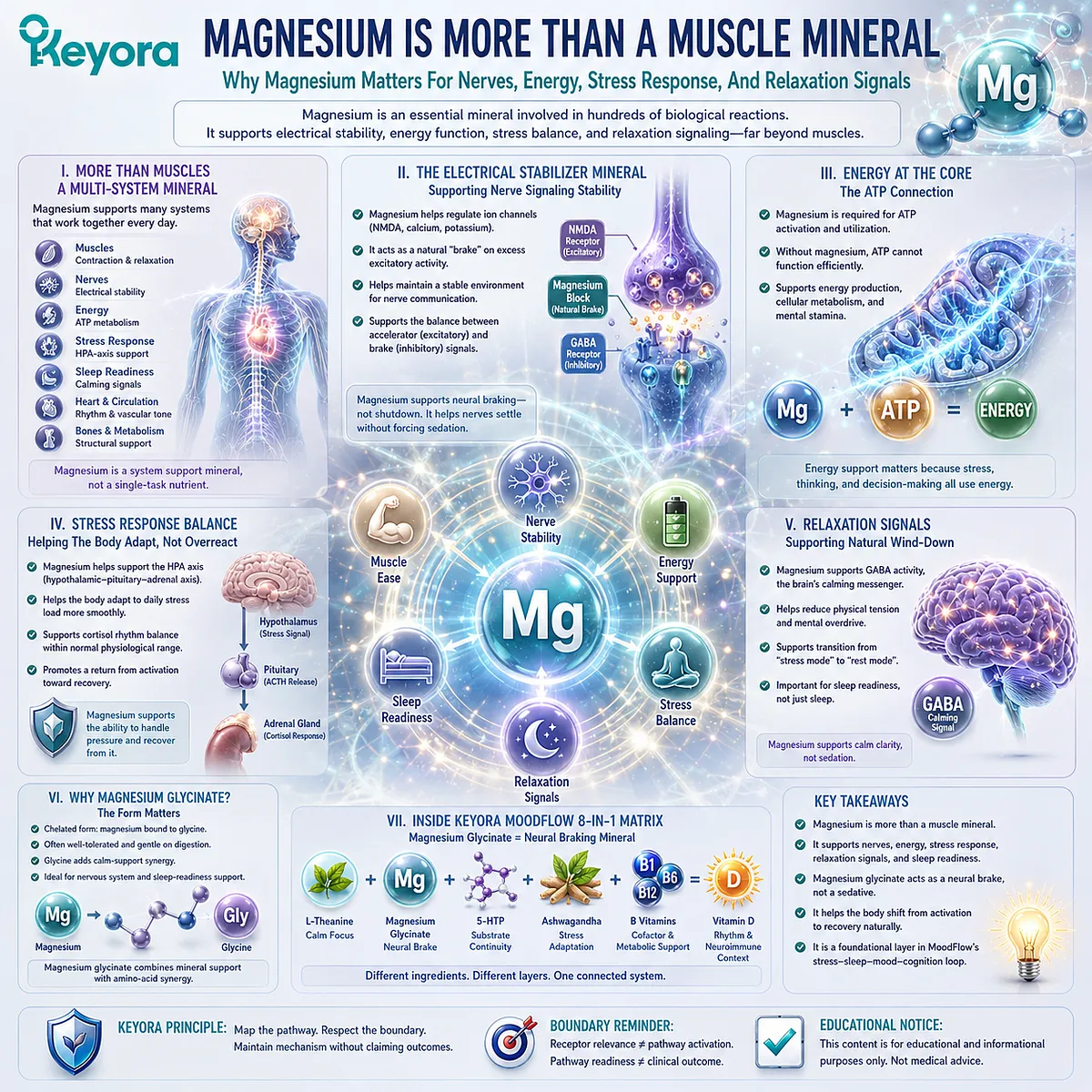
Magnesium Is More Than a Muscle Mineral
Why magnesium matters for nerves, energy, stress response, and relaxation signals.
Many people first hear about magnesium in relation to muscles. They may associate it with cramps, tightness, or physical relaxation. That connection is real, but it is only one part of the story.
Magnesium is much more than a muscle mineral. It also plays an important role in the nervous system. Nerves communicate through electrical and chemical signals, and magnesium helps support the stability of that signaling environment.
A simple way to understand magnesium is to imagine it as part of the body’s electrical stabilizer system.
When the nervous system is under pressure, signals can feel too active, too sharp, or too difficult to settle. Magnesium helps support the conditions that allow the system to remain steady.
This matters for stress.
When daily pressure stays high, the body can remain in an activated state for too long.
A person may feel tense, mentally busy, physically tight, or unable to shift smoothly into rest. Magnesium is relevant because it helps support the body’s natural relaxation readiness.
Magnesium is also connected to energy. The body uses ATP as a basic energy currency, but magnesium is needed for ATP to function properly in biological systems. This is why magnesium is not only about relaxation. It also supports the energy processes behind normal brain and body function.
This energy connection is especially important for high-load people.
Students, professionals, entrepreneurs, and busy adults often think of stress only as a mental feeling. But stress also uses energy. The brain must keep processing, adapting, deciding, remembering, and responding.
When the nervous system is constantly working, the body needs both calming support and energy-use support. Magnesium sits at the intersection of these two needs. It helps explain why someone can feel both tired and wired: the body may feel depleted, while the nervous system still feels switched on.
Magnesium also helps support the balance between activating and calming signals.
In simple terms, the brain has accelerator signals that keep it alert and brake signals that help it settle. A healthy nervous system needs both. Too much acceleration can feel like racing thoughts, tension, or internal noise.
This is why Keyora does not reduce magnesium glycinate to a generic mineral supplement.
In the Keyora MoodFlow framework, magnesium glycinate is positioned as a neural braking mineral that supports the electrical stability behind calm, sleep readiness, and cognitive resilience.
That does not mean magnesium glycinate acts like a sedative.
It does not need to force the brain into sleepiness.
Its role is more foundational.
It supports the body’s ability to shift from stress activation toward a steadier recovery state.
For ordinary consumers, the main takeaway is simple: magnesium is not just for muscles. It also supports nerves, energy, relaxation signals, and stress-response balance.
Magnesium glycinate is one form that makes this nervous-system role especially relevant inside MoodFlow.
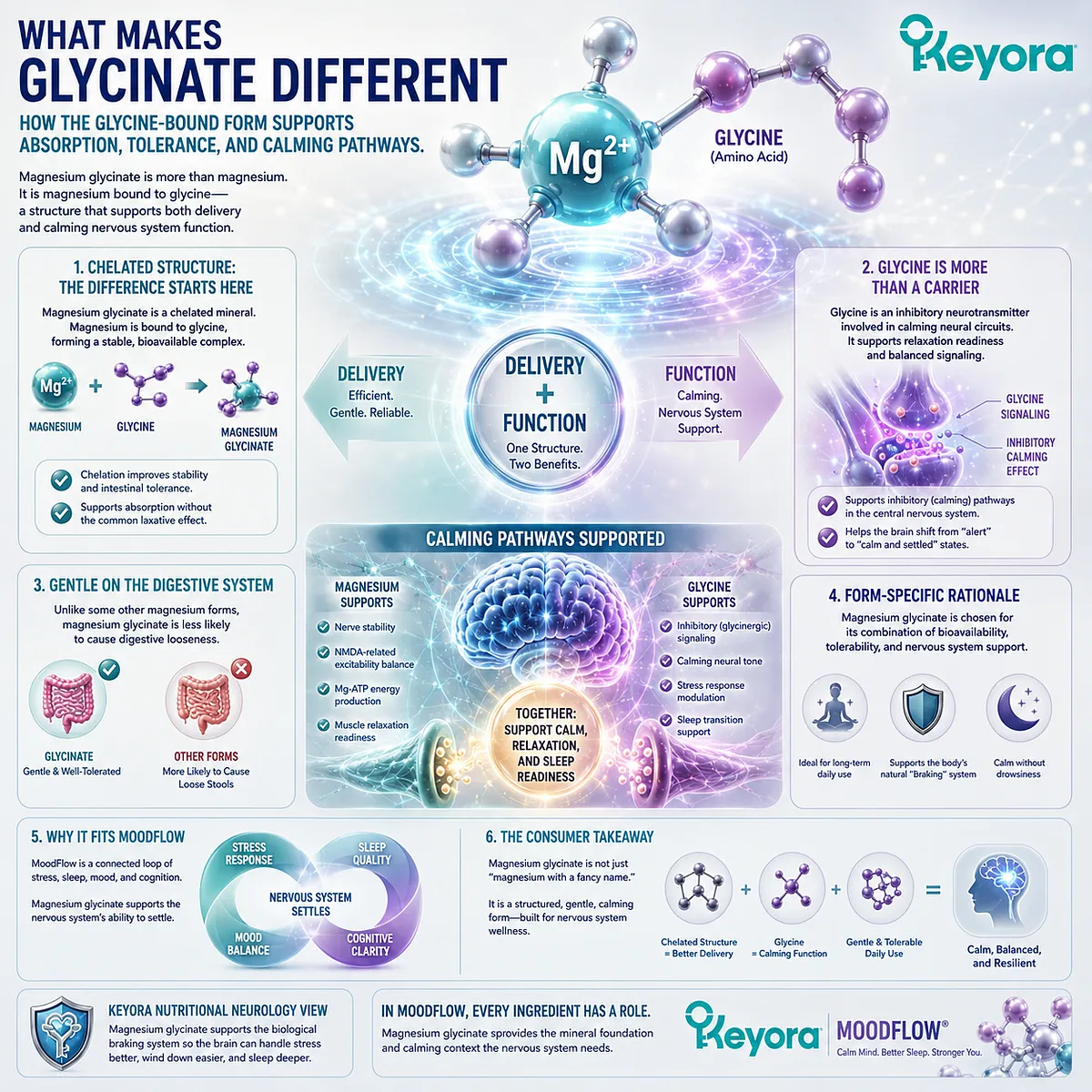
What Makes Glycinate Different
How the glycine-bound form supports absorption, tolerance, and calming pathways.
Magnesium glycinate is different because of its structure. It is a chelated form of magnesium, which means magnesium is bound to another molecule. In this case, it is bound to glycine, an amino acid.
This matters because not all magnesium forms behave the same way. Some magnesium forms are more commonly associated with digestive looseness or a laxative effect. Others may be used mainly for short-term bowel support rather than daily nervous-system support.
Magnesium glycinate is often valued because it is gentle. Many consumers choose it when they want magnesium support without feeling that the supplement is acting mainly in the digestive tract. This is one reason it is commonly discussed for long-term wellness routines.
The word “glycinate” also matters because glycine is not just a carrier. Glycine has its own relevance in the nervous system. It is involved in inhibitory signaling, especially in areas connected with calming and relaxation readiness.
A simple analogy is delivery plus function. The magnesium is the main mineral being delivered. The glycine helps form the chelated structure and also adds a calming context. Together, they create a form that is especially relevant to nervous-system support.
This does not mean magnesium glycinate is automatically the best form for every person or every purpose. Different magnesium forms can have different uses. The important point is that magnesium glycinate has a form-specific rationale: it is commonly valued for tolerability, daily use, and calm-readiness support.
This is why it fits so well in a formula like Keyora MoodFlow.
MoodFlow is not designed around a one-pathway idea. It is built around the connected loop of stress, sleep, mood, and cognition.
Magnesium glycinate supports one of the most important layers in that loop: the nervous system’s ability to settle.
When stress is high, the body may feel like it is receiving too many signals at once. The muscles may feel tight. The mind may feel busy. The sleep transition may feel delayed. The person may not need a heavy sedative; they may need support for the underlying braking system.
Magnesium glycinate helps explain that support.
Magnesium contributes to nerve stability, NMDA-related excitability balance, and Mg-ATP energy use.
Glycine contributes a calming context through inhibitory signaling. The chelated structure supports the practical value of the form.
In everyday language, magnesium glycinate is not just “magnesium with a fancy name.” It is magnesium paired with glycine in a form that is especially relevant for people seeking gentle, nervous-system-centered support.
For consumers, this distinction can be helpful.
When they see magnesium glycinate on a label, they can understand that the form was chosen for more than mineral content alone. The structure, tolerance, and calming context all matter.
In Keyora MoodFlow, this is exactly the point.
Magnesium glycinate is used because MoodFlow is not simply trying to add magnesium. It is building a nutritional neurology matrix where each ingredient has a specific role.
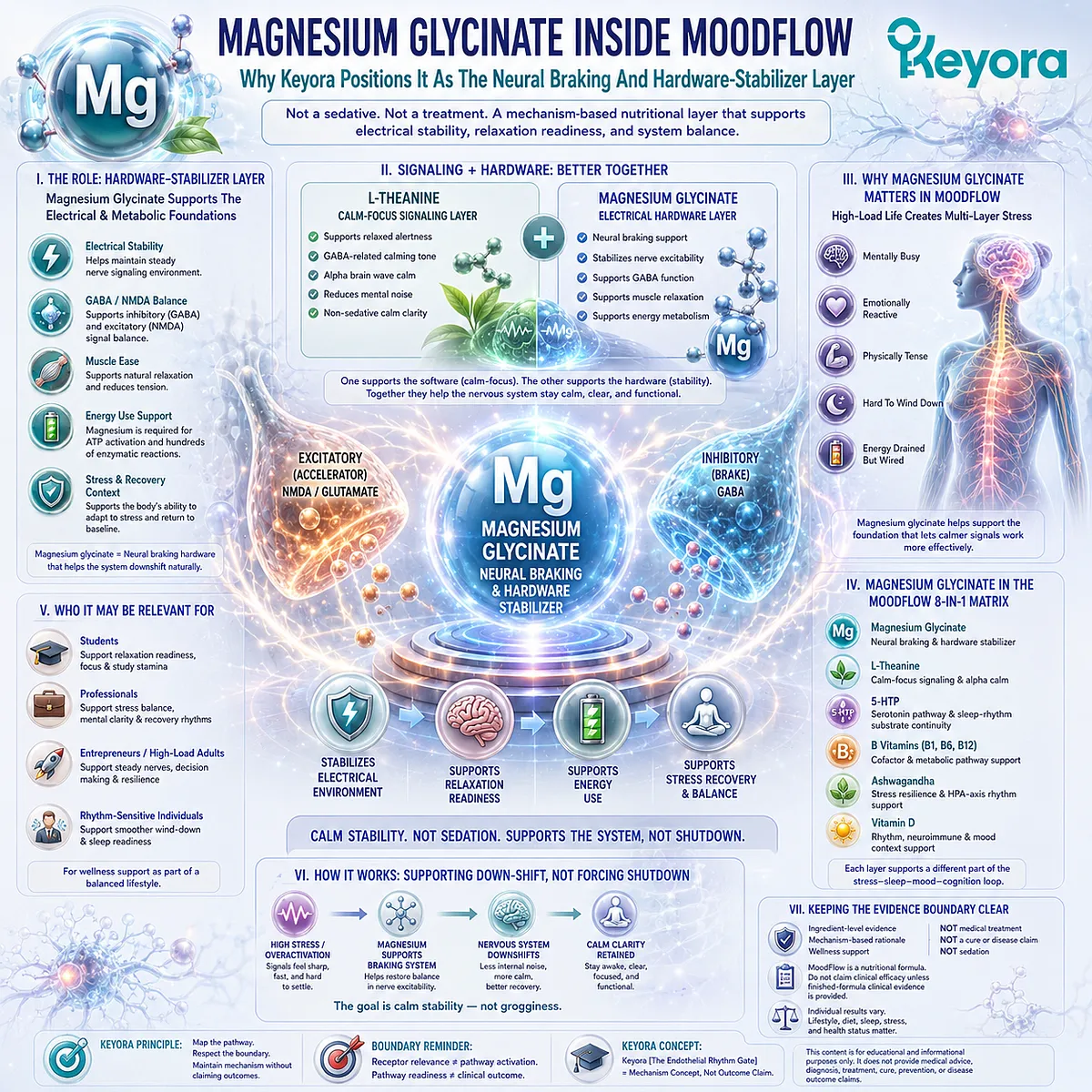
Magnesium Glycinate Inside MoodFlow
Why Keyora positions it as the neural braking and hardware-stabilizer layer.
Inside Keyora MoodFlow, magnesium glycinate works as the hardware-stabilizer layer. It supports the electrical and metabolic conditions that help the nervous system downshift without being framed as a sedative or medical treatment.
This makes it different from L-Theanine, but also complementary to it. L-Theanine is best understood as a calm-focus signaling layer. It supports relaxed alertness, GABA-related calming tone, and alpha-wave calm. Magnesium glycinate works more like the stabilizing hardware underneath the signaling system.
A simple analogy is software and hardware.
-
L-Theanine helps support the brain’s calm-focus software.
-
Magnesium glycinate helps support the electrical hardware that allows signals to remain steady.
Both are useful when the brain feels overstimulated or difficult to settle.
This pairing is important for MoodFlow. Many people experience stress in more than one way. They may feel mentally busy, emotionally reactive, physically tense, and unable to wind down. A single pathway may not fully explain that pattern.
Magnesium glycinate contributes to the MoodFlow 8-in-1 Matrix by supporting GABA/NMDA balance, relaxation readiness, muscle ease, and energy-use context. L-Theanine helps quiet mental noise.
Together, they form a neural quieting and electrical braking layer.
MoodFlow also includes 5-HTP, which supports normal serotonin-related pathways and sleep-rhythm substrate continuity.
-
B vitamins support cofactor and metabolic pathways that help the nervous system function properly.
-
Ashwagandha supports stress resilience and HPA-axis rhythm context.
-
Vitamin D adds broader rhythm and neuroimmune support context.
This is why magnesium glycinate should not be viewed in isolation inside MoodFlow. It is part of a larger architecture. The formula does not try to force one result through one ingredient. Instead, it supports multiple layers of the stress-sleep-mood-cognition loop.
-
For a high-load student, magnesium glycinate may be relevant to relaxation readiness and nervous-system steadiness.
-
For a busy professional, it may help explain support for tension, wind-down, and clear recovery rhythms.
-
For an entrepreneur or high-alert adult, it may support the ability to move from constant activation toward a calmer baseline.
The goal is not to create grogginess. The goal is calm stability. This is why magnesium glycinate fits the Keyora idea of “supporting the system, not forcing shutdown.”
It is also important to keep the evidence boundary clear.
Magnesium glycinate should not be described as treating anxiety, insomnia, depression, burnout, or neurological disease.
MoodFlow should not be described as clinically proven as a finished formula unless finished-formula clinical evidence is provided. The correct framing is ingredient-level evidence, mechanism-based rationale, and wellness support.
For ordinary users, the simplest explanation is this: magnesium glycinate helps support the body’s internal braking system.
In MoodFlow, it works with L-Theanine and the broader 8-in-1 Matrix to support stress resilience, sleep readiness, calm mood, and cognitive clarity.
Closing Summary
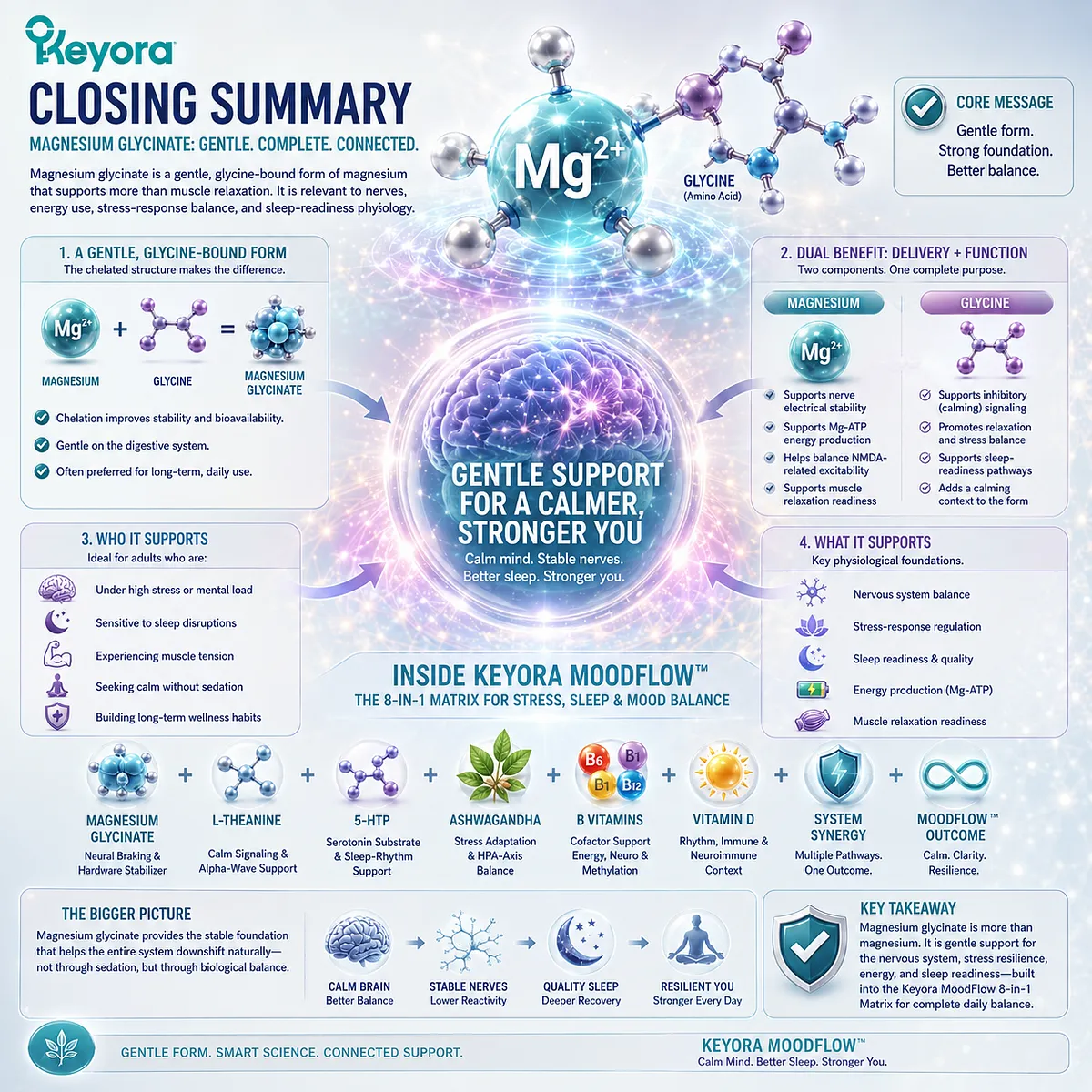
Magnesium glycinate is a gentle, glycine-bound form of magnesium that supports more than muscle relaxation. It is relevant to nerves, energy use, stress-response balance, and sleep-readiness physiology.
Its value comes from both parts of the structure. Magnesium supports electrical stability, Mg-ATP energy use, and nervous-system balance. Glycine adds a calming context and helps explain why this form is often chosen for gentle daily support.
Inside Keyora MoodFlow, magnesium glycinate is positioned as the neural braking and hardware-stabilizer layer of the MoodFlow 8-in-1 Matrix. It works alongside L-Theanine, 5-HTP, Ashwagandha, B vitamins, and Vitamin D to support the connected system of stress resilience, sleep readiness, calm mood, and cognitive clarity.
For high-load, stress-sensitive, or rhythm-sensitive adults, magnesium glycinate offers a practical idea: calm support is not only about feeling relaxed. It is also about giving the nervous system the stable foundation it needs to downshift naturally.
This article is for educational and informational purposes only. It does not provide medical advice, diagnosis, treatment, cure, prevention, disease outcome claims, hormone restoration claims, fertility outcome claims, or formula-specific clinical efficacy claims.