
What is L-Theanine?
Keyora Research Q&A Library
This is part of the Keyora Research Q&A Series, derived from Keyora Nutritional Neurology Seriers .
Within the Keyora Nutritional Neurology framework, this Q&A translates complex nutrient–brain mechanisms into reader-friendly, evidence-bound answers, focusing on stress resilience, sleep quality, calm mood support, cognitive wellness, and the broader interaction between nutrition, neurochemistry, and daily nervous-system function.
Direct Answer
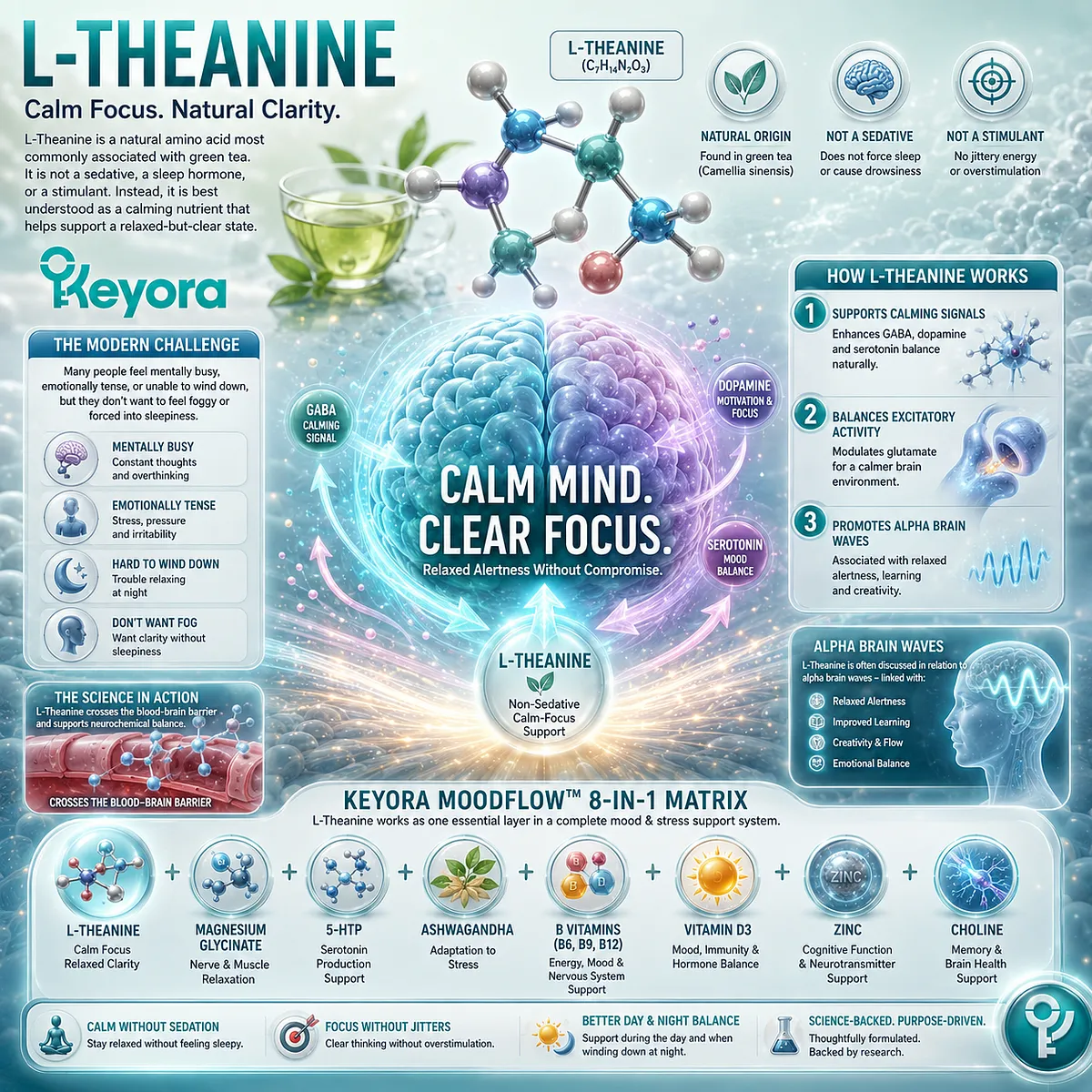
L-Theanine is a natural amino acid most commonly associated with green tea. It is not a sedative, a sleep hormone, or a stimulant. Instead, it is best understood as a calming nutrient that helps support a relaxed-but-clear state.
In the Keyora MoodFlow framework, L-Theanine is positioned as a non-sedative calm-focus ingredient. It supports the brain’s natural calming signals, helps balance excitatory activity, and is often discussed in relation to alpha brain waves, which are linked with relaxed alertness.
This makes L-Theanine especially useful for explaining a common modern pattern: people may feel mentally busy, emotionally tense, or unable to wind down, but they do not want to feel foggy or forced into sleepiness.
Inside Keyora MoodFlow, L-Theanine works as one layer of the MoodFlow 8-in-1 Matrix, supporting calm clarity alongside magnesium glycinate, 5-HTP, Ashwagandha, B vitamins, and Vitamin D.
L-Theanine Comes From Green Tea
Why this amino acid is linked with calm clarity rather than forced sleepiness.
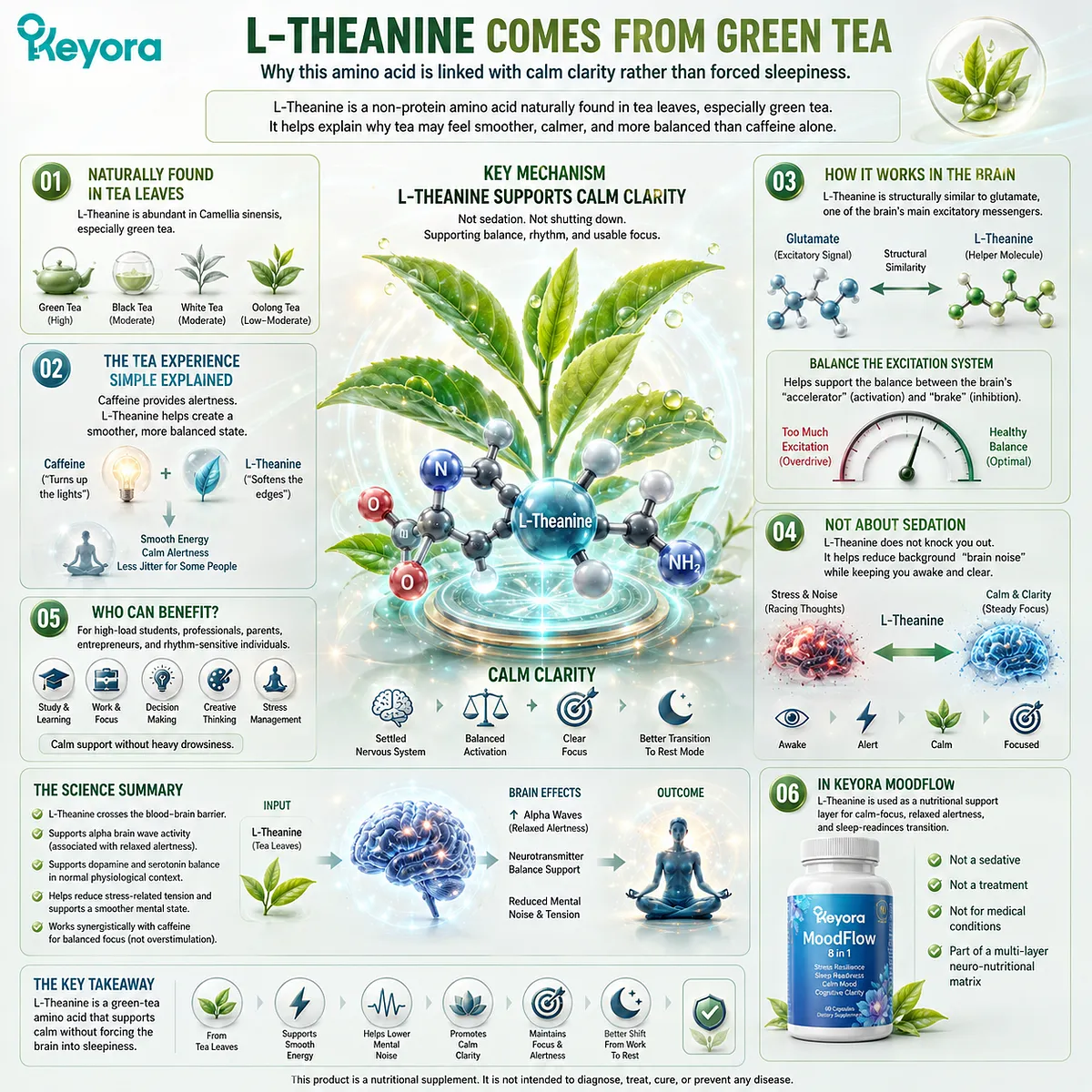
L-Theanine is a non-protein amino acid naturally found in tea leaves, especially green tea. Many people notice that green tea feels different from coffee. It can feel gently alert, but less sharp or jittery for some people.
Part of that difference comes from L-Theanine. Green tea contains caffeine, but it also contains L-Theanine, which helps explain why the experience of drinking tea may feel smoother than a strong caffeine-only drink. L-Theanine does not erase stimulation, but it helps support a more balanced state.
This is why L-Theanine is often described as a calm-focus nutrient. It is not about shutting the brain down. It is about helping the brain feel less noisy while staying awake and clear.
A simple way to understand L-Theanine is to imagine a busy room.
Caffeine may turn up the lights.
Stress may increase the noise.
L-Theanine does not turn off the room.
Instead, it helps lower the background noise so the person can stay present, steady, and focused.
This matters because many people do not want heavy relaxation during the day.
-
A student still needs to study.
-
A professional still needs to think clearly.
-
A parent, founder, or creative worker still needs to make decisions. They may want calm, but not drowsiness.
That is one reason Keyora frames L-Theanine through the idea of calm clarity. Calm clarity means the nervous system feels more settled, but the mind remains usable. It is different from being knocked out, foggy, or sedated.
L-Theanine is also relevant because it can interact with brain signaling. It is structurally related to glutamate, one of the brain’s main excitatory messengers.
Glutamate is important for learning, attention, and mental activity. But when the brain feels overstimulated, too much excitatory pressure can feel like a runaway accelerator.
In ordinary language, L-Theanine helps explain how a nutrient can support the balance between the brain’s accelerator and brake systems. The goal is not to remove alertness. The goal is to support a healthier rhythm between activation and calm.
This is especially important for people who experience racing thoughts, stress-related tension, or difficulty shifting from work mode into rest mode. These everyday patterns do not always mean someone needs a sedative.
Sometimes the more relevant question is whether the nervous system has enough support to downshift naturally.
Keyora MoodFlow uses L-Theanine in that context.
It is not presented as a treatment for anxiety, insomnia, depression, or any medical condition.
Instead, it is positioned as a nutritional support layer for calm focus, relaxed alertness, and sleep-readiness transition.
For consumers, the main takeaway is simple: L-Theanine is a green-tea amino acid that supports calm without forcing the brain into sleepiness. That makes it one of the most important ingredients for understanding the “calm without sedation” idea inside MoodFlow.
How L-Theanine Supports the Brain’s Calm Signals
GABA, glutamate balance, and alpha waves explained in ordinary language.
To understand L-Theanine, it helps to understand three simple ideas: the brain has calming signals, activating signals, and rhythm patterns.
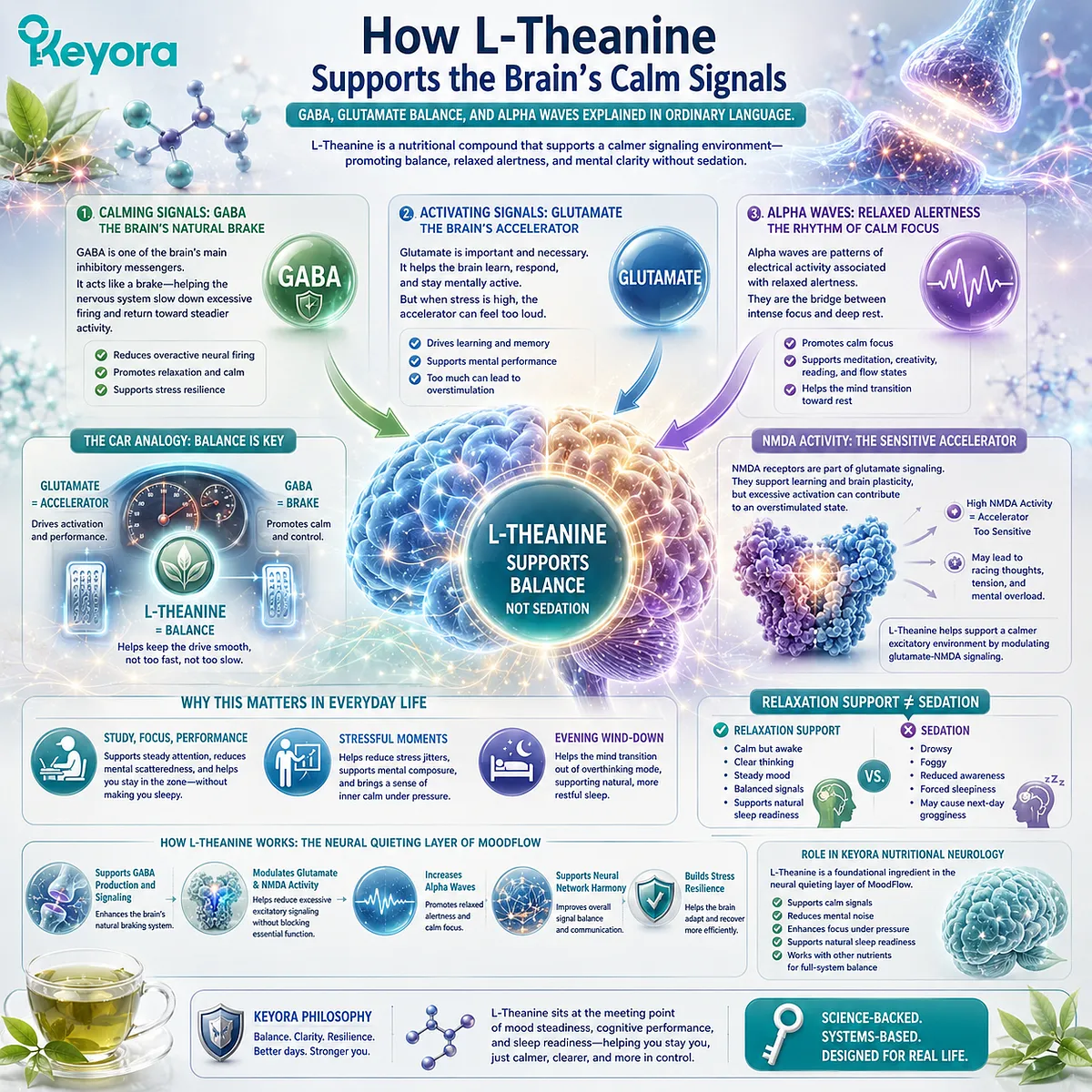
The calming side is often connected with GABA. GABA is one of the brain’s main inhibitory messengers. In plain language, GABA acts like a brake. It helps the nervous system slow down excessive firing and return toward steadier activity.
The activating side is often connected with glutamate. Glutamate is important and necessary. It helps the brain learn, respond, and stay mentally active. But when stress is high, the activating side can feel too loud. The person may feel mentally “on,” even when the body is tired.
L-Theanine is often discussed because it helps support the balance between these systems. It is not a drug that forces one signal to dominate. Instead, it is a nutritional compound that supports a calmer signaling environment.
A useful analogy is a car. Glutamate is like the accelerator. GABA is like the brake. A healthy nervous system needs both.
If the accelerator is always pressed, the system feels tense.
If the brake is too strong, the person feels dull or sleepy.
L-Theanine is valuable because it supports balance rather than simply pushing the system into sedation.
Another important concept is NMDA activity.
NMDA receptors are involved in glutamate signaling. They play a role in learning and brain plasticity, but excessive activation can be part of an overstimulated brain state. In consumer-friendly language, NMDA overactivity can be imagined as the accelerator becoming too sensitive.
L-Theanine helps explain how the brain may be supported when excitatory activity feels too high. This does not mean L-Theanine treats a disorder. It means L-Theanine has a mechanism that fits the everyday experience of mental overactivation, stress-related tension, and difficulty winding down.
The third concept is alpha brain waves. Brain waves are patterns of electrical activity in the brain. Alpha waves are often associated with relaxed alertness. This is the state many people want during focused work, meditation, reading, creative thinking, or gentle evening wind-down.
Alpha waves are not the same as deep sleep. They are more like a bridge between intense alertness and rest. When alpha activity is supported, a person may feel calmer while still awake. This is one reason L-Theanine is so often connected with calm focus.
For example, someone preparing for an exam may not want a sleep aid. They may want to feel steady and less scattered.
A professional before a presentation may not want to feel sleepy. They may want fewer stress jitters and more mental composure.
A person at night may not want to be “knocked out.” They may want the mind to stop racing so sleep can come more naturally.
This is the difference between relaxation support and sedation. Sedation pushes the system toward drowsiness. L-Theanine supports a calmer state without forcing that heavy feeling.
Inside Keyora Nutritional Neurology, this makes L-Theanine a key ingredient for explaining non-sedative nervous-system support.
It belongs to the neural quieting layer of MoodFlow.
Its role is to help the brain move away from excessive noise and toward calm clarity.
That is why L-Theanine appears repeatedly in discussions of stress resilience, pre-sleep relaxation, and focus under pressure. It sits at the meeting point between mood steadiness, cognitive performance, and sleep readiness.
Why L-Theanine Matters Inside MoodFlow
How it works with magnesium glycinate and other nutrients as part of a larger stress-sleep support matrix.
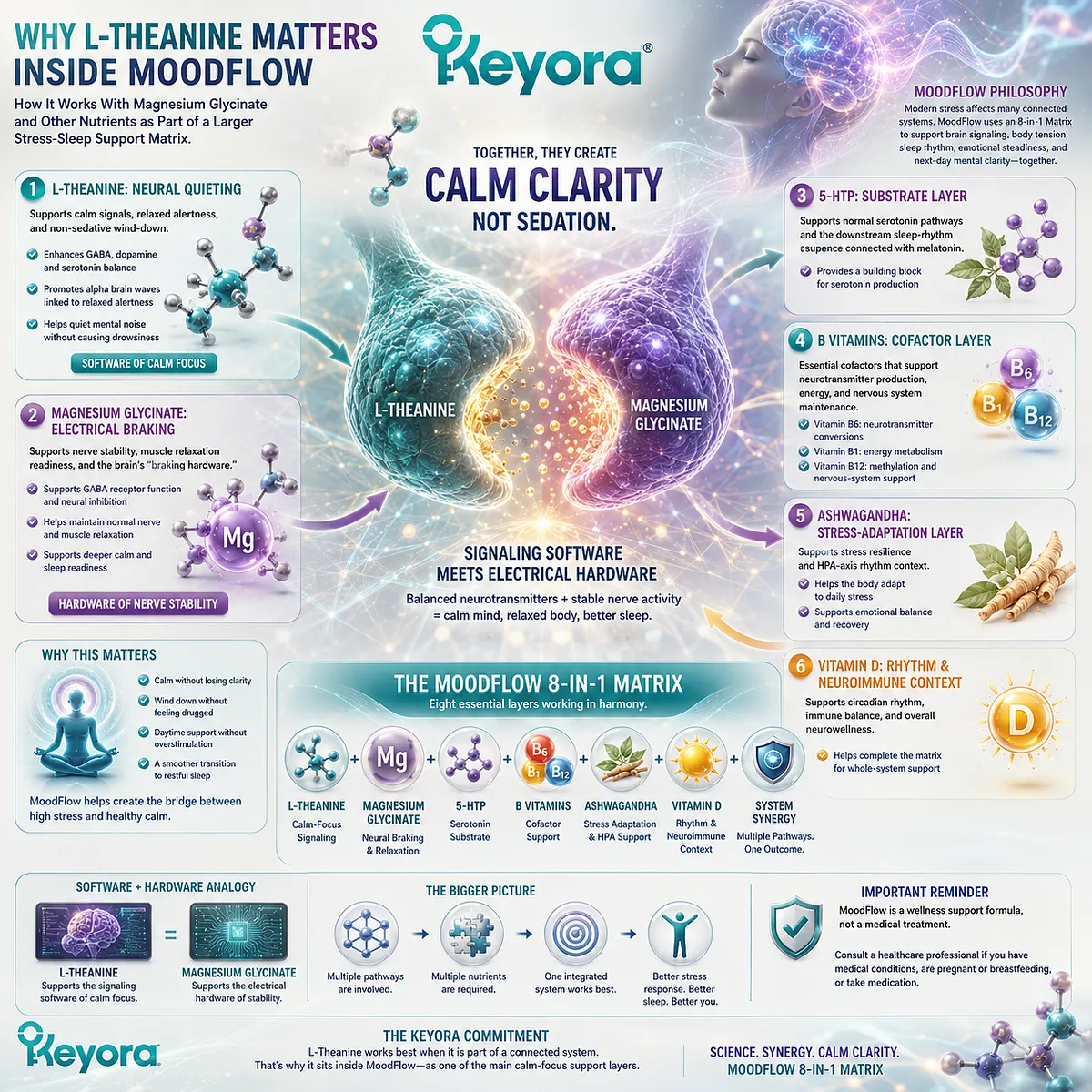
L-Theanine is important on its own, but Keyora MoodFlow does not treat it as a standalone magic ingredient. MoodFlow uses it as part of a larger 8-in-1 Matrix because stress, sleep, mood, and cognition usually involve more than one pathway.
This is a core idea behind Keyora MoodFlow: modern stress is not just a feeling. It can affect brain signaling, body tension, sleep rhythm, emotional steadiness, and next-day mental clarity. Because the pattern is connected, the support system should also be connected.
L-Theanine’s main role inside MoodFlow is neural quieting. It helps support calm signals, relaxed alertness, and non-sedative wind-down. But another ingredient, magnesium glycinate, supports the electrical braking layer.
These two nutrients are complementary.
-
L-Theanine helps support neurotransmitter balance and alpha-wave calm.
-
Magnesium glycinate supports nerve stability, muscle relaxation readiness, and the brain’s “braking hardware.”
Together, they help explain why MoodFlow is built around calm clarity rather than forced sleepiness.
A simple analogy is software and hardware. L-Theanine helps support the signaling software of calm focus. Magnesium glycinate helps support the electrical hardware that keeps nerve activity stable. Both layers matter when someone feels mentally overstimulated or physically tense.
MoodFlow also includes 5-HTP, which supports normal serotonin-related pathways and the downstream sleep-rhythm sequence connected with melatonin. This gives the formula a substrate layer. In simple language, substrate support means giving the body a nutritional building block used in a normal pathway.
B vitamins help support the cofactor layer.
-
Vitamin B6 is involved in neurotransmitter-related conversions.
-
Vitamin B1 supports energy metabolism.
-
Vitamin B12 supports methylation and nervous-system maintenance.
These are background processes, but they matter because the brain’s calm signals depend on more than one nutrient.
Ashwagandha adds a stress-adaptation layer. It is used in MoodFlow to support stress resilience and HPA-axis rhythm context. If L-Theanine helps quiet the immediate mental noise, Ashwagandha helps explain the broader stress-response environment.
Vitamin D adds rhythm and neuroimmune context. It helps complete the formula as a broader wellness-support matrix rather than a narrow calm-only formula.
This is why MoodFlow is not simply “an L-Theanine product.” L-Theanine is one important part, but the formula logic is wider.
MoodFlow combines calm-focus support, neural braking, serotonin-melatonin substrate continuity, cofactor support, and stress-rhythm adaptation.
For the reader, the practical meaning is clear. L-Theanine matters because many people want calm without losing clarity.
-
They want to wind down without feeling drugged.
-
They want support during the day without feeling overstimulated.
-
They want a calmer transition at night without turning to a heavy sedative approach.
In MoodFlow, L-Theanine helps create that bridge. It supports the space between high stress and healthy calm, between mental noise and focus, and between daytime alertness and evening wind-down.
As always, MoodFlow should be understood as wellness support, not medical treatment. People with medical conditions, persistent mood or sleep concerns, pregnancy or breastfeeding status, or medication use should seek professional guidance before using supplements.
The Keyora view is that L-Theanine works best when it is not isolated from the larger system.
Calm clarity depends on signaling, rhythm, stress recovery, and nutrient cofactors working together.
That is why L-Theanine sits inside the MoodFlow 8-in-1 Matrix as one of the main calm-focus support layers.
Closing Summary
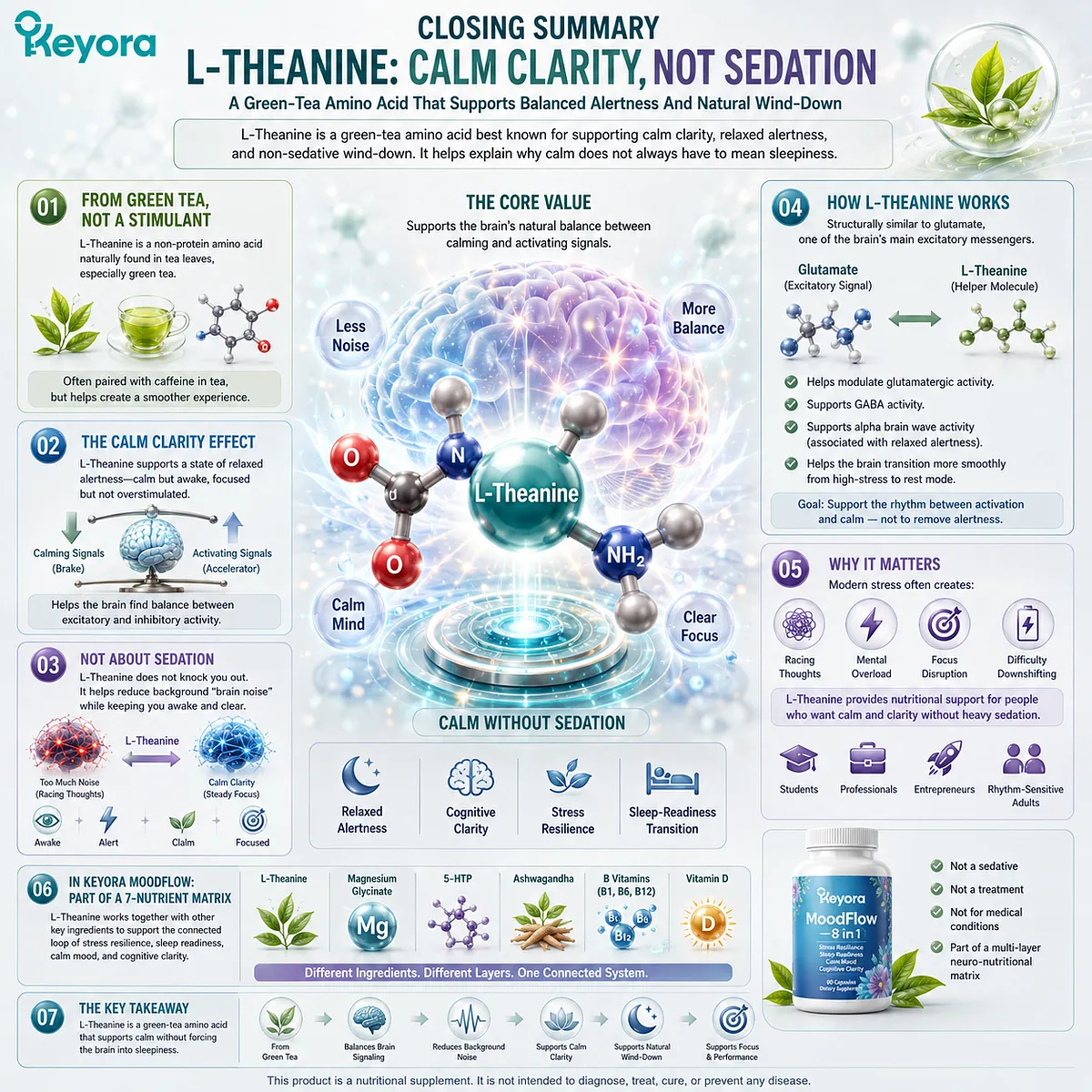
L-Theanine is a green-tea amino acid best known for supporting calm clarity, relaxed alertness, and non-sedative wind-down. It helps explain why calm does not always have to mean sleepiness.
Its key value comes from supporting the brain’s natural balance between calming and activating signals. In simple terms, L-Theanine helps the nervous system move away from excessive noise without turning off healthy alertness.
Inside Keyora MoodFlow, L-Theanine is part of a broader nutritional neurology matrix. It works alongside magnesium glycinate, 5-HTP, Ashwagandha, B vitamins, and Vitamin D to support the connected loop of stress resilience, sleep readiness, calm mood, and cognitive clarity.
For high-load students, professionals, entrepreneurs, and rhythm-sensitive adults, L-Theanine represents one of MoodFlow’s most important ideas: calm without sedation, clarity without overstimulation, and wind-down support without forcing the brain into fog.
This article is for educational and informational purposes only. It does not provide medical advice, diagnosis, treatment, cure, prevention, disease outcome claims, hormone restoration claims, fertility outcome claims, or formula-specific clinical efficacy claims.