
What is Keyora MoodFlow 8 in 1?
Keyora Research Q&A Library
This is part of the Keyora Research Q&A Series, derived from Keyora Nutritional Neurology Series .
Within the Keyora Nutritional Neurology framework, this Q&A translates complex nutrient–brain mechanisms into reader-friendly, evidence-bound answers, focusing on stress resilience, sleep quality, calm mood support, cognitive wellness, and the broader interaction between nutrition, neurochemistry, and daily nervous-system function.

Direct Answer
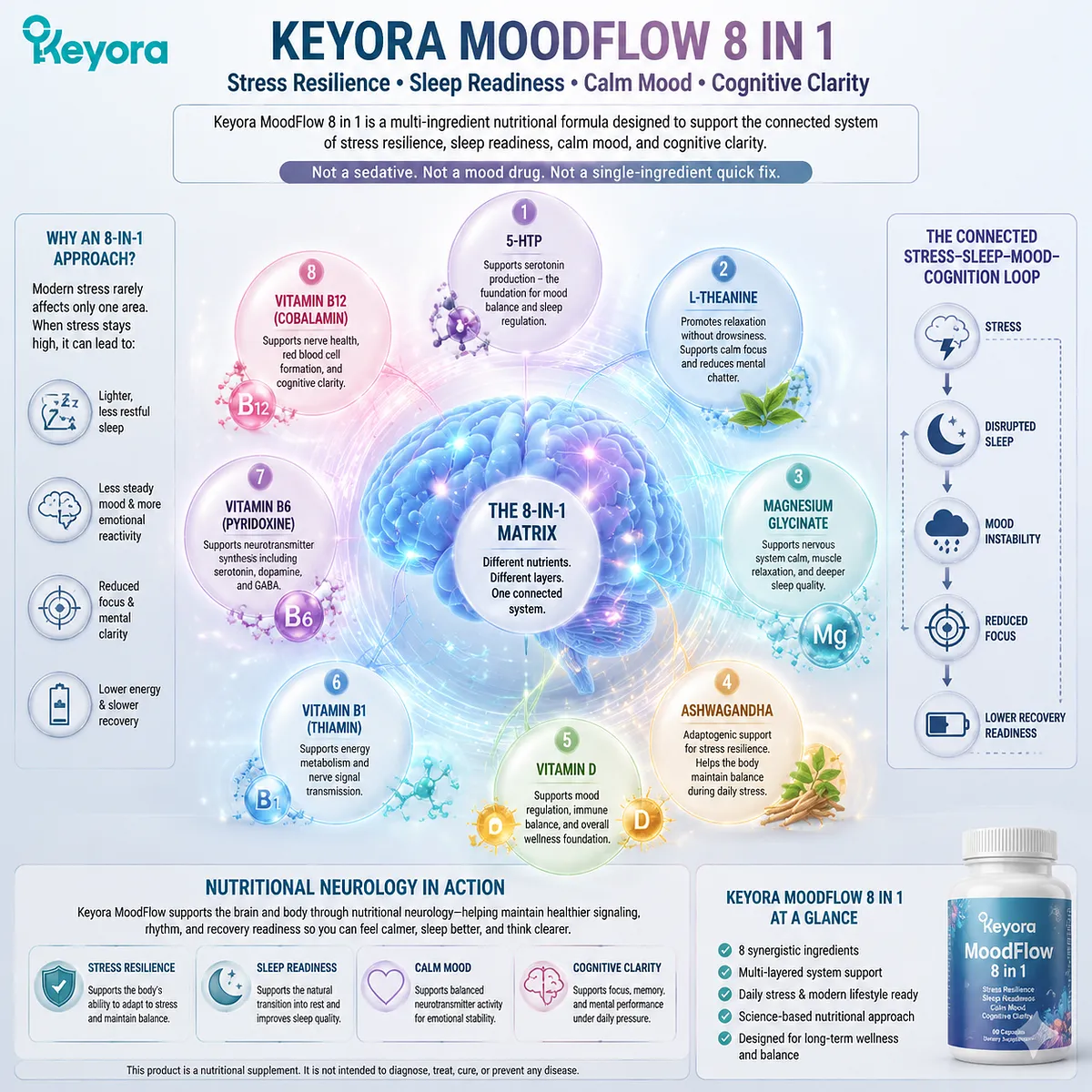
Keyora MoodFlow 8 in 1 is a multi-ingredient nutritional formula designed to support the connected system of stress resilience, sleep readiness, calm mood, and cognitive clarity. It is not positioned as a sedative, a mood drug, or a single-ingredient “quick fix.”
Instead, MoodFlow uses an 8-in-1 Matrix that brings together 5-HTP, L-Theanine, magnesium glycinate, Ashwagandha, Vitamin D, and three B vitamins: B1, B6, and B12. Each nutrient supports a different layer of the stress-sleep-mood-cognition loop.
In simple terms, MoodFlow is built around the idea that modern stress rarely affects only one area. When stress stays high, sleep can become lighter, mood can feel less steady, and focus can become harder to maintain.
Keyora MoodFlow supports this system through nutritional neurology: helping the brain and body maintain healthier signaling, rhythm, and recovery readiness.
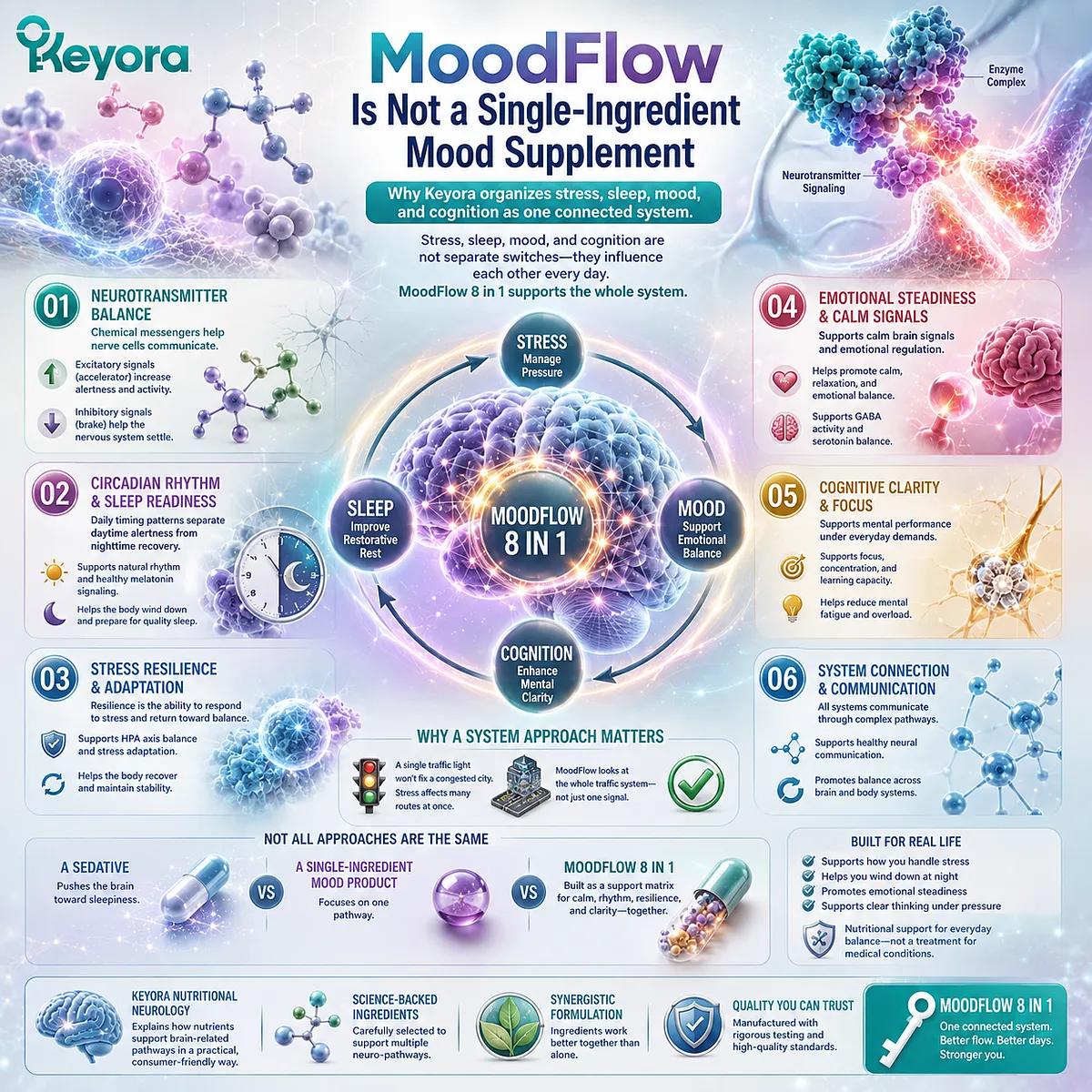
MoodFlow Is Not a Single-Ingredient Mood Supplement
Why Keyora organizes stress, sleep, mood, and cognition as one connected system.
Many people search for mood support as if mood were a single switch. They may look for one ingredient for calm, one ingredient for sleep, one ingredient for focus, or one ingredient for stress. But in daily life, these areas are rarely separate.
A stressful day can make the mind race at night. Poor sleep can make the next morning feel emotionally heavier. Mental overload can make simple decisions feel harder. When this pattern repeats, stress, sleep, mood, and cognition start feeding into each other like a loop.
This is the basic idea behind Keyora MoodFlow 8 in 1.
MoodFlow is not designed around the idea that one nutrient should force one result. It is organized around the idea that the nervous system works through many connected signals.
Think of the brain and body like a busy traffic network. Stress is not just one car on the road. It can affect traffic lights, road speed, timing, and the ability of different routes to stay coordinated. If only one traffic light is adjusted, the whole city may still feel congested.
MoodFlow uses a broader approach. It looks at the “traffic system” behind daily stress, sleep readiness, emotional steadiness, and clear thinking. This is why Keyora uses the term Keyora Nutritional Neurology. The goal is to explain how nutrients can support brain-related pathways in a practical, consumer-friendly way.
One part of the system involves neurotransmitters. These are chemical messengers that help nerve cells communicate. Some signals act more like an accelerator, increasing alertness and activity. Other signals act more like a brake, helping the nervous system settle.
Another part involves rhythm. The body has daily timing patterns that help separate daytime alertness from nighttime recovery. When stress runs too high for too long, this timing can feel blurred. A person may feel tired in the body but still mentally switched on.
A third part involves resilience. Stress resilience does not mean never feeling pressure. It means the body can respond to pressure, then return toward balance. This recovery ability is important for sleep readiness, calm mood, and cognitive performance under everyday demands.
MoodFlow is built for this multi-layer view. It does not claim to treat anxiety, depression, insomnia, burnout, or any medical condition. Its purpose is nutritional support for people who want a calmer, steadier foundation under normal life stress.
That distinction matters.
A sedative tries to push the brain toward sleepiness.
A single-ingredient mood product may focus on one pathway.
MoodFlow is different because it is built as a support matrix. It combines ingredients that help explain calm signals, stress adaptation, sleep rhythm, and mental clarity together.
For the everyday consumer, the simplest way to understand MoodFlow is this: it supports the system behind how you handle stress, wind down, stay emotionally steady, and think clearly under pressure.
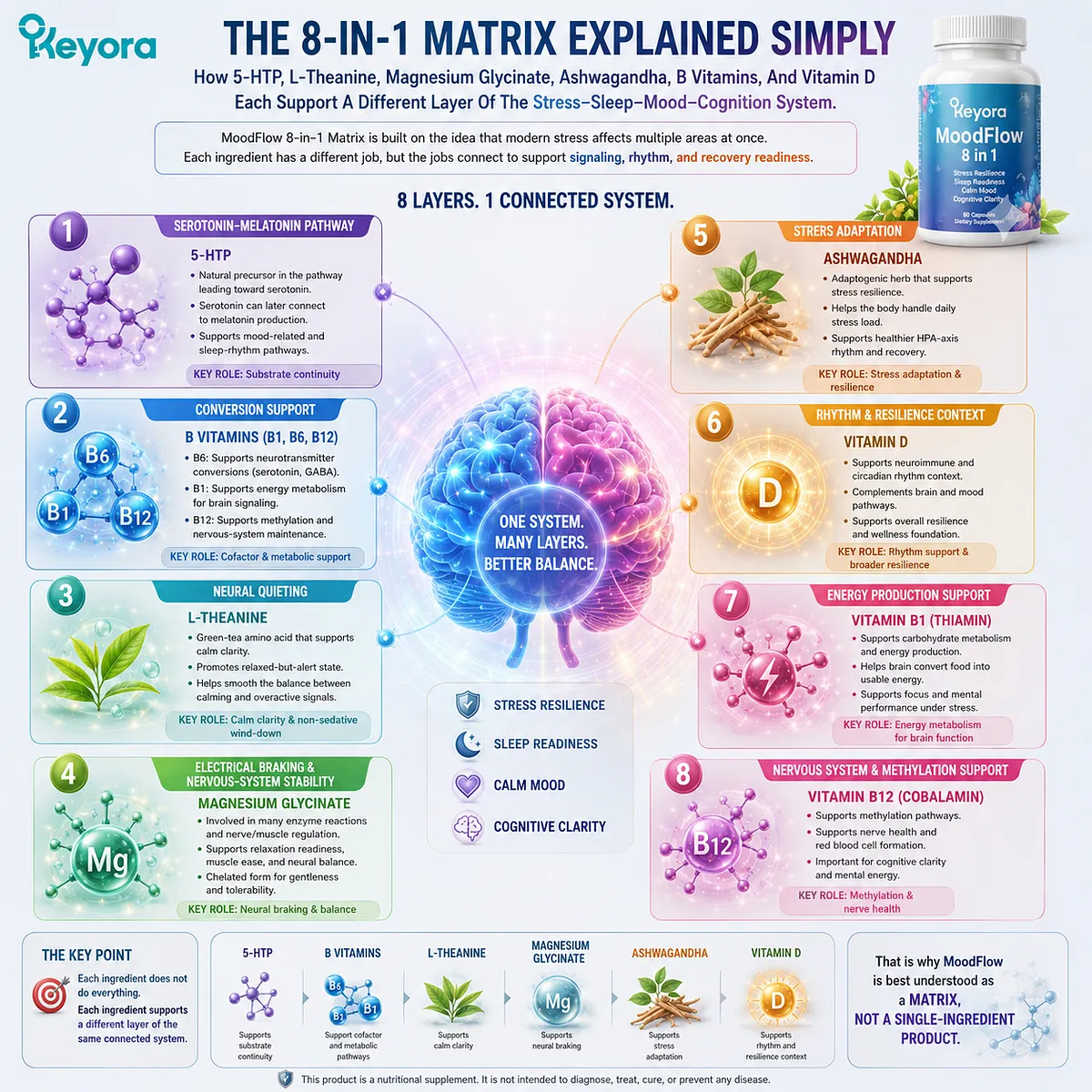
The 8-in-1 Matrix Explained Simply
How 5-HTP, L-Theanine, magnesium glycinate, Ashwagandha, B vitamins, and Vitamin D each support a different layer.
The MoodFlow 8-in-1 Matrix can be understood as a layered support system. Each ingredient has a different job, but the formula is designed so the jobs connect.
The first layer is the serotonin-melatonin pathway.
This is where 5-HTP becomes important. 5-HTP is a natural precursor involved in the pathway that leads toward serotonin, and serotonin can later connect to melatonin production. In simple language, 5-HTP helps explain why substrate support matters for mood-related and sleep-rhythm pathways.
This does not mean 5-HTP is serotonin itself. It is not a medication and should not be described as a treatment for depression or insomnia. A better way to understand it is as an upstream nutritional building block. It supports normal serotonin-related pathways and helps the body maintain the biochemical sequence connected with sleep readiness.
The second layer is conversion support.
This is where B vitamins matter. Vitamin B6 helps support important neurotransmitter conversions, including pathways related to serotonin and GABA. Vitamin B1 supports energy metabolism, which matters because the brain uses a large amount of energy to maintain signaling. Vitamin B12 supports methylation and nervous-system maintenance.
These B vitamins are not included as decoration. They help explain why Keyora does not view mood and cognition as only “brain chemistry.” The brain also needs metabolic support. If neurotransmitter pathways are like messages, B vitamins help support the background work that allows those messages to be made, processed, and maintained.
The third layer is neural quieting.
This is where L-Theanine plays a central role. L-Theanine is a green-tea amino acid known for supporting calm clarity. It is often associated with a relaxed-but-alert state rather than heavy drowsiness.
A simple analogy is the difference between turning down noise and turning off the lights. L-Theanine does not need to “knock out” the brain. It helps support a smoother balance between calming signals and overactive signals. In Keyora MoodFlow, L-Theanine is used as a calm-focus nutrient that supports non-sedative wind-down.
The fourth layer is electrical braking and nervous-system stability.
This is where magnesium glycinate fits in. Magnesium is involved in many enzyme reactions and helps regulate nerve and muscle activity. Magnesium glycinate is a chelated form, meaning magnesium is bound to glycine. This form is often valued for gentleness and tolerability.
In simple terms, magnesium can be imagined as part of the nervous system’s braking hardware. When stress makes the body feel tense or switched on, magnesium glycinate supports relaxation readiness, muscle ease, and neural balance. It also pairs well with L-Theanine because both ingredients support the calm side of the stress response from different angles.
The fifth layer is stress adaptation.
This is where Ashwagandha is important. Ashwagandha is an adaptogenic herb used to support stress resilience and HPA-axis rhythm context. The HPA axis is the body’s stress communication system, connecting the brain and adrenal response.
Ashwagandha is not simply a “calm herb.” In MoodFlow, it is positioned as a stress-adaptation layer. It supports the body’s ability to handle pressure, recover from daily stress load, and maintain a healthier stress rhythm.
The sixth layer is Vitamin D context.
Vitamin D is often discussed for bone or immune health, but it also has relevance to brain and rhythm support. In MoodFlow, Vitamin D helps round out the formula’s neuroimmune and circadian support context.
Together, these eight components form the MoodFlow 8-in-1 Matrix: 5-HTP, L-Theanine, magnesium glycinate, Ashwagandha, Vitamin D, Vitamin B1, Vitamin B6, and Vitamin B12.
The key point is not that each ingredient does everything.
The key point is that each ingredient supports a different layer of the same connected system.
- 5-HTP supports substrate continuity.
- B vitamins support cofactor and metabolic pathways.
- L-Theanine supports calm clarity.
- Magnesium glycinate supports neural braking.
- Ashwagandha supports stress adaptation.
- Vitamin D supports broader rhythm and resilience context.
That is why MoodFlow is best understood as a matrix, not a single-ingredient product.
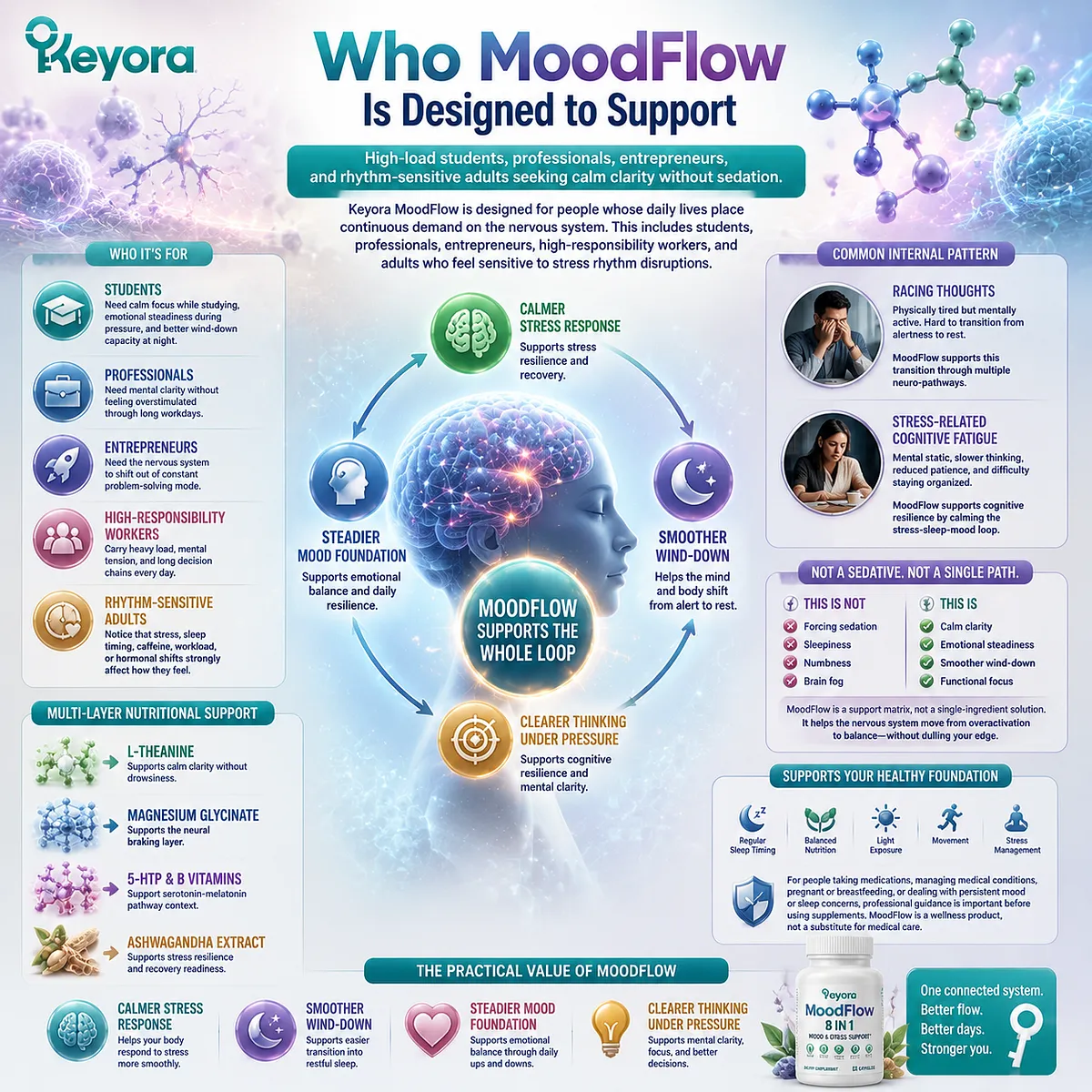
Who MoodFlow Is Designed to Support
High-load students, professionals, entrepreneurs, and rhythm-sensitive adults seeking calm clarity without sedation.
Keyora MoodFlow is designed for people whose daily lives place continuous demand on the nervous system. This includes students, professionals, entrepreneurs, high-responsibility workers, and adults who feel sensitive to stress rhythm disruptions.
- A student may not simply need “focus.” They may need calm focus while studying, emotional steadiness during pressure, and better wind-down capacity at night.
- A professional may not simply need “energy.” They may need mental clarity without feeling overstimulated.
- An entrepreneur may not simply need “sleep.” They may need the nervous system to shift out of constant problem-solving mode.
This is why MoodFlow is especially relevant for high-load users. These are people who may function well on the outside but feel internally overactivated. They may carry mental tension through the day, then find it difficult to transition into rest at night.
One common pattern is racing thoughts. The person may feel physically tired but mentally active. They may lie down, but the brain continues reviewing conversations, tasks, plans, or worries. In this kind of pattern, the issue is not only “sleep time.” It is the transition from alertness to rest.
MoodFlow supports this transition through several layers.
- L-Theanine supports calm clarity.
- Magnesium glycinate supports the neural braking layer.
- 5-HTP and B vitamins support serotonin-melatonin pathway context.
- Ashwagandha supports stress resilience and recovery readiness.
Another common pattern is stress-related cognitive fatigue. This can feel like mental static, slower thinking, reduced patience, or difficulty staying organized.
MoodFlow does not claim to fix cognitive disorders. Instead, it supports cognitive resilience by addressing the stress-sleep-mood loop that can influence daily clarity.
MoodFlow may also be relevant for adults who are rhythm-sensitive. These are people who notice that stress, sleep timing, caffeine, workload, emotional load, or hormonal transition can strongly affect how they feel. For them, a formula that only pushes sedation may not feel appropriate. They may want support for calm, but still need to stay clear and functional.
This is an important distinction.
MoodFlow is not designed to make people feel numb, foggy, or forced into sleepiness. The goal is calm clarity. That means supporting the ability to feel more settled while still maintaining normal alertness.
MoodFlow can also help consumers understand why multi-ingredient formulas exist. The modern stress experience is rarely one-dimensional.
A person may feel tense, sleep lightly, wake unrefreshed, and struggle with afternoon focus. These are different experiences, but they can belong to one connected rhythm problem.
The MoodFlow approach is to support the whole loop. It does not replace healthy habits such as regular sleep timing, balanced meals, light exposure, movement, and stress-management routines. Instead, it provides nutritional support around the pathways that help those habits work better.
For people taking medications, managing medical conditions, pregnant or breastfeeding, or dealing with persistent mood or sleep concerns, professional guidance is important before using supplements. MoodFlow is a wellness product, not a substitute for medical care.
For the right consumer, the practical value of MoodFlow is simple: it supports a calmer stress response, a smoother wind-down process, a steadier mood foundation, and clearer thinking under everyday pressure.
Closing Summary
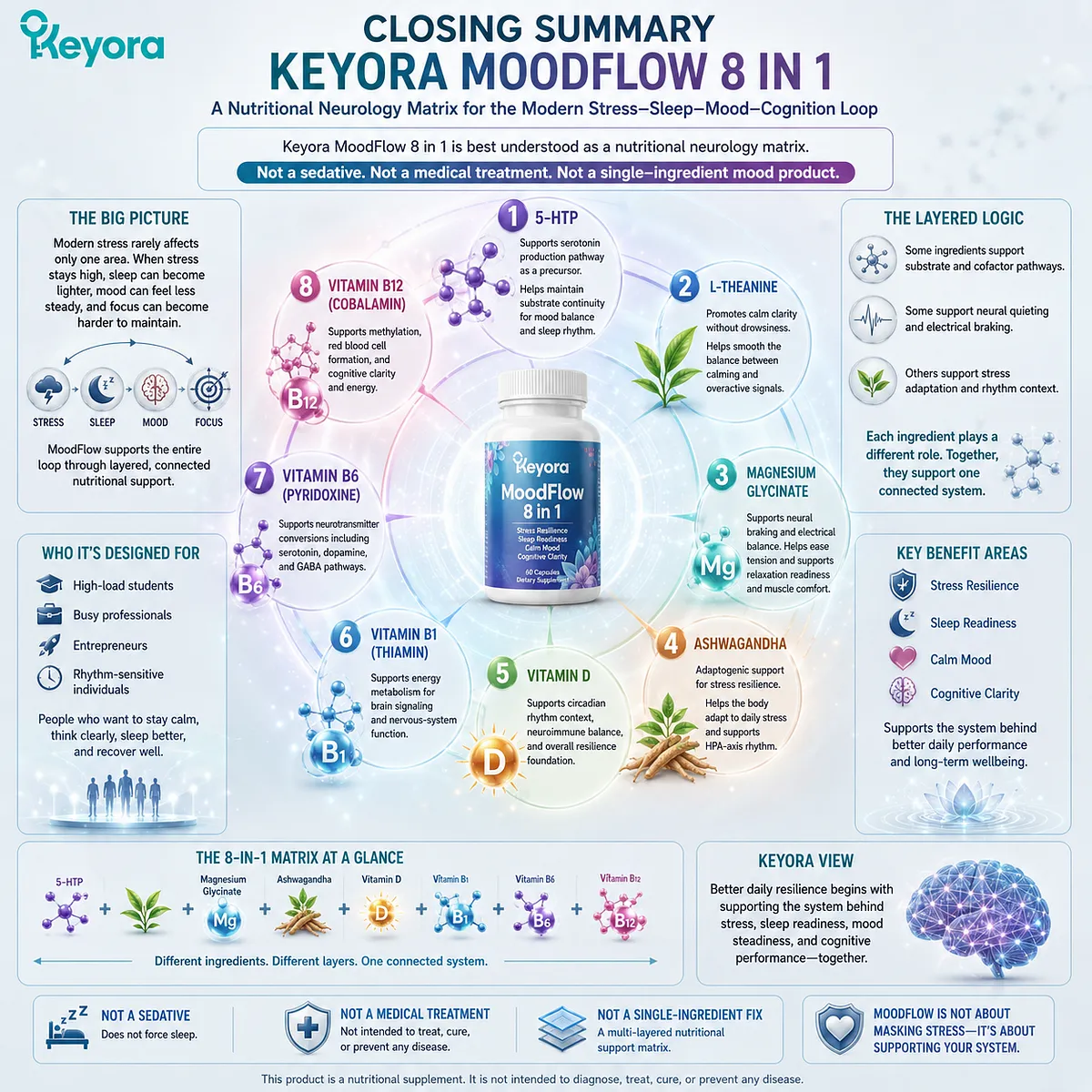
Keyora MoodFlow 8 in 1 is best understood as a nutritional neurology matrix for the modern stress-sleep-mood-cognition loop. It is not a sedative, not a medical treatment, and not a single-ingredient mood product.
Its formula logic brings together 5-HTP, L-Theanine, magnesium glycinate, Ashwagandha, Vitamin D, and B vitamins to support different layers of nervous-system balance.
- Some ingredients support substrate and cofactor pathways.
- Some support neural quieting and electrical braking.
- Others support stress adaptation and rhythm context.
For high-load students, professionals, entrepreneurs, and rhythm-sensitive adults, MoodFlow offers a structured way to support calm clarity without forcing sedation.
In the Keyora view, better daily resilience begins with supporting the system behind stress, sleep readiness, mood steadiness, and cognitive performance together.
This article is for educational and informational purposes only. It does not provide medical advice, diagnosis, treatment, cure, prevention, disease outcome claims, hormone restoration claims, fertility outcome claims, or formula-specific clinical efficacy claims.